Design Life-Cycle
assess.design.(don't)consume
Shuping, Yu
DES 040A
Professor Cogdell
12 March 2026
The Impact of Climbing Hold Materials on Nature: A Life Cycle
Indoor rock climbing has become a rapidly growing leisure activity in people's daily lives, and its enhanced safety has also spurred the rapid development of climbing gyms. The most crucial part of a climbing wall is the hold, which allows climbers to grip the surface and perform various climbing maneuvers. These seemingly simple, colored holds are actually meticulously designed, each with its unique shape. The shape of the hold must provide good friction to support the climber's movements. Currently, most climbing holds are made of synthetic resin materials such as polyurethane and polyester because these materials are more durable, stronger, and offer a rich texture.
However, despite the practical functionality of climbing holds, the use of synthetic resin materials causes serious environmental problems. Because synthetic resins are typically derived from petroleum resources, their production requires significant energy expenditure on chemical processing. Since climbing holds are not permanent, this energy consumption during replacement pollutes the earth, continuously impacting the environment throughout the product's lifecycle. Therefore, after studying the life cycle of climbing hold materials, it was found that the environmental impact of climbing hold materials is most significant during the raw material mining and production stages, so more sustainable alternative materials should be explored.
Raw Materials of Climbing Holds:
Most traditional climbing holds are made of polyurethane and polyester resins. Both materials are synthetic polymers. Polyurethane and polyester resins are popular for their durability (Rezentes). Their mechanical properties make them suitable for climbing holds because they can withstand high-intensity, repetitive stress and have sufficient surface friction. While polyurethane holds are generally favored for their flexibility and durability, polyester holds tend to be stiffer and less expensive to manufacture (Volx).
The manufacture of these raw materials requires the use of petroleum, a fossil fuel. This petroleum is extracted from underground reservoirs (Patil et al.). The extraction, transportation, and refining of petroleum generates significant carbon emissions and consumes substantial amounts of energy. Crude oil itself also requires further chemical transformation to become usable materials. The production of polyurethane and polyester involves numerous chemical processes (Zhang et al.). These chemical reactions convert petroleum-based raw materials into polymers.
Typically, climbing hold manufacturers add additional materials to the resin mixture during the manufacturing process. For example, fillers are added to enhance the strength of the holds. Climbing holds can also be made using pigments of different colors. Using multiple materials consumes more resources and has a greater environmental impact. Petroleum-based resins can be combined with additives to create a durable composite material ideal for climbing applications. However, because this material is made of thermosetting plastic, it is difficult to break it down or recycle it afterwards.
Environmental Impacts of Petroleum-Based Materials:
Polyurethane and polyester resins are the most commonly used materials for traditional climbing holds. As mentioned earlier, both are synthetic polymers derived from fossil fuels. These materials are very durable, hence their popularity. The problem is that these materials are difficult to recycle after being extracted and processed from the ground. During the production of polyurethane and polyester resins, manufacturers add various additives to alter the physical properties of the final product.
Oil must be extracted from the ground, which damages the environment (Yin et al.). The production process of resin mixtures consumes more energy and generates more carbon emissions. Holds also consume more fuel during distribution to sellers and buyers. Even consumers who purchase the products need to transport the holds to the climbing site, which also contributes to carbon emissions. Unfortunately, the production of almost all products has some environmental impact.
Manufacturing and Material Processing:
Once the raw materials are mined and processed into usable resin, the production process can begin. Polyurethane or polyester resin is mixed with your chosen additives, fillers, and pigments, then poured into molds to create climbing holds (Laue). Producing this product requires electricity and heat to power the machinery, heat the material, and complete the curing process. Research indicates that the production of climbing holds requires mixing the resin system, molds, and release agents together.
While the environmental impact of the production process may be less than that of raw material extraction, it still consumes resources and generates waste. During production, excess resin is often trimmed or discarded, creating solid waste that is difficult to recycle. Transportation further exacerbates the environmental impact, as finished climbing holds are typically packaged in cardboard and plastic before being shipped to climbing gyms or retailers.
Sustainable Alternatives and Environmental Challenges:
Environmental concerns have prompted scientists and climbing hold manufacturers to investigate potential alternatives to resin climbing holds. Scientists have concluded that one solution is to manufacture bio-based resins using renewable materials. Bio-based resins are plant-derived polymers that use renewable biological components instead of petroleum-based components, as is the case with most polymers. One advantage of bio-based resins is their ability to reduce pollution from crude oil extraction.
Current research utilizes lignin derivatives as starting materials to synthesize polymers. Lignin is a major component of plant cell walls and is abundant in nature. Modified lignin can be used as a starting material for polymer synthesis (Carafa et al.). Polymers made from these starting materials exhibit good mechanical properties and excellent durability (Yan et al.). Furthermore, using lignin as a starting material reduces the amount of petroleum used in polymer production.
Other research focuses on developing bio-based polyurethane resins using renewable vegetable oils as raw materials to replace the petroleum-based raw materials currently used in polymer production. Compared to petroleum-based polyurethane systems, bio-based polyurethane systems can reduce carbon emissions (Patil et al.). Studies have shown that even with good mechanical properties, polyurethane systems can reduce environmental impact.
Some companies have begun exploring the use of recycled materials and new production methods to reduce pollution (Silver). Using recycled materials to manufacture climbing holds can reduce their overall carbon footprint. However, even these new methods and materials can be costly.
Continued research into environmentally friendly materials will help reduce the environmental impact of climbing holds. As the environmental impact of climbing becomes increasingly significant, more manufacturers and climbing gyms will seek to use more environmentally friendly products (Burgman and Robinson).
Sustainable Alternatives and Future Solutions:
As environmental impacts become increasingly apparent, researchers are seeking alternatives to resins. Researchers are developing bio-based resins made from renewable materials. Producing bio-based resins using renewable resources can reduce the use of fossil fuels. Some researchers are exploring the use of lignin, a chemical found in plants, to produce diols. Diols are believed to be helpful in the production of polyester and polyurethane resins.
Other research focuses on producing bio-based polyurethane resins using renewable raw materials. Using renewable resources allows for the production of resins with lower carbon emissions. Studies have shown that producing bio-based polyurethane can reduce emissions of volatile organic compounds (VOCs). It also produces polyurethane with excellent mechanical properties. Using recyclable or biodegradable materials can reduce the environmental impact of climbing hold production. However, unless these materials achieve durability comparable to resins or are more cost-effective, their application will remain limited. Finding sustainable alternatives presents many challenges, but related research contributes to reducing future environmental impacts.
Conclusion:
Climbing holds are essential for the normal operation of climbing gyms, but the use of petroleum-based materials has a certain environmental impact. The production and disposal of petroleum-based polyurethanes and polyesters release pollutants into the air and consume a large amount of energy. The production of traditional resins is harmful to the environment, and the products are almost impossible to recycle. Currently, there are alternatives to traditional petroleum-based products, such as bio-based resins and recycled materials. Researchers will continue to explore innovative methods to reduce the environmental impact of climbing holds.
Works Cited
Burgman, John, and Joe Robinson. “Climbing Hold Businesses around the World Are Working on Sustainability...One Grip at a Time.” Climbing Business Journal, 19 Aug. 2024, climbingbusinessjournal.com/climbing-hold-businesses-around-the-world-are-working-on -sustainability-one-grip-at-a-time/.
Carafa, Rachele N., et al. “Functionalisation of Lignin-Derived Diols for the Synthesis of Thermoplastic Polyurethanes and Polyester Resins.” MDPI, 16 June 2025, https://doi.org/10.3390/molecules30122604
Laue, Andrea. “How Climbing Holds Are Made.” Climbing, 2 Aug. 2022, www.climbing.com/photos/how-climbing-holds-are-made/.
Patil, Vikas J., et al. “Bio-Based Polyester Polyurethane Acrylate Resin: Synthesis and Application for Solventless UV-Curable Coatings. ” Reactive and Functional Polymers, Elsevier, 22 May 2025, https://doi.org/10.1016/j.reactfunctpolym.2025.106345.
Rezentes, Noah. “Super Soft Climbing Holds Promise to Preserve Your Skin.” Climbing Business Journal, 31 Jan. 2020, climbingbusinessjournal.com/super-soft-climbing-holds-promise-to-preserve-your-skin/.
Volx. “Climbing Holds: Pe (Polyester) or Pu (Polyurethane)?” Volx Holds - Prises d’escalade, 22 Aug. 2024, volxholds.com/en/post/prises-d-escalade-%3A-pe-ou-pu.
Silver, Maya. “Peace out, Plastic. These New Climbing Holds Are Made of Mushrooms.” Climbing, 18 Aug. 2025, www.climbing.com/culture-climbing/sustainable-climbing-holds-mushrooms-bioresins-recycled-plastic/.
Yan, Guobao, et al. “From Molecular Design to Scenario Adaptation: Cutting-Edge Exploration of Silicone-Modified Polyurethane in Smart Sports Fields.” MDPI, Multidisciplinary Digital Publishing Institute, 20 June 2025, https://doi.org/10.3390/coatings15070737.
Yin, Longxiang, et al. “Reinforced Polyurethane Acrylic Resin Coating on Liquid-Crystalline Polyester Substrates.” Reinforced Polyurethane Acrylic Resin Coating on Liquid-Crystalline Polyester Substrates, June 2025, https://doi.org/10.1016/j.matchemphys.2025.130550.
Zhang, Hongliang, et al. “Nano-SiO2/Polyurethane Modified Unsaturated Polyester Resin Mortar for Thin Layer Repairing on Airport Pavement.” Journal of Reinforced Plastics and Composites, Nov. 2025, https://doi.org/10.1177/07316844241256415.
Minh Ly
Christina Cogdell
DES40A A02
March 12, 2026
Embodied Energy Analysis of Climbing Holds
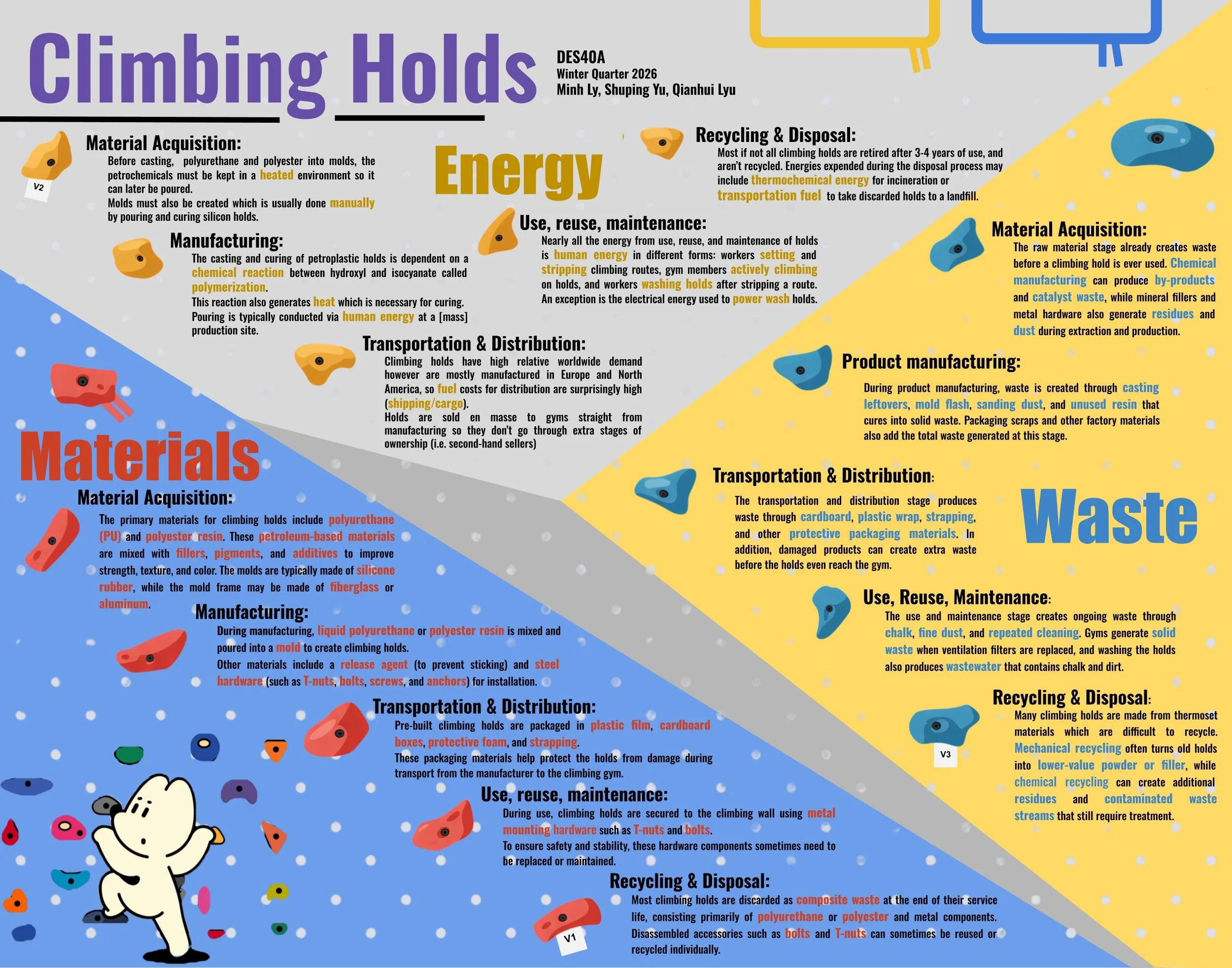
From the late 2000s, indoor rock climbing has exploded in popularity on a global scale, paving the way for climbing gyms to boom in number and popularity around the world. Today, these gyms are still only growing in popularity, with individual gyms hosting thousands of climbers each day. As climbing holds are a given at these gyms, similar to how weights are a given in a fitness gym, it's not common for people to inquire about the lifecycles and costs of each of the many thousands of holds any gym needs. Furthermore, the handling of these holds outside of direct use while on a climbing wall, including the setting of routes, stripping of routes, cleaning, and eventual disposal of holds is done largely behind closed doors by gyms away from consumers. Because of the passive nature of climbing hold usage, holds do not require any non-human energy during their use phase. However, due to their petroleum-derived polymers and worldwide demand, they have a high level of embodied energy. Analysing the lifecycle of climbing holds reveals that there are steep energy costs during polymer production and molding, while transportation and disposal also contribute significantly to their total environmental footprint. This high energy cost is exacerbated by the relatively short time of use of these climbing holds and the inability to recycle them after use.
Polyester and Polyurethane, the primary materials of climbing holds, have extremely high energy costs for acquisition and processing alone before holds can even be made. The first step for any climbing gym to run at all (after being built) is to acquire climbing holds; lots of them. Each year, an estimated 7.7 million climbing holds are produced (Silver 2025). The vast majority of these holds are made up of the petroplastics polyurethane and polyester which are temperature sensitive thermoset materials, meaning that they are molded into solid holds when cooled down below certain temperatures. These petroplastics originate in the form of crude oil and natural gas, which must be extracted and chemically refined before they can be used to create the holds themselves. These polymers can require anywhere between 60 and 100 megajoules of energy per kilogram of production (Boustead 2005). Given that an average climbing hold weighs about half a kilogram, this would come out to between 0.23 and 0.39 petajoules of energy per year on polymer acquisition alone. Furthermore, it is common practice for holds to be tempered with additives such as sand or fiberglass to change hold texture and improve durability increasing the overall energy input from mining and mineral processing depending on the additive for any given batch of holds (Agripp). While material acquisition and processing is so costly already, it is not the only significant energy sink in the early stages of a climbing hold’s lifecycle.
Besides the acquisition of polymers necessary to form the petroplastic holds, the actual process of manufacturing and processing holds is also a significant energy sink. Because of their thermoset nature, it is necessary for the polymers in a factory to be stored in a sufficiently heated environment such that they remain pourable for molding and casting later on. This heating can take significant amounts of energy, as it requires factories to have large dedicated heated storage compartments, which is extremely high in electrical energy costs as the conversion between electrical and thermal energy tends to be relatively inefficient. These energy costs are far more unpredictable as it depends highly on the conditions of any given mass production site. Once the petrochemical solutions are taken to be set into actual holds, they are poured into molds generally by human work, and then cured into hard polyurethane or polyester blocks through chemical reaction called polymerization, requiring chemical energy in order to form. These molds are highly specialized, as climbing holds must generally be different in shape and size from each other. A mass production site must have hundreds to thousands of different molds so that they can bulk sell to gyms who want variety in the holds they use. On top of that, typical molds for polyester and polyurethane are metal and can be made automatically with CNC machine tools, but due to the awkward shape of climbing holds, silicon molds are used instead which tend to be less reusable, and more difficult to make. Once molds are made, the energy required to pour, set, and cure the petrochemicals is relatively low compared to the energy costs of storage, and this step is commonly done through human work and energy within factories. Now that the holds are made, the next step before they can be used is to be distributed to gyms.
Climbing holds are distributed to climbing gyms worldwide and often, adding up to high totals of energy for transport in the form of fossil fuels as they move through global supply chains. Indoor climbing is a rapidly growing and evolving worldwide sport, with thousands of indoor climbing facilities operating worldwide, and hundreds more opening up every year. These facilities tend to be highly concentrated in urban areas everywhere in the world, and recently have started to gain traction in more suburban areas across North America, Europe and Asia. These holds are in high demand worldwide, however the vast majority of manufacturers are based in North America and Europe which then need to be shipped to distributors and gyms around the world. Gyms almost exclusively buy climbing holds in bulk packages as a facility would need thousands of holds to function, which means shipments are normally done in hundreds to thousands of kilograms worth of holds at a time. This typically involves many stages of transportation, from trucking from factories to ports and warehouses, then shipping via cargo ships, and then another step of trucking to reach the climbing facility. All of these steps rely heavily on fossil fuels significantly increasing the embodied energy of each hold in the mass shipment especially as it is typical for climbing materials to be manufactured far from where they end up being used (Savage 2021). Furthermore, indoor climbing, which includes toproping, sport climbing, and bouldering, is a quickly evolving sport where popular styles of holds change dramatically from year to year. Although the petroplastic holds may last several years, new holds are often bought before the end of the previous batch’s lifetime in order to keep up with popular climbing styles. This boosts the annual embodied energy of the climbing industry as a whole, and increases the embodied energy to lifetime ratio of the individual holds themselves, meaning that they become even less energy efficient as the ‘meta’ of indoor climbing changes. As new holds are brought in through these quickly changing trends in climbing, older holds must then be rotated out of use leading to the end of life stage of these holds.
Because of their thermoset nature, polyester and polyurethane climbing holds cannot be recycled via melting or grinding the plastics, and so they almost always end up in a landfill or incineration facility at the end of their lives. Petroplastic climbing holds have a lifespan of about five years (which may be shortened by the severity of use wear), but are generally cycled out of use within two to three years. It is extremely difficult to recycle thermoset plastics, as they cant be reset and recurred, nor can they be ground up and mixed with other plastics. Because of this, the normal disposal stage of climbing holds is virtually always to send them straight to landfill or incineration. While not quite as high as the material acquisition or distribution stages, the energy cost of the disposal stage is still worth looking at. This includes transportation costs from an indoor climbing facility to a landfill or incinerator, and then energy costs of incineration at the latter. Now these energies are actually quite negligible compared to the acquisition and production of petrochemicals and holds, the most important aspect of the disposal stage is the lack of recyclability. Because the petroplastics cannot be renewed and used later, that means the lifecycle of the plastics ends at the end of the climbing hold’s lifetime. The energy cost per unit of usable time of the petroplastics is extremely high, meaning that the use of climbing holds is unsustainable and extremely energy inefficient.
Despite the emphasis of environmental sustainability in modern climbing culture, the lifecycle of indoor climbing holds is actually quite energy intensive. Due to their makeup as petrochemical plastics, climbing holds embody extremely high levels of energy to produce and manufacture while also having high worldwide demand, necessitating huge amounts of energy on an annual basis. One might expect climbing holds to last quite a long time due to the durability of petrochemicals and regular maintenance on them. However, typical holds aren’t discarded due to unusability from wear, but rather from quickly evolving trends in indoor climbing, which results in most if not all climbing holds being disposed of long before the end of their usable lives. In turn this increases the demand for climbing hold production and decreases the amount of use the holds get per unit of energy necessary for their creation and distribution. While there are efforts to make indoor climbing a more sustainable sport, the already established system of mass production for climbing holds, and the culture of evolving trends in popular climbing styles, makes it very difficult to move towards less energy intensive alternatives.
Works Cited
“Embodied Energy Coefficients.” https://www.wgtn.ac.nz/architecture/centres/cbpr/resources/pdfs/ee-coefficients.pdf.
Fuss, Franz Konstantin, et al. “Climbers’ Perception of Hold Surface Properties: Roughness Versus Slip Resistance.” Frontiers in Psychology, vol. 11, Mar. 2020, p. 252. DOI.org (Crossref), https://doi.org/10.3389/fpsyg.2020.00252.
Fuss, Franz Konstantin, and Günther Niegl. “Instrumented Climbing Holds and Dynamics of Sport Climbing.” The Engineering of Sport 6, edited by Eckehard Fozzy Moritz and Steve Haake, Springer New York, 2006, pp. 57–62. DOI.org (Crossref), https://doi.org/10.1007/978-0-387-46050-5_11.
Ian, Boustead. Eco-Profiles of the European Plastics Industry. PlasticsEurope, Mar. 2005, p. 15, https://www.inference.org.uk/sustainable/LCA/elcd/external_docs/petb_31116f00-fabd-11da-974d-0800200c9a66.pdf.
“Indoor Climbing Is Full Of Toxic Plastic.” Spiderchalk, 4 Dec. 2025, https://spiderchalk.com/blogs/chalk/indoor-climbing-is-full-of-toxic-plastic.
Laue, Andrea. “How Climbing Holds Are Made.” Climbing, 2 Aug. 2022, https://www.climbing.com/photos/how-climbing-holds-are-made/.
Laurence. “Life Cycle Assessment of a Climbing Wall: The Titan by EP Climbing.” La Fabrique Verticale, 16 Nov. 2023, https://lafabriqueverticale.com/en/life-cycle-assessment-of-a-climbing-wall-the-titan-by-ep-climbing/.
Medina, Paul. “How Is Polyurethane Made?” Polydrive Industries, 30 May 2016, https://www.polydrive.com/how-is-polyurethane-made/.
Savage, Reuben. The Impacts of Rock Climbing on Climate Change: A Comparative Study on Carbon Emissions and the Ethics of Nature Based Recreation. 2021, https://jewlscholar.mtsu.edu/server/api/core/bitstreams/8c88e451-9957-4ee4-8f18-6484115a3788/content. Middle Tennessee State University.
Sherman, Anya, et al. “The Invisible Footprint of Climbing Shoes: High Exposure to Rubber Additives in Indoor Facilities.” ACS ES&T Air, vol. 2, no. 5, May 2025, pp. 930–42. DOI.org (Crossref), https://doi.org/10.1021/acsestair.5c00017.
Silver, Maya. “Peace Out, Plastic. These New Climbing Holds Are Made of Mushrooms.” Climbing, 6 Aug. 2025, https://www.climbing.com/culture-climbing/sustainable-climbing-holds-mushrooms-bioresins-recycled-plastic/.
Technology, Synthesia. Polyurethane Systems for Climbing Holds. https://blog.synthesia.com/en/polyurethane-systems-for-climbing-holds.
“The Different Materials of Climbing Holds.” Agripp, https://www.agripp.com/en/how-to-choose-your-grips/801-different-materials-climbing-holds.html.
Yan, Guobao, et al. “From Molecular Design to Scenario Adaptation: Cutting-Edge Exploration of Silicone-Modified Polyurethane in Smart Sports Fields.” Coatings, vol. 15, no. 7, June 2025, p. 737. DOI.org (Crossref), https://doi.org/10.3390/coatings15070737.
Qianhui Lyu
Christina Cogdell
DES40 A02
12 Mar. 2026
From Wall to Landfill: Waste and Recycling Challenges for Climbing Holds
Indoor climbing looks like a harmless hobby, but it quietly creates a long chain of waste. A lot of this waste is easy to miss because it appears late in the life cycle when holds get dirty, wear down, and finally get replaced. My role in our team project is waste and pollution, so I focus on what happens during cleaning and maintenance, and what happens when holds reach the end of their life. Many common holds are made from petroleum-based thermoset materials like polyester resin and polyurethane, and industry articles about climbing holds and plastic recycling explain that these materials normally do not melt again in a simple way, so they are hard to recycle and often end up as waste instead of new raw material (Burgman and Robinson).
The waste stage starts earlier than most people think, because climbing holds already create waste during normal gym use and regular maintenance, not only when they are thrown away. Gyms have to control chalk and fine dust for health and cleanliness, and this creates solid waste because filters in the ventilation system are replaced often and then discarded. Some climbing brands also try to reduce chalk-related impacts by promoting liquid chalk that avoids harsh resins and comes in bottles made from recycled plastic, which shows that part of the waste problem can be addressed at the product level (Mantle Climbing). A case study from K&N Global Filtration describes working with Bouldering Project, a large climbing gym company, and reports that before switching systems they were sending about 14,000 single-use filters and roughly 15 tons of filter waste to landfills each year (K&N Global Filtration). When they changed to washable filters, they could wash and reuse the same filters instead of throwing them away, which shows how hidden waste from air cleaning can add up. Cleaning the holds themselves also creates waste water that contains chalk and dirt, and this water eventually flows into the sewer system. Even before a hold reaches the end of its life, these day-to-day actions already create waste and pollution, especially when cleaning is frequent. When holds become too worn or break, the next question is what end of life really looks like and whether it means landfill, grinding into smaller pieces, or some kind of true recycling option.
Most end-of-life climbing holds are difficult to recycle, because many are made from thermoset plastics that do not melt into usable material in the way people usually imagine when they think about plastic recycling. An article in Climbing Business Journal explains that typical hold materials include polyester (PE) and polyurethane (PU) resins and also points out that normal recycling centers usually do not accept these resins (Burgman and Robinson). The same article notes that brands are experimenting with new systems such as more recyclable blends, but it suggests that at the moment many old holds still do not have an easy path back into the material cycle (Burgman and Robinson). This means the waste stage is not only about disposal choices at the very end, because the material choice and product design earlier in the life cycle already decide a lot about what is possible later. If a hold is made from a crosslinked thermoset that will not soften again, then even a motivated gym or recycler has fewer options than they would for a simple thermoplastic.
Some newer projects in the industry show that it is possible to design the waste stage in a more circular way, and these examples help point to future options for reducing waste from climbing holds. A partner article from ArtLine and Ghold describes a recyclable hold system based on injection-molded material that can be ground up and made into new holds at the end of its life. They estimate that about seven million end-of-life holds are thrown away every year and argue that this number is too high for a sport that wants to be environmentally responsible (“New ArtLine Holds”). In their system, worn holds are collected, crushed, and turned into new holds that can be recycled up to ten times without losing quality, and the article claims that the carbon impact is cut roughly in half from the first recycling cycle (“New ArtLine Holds”). This example is still limited to specific brands and regions, but it shows that when designers think about recycling from the beginning, the waste stage of the life cycle can look very different.
A common practical way to avoid direct disposal for traditional thermoset holds is to break old holds into smaller pieces, but this often turns a useful product into mixed powder that has limited value and may still become waste later. Reviews of thermoset recycling describe mechanical routes where composite parts are shredded or ground into fragments or powders and then used as filler in new products instead of being turned back into the same kind of part (Jamei-Oskouei et al.). Because the pieces are irregular and still contain the old resin and any fillers, the performance of the new material is usually lower and less predictable. Researchers call this downcycling, since the new product normally cannot replace the original material in a demanding use. For climbing holds, that means that even if old holds are recycled by grinding, the result is often filler for something else, and some portion of the material may still be discarded later. The landfill problem is reduced at first but not completely solved, and there is also extra energy use and dust from the grinding process itself.
Other chemical routes focus on acidolysis, where strong acids are used to break down polyurethane networks. A study on the acidolysis of flexible polyurethane foams shows that this method can recover polyols, but it still needs high temperatures and significant amounts of acid, which makes industrial scale-up harder and adds more process waste to manage (Grdadolnik et al.). An article in ACS Sustainable Chemistry and Engineering similarly notes that many existing chemical recycling methods for polyurethane still use lots of input materials and energy and have slow reaction rates, even though they can recover most of the polyol (Liu et al.). All of these steps can create spent chemicals and contaminated residues that must be treated as waste. This creates an important tradeoff for the waste-stage argument in my paper: chemical recycling can reduce landfill disposal and save resources, but it only helps overall sustainability if the new process wastes are carefully tracked and treated instead of being ignored.
New research is also trying to change the nature of thermosets themselves so they can be reshaped and recycled, which may eventually help reduce waste from climbing holds. One line of research is called vitrimerization. In this approach, old thermoset networks are converted into vitrimers that still behave like hard plastics at room temperature but have dynamic bonds that can rearrange when heated. A recent study in Global Challenges reports that solid-state shear extrusion can turn ground thermoset powders into vitrimer materials that keep most of their mechanical strength after several recycling cycles, which means parts made from these materials can be reprocessed more than once (Jamei-Oskouei et al.). So far these tests are usually done on epoxy systems for products like wind turbine blades instead of polyurethane climbing holds, and they are still at the research stage. However, they suggest that in the future designers could choose resin systems that allow the same hold material to move through more than one product life instead of becoming a dead-end waste.
Another part of the waste stage comes from the social side of how people use and replace holds, which is harder to measure but still important. Gym managers decide how often to reset routes, how quickly to throw away holds that look worn or out of style, and how much money to invest in reusable filters and washing systems. Climbers also play a role when they complain about slightly worn texture or always ask for new sets, which can pressure gyms to retire holds earlier than necessary. Articles about sustainable hold brands hint that education and communication are needed so that climbers understand why some holds are kept in use longer and why certain environmentally friendly sets may look or feel a little different (Burgman and Robinson). If people in the gym see the whole life cycle, including the waste side, they may be more willing to support repair, reuse, and take-back programs instead of expecting endless new plastic.
Overall, the waste stage for climbing holds is not one single moment when old holds are dumped. It is a chain of wastes that includes chalk dust and filter disposal from daily gym use, dirty outputs from cleaning, and then the final problem of what happens to worn holds. The main reason this stage matters so much is that many holds are made from polyester resin or polyurethane, and industry and research sources explain that these thermoset systems are not easy to recycle in normal facilities, so landfill often becomes the default outcome when holds reach the end of their life (Burgman and Robinson). Gyms can create large recurring solid waste through filter replacement and chalk control. Mechanical recycling usually downcycles hard-to-recycle plastics into lower-value powders, and chemical recycling and vitrimerization can work in theory but also introduce new waste streams and technical challenges.
A reasonable sustainability judgment is that the best path is a combined approach. First, gyms and brands can try to extend hold life through better maintenance, careful route setting, and repair when possible, which slows down the flow of waste into the end-of-life stage. Second, they can reduce operational waste by choosing reusable or washable filtration systems and more efficient washing setups that use less water and keep chalk out of landfills where possible (Bouldering Project). Third, hold companies can build take-back programs and partner with recyclers while also investing in new materials that can either be reprocessed more easily or are designed for chemical recycling and vitrimerization from the start. Articles about new recyclable holds and experiments with recycled or lower-impact materials show that this shift has already begun in the climbing industry (Burgman and Robinson). Finally, whenever new recycling methods are used, it is important to monitor the process carefully so that catalysts, solvents, and other residues are treated and not simply moved from the gym to the factory. If designers, gyms, and recyclers work together in this way, the waste burden from climbing holds can be reduced in a practical and honest way instead of being pushed out of sight.
Works Cited
ArtLine. “New ArtLine Holds Are Shaped to Be Recycled.” Climbing Business Journal, 12 Jan. 2024, www.climbingbusinessjournal.com/new-artline-holds-are-shaped-to-be-recycled/.
Bouldering Project. “Clean Air in Climbing Gyms.” Bouldering Project, 2024, boulderingproject.com/climbing-gym-air-filters/.
Burgman, John, and Joe Robinson. “Climbing Hold Businesses Around the World Are Working on Sustainability…One Grip at a Time.” Climbing Business Journal, 23 June 2023, www.climbingbusinessjournal.com/climbing-hold-businesses-around-the-world-are-working-on-sustainability-one-grip-at-a-time/.
Donadini, Riccardo, et al. “Chemical Recycling of Polyurethane Waste via a Microwave-Assisted Glycolysis Process.” ACS Omega, vol. 8, no. 5, 2023, pp. 4655–4666, https://doi.org/10.1021/acsomega.2c06297.
Grdadolnik, Maja, et al. “Insight into Chemical Recycling of Flexible Polyurethane Foams by Acidolysis.” ACS Sustainable Chemistry and Engineering, vol. 10, no. 3, 2022, pp. 1323–1332, https://doi.org/10.1021/acssuschemeng.1c07911.
Jamei-Oskouei, Behzad, et al. “Recycling Thermoset Systems by Vitrimerization Using Solid-State Shear Extrusion: A Feasibility Study.” Global Challenges, vol. 10, no. 1, 2026, e00417, doi:10.1002/gch2.202500417.
K&N Global Filtration. “Partnering with a Leading Climbing Gym and Fitness Center to Reduce Annual Filter Waste by 15 Tons.” K&N Global Filtration, 2024, www.knglobalfiltration.com/partnering-with-a-leading-climbing-gym-and-fitness-center-to-reduce-annual-filter-waste-by-15-tons/.
Liu, Baoyuan, et al. “Polyurethane Foam Chemical Recycling: Fast Acidolysis with Maleic Acid and Full Recovery of Polyol.” ACS Sustainable Chemistry and Engineering, vol. 12, no. 11, 2024, pp. 4435–4443, doi:10.1021/acssuschemeng.3c07040.
Mantle Climbing. “Good Grip for Everyone: Mantle Liquid Chalk without Rosin.”Mantle Climbing, n.d., https://www.mantle-climbing.de/en/good-grip-for-everyone-mantle-liquid-chalk-without-rosin/.
Wieczorek, Kinga, et al. “Recycling of Polyurethane Foams via Glycolysis: A Review.” Materials, vol. 17, no. 18, 2024, article 4617, doi:10.3390/ma17184617.