Design Life-Cycle
assess.design.(don't)consume
Ava Galustian
Professor Cogdell, TA Elizabeth Kubey
DES040A
March 08, 2026
Raw Materials in the Production of Moxi Roller Skates
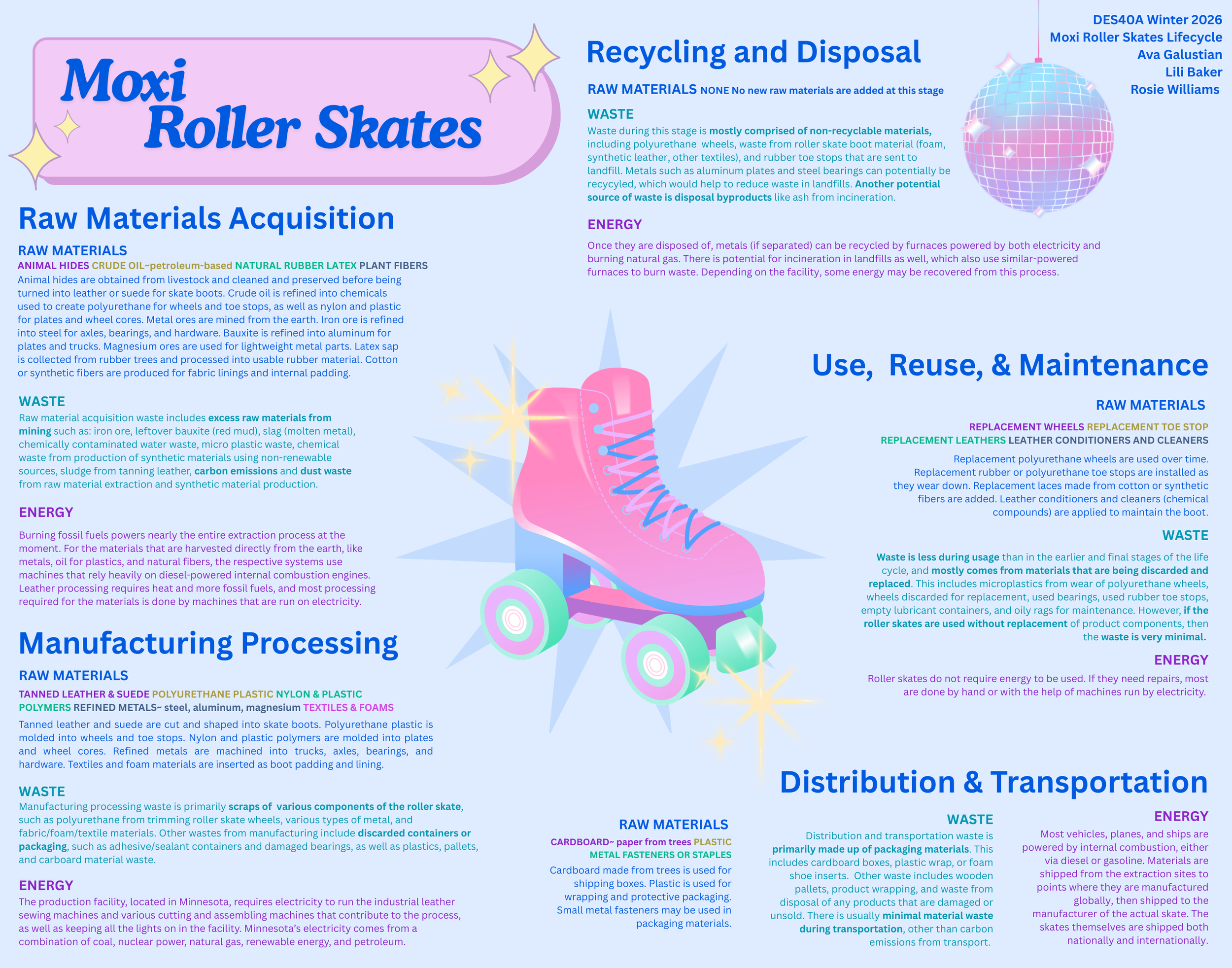
Roller skating has become a popular recreational activity and form of exercise in recent years. Many people use roller skates for outdoor skating, artistic skating, and even transportation. One popular brand of roller skates is Moxi, which sells colorful quad roller skates designed for both beginners and experienced skaters. Even though roller skates might seem like a simple product, they are actually made from many different materials that come from a variety of natural and industrial sources. A life cycle analysis studies the stages a product goes through, beginning with raw material extraction and continuing through manufacturing, distribution, use, and disposal. Looking at the materials used to make roller skates helps show how natural resources are transformed into the final product people use every day.
Many of the materials used in Moxi roller skates come from natural, mineral, and petroleum-based resources. These materials are processed into secondary materials like leather, metal, rubber, and plastic before they are assembled into skate components. Understanding where these materials come from and how they are transformed provides insight into the environmental impact of producing consumer products. Focusing on raw materials shows that the most important stage in the life cycle of Moxi quad roller skates is the extraction and processing stage, where natural and chemical resources are transformed into the materials used to manufacture the skates.
One group of materials used in Moxi quad roller skates comes from biological sources such as animals and plants. These materials must go through several processing steps before they can be used in skate parts. One example is the leather or suede used to create the outer skate boot. Leather is produced from animal hides that are treated through a tanning process that preserves the material and makes it flexible and durable (RollerSkateNation). This process allows the leather to bend and move while still supporting the skater’s foot and ankle. Once the leather has been treated, it can be cut and shaped into the upper portion of the skate boot.
Other natural materials are also used to improve comfort inside the skate. Fabric linings and padding may be made from plant fibers such as cotton or other textile materials that help cushion the foot and reduce friction while skating. These materials make the skates more comfortable during long periods of use. Natural rubber can also be used in some components such as cushions or toe stops. Rubber originally comes from latex sap harvested from rubber trees, which is then processed into a flexible material that can absorb shock and impact (The Chemistry of Rollerblading). These examples show how materials from plants and animals are transformed into important components of roller skates. While natural materials play an important role, many key skate components are actually made from synthetic materials.
Synthetic materials are widely used in modern roller skate manufacturing because they provide strength, flexibility, and durability. Many of these materials are created from petroleum-based chemicals. One of the most important synthetic materials used in roller skates is polyurethane. Polyurethane is a type of plastic polymer created through chemical reactions involving petroleum-derived compounds. This material is commonly used to make roller skate wheels because it combines durability with flexibility and grip. Polyurethane wheels help absorb vibrations and allow skaters to move smoothly across different surfaces (Larios et al.). Because of these properties, polyurethane has become the standard material used in roller skate wheels (Figure 1).
Other plastic materials are also used in different skate components. For example, nylon and other polymers may be used in the skate plate or wheel core. These materials are created through industrial chemical processes that convert refined petroleum into plastic materials that can be molded into precise shapes. Some skate boots may also include synthetic leather or vinyl materials that imitate real leather while reducing production costs (Figure 2). Although these materials help improve durability and manufacturing efficiency, they rely heavily on fossil fuels and energy-intensive production processes. Because of this, synthetic materials play a major role in the environmental footprint of roller skate manufacturing.
In addition to natural and synthetic materials, mineral resources are another major category of raw materials used in Moxi quad roller skates. These materials originate from ores that are mined from the earth and then refined into usable metals. Steel is one of the most important metals used in roller skates. It is produced by refining iron ore and is commonly used in parts such as axles, bearings, and mounting hardware. Steel is strong enough to support the skater’s weight while allowing the wheels to spin smoothly during movement (Pigeon’s Roller Skate Shop).
Aluminum is another metal frequently used in roller skate components. Aluminum comes from bauxite ore that is mined from the earth and processed through industrial refining methods. Once refined, aluminum can be shaped into lightweight but durable parts such as skate plates and trucks. These parts connect the boot to the wheels and help control the movement of the skate. Magnesium alloys may also be used in some skate components to reduce weight while still maintaining strength. The use of these metals allows roller skates to remain durable while also being light enough for comfortable skating. Mining and refining these mineral resources is an important part of the raw material stage of the product life cycle.
After raw materials are extracted, they must be transformed into secondary materials that can be used in manufacturing. This stage involves a variety of industrial processes. For example, animal hides must be cleaned and chemically treated during the tanning process before they become leather. Petroleum-based chemicals must be refined and processed to create plastics like polyurethane and nylon. Metal ores must go through smelting and refining processes before they can be turned into steel or aluminum components. These materials are then shaped, molded, or machined into the specific parts used in roller skate construction.
Once the materials are prepared, the manufacturing stage begins. During this stage, the different materials are assembled into the final roller skate product. The leather boot is attached to a metal or plastic skate plate, and wheels made from polyurethane are mounted onto the axles. Bearings, trucks, cushions, and toe stops are also added during this stage. Each component is made from a different type of processed material, showing how many resources are required to create a single pair of roller skates (Anatomy of a Roller Skate) (Figure 3). The manufacturing stage combines all of these materials into the finished product that consumers purchase.
The next stage in the life cycle is distribution and transportation. After roller skates are manufactured, they must be packaged and shipped to retailers or directly to consumers. Packaging materials such as cardboard boxes and plastic wrapping are used to protect the skates during shipping. Cardboard packaging comes from wood pulp, while plastic wrapping is produced from petroleum-based materials. Transportation also requires fuel and energy, which adds to the environmental impact of the product’s life cycle.
During the stage of use, roller skates may require maintenance and replacement parts. Over time, wheels, toe stops, and laces may wear out and need to be replaced. Replacement wheels are typically made from polyurethane, while toe stops may be made from rubber or plastic. Skaters may also use products such as leather conditioners to help maintain the boot material (Bayside Blades). These maintenance activities extend the life of the skates but also involve additional materials and resources.
The final stage of the life cycle is disposal or recycling. When roller skates can no longer be used, they may be thrown away or partially recycled. Some metal parts such as steel axles or aluminum plates can potentially be recycled if they are separated from the rest of the skate. However, many parts of the skate are made from mixed materials like plastic, rubber, and leather, which are more difficult to recycle. Because of this, some components may end up in landfills. This shows how decisions made during the raw material stage can affect how easily a product can be recycled at the end of its life.
Overall, studying the raw materials used in Moxi quad roller skates reveals how many natural resources and industrial processes are required to create a recreational product. Biological materials such as leather and rubber come from animals and plants, while synthetic materials like polyurethane and nylon are produced from petroleum-based chemicals. Metals such as steel and aluminum originate from mineral ores that are mined and refined through industrial processes. These materials are then transformed into secondary materials and assembled into the final skate components. By examining the life cycle of Moxi roller skates, it becomes clear that the extraction and processing of raw materials is one of the most important stages in the product’s life cycle. Understanding these processes helps highlight the environmental impact of manufacturing everyday consumer products.
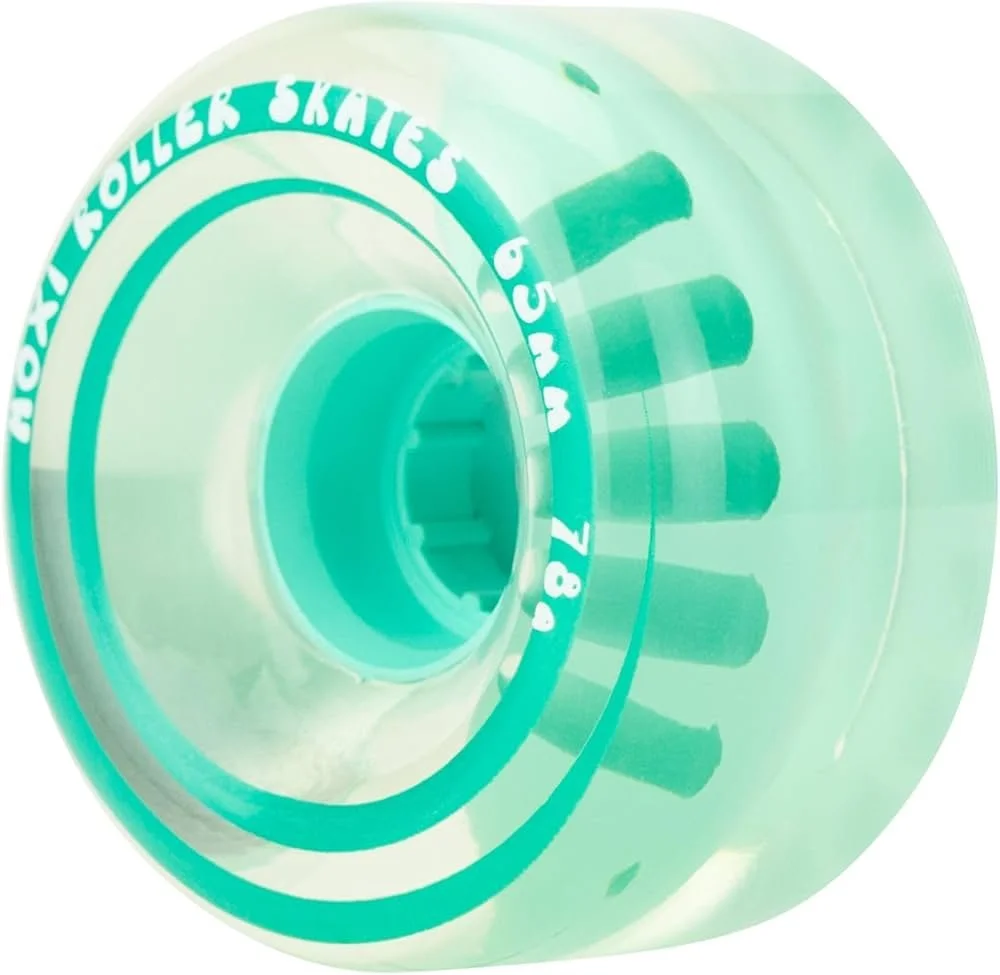
Figure 1. Polyurethane roller skate wheels. Polyurethane is a petroleum-based polymer that provides durability, grip, and vibration absorption, making it the most common material used for roller skate wheels (Larios et al.).
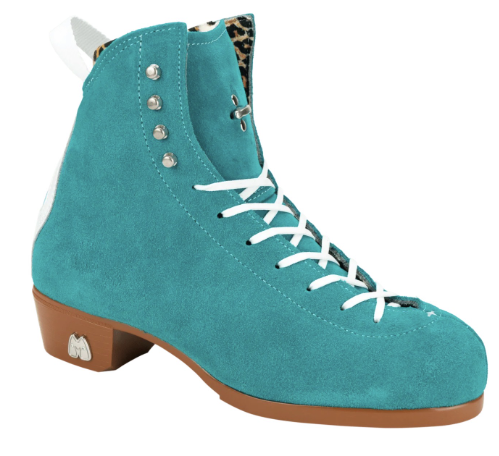
Figure 2. Leather roller skate boot used in many Moxi skates. Leather is produced from animal hides that are chemically treated through the tanning process to create a flexible and durable material for skate boots (RollerSkateNation).
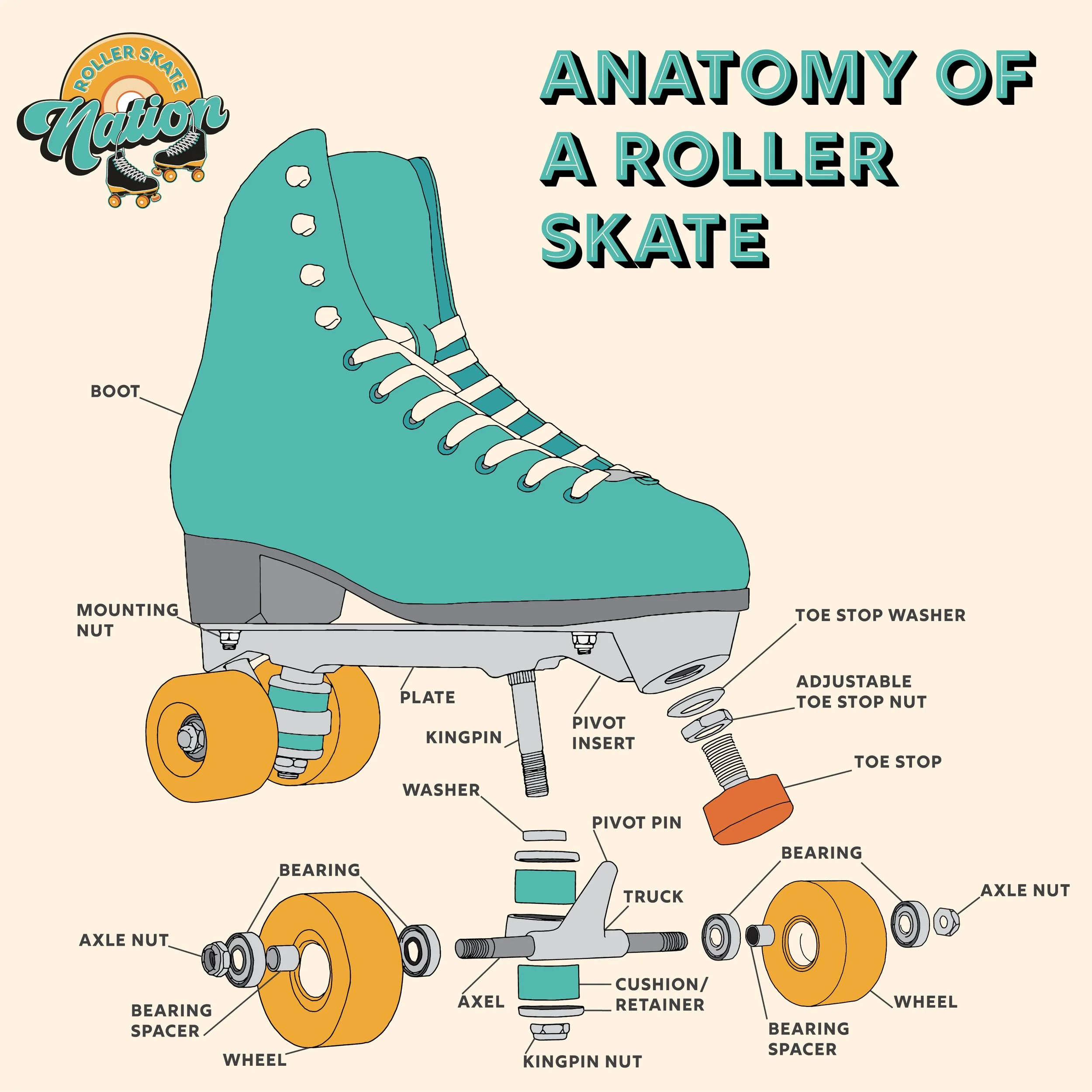
Figure 3. Diagram showing the main components of a quad roller skate, including the boot, plate, trucks, wheels, and toe stop. These parts are made from different raw materials such as leather, metal, rubber, and polyurethane (RollerSkateNation).
Bibliography
“Anatomy of a Roller Skate.” RollerSkateNation.com, 2026, rollerskatenation.com/anatomy-of-a-roller-skate/?srsltid=AfmBOooCq3RVI7AW8EiuQd8V2kL5tBgt13JjIGwxirAVVs8I0bEwkh-X. Accessed 15 Feb. 2026. (Figure 3)
“Bayside Blades.” Bayside Blades, 2020, www.baysideblades.com.au/pages/how-to-take-care-of-roller-skates?srsltid=AfmBOooBEtGSD6n-UBPowSWgi9Ps19_-3MCYUcsT5OhV_yIDw_7kdoD1. Accessed 15 Feb. 2026.
Larios , Emmanuel , et al. “Polyurethane Skateboard Wheels.” Design Life-Cycle, 6 Dec. 2018, www.designlife-cycle.com/polyurethane-wheels.
“Moxi Gummy Outdoor Wheels | 65mm.” RollerSkateNation.com, 2026, rollerskatenation.com/moxi-gummy-outdoor-wheels-65mm/?srsltid=AfmBOopNnq6dNYY2J4dVg_7dbt1UBFxhECO8Fi8o-hvKbQA-NeJ27_hq. Accessed 5 Mar. 2026. (Figure 1)
“Moxi Indoor/Outdoor Roller Skates for Girls | RollerSkateNation.com.” Rollerskatenation.com, 2026, rollerskatenation.com/brands/Moxi.html. Accessed 17 Feb. 2026.
“Moxi Jack Skate Package - Jade.” Fritzy’s Roller Skate Shop, 2023, fritzysrollerskateshop.com/products/moxi-jack-skate-package-2-0-jade?srsltid=AfmBOopmavzP4uOTZg5_6cm5TysIttV-uygyC6wyYUWw_bkpPYeRvVzP. Accessed 5 Mar. 2026. (Figure 2)
“Polyurethane and Skateboard Wheels: The Perfect Marriage.” TPC, 2 Oct. 2019, goturethane.com/polyurethane-and-skateboard-wheels-the-perfect-marriage/.
“Pigeon’s Roller Skate Shop.” Pigeon’s Roller Skate Shop, 2021, pigeonskates.com/blogs/faqs/parts-of-a-roller-skate?srsltid=AfmBOorHgzBVl30PKkKnmFmOXeITmmmDlJfm-Y_tlz4WvBFCs5hhk-mS. Accessed 15 Feb. 2026.
The. “Www.ChemistryIsLife.com - the Chemistry of Rollerblading.” Chemistryislife.com, 2026, www.chemistryislife.com/the-chemistry-of-rollerblading. Accessed 15 Feb. 2026.
“The Skate - Understanding the Parts of an Artistic Roller Skate.” Facebook.com, 2026, www.facebook.com/theskatestudio/photos/-save-this-post-understanding-the-parts-of-an-artistic-roller-skate1-bootprovide/1272746568188850/?_rdr. Accessed 15 Feb. 2026.
Rosie Williams
Professor Cogdell, TA Elizabeth Kubey
DES40A
March 12, 2026
Energy Life Cycle Assessment: Moxi Roller Skates
Energy is needed at every step of the process to bring a product into the world, especially in terms of industrial mass production. An energy life cycle assessment attempts to track all the energy used to make something, across the raw material acquisition, product manufacturing, transportation and distribution, use, reuse and maintenance, and recycling and disposal. This life cycle assessment will be looking at Moxi Lolly roller skates. Although Moxi roller skates don’t require energy to wear and use them, a lot of energy is required to bring them into the world, and once they are worn out completely, they need more energy to either be repaired, recycled, or thrown away.
Moxi is a roller skate brand based in the United States. Their main headquarters is located in California, but they manufacture skates in a few different locations around the world, depending on the type of skate that is ordered (MoxiSkates.com). This lifecycle assessment will only be looking at the Lolly model of skates. A lot of information can be found around the Lolly because it is the most ethically made and high quality, therefore they are more proud to advertise the process. Moxi has other skates that are made in China. They are significantly cheaper and very affordable, but there is very little information about their process available online.
Moxi Lolly skates are made by hand by Riedell Skate Company in the United States in Red Wing, Minnesota. They are a stitched suede leather boot with polyester laces, metal eyelets and lace hooks, with a pvc sole. They are lined with a polyester blend fabric and polyester padding. The boot is mounted on a nylon plate connecting the boot to the polyurethane wheels using aluminum hardware. The wheels have a chrome steel bearing on the inside that allows the skate to roll smoothly. Rubber toe stops are included on the front of the skate, which also include aluminum hardware (MoxiSkates.com). All of these pieces are created from raw materials found in or on the earth.
In order for them to be usable as products, all the materials have to be extracted from the earth first and professionally processed into components. Suede leather is extracted from animals and needs to undergo the process of tanning to make it usable and preserved. According to the Montana Leather Co., vegetable tanning can take anywhere from 30-60 days, and includes soaking the leather in different mixtures of natural materials and very hot water. The tannins in the materials “penetrate and stabilize the hide’s proteins” (Montana Leather Co). Industrial processes typically burn fossil fuels and/or natural gas for heating and maintaining the temperatures over several days.
Polyester, nylon, and polyurethane are all different types of plastic. Plastic’s main raw material is crude oil, and it forms plastic when combined with chemicals, forming different types of plastics when different chemicals and balances are combined (textileexchange.com). Drilling rigs extract crude oil from the earth using a combination of internal combustion and electrical power. Sophia Oilfield Supply Services explains that “Diesel engines combined with generators convert mechanical energy to provide electrical power. These generators produce AC (alternating current) and DC (direct current) power. Some rigs may use electric motors directly to power the rotary system. These motors can be powered by generators driven by diesel engines or connected to the power grid.” (Vanya). Diesel engines power most industrial operations these days. For the aluminum and chrome steel hardware on the skates, both ores need to be processed, melted, and molded. Metal extraction is also powered by diesel engines, and requires much more further processing to turn the ores into usable material (Metal Supermarkets). Metal Supermarkets explains that metals need to be processed with intense heat and grinding in order to separate contaminates from the actual material. In their article on metal extraction, it is stated that there are 5 steps the metal has to go through in order to be usable: screening, crushing, reclaim, grinding, and separation, and the metals might need to go through these processes multiple times to reach the desired purity state. The machines used in this process typically burn natural gas because it can burn at the very high temperatures required for extraction (US EIA). Both aluminum and chrome steel are processed this way for the hardware and bearings. The rubber found in the toe stop is the final material necessary to complete the skate’s anatomy. It is natural rubber, so the latex is harvested from the tree. For industrial purposes, no energy is necessary to harvest the latex, as they use a process called “rubber tapping”. AirBoss Rubber Solutions explains this saying, “a groove is cut into the tree. Then the bark is peeled back and removed. This allows the latex sap to run down the tree where it is collected.” They go on to explain that chemicals, fillers, and polymers might be added to the latex in order to stabilize the rubber and give it different characteristics.
Once all the materials are extracted, they can be made into workable components. Although Moxi’s manufacturer, Riedell Skates, does not explicitly disclose where their individual components are made, they do manufacture some pieces usable for the skates. Riedell’s website shows their list of brands they manufacture, including Kwik Bearings, Radar Wheels, and PowerDyne plates and accessories. Taking this into consideration, it may be safe to assume that they use their own bearings, wheels, plates, and hardware, but it is important to note that this is an assumption and not confirmed to be true. Heating, molding, and cooling requires a lot of energy, especially when dealing with metals, rubber, and plastics. In order to make the Moxi Lolly skates, industrial level sewing machines, cutting machines, and assembling machines also need to be accounted for in energy consumption (RollerPlanet). They are made by hand with the help of these machines, and require a significant amount of electricity to run the industrial level motors for each machine. Riedell’s facility is located in Red Wing, Minnesota where industrial manufacturing uses the most electricity in the state at 33.3% of end-use consumption, compared to commercial, residential, and transportation energy consumption (US EIA). According to the US Energy Information Administration’s 2023 end-use energy consumption estimates, this electricity is 30.5% powered by coal, 28.8% by nuclear power, 25.1% natural gas, 15.4% renewable energy, and 0.2% petroleum. Although information is not disclosed as to Riedell’s specific facility energy sources, the state’s data reflects that the industry is still heavily dependent on coal and fossil fuel.
Once the skates are fully assembled, they are then placed in their own boxes and packaging, as well as an extra box for shipping as demonstrated in Moxi’s video of the packaging (Moxi Roller Skates). Then they can be shipped to either brick-and-mortar skate shops, distributors, or directly to the consumers if they are purchased online. Moxi skates are sold mostly in the US in independent skate shops, but they can be found in official retailers in Australia and the United Kingdom/Ireland (MoxiSkates.com). They do appear in other parts of the world, but not officially distributed there unless shipped internationally. The skates are shipped from the manufacturer in Red Wing, Minnesota. Again, specifics to Moxi and Riedell are not officially disclosed, but typically for distribution, items are shipped in bulk by trucks within the United States, or they can also be shipped by plane. International distribution would need to be distributed either by air transport or ocean freight. The majority of freight vehicles are fueled by various different types of specialized diesel, including ground transportation, air transportation, and ocean transportation with the exception of a few electric vehicles (EVs) (SA Oil, AOPA.org). EVs are not very common in this industry yet, as it is expensive to replace diesel powered fleets upfront, but they are starting to be put to use in the current climate (Environmental and Energy Study Institute). Transportation is still heavily reliant on burning fossil fuel since it is cheap energy, and it is cheaper for big companies to use what is already working for them.
Once the Moxi skates make it to the person wanting to skate, they do not require any energy to have them and wear them. They are a great form of personal transportation since they do not need energy or electricity to be used, they are entirely self sufficient. When they are consistently being used, they may show signs of wear and will need repairs or replacement parts. In this case, some energy may be needed if they are being sent to the manufacturer to get repaired (Riedell Skates). Local skate and repair shops will also use electricity to perform some repairs, but it will likely be on a much smaller scale since they are running significantly smaller operations.
Typically, a set of roller skates is built to last, especially the Moxi Lolly skates. They are intended to be used, worn, and repaired. However, once a person is done using them they have a few options for what to do. Most people might donate them or give them to someone else. This is the most sustainable option as it keeps them in circulation and out of a landfill. Since they are designed to be repaired, this option also makes the most sense in terms of longevity and the lifetime of the product can be extended. However, if they were to be disposed of, they would likely end up in a landfill. Since they are made up of so many different materials, they cannot be commercially separated to recycle (naparecycling.com). The metal parts can be recycled, but only if they are separated before they are thrown away (inlineplanet.com). The metal can be melted down in a very high temperature furnace. They are usually fueled by burning natural gas, similar to the original process of manufacturing since they need to reach such high temperatures (US EIA).
Manufacturing anything in large quantities takes a very large amount of energy, from extracting the raw materials to recycling those materials at the end. A lot of processing and manufacturing needs electricity to power machinery, and that electricity comes from a much larger system that is connected to an entire power grid. For Moxi Lolly roller skates, they contribute and take from the energy consumption of the state of Minnesota, which is heavily reliant on fossil fuels, but making progress on other sources of energy. The extraction process is almost exclusively run on fossil fuels, and these two areas consume the most energy in the skates’ lifetime. Having the skates is fairly sustainable and requires little to no energy to maintain.
Bibliography
AirBoss Rubber Solutions. “The Manufacturing Process of Rubber.” AirBoss Rubber Solutions, https://airbossrubbersolutions.com/the-manufacturing-process-of-rubber/. Accessed 12 Mar. 2026.
Aircraft Owners and Pilots Association. “Fueling Process.” AOPA, https://www.aopa.org/training-and-safety/online-learning/safety-spotlights/fuel-management/fueling-process. Accessed 12 Mar. 2026.
Aluminium.org.au. “About Aluminium: How Aluminium Is Made – Recycling.” Australian Aluminium Council, https://aluminium.org.au/about-aluminium/how-aluminium-is-made/recycling/. Accessed 12 Mar. 2026.
Brooke, Michael. The Concrete Wave: The History of Skateboarding. Warwick Publishing, 1999. Internet Archive, https://archive.org/details/concretewavehist00broo/page/46/mode/2up.
Derby Warehouse. “Moxi Lolly Skates.” Derby Warehouse, https://www.derbywarehouse.com/Moxi_Lolly_Skates/descpage-MLOLLY.html. Accessed 12 Mar. 2026.
Environmental and Energy Study Institute. “Fact Sheet: The Future of the Trucking Industry – Electric Semi Trucks.” EESI, https://www.eesi.org/papers/view/fact-sheet-the-future-of-the-trucking-industry-electric-semi-trucks-2023. Accessed 12 Mar. 2026.
I Love Inspired. “Riedell’s Got Moxi.” I Love Inspired, https://iloveinspired.com/riedells-got-moxi/. Accessed 12 Mar. 2026.
Inline Planet. “Recycle Inline Skates.” Inline Planet, https://www.inlineplanet.com/08/04/recycle.html. Accessed 12 Mar. 2026.
Metal Supermarkets. “Getting to Know Metal: How the Extraction Process Works.” Metal Supermarkets, https://www.metalsupermarkets.com/getting-to-know-metal-how-extraction-process-works/. Accessed 12 Mar. 2026.
Montana Leather Company. “Explaining the 3 Main Leather Tanning Methods.” Montana Leather Company, https://www.montanaleather.com/explaining-the-3-main-leather-tanning-methods/. Accessed 12 Mar. 2026.
Moxi Skates. “FAQ.” Moxi Skates, https://www.moxiskates.com/pages/faq. Accessed 12 Mar. 2026.
Moxi Skates. “Lolly Roller Skates – Poppy Red.” Moxi Skates, https://www.moxiskates.com/collections/made-in-usa/products/lolly-roller-skates-poppy-red. Accessed 12 Mar. 2026.
Moxi Skates. “Skate Maintenance.” Moxi Skates, https://www.moxiskates.com/pages/skate-maintenance. Accessed 12 Mar. 2026.
Napa Recycling and Waste Services. “Sports Equipment Recycling Guide.” Napa Recycling, https://naparecycling.com/guide/sports-equipment/. Accessed 12 Mar. 2026.
Planète Énergies. “Fuels for Aviation and Shipping.” Planète Énergies, https://www.planete-energies.com/en/media/article/fuels-aviation-and-shipping. Accessed 12 Mar. 2026.
ResearchGate. “The Process for Manufacturing of Ball Bearing and Effect of Material in Bearing Life.” ResearchGate, https://www.researchgate.net/profile/Amit-Tiwari-42/publication/352055728. Accessed 12 Mar. 2026.
Riedell Skates. “Brands.” Riedell Skates, https://riedellskates.com/brands/. Accessed 12 Mar. 2026.
Riedell Skates. “Our Process.” Riedell Skates, https://riedellskates.com/our-process/. Accessed 12 Mar. 2026.
Riedell Roller. “Warranty and Repairs.” Riedell Roller, https://roller.riedellskates.com/Customer-Service/Warranty-and-Repairs. Accessed 12 Mar. 2026.
SOS Oilfield Services. “How Do Drilling Rigs Work?” SOS Oilfield Services, 25 July 2024, https://sossusa.com/2024/07/25/how-do-drilling-rigs-work/.
Texas Iron and Metal. “Most Popular Metal Types.” Texas Iron and Metal, https://www.texasironandmetal.com/most-popular-metal-types/. Accessed 12 Mar. 2026.
Textile Exchange. “Polyester.” Textile Exchange, https://textileexchange.org/polyester/. Accessed 12 Mar. 2026.
The Invading Sea. “Gasoline Production and Energy Use.” The Invading Sea, 7 May 2025, https://www.theinvadingsea.com/2025/05/07/gasoline-production-energy-fossil-fuels-refineries-internal-combustion-engine-electric-vehicles/. Accessed 12 Mar. 2026.
U.S. Department of Energy. “Oil Study Guide.” Energy.gov, https://www.energy.gov/sites/prod/files/2013/04/f0/HS_Oil_Studyguide_draft2.pdf. Accessed 12 Mar. 2026.
U.S. Energy Information Administration. “Petroleum Refineries.” Today in Energy, https://www.eia.gov/todayinenergy/detail.php?id=16211. Accessed 12 Mar. 2026.
U.S. Energy Information Administration. “State Energy Profile: Minnesota.” EIA, https://www.eia.gov/states/MN/overview. Accessed 12 Mar. 2026.
Wiley Online Library. “Chemistry Reference Chapter.” Wiley, https://onlinelibrary.wiley.com/doi/epdf/10.1002/9783527649846.ch2. Accessed 12 Mar. 2026.
YouTube. “Video.” YouTube, https://www.youtube.com/watch?v=K5iUHUCVevs. Accessed 12 Mar. 2026.
YouTube. “Video.” YouTube, https://www.youtube.com/watch?v=aYv3ucq-Lfg. Accessed 12 Mar. 2026.
YouTube. “Video.” YouTube, https://www.youtube.com/watch?v=ZsneY-f4zXs. Accessed 12 Mar. 2026.
Elsevier. “Scientific Article.” ScienceDirect,https://www.sciencedirect.com/science/article/pii/S2213846324002827. Accessed 12 Mar. 2026.
Lili Baker
Professor Cogdell, TA Elizabeth Kubey
DES040A
March 12, 2026
Research Analysis: LCA of Waste for Roller Skates
In life cycle analysis research, it is imperative for consumers, designers, and companies to understand the waste, pollution, and environmental impacts that result from the production of footwear like roller skates. For each phase of the life cycle–raw materials acquisition, manufacturing, distribution and transportation, use/reuse/maintenance, and disposal/recycling– research on roller skates and similar footwear has shown that each of these phases generate their own waste. However, due to research and advancements in technology, there are also several strategies that designers, consumers, and companies can implement in order to reduce the overall waste that is generated from a product like roller skates.
The first phase of the LCA is the acquisition of raw materials. One of the predominant raw materials is polyurethane/polymer for different parts of the skates such as the wheels, boot, brakes, and more (How In-Line Skates Is Made). Other materials include: leather, hides for suede, rubber, ethylene vinyl acetate (EVA) for foam insoles, carbon fiber, nylon, plastic, steel, titanium, and more depending on the brand of skates (How In-Line Skates Is Made). Many of these primary materials are combined into secondary synthetic materials such as microfiber, polyester or epoxy resin, or polyamides like nylon (How In-Line Skates Is Made). The amount of raw materials used varies depending on the style of skates–low top skates that end below the ankle using less material than high top skates that sit above the ankle (All About Boots: Boots 101). Beginner skaters usually use high tops, as it provides more stability and balance, and consequently move on to low top skates after becoming more experienced (All About Boots: Boots 101). As such, one potential solution to reducing waste during the raw material acquisition phase is to tweak the overall design of skates to be easily converted from high top to low top, so that consumers will not have to purchase a whole new set of skates when transitioning through levels of skating experience. Since one of the primary materials used to make roller skates is polyurethane, much of the waste that comes from raw material extraction comes from the extraction of materials used to make polyurethane. Because polyurethane is usually produced using nonrenewable sources such as fossil fuels, greenhouse gas emissions are a byproduct of the roller skate raw materials extraction process (Chaudhary et al.). Overall, the polyurethane industry is extremely harmful to the environment, contributing to about 7.8 million metric tons of greenhouse gas emissions in an estimate from 2016 (Chaudhary et al.). Polyurethane is also not typically recycled, usually ending up either incinerated or disposed of in landfills, further contributing to environmental and land resource pollution (Chaudhary et al). In order to lessen the waste and emissions of polyurethane, another waste reducing solution may be for roller skate manufacturers to use extraction and production processes that create bio-based, recyclable, and biodegradable polyurethane that is less likely to end up in landfills (Chaudhary et al.).
In comparison to the waste that results from raw material extraction processes, the manufacturing processes of footwear like roller skates has a greater negative impact on the environment. The manufacturing process of running shoes (a similar process to manufacturing roller skates) can potentially contribute to over two thirds of its overall carbon footprint (Footwear’s (carbon) Footprint). This may be attributed to the power required for manufacturing plants in order to go through 360 or more processing assembly steps, some of them being injection molding, foaming, heating, sewing, cutting (Footwear’s (carbon) Footprint). These processes are small, but unexpectedly use high amounts of energy, more so than the energy required in the extraction and production phase of raw materials like polyurethane (Footwear’s (carbon) Footprint). Aside from carbon emissions, much of the waste from footwear comes from scraps of material that are thrown out instead of recycled. This includes polyurethane scraps from roller skate wheels, metal swarf from trimming metal components like plates, axles, and bearings, and other fabric/foam/textile materials of the footwear (Nikje et al. 398, Metal swarf, Hariprriya 3). Other wastes from manufacturing include discarded containers, plastics, pallets, foam, and cardboard material waste that were used for raw materials packaging (Ma et al. 1846). Though there is a significant amount of waste generated during the manufacturing phase of the roller skate life cycle, there are also several solutions companies and designers could implement to reduce waste. Recycling methods such as polyurethane grinding to be converted and used for other purposes, combining shoe components to decrease the number of processing steps and energy used, and using recycled textile and metal materials as opposed to new materials will help to reduce waste during this phase (Footwear’s (carbon) Footprint).
After manufacturing, the next phases of the life cycle would be distribution/transportation, and use/reuse/maintenance. Since no additional materials are added to the product itself, most of the waste comes from packaging and transportation materials, as well as emissions from transportation and distribution. Some packaging materials are plastics, pallet or bubble wraps, cardboard boxes, or wooden pallets used both during transportation and for product packaging (Webster). It would be extremely useful to lessen the amount of waste during this phase, as the materials used for packaging and transportation usually have a very short lifespan and are discarded after one use (Webster). The most environmentally damaging component of transportation packaging is the use of plastic film, being one of the top contaminants in organics collections bins, and in certain counties it has accounted for merely half of the plastics disposed of by businesses (Webster). One solution to reduce transportation waste is to use reusable/recyclable alternatives for packing materials that can be used for multiple years, as opposed to disposable materials that are discarded after one use (Webster). Greenhouse gas emissions are another form of waste that results from distribution and transportation. Overall, freight is a major contributor to climate change and global warming, with freight transportation contributing to eight percent of global greenhouse gas emissions as of 2021 (How can carbon emissions from freight be reduced?). Since trucks and vans produce more than a hundred times as much carbon emissions as sea traveling cargo ships, these emissions would be best reduced if companies and designers focus on ways to make land transportation and distribution less carbon intensive. One way to do so would be to use cleaner fuel sources, such as through battery electric power, and using more wind and solar energy to charge the trucks instead of using fossil fuels (How can carbon emissions from freight be reduced?). Fortunately, little waste is generated during the use, reuse, and maintenance phase of the roller skate life cycle. In research on mountain bike tires, which also utilize the same kind of polyurethane that roller skates use, it was found that wheel abrasion over time releases microplastic waste and emissions into the environment (Mousania et al. 5). Though it is a small percentage of emissions, companies can still take action to reduce microplastic waste by manufacturing roller skates with materials that are more durable over time, and less prone to degradation (Mousania et al. 5). Other wastes from roller skate usage includes any components that are discarded for replacement, however, if roller skates are used without replacement, then waste is very minimal. For both transportation/distribution and consumer usage, it is important for companies to find ways to produce materials that are reusable and durable over time in order to reduce waste.
The final stage of the life cycle is disposal and recycling. Most of the waste that results from this stage is composed of materials that are not recyclable, such as the polyurethane wheels used in roller skates. Because polyurethane is not recyclable and is often resistant to combustion processes, products made with polyurethane are often discarded in landfills (Kemona et al.). However, in recent years mechanical recycling has become more common, allowing for polyurethane products to be finely ground up into powders and repurposed as fillings for different products. Chemical and feedstock recycling has also made it so the polymerization of polyurethane products can be reversed, and broken down to be reused for new products, materials, and processes. Other wastes during this phase include waste from roller skate boot material– foam, synthetic leather, and other textiles– that are sent to landfill instead of recycled or repurposed (Textiles: Material-Specific Data). As of 2018, over fifty percent of textile waste generated from clothing and footwear was landfilled, as opposed to recycled or combusted with energy recovery (Textiles: Material-Specific Data). Aluminum plates and other metal components are usually recyclable, which helps to reduce waste in landfills. Lastly, disposal byproducts like ash from incineration can also contribute to end of life waste, however this is a minimal trade off since incineration helps to lessen the volume of overall waste of rollerskates during disposal and recycling (Kemona et al.)
Through analyzing waste through the life cycle phases of roller skates, it is apparent how important understanding waste, pollution, and the environmental impact of footwear production like roller skates is to consumers, designers, and companies. Because each phase of the roller skate life cycle is waste inducing, it is important that designers continue to seek new ways to design out waste in products, from the very start of raw materials extraction and on. Because of advancements in research and technology, manufacturing companies and designers have much more resources to implement strategies to help reduce the total waste generated by products like roller skates in the future.
Bibliography
“All About Boots: Boots 101.” RollerSkateNation.Com, https://rollerskatenation.com/all-about-boots-boots-101/. Accessed 11 Mar. 2026.
Chaudhary, Mayankkumar L., and Ram K. Gupta. “Environmental and Health Concerns in Polyurethane.” Non-Isocyanate Polyurethanes: Chemistry, Progress, and Challenges, vol. 1507, American Chemical Society, 2025, pp. 15–30. ACS Symposium Series 1507. ACS Publications, https://doi.org/10.1021/bk-2025-1507.ch002.
“Footwear’s (Carbon) Footprint.” MIT News | Massachusetts Institute of Technology, 22 May 2013, https://news.mit.edu/2013/footwear-carbon-footprint-0522.
How Can Carbon Emissions from Freight Be Reduced? | MIT Climate Portal. https://climate.mit.edu/ask-mit/how-can-carbon-emissions-freight-be-reduced. Accessed 11 Mar. 2026.
How In-Line Skates Is Made - Material, Manufacture, Making, History, Used, Parts, Components, Dimensions, Product. https://www.madehow.com/Volume-2/In-Line-Skates.html. Accessed 11 Mar. 2026.
Kemona, Aleksandra, and Małgorzata Piotrowska. “Polyurethane Recycling and Disposal: Methods and Prospects.” Polymers, vol. 12, no. 8, Aug. 2020. www.mdpi.com, https://doi.org/10.3390/polym12081752.
Ma, Hongzhi, et al. “Comprehensive Treatment and Disposal of Logistics Waste in China: Prospects of Biomass Resource Conversion.” BioResources, vol. 19, no. 1, Nov. 2023. DOI.org (Crossref), https://doi.org/10.15376/biores.19.1.Ma.
“Metal Swarf.” Wikipedia, 10 Jan. 2026. Wikipedia, https://en.wikipedia.org/w/index.php?title=Metal_swarf&oldid=1332208605.
Mousania, Zeinab, et al. “Quantifying the Environmental Impact of Transportation for Plastic Film Packaging End-of-Life: Landfill, Incineration, Physical Recycling, or Chemical Recycling.” Resources, Conservation and Recycling, vol. 207, Aug. 2024, p. 107681. ScienceDirect, https://doi.org/10.1016/j.resconrec.2024.107681.
Nikje, Mir Mohammad Alavi, et al. “Polyurethane Waste Reduction and Recycling: From Bench to Pilot Scales.” Designed Monomers and Polymers, vol. 14, no. 5, Jan. 2011, pp. 395–421. DOI.org (Crossref), https://doi.org/10.1163/138577211X587618.
S, Hariprriya. “RECYCLED TEXTILES IN SHOES: A REVIEW.” INTERNATIONAL JOURNAL OF SCIENTIFIC RESEARCH IN ENGINEERING AND MANAGEMENT, vol. 07, no. 03, Mar. 2023. DOI.org (Crossref), https://doi.org/10.55041/IJSREM17883.
Sommer, Fabian, et al. “Quantifying Abrasion of Microplastics from Mountain Bike Tires.” Science of The Total Environment, vol. 969, Mar. 2025, p. 178971. DOI.org (Crossref), https://doi.org/10.1016/j.scitotenv.2025.178971.
St, Webster. Preventing Transport Packaging Waste.
US EPA, OLEM. Textiles: Material-Specific Data. Collections and Lists. 12 Sept. 2017, https://www.epa.gov/facts-and-figures-about-materials-waste-and-recycling/textiles-material-specific-data.