Design Life-Cycle
assess.design.(don't)consume
Justin Hester
Professor Cogdell
DES 40A
12 March 2026
From Capsicum to Canister: The Lifecycle of Raw Materials of SABRE Pepper Spray
During late night walks, or while being in a sketchy area, pepper spray has been used to protect oneself. Due to pepper spray being user-friendly and the fact that it is cheap and easy to acquire, it is the go-to self defense device. At first, it was used only for military and police personnel. Police officers began using it much more than guns, as it was a less lethal option. It soon became an open option for the public to use to defend themselves from attacks. Pepper spray may seem to have its safety benefits, but its consumption is making the environment less safe from the human population. As the manufacturing, distribution, and disposal of SABRE Pepper Spray continues, it requires many more raw materials to create the pepper spray, such as oleoresin capsicum, pure aluminum, and fossil fuels, which all have the potential to make a negative impact on the environment.
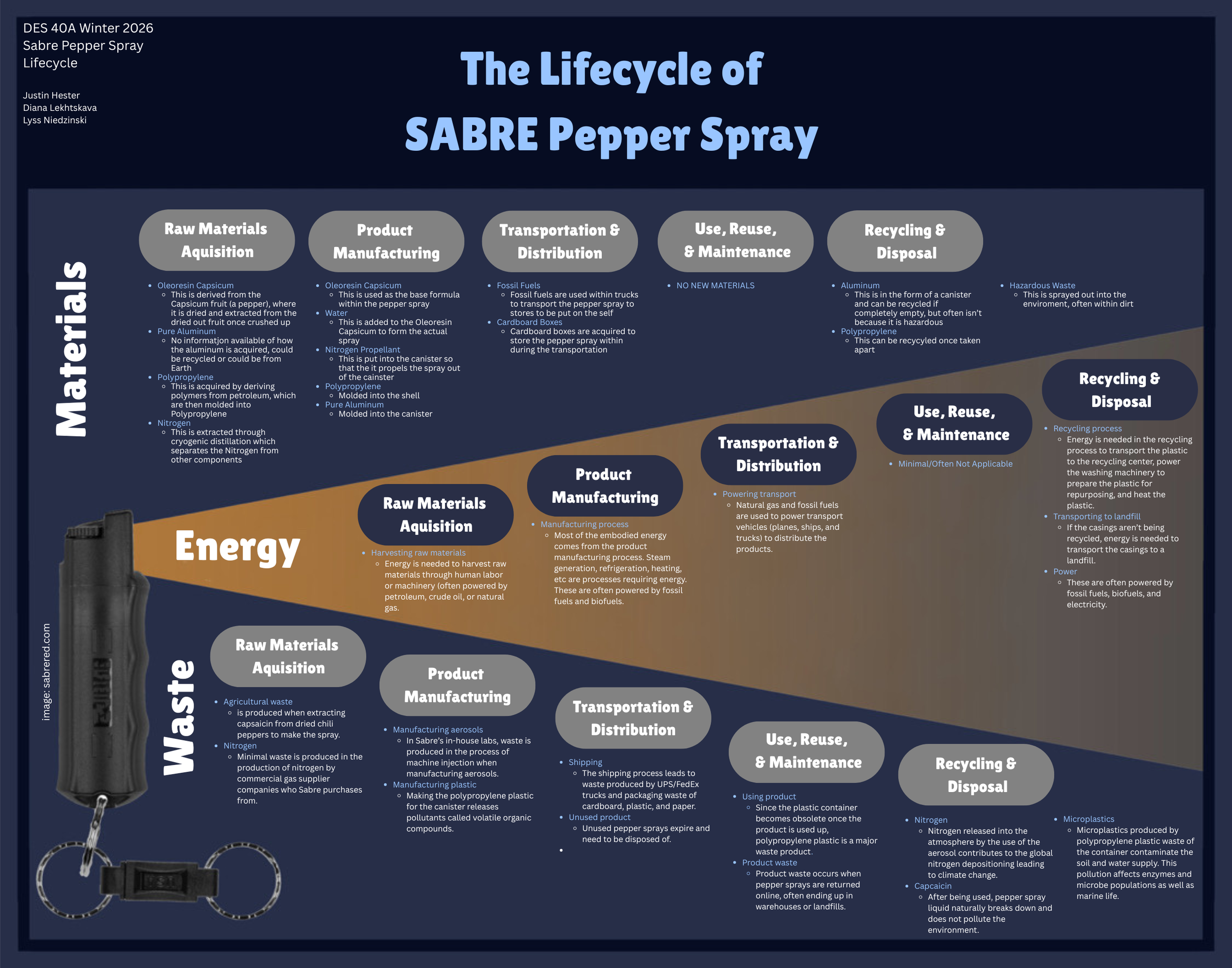
At the very beginning of SABRE Pepper Spray’s lifecycle, is the acquisition of raw materials that the pepper spray is composed of. The first raw material that is acquired is oleoresin capsicum, which “is obtained through an extraction process from chili peppers” (DuBay 6). The capsicum fruit is first grown, where it is then harvested. These harvested peppers are then typically sun dried, where “the product is exposed directly to the sun allowing the solar radiation to be absorbed by the material” (Melgar-Lalanne 56). Once fully dried out, they are grinded into a fine powder. After the capsicum is reduced to a powder, an organic solvent is added to it which is typically water. The solvent is evaporated out of the solution, and what is left is an oily substance of raw oleoresin capsicum. This serves as the main ingredient that will be sprayed out from the actual canister of SABRE Pepper Spray.
Along with this, pure aluminum is another raw material that is acquired during this stage. Aluminum serves as a great choice to make up the canister of the pepper spray because of how lightweight, durable, and corrosion-resistant it is. There is no information released by SABRE Pepper Spray regarding how the aluminum is acquired, but it is speculated that it could be from recycled aluminum. If it were to be from recycled aluminum, the process would be “the extraction of aluminum from aluminum slag by sulfuric acid pressure leaching” (Amer 60), where the “scrap originates from different Al alloys, with different alloying elements” (Capuzzi 2). The scrap is placed under high temperature and pressure conditions, with the addition of sulfuric acid. The iron and other undesirable metals are also filtered out until there is just the crystallization of aluminum sulfate, which then can be produced into pure aluminum.
Another raw material that must be acquired during this phase is polypropylene, which is a plastic derived from petroleum. Polypropylene is used for the shell of the pepper spray for similar reasons as the aluminum, as it provides an “excellence in properties such as stiffness, heat resistance and processability in addition to light weight material density and also a relatively low price” (Ogawa and Sato 1). Polypropylene starts off as propylene, which is a gas derived from petroleum. The petroleum is processed, meaning heat and pressure are added to it, along with a catalyst in order to convert it into a new form known as propylene. Since propylene is a monomer, it is polymerized until it turns into the polymer known as polypropylene, and is ready to be molded into shapes for the usage of products.
The last material that needs to be acquired during this phase is nitrogen gas, which is done through the process of cryogenic distillation. This process separates chemicals with very low boiling points, by starting with the “filtering of the air to eliminate any impurities is the first step before compressing it to high pressures” (Cryogenic Distillation Process). Once compressed to high pressures, the temperatures are lowered until the chemicals are liquids. Once in liquid form, the nitrogen is extracted by separating it from different elements using different boiling points. What is left is pure nitrogen gas ready to be used in the manufacturing process.
After the materials acquisition phase comes the product manufacturing phase, which is all the materials used to make the product. The first material that is used during this phase is oleoresin capsicum. This is used as the base of the pepper spray, which is the part that gives the spray its signature sting. This is combined with the second material in this phase, water, to form the actual spray itself, as “the raw OC is diluted to various strengths according to customer specifications” (DuBay 6). These two materials compose the actual pepper spray itself, making a fairly simple product to manufacture. But in order for the spray to work, a propellant needs to be added to the canister. A propellant is compressed gas that is used to produce thrust, in this case, for the pepper spray. The gas to do this job is nitrogen. So the nitrogen that was acquired during the first phase is compressed and injected into the canister so that the pepper spray will be a functional product. But there needs to be a canister for all of those materials to be put into.
The material that composes this canister to hold all of these components is made out of that extracted aluminum. Through the process of extrusion, the canister is able to be formed. This takes the aluminum and lubricates it, which is then placed through a steel die and pounded at high speeds by a hydraulic ram. The metal then flows around the ram due to the speed at which it was struck, forming the can shape that it is known for. It is then trimmed up, releasing all the excess aluminum, and what's left is a canister ready for the fluids and gasses to be put inside. In order for the canister to be protected, it needs an outer casing as well.
The thing that will protect it is a shell made from polypropylene. During the manufacturing process, polypropylene is molded into a shell around the canister through a process called injection molding. During this manufacturing process, the polypropylene “material is fed into a heated barrel where it is also melted” (Injection Molding Explained) and turned into molten polypropylene. It is then placed into a metal mold where it cools down and hardens. Once cooled, the pieces are taken out and put together around the canister in order to keep it protected. After the whole product is manufactured using these materials, it must be distributed around the country.
When being distributed and transported throughout the country, two new materials are being used throughout this process. Fossil fuels are used as a fuel source for all the vehicles that haul the products to warehouses and stores. The vehicles are filled up before they leave so that they can be as efficient as possible in order to make it to their destination. By using this material though, it causes significant environmental harm as it releases air pollutants throughout the atmosphere.
Along with fossil fuels, cardboard boxes are a new material that is being used. The pepper spray needs to be packaged up so that it is protected on the way to its destination, and cardboard boxes provide a cheap and durable way for that to happen. Once the pepper spray is on the shelf, and then bought by customers, it moves into the phase of use, reuse, and maintenance. No new materials are used during this phase, as you just need to hold down the trigger for it to spray. Otherwise customers just carry it around without needing to maintain or clean it. Once used though, it needs to be recycled and disposed of.
As pepper spray moves into the recycling and disposal phase, three materials are used in order to dispose of it. The first material that is disposed of is the actual pepper spray, which must be disposed of by “stand[ing] upwind and spray the contents downwind, ideally into the ground” (Self-Defense Spray Disposal). By doing this, it prevents any hazardous material from ending up in the trash, therefore protecting sanitation workers. It is also required that the contents of the canister be empty for disposing of the rest of the canister, so this step is vital to perform.
When taking the rest of the canister into account, the polypropylene and aluminum parts must be split up before disposal. The polypropylene can be taken apart and put into the recycling bin, as it is able to be recycled. This helps the environment as this outer shell is not contaminated by the inside material of the pepper spray, along with it being able to be repurposed in the future for new products, whether it is the pepper spray shell again or something completely different. Just like polypropylene, the last material, aluminum, can also be recycled, but this has to be done only if the can is completely empty of the inside pepper spray. Typically you need to double check if they are able to be recycled in your area, but because the “empty canisters are made of metal, they can be recycled in many areas” (Self-Defense Spray Disposal). Otherwise, in order to not risk putting it through the recycling process, people often discard the canister in the trash. This way, although easier, does cause harm to the environment. The material of aluminum would end up in the dump, where it would take many years to decompose on its own.
Just because pepper spray is used for safety for oneself, does not imply it is safe to continue the production of this product, as its lifecycle of materials unveils environmental concerns. As pepper spray moves from phase to phase, new materials are introduced. The first stage of acquiring raw materials introduced the materials needed such as polypropylene, pure aluminum, oleoresin capsicum, and nitrogen. These materials are manufactured through various methods to create the product of pepper spray. Once distributed though, fossil fuels are burned up and air pollutants are released into the atmosphere, posing a negative impact on the environment. Then in the last phase, all of the materials that were first acquired but be disposed of, and if they are not recycled, they can make an everlasting impact on the environment. By recognizing and understanding the impacts of the lifecycle, consumers and manufacturers will be able to better consider different methods to help the environment when trying to create this product.
Works Cited
“A Complete Guide on Pepper Spray: Safety, Use, and Law.” SABRE, 18 July 2025, www.sabrered.com/blog/a-complete-guide-on-pepper-spray-safety-use-and-law/?srsltid=AfmBOoppIZGkiPVFJZeU3f9J6u7ZZ0M0BFaLqPUoQLu3r_xwp79CvCQT#what-is-pepper-spray-and-how-does-it-work.
Amer, A. M. “Aluminum Extraction from Aluminum Industrial Wastes - Jom.” SpringerLink, Springer US, 13 May 2010, link.springer.com/article/10.1007/s11837-010-0080-0.
Capuzzi, Stefano, and Giulio Timelli. “Preparation and Melting of Scrap in Aluminum Recycling: A Review.” MDPI, Multidisciplinary Digital Publishing Institute, 8 Apr. 2018, www.mdpi.com/2075-4701/8/4/249.
“Cryogenic Distillation Process: A Guide to Air Separation.” Jalon, 20 Mar. 2025, www.jalonzeolite.com/cryogenic-distillation-process-air-separation/.
DuBay, David. “DT/FL Research Journal 6 Oleoresin Capsicum and Pepper Sprays.” OLEORESIN CAPSICUM AND PEPPER SPRAYS, www.defense-technology.com/wp-content/uploads/2020/06/oc-and-pepper-sprays-062620.pdf. Accessed 3 Feb. 2026.
Is Your Pepper Spray Hot Enough? (HPLC Testing), 22 Nov. 2022, www.youtube.com/watch?v=Lw2wqSbqw-c&t=152s.
Melgar-Lalanne, Guiomar, et al. “Oleoresins from Capsicum Spp.: Extraction Methods and Bioactivity - Food and Bioprocess Technology.” SpringerLink, Springer US, 9 Sept. 2016, link.springer.com/article/10.1007/s11947-016-1793-z.
Member, Parkway Plastics Team. “Injection Molding Explained - How PP and PS Jars and Containers Are Manufactured - How Parkway Plastics Manufacture Plastic Jars.” Plastic Jars, Plastic Bottles, Glass Jars & Containers Wholesale, parkwayjars.com/blog-1/injection-molding-explained-how-pp-and-ps-jars-and-containers-are-manufactured-how-parkway-plastics-manufacture-plastic-jars-/.
Ogawa, Hiroyuki, and Hideki Sato. Review on Development of Polypropylene Manufacturing Process, www.sumitomo-chem.co.jp/english/rd/report/files/docs/02_2009-2e.pdf.
Person, et al. “Characterization of Capsicum Oleoresin: 3 : Handbook of Oleoresins |.” Taylor & Francis, Taylor & Francis, 7 June 2022, www.taylorfrancis.com/chapters/edit/10.1201/9781003186205-3/characterization-capsicum-oleoresin-asif-ahmad-muhammad-suhail-ibrahim.
“Self-Defense Spray Disposal: Compliance Made Easy.” Hazardous Waste Experts, 10 Oct. 2025, www.hazardouswasteexperts.com/self-defense-spray-disposal-compliance-made-easy/.
Y., Cody. “Pepper Spray & Self-Defense Shipping Restrictions by State.” Ship Restrict, Ship Restrict, 25 Sept. 2025, shiprestrict.com/blog/shipping-restrictions/pepper-spray-and-self-defense-product-shipping-restrictions-by-state.
Elyssa Niedzinski
Professor Cogdell
DES 040A
11 March 2026
Embodied Energy of SABRE Pepper Spray
In recent years, pepper spray has been increasing in popularity as the average person has begun to purchase it as a form of self defense. On college campuses or in cities, especially, it’s not uncommon for people to be carrying SABRE pepper spray in their purse or on their keychain, but how many people know how these products are made and what goes into them? How much energy does it take to bring raw materials all the way to a package of pepper spray to someone’s doorstep? Is this increasingly popular product sustainable in the long term to keep producing? The ingredients that make up pepper spray are Oleoresin Capsicum, the active ingredient in pepper spray, water, and some sort of propellant, often nitrogen. All of this is safely kept inside an alluminum canister covered by a Polypropylene plastic casing. The product life cycle of pepper spray, from raw material acquisition to manufacturing to recycling, is quite energy intensive. In the long term, it would be advisable to consider changes in the products life cycle in order to lessen the energy demand of pepper spray. During the SABRE Pepper Spray’s life cycle, most of the energy use and unsustainibility come from the manufacturing stage of the life cycle, in particular the manufacturing of the plastic casing. Utilizing developing recycling techniques like recycled plastic into fuel briquettes or reusing old product casing could cut down on environmental impacts and energy use of the SABRE Pepper Spray significantly.
The current fuel sources utilized in the manufacturing process for the plastic casing of SABRE Pepper spray is arguably unsustainable in the long term. Fossil fuels such as natural gas, gasoline, and petroleum oil, among others, are commonly used to power engines for manufacturing and transportation, but they’re also limited resources, and excessive use of these resources is unsustainable in the long term. Unfortunately, the exact fuel and energy needs can’t be calculated without knowing the locations that SABRE sources their materials from or the locations of the factories they use, but general estimates can still be made. Capsicum peppers are commonly grown in India, with “India rank[ing] first in dry chilli production with a 33% share” (Jalgaonkar), and harvesting the capsicum peppers is commonly done by human labor and “Approximately 125 workers are required to handle the total chilli picking per hectare” (Jalgaonkar). They’re then they’re often dried naturally in the sun or using heat pumps to generate heat and dry them. This process isn’t extremely energy intensive in comparison to other components of pepper spray, especially if the peppers are sun dried. As for the manufacturing of the oleoresin, “To extract oleoresins, trichloroethylene, acetone, propan-2-ol, methanol, ethanol, hexane solvents are used. The organic solvent can be recovered afterwards from the oleoresin” (Jalgaonkar), making this energy efficient as well. For the main part, the raw material acquisition and manufacturing of oleoresin capsicum are powered by human labor along with jet fuel for plane transport, the fuel oil used by commercial ships, and the gasoline used by cars to transport the oleoresin along the course of its life cycle. Polypropylene, on the other hand, poses a large number of issues. Polypropylene itself is made up of fossil fuels, and “the manufacturing process of propylene has extremely high impacts on global warming potential, fossil resource depletion (1.722 kg Oil eq./kg-PP)”(Alsabri). “The GCC is considered the major producer and exporter of PP to markets worldwide and is a steady global supplier [8]. This is due to… the raw products of crude oil and natural gas within the region.” This minimizes the energy needed for raw material transportation as the materials are already near by, as the GCC located in Saudi Arabia, has “access to one-third of the world’s oil and natural gas reserves” (Alsabri). The manufacturing process focused on in Alsabri’s article is based off of an existing plant owned by the GCC, and “consists of four main areas or stages which are as follows: the utility and purification area, the reaction area, the pelleting area, and finally the packaging area” (Alsabri). is heavily dependent on machinery likely powered by fossil fuels, as “The fossil resource depletion (FD) indicates fossil-based resource consumption during a particular process”(Alsabri). The specifics are difficult to verify, as much of that information is confidential and also differs between plants. While this works for current production, it leaves room for improvement and could be improved with strategies to either decrease the amount of fuel needed, or to change the unsustainible fuel sources entirely.
To decrease the amount of fuel needed during the manufacturing process, taking advantage of already manufactured polypropylene through recycling would lessen the energy needs of manufacturing. Currently, “only 10% of plastic waste is recycled properly” (Zabaniotou) which leaves a majority of plastic waste unutilized. That 90% of unrecycled plastic is disposal of energy since the product isn’t being fully utilized and forces companies to continue manufacturing new plastic with high energy needs rather than reusing already existing plastic. Recycling and reuse allows for circular energy to a degree in the life cycle of pepper spray. As for the productivity of recycling itself, “high-quality post-consumer polypropylene recycling process, an overall PP yield of 85 wt% is achieved” (Kasper), and the additional plastic that can’t be reused can always be recycled into fuel, which this paper will address later on. By increasing the amount of plastic recycled, a significant amount of plastic can be resued in packaging and thus minimizes energy input and fossil fuel use for plastic production. The energy needed to clean and process the plastic in the recycling process is also less than that of initial manufacturing. There’s also the added benefit in this of reducing waste and raw material acquisition needs. Polypropylene is disposed of and not recycled, is non-biodegradable waste, and Polypropylene is a product created from fossil fuels. Recycling casings can reduce the energy cost of harvesting the raw materials needed for the casing and cut down on manufacturing energy costs.
An alternative fuel source to fossil fuels, such as briquettes from plastic recycling, oil and gas from plastic recycling, or nuclear power, would also help to lessen the issues surrounding energy in the manufacturing stage. This change would help to lessen carbon emissions from the production process. Briquettes are a condensed brick of fuel materials. They’re commonly made of charcoal, but it’s also possible to be created with plastics. The large amounts of energy put into plastic production, along with its raw material already being fossil fuels makes it an extremely energy rich material. If the material isn’t able to be recycled through heating into a plastic casing, it’s beneficial to recycle it into a fuel source to utilize all plastic at the end of a product’s life cycle. One way of recycling plastics involces heating in a process called Pyrolysis, which results in oil, gas, and char. “Pyrolysis oil can be used as a fuel… The gas can be used to partially cover the energy demands of the process, while the solid product (char) can either be sold or used to produce activated carbon and other useful products” (Zabaniotou) and this char can also be used as fuel if turned into briquettes. In one study, efficiency for Polypropylene briquettes “obtained a calorific value test result of 9,949 cal/gram” (Agustine). Although this likely can’t be immediately implemented on a large commercial scale, these briquettes can be used by the average person in homes to meet energy needs. With more research, these briquettes could be more frequently utilized and make it to all parts of plastic can be recycled to reduce energy needs or change fuel sources to become more sustainable. If plastics aren’t being recycled into fuel sources, alternative energy sources such as biofuels, solar, wind, or nuclear energy could be utilized. If energy needs aren’t going to be reduced, it would be beneficial to change to more sustainable energy sources if possible. Utilizing alternative energy is, in theory, an ideal way to make the embodied energy of SABRE pepper spray more sustainible, but unfortunately, there are some logistical difficulties. Many of the machines used in manufacturing and transportation are designed to run off of fossil fuels. Economically, replacing all transportation vehicles and manufacturing machinery would likely be unrealistic, so the most ideal solution would likely have to either work with existing machinery or be economically beneficial enough to justify machinery replacement. If it weren’t for this issue, this would be the most advisable adjustment to pepper spray’s life cycle.
There is no way to eliminate the negative environmental impacts of mass production, but for the sake of the planet’s future health, changes should be made. This is an issue bigger than pepper spray and an issue that is most definitely easier to solve in theory than in practice. Ideal solutions environmentally might not be possible economically. Financial costs will play a large role in what changes are possible, so without huge systematic changes, sustainable alterations for pepper spray production likely won’t be possible. Changes won’t be able to occur unless they can be considered financially reasonable. Changes in fuels or increased recycling are practices that could be applied to any product that uses polypropylene plastic. The fossil fuels that are needed to manufacture Polypropylene are limited, and this plastic is also a non-biodegradible waste. But for this specific case, the issue of unsustainable energy sources could be lessened while also lessening the issues with pastic waste by changing certain approaches to the manufacturing process, making pepper spray a more sustainable product to keep producing into the future. Altering the manufacturing process would be environmentally beneficial to the raw materials, embodied energy, and waste aspects of the SABRE Pepper Spray’s life cycle.
Works Cited
Agustine, Dine, et al. “Sustainable Waste Management Breakthrough: Transforming Plastic Waste into Eco-Friendly Briquette Charcoal.” Jurnal Presipitasi, vol. 20, no. 2, July 2023, pp. 452–60, https://doi.org/10.14710/presipitasi.v20i2.452-460.
Alsabri, Amzan, et al. “Life-Cycle Assessment of Polypropylene Production in the Gulf Cooperation Council (GCC) Region.” Polymers [Basel], vol. 13, no. 21, 2021, p. 3793, https://doi.org/10.3390/polym13213793.
Bora, Raaj R, et al. “Waste Polypropylene Plastic Recycling toward Climate Change Mitigation and Circular Economy: Energy, Environmental, and Technoeconomic Perspectives.” ACS Sustainable Chemistry & Engineering, vol. 8, no. 43, 2020, pp. 16350–63, https://doi.org/10.1021/acssuschemeng.0c06311.
Borusiewicz, R., Martyna, A., Zadora, G., & Zahrebelna, A. (2021). Differentiation of oleoresin capsicum sprays based on their capsaicinoid profiles. Forensic Science International (Online), 328 doi:https://doi.org/10.1016/j.forsciint.2021.111031.
De Aguiar, Ana Carolina, et al. “Economic Analysis of Oleoresin Production from Malagueta Peppers (Capsicum Frutescens) by Supercritical Fluid Extraction.” The Journal of Supercritical Fluids, vol. 133, 2018, pp. 86–93, https://doi.org/10.1016/j.supflu.2017.09.031.
De Aguiar, Ana Carolina, et al. “Supercritical Fluids and Fluid Mixtures to Obtain High-Value Compounds from Capsicum Peppers.” Food Chemistry: X [Netherlands], vol. 13, no. 100228, 2022, https://doi.org/10.1016/j.fochx.2022.100228.
Edwards, Steven Michael, et al. Evaluation of Pepper Spray. U.S. Department of Justice, Office of Justice Programs, National Institute of Justice, 1997, search.library.ucdavis.edu/permalink/01UCD_INST/9fle3i/alma9912298556906531.
Jalgaonkar, Kirti, et al. “Post-Harvest Profile, Processing and Value Addition of Dried Red Chillies (Capsicum Annum L.).” Journal of Food Science and Technology [New Delhi], vol. 61, no. 2, 2024, pp. 201–19, https://doi.org/10.1007/s13197-022-05656-1.
Kasper, Johann B, et al. “Losses and Emissions in Polypropylene Recycling from Household Packaging Waste.” Waste Management (Elmsford) [United States], vol. 191, 2025, pp. 230–41, https://doi.org/10.1016/j.wasman.2024.11.029.
Rodrigues, Kelly C.S, and Arthur G Fett-Neto. “Oleoresin Yield of Pinus Elliottii in a Subtropical Climate: Seasonal Variation and Effect of Auxin and Salicylic Acid-Based Stimulant Paste.” Industrial Crops and Products, vol. 30, no. 2, 2009, pp. 316–20, https://doi.org/10.1016/j.indcrop.2009.06.004.
Zabaniotou, Anastasia, and Ioannis Vaskalis. “Economic Assessment of Polypropylene Waste (PP) Pyrolysis in Circular Economy and Industrial Symbiosis.” Energies (Basel) [Basel], vol. 16, no. 2, 2023, p. 593, https://doi.org/10.3390/en16020593.
Zhang, Wujie, et al. “Multi-Objective Optimization of Cryogenic Propellant Zero Boil-off Storage: Modeling, Optimization Method and Performance Enhancement.” Energy (Oxford) [OXFORD], vol. 320, no. 135365, April 2025, https://doi.org/10.1016/j.energy.2025.135365.
Diana Lekhtsikava
Professor Cogdell
Energy, Materials, and Design Over Time
12 March 2026
Analysis of Waste and Pollution in the Life-Cycle of Sabre Pepper Spray
Pepper spray is an item considered essential by many people. Sabre is one of the most ubiquitous brands for pepper spray across the US. Considering the widespread use of the brand’s pepper spray, it is essential as conscientious consumers to consider the waste and pollution associated with the product. Specifically, one must examine the waste generated throughout the different lifecycle stages of production. In the life cycle of a Sabre pepper spray, waste production begins with the processes of capsaicin acquisition, aerosol manufacturing, and polypropylene plastic production. Following the wastes related to the shipping processes, it is important to examine capsaicin and aerosol emissions released during use, as well as the waste associated with the canister, as this stage of the lifecycle creates the most pollution.
In examining the lifecycle of the Sabre pepper spray, waste is first generated in the making of the components that go into the product. To manufacture the pepper spray liquid, oleoresin capsicum is extracted from dried chili peppers and combined with a water-based carrier liquid. In the process of growing and processing the chili peppers, agricultural waste is created. When extracting oleoresin capsicum, waste is composed of unused parts of the pepper, including seeds, stems, pepper skin, and ground pepper fruit residue (Soldan and Carolina). These components can be discarded or used for other uses, such as composting or animal feed; it is unclear how Sabre handles these wastes. Luckily, even when discarded, these pepper residues do not have adverse effects on soil health or on the water supply. However, solvents used to extract the capsaicin are combined with water during processing and may also end up in the waterway, acting as a pollutant (Yanmin and Cui). Not only is waste produced during capsaicin manufacturing, but also during the making of the aerosol propellants that make the product able to spray. Sabre’s aerosols are manufactured in in-house Sabre facilities (SABRE Personal Safety). In this process, airborne waste can occur. The small amounts of gas used to pressurize the pepper spray canister, likely nitrogen, can escape during the pressurization process or when there is a faulty canister. When released into the atmosphere, nitrogen contributes to greenhouse gas emissions, leading to climate change and damaging ecological systems (“Why Aerosols are Harmful to the Environment & Your Business”). Another manufacturing waste in Sabre pepper spray production is that which is created during the process of plastic production. While Sabre does not directly disclose the specific plastic used in the pepper spray canister, it is likely to be polypropylene. The process of manufacturing polypropylene creates hazardous wastes, such as spent catalysts, and nonhazardous wastes such as resins; the hazardous wastes can be especially damaging to the environment when discarded (Markus and Paulik). Having considered the manufacturing wastes associated with oleoresin capsicum acquisition, aerosol creation, and polypropylene plastic production, it is important to consider the wastes generated by shipping Sabre’s pepper sprays.
In the process of shipping Sabre pepper spray, waste accumulated from the use of “UPS or FedEx” trucks to transport the product, and the use of mostly cardboard and paper packaging to secure the product whilst in transit (“Sabre Shipping & Returns”). To transport products, UPS and FedEx trucks rely on diesel fuel, creating a large source of pollution. “The final leg of home deliveries in the U.S. was responsible for more than 4.5 million tons of carbon dioxide emissions in 2020” (Waddell). This level of carbon dioxide emission occurs with nearly every purchase of Sabre pepper spray and should not go unstated. Carbon dioxide “is responsible for about 80 percent of the total heating influence of all human-produced greenhouse gases since 1990” (Lindsey). Likewise, packaging also creates waste. Pepper spray is most often shipped in cardboard boxes and/or paper parcels. While these materials are frequently recycled and have high success rates of being recycled properly, the sheer quantity of these packaging materials being used means that a significant amount is still wasted. The United States Environmental Protection Agency informs that “the recycling rate for corrugated boxes was 96.5 percent [in 2018]. After recycling, the combustion of corrugated boxes was 230,000 tons, and landfills received 940,000 tons.” Interestingly, due to the fact that pepper spray is not permitted in large quantities on airplanes, Sabre pepper spray is shipped only throughout the continental US (“Sabre Shipping & Returns”). This reduced shipping pollutants when compared to products that are shipped internationally, as that process requires large quantities of fuel and energy and generates enormous amounts of waste. The wastes generated in the life-cycle of the pepper spray continue after shipping, once Sabre pepper spray reaches the consumer.
Another major area of waste is associated with the ability to use and reuse the pepper spray once it has been produced, purchased, and shipped. A major consideration is how the liquid spray inside of the pepper spray affects the environment. Being used as a defense mechanism, pepper spray is mostly used to spray attackers’ eyes and faces. Assuming that most of the spray is used either for its intended purpose of self-defense, the liquid can end up in settling in the soil or being washed off and ending up in the water. Since the liquid is mostly composed of capsaicin and water, according to the National Pesticide Information Center, it does not pose significant dangers to the environment’s soil systems as “[b]acteria in the soil break down capsaicin”. The Environmental Protection Agency classifies capsaicin as a biochemical pesticide based on the fact that it is naturally occurring and nontoxic. Furthermore, toxicology reports and hazard reviews demonstrate that it does not negatively affect the environment, and instead breaks down naturally (Archuleta). The same cannot be said about the gases released into the air from the aerosol. The impact of aerosol use is very significant as“aerosols contribute to the second-largest forcing to climate change” (Li). Nitrogen is a major contributor to the build-up of the ozone layer in our atmosphere, classified by the UN Environment Programme as being “the biggest human-made threat to the ozone layer” with an atmospheric lifetime of 200 years and a potency of over 300 times more than other greenhouse gases like carbon dioxide. By contributing to the ozone layer, this pollutant causes habitat destruction, soil degradation, and “‘dead zones’ in the ocean … [that] cause toxic algae blooms to spread in marine ecosystems.” Additionally, it contributes to smog levels, which contribute to making the air unsafe to breathe. These are some of the major wastes that result from the product being used, but it is crucial to consider what happens when the product remains unused.
Being a self-defense product, one hopes not to be put into a dangerous situation and have a reason to use Sabre’s pepper spray. This puts Sabre pepper spray into a unique situation when it comes to the lifecycle of the product, as waste can be generated even when the product has not been used. When the pepper spray goes unused, it expires and becomes less effective. At that point, it needs to be emptied outside and discarded, creating waste. The expiration date significantly cuts down the lifecycle of the product. If the pepper spray formula could be changed so that the expiration date is extended, it would systematically prolong the lifecycles of each canister that goes unused; this would reduce the need to repurchase the product as often and, therefore, reduce waste. Another case of waste that should not be overlooked is the waste associated with product returns. Many online shipping companies, such as Amazon, accept returns but do not have a good system to keep those returns from being wasted, often ending up in the landfill. In 2022 alone, “about 9.5 billion pounds” of returns ended up in landfills (Peinkofer). “The return process, with transportation and packaging, also generated about 24 million metric tons of planet-warming carbon dioxide emissions in 2022” (Peinkofer). Even if the pepper spray is not returned and is fully used up, the plastic canister must eventually be discarded.
Once the pepper spray liquid ends, whether through being used or being emptied upon expiration, the plastic canister (which is assumed to be polypropylene plastic) is recycled or thrown away. Unfortunately, “the rate of post-consumer recycling of PP worldwide is about 1 %, meaning that huge amounts of PP find their way to landfills” (Alsabri). Other methods of disposal, such as incineration, cannot be used to dispose of polypropylene plastics either, as “burning it can discharge toxins such as vinyl chloride and dioxins”. As a result, almost all of the plastic used in Sabre’s canisters ends up in landfills, affecting the environment when it comes into contact with water and soil systems. When plastics come into contact with marine environments, they undergo weathering, which leads to both physical and chemical reactions. This is problematic, as polypropylene plastic (PP), when exposed to these conditions, releases chemicals called “plastic leachates” into the environment, which negatively affects marine life. For example, a study shows that for a specific type of algae called P. tricornutum, “leachates from the tested weathered SR-PP items inhibited the population growth” (Niu). Similarly, when coming into contact with soil systems, polypropylene deposits microplastics into the soil “driven by mechanical stress, thermal aging, UV exposure, and biodegradation” (Bagheri). This disrupts enzyme activity and microbe populations in the soil, which has a negative effect on soil health and, in turn, affects plants and animals, trickling out into the ecosystem. The waste and pollution created in discarding the polypropylene plastic canisters is the final step within the lifecycle stages of Sabre’s pepper spray.
Throughout the stages of material acquisition, manufacturing, shipping, product use (or lack thereof), and disposal, enormous quantities of waste are generated, much of which has significant environmental externalities. Yet, the waste and pollution brought about by each phase of the life-cycle is unequal. Clearly, the wastes generated by polypropylene plastic use, aerosol use, and transportation have massive environmental ramifications. Meanwhile, the wastes associated with the production of capsaicin and the discarding of pepper spray liquid are less detrimental. Certain avenues of waste might be hard to reduce, such as those related to aerosol production, as this is needed for the product to function. However, I believe that changes can be implemented to significantly improve some of the major contributors to waste from the pepper spray. Specifically, changing the plastic type used for the canister from polypropylene, which, while cost-effective, is one of the most detrimental to the environment, to another plastic type or better yet, a plastic-alternative that might be able to decompose in the environment. Additionally, formulating a longer-lasting pepper spray liquid would reduce waste, as pepper sprays would take longer to expire and need to be replaced less frequently. Considering that Sabre pepper spray is a safety necessity for so many individuals, improving even small aspects of the product’s lifecycle would significantly reduce waste and pollution; this would allow the personal safety of consumers to not be in conflict with our global environmental safety, which is currently being put into jeopardy by waste and pollution.
Works Cited
Alsabri, Amzan, et al. “Environmental impacts of polypropylene (PP) production and prospects of its recycling in the GCC region.” MaterialsToday: Proceedings, vol. 56, no. 4, 2022, pp. 2245-2251. ScienceDirect, https://www.sciencedirect.com/science/article/pii/S2214785321075969. Accessed 12 March 2026.
Archuleta, Melecita M. “Oleoresin Capsicum toxicology evaluation and hazard review.” UNT Digital Library, Sandia National Labs, October 1995, https://digital.library.unt.edu/ark:/67531/metadc623072. Accessed 12 March 2026.
Bagheri, M., and T. Tshireletso. “Degradation pathways and microplastic pollution of polypropylene geotextiles in soil systems.” Environ Geochem Health, vol. 47, no. 12, 2025, p. 552. PubMed, https://pubmed.ncbi.nlm.nih.gov/41191149. Accessed 12 March 2026.
Chen, Alexandra. “Chemical Weapons and their Unforeseen Impact on Health and the Environment.” Seattle Journal of Technology, Environmental & Innovation Law, vol. 12, no. 1, 2022, pp. 1-26. Seattle University School of Law Digital Commons, https://digitalcommons.law.seattleu.edu/cgi/viewcontent.cgi?article=1028&context=sjteil. Accessed 12 March 2026.
“Facts about Nitrogen Pollution.” UN Environment Programme, 29 Sept. 2023, https://www.unep.org/facts-about-nitrogen-pollution. Accessed 12 March 2026.
Fornereto Soldan, Ana Carolina, et al. “Supercritical Fluid Extraction of Oleoresin from Capsicum Annuum Industrial Waste.” Journal of Cleaner Production, vol. 297, May 2021, p. 126593. ScienceDirect, https://doi.org/10.1016/j.jclepro.2021.126593. Accessed 12 March 2026.
Gahleitner, Markus, and Christian Paulik. “Polypropylene.” Ullmann’s Encyclopedia of Industrial Chemistry, edited by Wiley-VCH Verlag GmbH & Co. KGaA, Wiley-VCH Verlag GmbH & Co. KGaA, 2014, pp. 1–44. https://doi.org/10.1002/14356007.o21_o04.pub2. Accessed 12 March 2026.
Gervais, J. A., et al. “Capsaicin Fact Sheet.” National Pesticide Information Center, Oregon State University Extension Services, 2008, https://npic.orst.edu/factsheets/capgen.html. Accessed 12 March 2026.
“Increasing Recycling: Adding Aerosol Cans to the Universal Waste Regulations | US EPA.” EPA, United States Environmental Protection Agency, 16 December 2025, https://www.epa.gov/hw/increasing-recycling-adding-aerosol-cans-universal-waste-regulations. Accessed 12 March 2026.
Li, J., et al. “Scattering and absorbing aerosols in the climate system.” Nat Rev Earth Environ, vol. 3, 2022, pp. 363–379. Nature, https://doi.org/10.1038/s43017-022-00296-7. Accessed 12 March 2026.
Lindsey, Rebecca. Climate Change: Atmospheric Carbon Dioxide | NOAA Climate.Gov. 21 May
2025, https://www.climate.gov/news-features/understanding-climate/climate-change-atmospheric-carbon-dioxide. Accessed 12 March 2026.
Lu, Yanmin, and Bo Cui. “Extraction and Purification of Capsaicin from Capsicum Oleoresin Using a Combination of Tunable Aqueous Polymer-Phase Impregnated Resin (TAPPIR) Extraction and Chromatography Technology.” Molecules (Basel, Switzerland), vol. 24, no. 21, Oct. 2019, p. 3956. PubMed, https://doi.org/10.3390/molecules24213956. Accessed 12 March 2026.
Niu, Z., et al. “Leachates from weathered polypropylene items, but not from polylactic acid, induce ecotoxicological effects on a marine diatom.” Micropl.&Nanopl., vol. 5, no. 35, 2025. Springer Nature Link, https://doi.org/10.1186/s43591-025-00143-8. Accessed 12 March 2026.
Peinkofer, Simone. “Inside the Black Box of Amazon Returns.” Eli Broad College of Business | Michigan State University, https://theconversation.com/inside-the-black-box-of-amazon-returns-206551. Accessed 12 Mar. 2026.
SABRE Personal Safety - Pepper Spray, Stun Guns & Home Security Defense. https://www.sabrered.com/. Accessed 12 Mar. 2026.
Shipping & Returns - FAQ: Delivery Information & Policies. https://www.sabrered.com/shipping-returns/. Accessed 12 Mar. 2026.
Tidwell, R. David, and Brandon K. Wills. “Tear Gas and Pepper Spray Toxicity - StatPearls - NCBI Bookshelf.” NCBI, National Library of Medicine; National Center for Biotechnical Information, 14 May 2023, https://www.ncbi.nlm.nih.gov/books/NBK544263. Accessed 12 March 2026.
US EPA, OLEM. Containers and Packaging: Product-Specific Data. 7 Sept. 2017, https://www.epa.gov/facts-and-figures-about-materials-waste-and-recycling/containers-and-packaging-product-specific. Accessed 12 March 2026.
Waddell, Kaveh. “How Home Deliveries From Online Shopping Increase Air Pollution.” Consumer Reports, 12 July 2022, https://www.consumerreports.org/environment-sustainability/home-deliveries-from-online-shopping-increase-air-pollution-a1594467530/. Accessed 12 March 2026.
“Why Aerosols are Harmful to the Environment & Your Business.” Citron Hygiene, Citron Hygiene, 12 February 2024, https://citronhygiene.com/resources/aerosols-harmful-to-the-environment/. Accessed 12 March 2026.