Design Life-Cycle
assess.design.(don't)consume
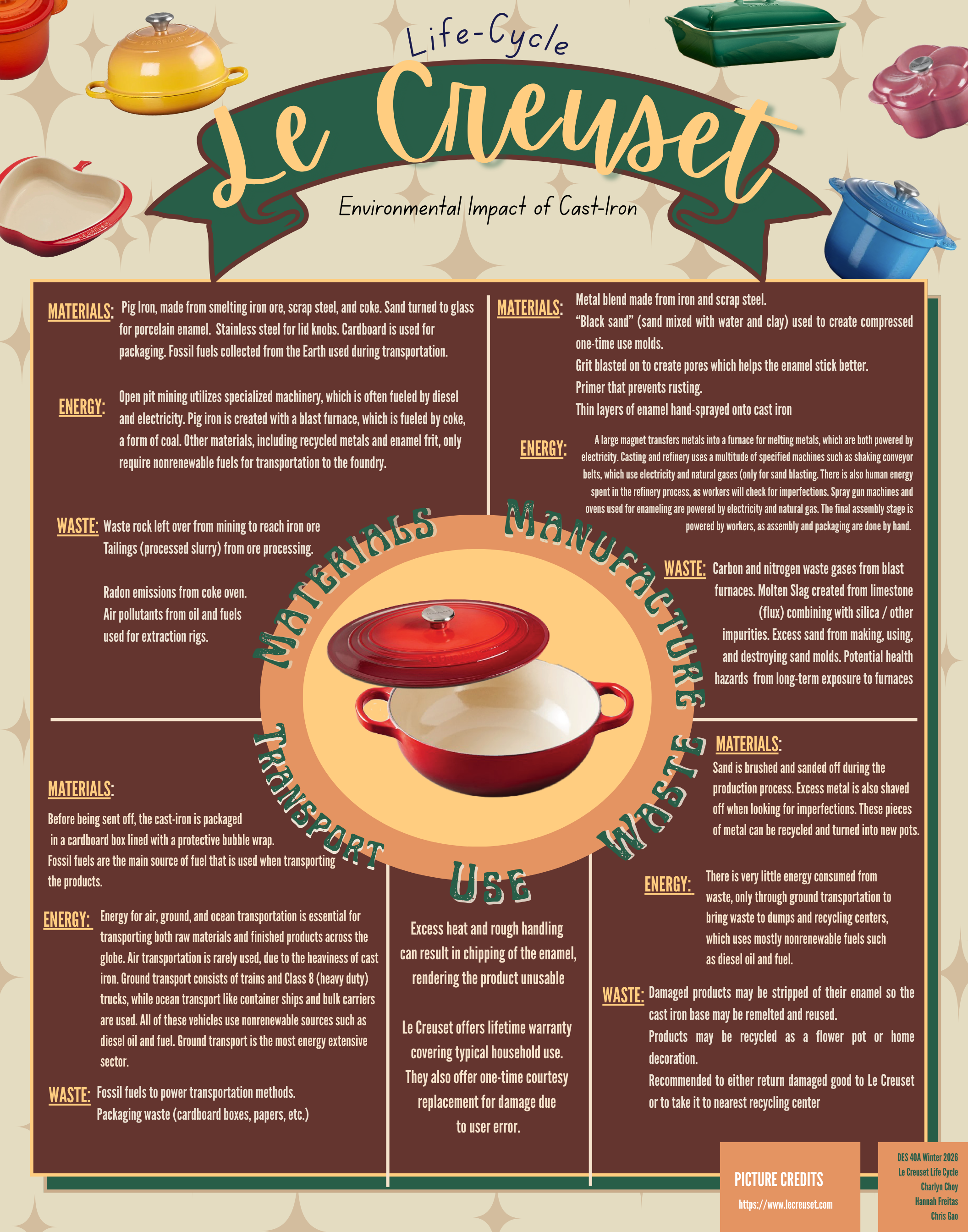
Chris Gao
DES 40A Winter 2026
Professor Cogdell
13 March, 2026
Raw Materials of The Le Creuset Cast-Iron
The Le Creuset is a luxury brand that has been used for decades. Known for its distinctive colors and timeless design, it fits easily into many households. The Le Creuset was first made in France in 1925 by a professional enameler and an expert in iron casting. The English translation of Le Creuset is “the melting pot”. Today Le Creuset is known as a luxury kitchen appliance brand that every chef dreams to have. Le Creuset has the reputation as one of the highest-quality and most prestigious cookware brands, but it’s also known for being very expensive. However, people believe the price is reasonable due to the fact that their products can be used for a lifetime and are easy to upkeep. In this Life-Cycle Analysis assignment, the main goal is to learn the life cycle of the Le Creuset Cast-Iron. My role is to explain the raw materials used to create this cast-iron. The Le Creuset is made up of many different raw materials that makes it what it is, durable and high performing. These materials play an important role in making the cast-iron strong and reliable as it is meant to be kept in the family for “generations”.
The founders and creators of the Le Creuset made sure that each product was made carefully with great attention and accuracy. The Le Creuset is made with pig iron, enamel, silica, and stainless steel. Each cast-iron is made in a sand mold that is carefully crafted by artisans. The molds are used only once to ensure the shape and quality of each pot. The actual exact mix of metal materials that is used to create a pot is unknown and is kept secret within the Le Creuset factory. What is known is that it is a mixture of pure and recycled iron that is weighed out and then transferred to the furnace.
Iron ore is the main raw material that is used to produce the cast-iron. Iron is extracted from mining iron ore through high-temperature reduction processes. Iron ore mining can have environmental impacts such as land disturbance, high energy use, and climate change, which are important considerations in a life-cycle analysis. The iron ore is then heated at a high-temperature which makes pig-iron by using coke and flux. During this process, carbon emissions are released, this helps reduce the iron ore to molten iron. Carbon emissions are usually created from coal, which is added to the iron during production. The carbon is implemented into the pig iron because it improves strength and allows a longer lifespan for the cast iron. The carbon and metal blend create a strong lattice structure. Coke is a type of fuel created by heated coal. The coal is grounded into a powder-like substance and is cooked in an oven at 1800° F. In this cooking process, other elements like oil, tar, hydrogen, nitrogen and sulfur are removed and the remaining coal is called coke. It is mainly used as a fuel source for blast furnaces. Flux, which is typically limestone, is a substance added to furnaces to get rid of impurities in iron. Steel is also a main metal that is used in the product which is also produced by a blast furnace. After the pig iron and steel are created, the two are combined and heated to 1500° Celsius. Because Le Creuset uses a blend of recycled metals and pig iron, the materials are inexpensive and sustainable.
The metal blend is poured into a sand mold. These sand molds are individually made in blocks of compressed sand, which the liquid metal is poured into. Each sand mold is only used once which makes each cast-iron unique. This process is wasteful but the sand can be reused and melted down into glass for other products. Then, the product is sanded down and felted to ensure all the excess sand is off. Before the enameling process, each cast-iron is individually checked for imperfections. If any are found, they are sent back to the furnace and are created into a new cast-iron. This is why the Le Creuset products are created with a “mystery blend”. And if the cast-iron is perfect, it is sent to the next station, the enameling station.
Just like the sanding process, the enameling process is also very complex and requires great attention to detail. Each pot is enameled individually either by hand or through a machine to ensure that each one is perfect and will last generations. First, the cast-iron is placed into a machine that covers them with grit. This grit is blasted on to create pores which helps the enamel stick better. It is covered with a primer that prevents rusting. There are three coats of glass enamel which is made with a secret recipe. Each coat of enamel takes seven seconds to complete. The first coat is called the ground coat, which seals the cast-iron. The second is the colored interior enamel that is sprayed on for longevity. Last is the colored exterior enamel, which gives the products its unique and iconic colors. Another element that improves the durability of the dish is silica. The silica is made of sand which is used to produce the enamel coating on the cast-iron. The silica is a key component of glass and creates the hard smooth surface on the Le Creuset.
Although we do not know what exactly is in the colored enamel, it is typically made of mineral pigments. Mineral pigments are made from metal oxides. Metal oxides are compounds that are made from metal cations and oxygen anions. These pigments give the Le Creuset its signature colors like red, orange, and yellow. Each pot is made from a gradation of colors, typically with two colors. After the product is coated, it is air dried and then sent back into the furnace for its final bake. Mineral pigments last in high temperatures and don’t fade even when washed.
Water is another raw material used in the production and maintenance of the Le Creuset. In the production process, water is used as a quick way for the pig iron and other materials to cool and helps control temperature.
When the product is ready for shipment, it is packaged in a cardboard box that is wrapped in a protective bubble wrap. Cardboard is made from liners that come from long fibers in a softwood tree and a medium that comes from short fibers in a hardwood tree. The liner and medium are combined in a machine to make the waves that you see in cardboard. In terms of transportation, the Le Creuset is usually shipped across the globe, as all the products are made in France. Due to the long traveling distance a lot of fossil fuel is required. Fossil fuel is a non-renewable source that is obtained from digging and mining. While cardboard can be reused and recycled, fossil fuels can not. The use of fossil fuels is not sustainable or affordable. Unfortunately, it is required to transport products like the Le Creuset Cast-Iron from France to your home.
As it arrives in your kitchen and needs to be cleaned, appliances like dishwashers are not recommended for washing. Instead, to wash and maintain the Le Creuset in pristine conditions, use warm soapy water to protect the enamel. The Le Creuset was made with the intention of using it for life. Although, if it is not possible to use it anymore, Le Creuset recommends using it as a planter.
In the recycling process, no new materials are introduced. Some other options of reusing it other than a planter is gifting it to a collector, use it as decoration, or it can even be a family heirloom. In a time where it can not be reused, it can be brought to a recycling center or in a landfill.
Overall, the Le Creuset is made from different raw materials, including pig iron, steel, carbon, silica, and mineral pigments. With all of these raw materials combined, they make a long lasting and durable cast-iron. While some parts of production, such as mining, fuel use, and transportation, have environmental impacts, the cast-iron’s extremely long lifespan helps balance these effects and it reduces waste and the constant need of repurchasing lower-quality cookware. Its life cycle includes a long period of use and maintenance with minimal replacement. In this way, the raw materials and design behind Le Creuset makes a product that is not only high-quality but also more sustainable over time.
Works Cited
American Iron and Steel Institute. “Steel Production.” American Iron and Steel Institute, American Iron and Steel Institute, 2022, www.steel.org/steel-technology/steel-production/.
Audiopedia. “Pig Iron.” YouTube, 25 Aug. 2014, www.youtube.com/watch?v=nX_t3ebuZZ4. Accessed 12 Mar. 2026.
Bhadeshia, H.K.D.H. Carbon–Carbon Interactions in Iron. Sept. 2004, doi.org/10.1023/B:JMSC.0000031476.21217.fa.
BRANDMADE.TV. “How LE CREUSET Is Made - BRANDMADE.TV.” YouTube, 29 May 2020, www.youtube.com/watch?v=e08meZfLdgE.
“Cooling Technologies for the Iron and Steel Industry | Torraval.” Torraval Cooling, 22 Apr. 2025, www.torraval.com/en/solutions/cooling-technologies-for-the-iron-and-steel-industry/. Accessed 5 Feb. 2026.
“Enameled Cast Iron vs. Cast Iron: What’s the Difference?” Made in Cookware, 2024, madeincookware.com/blogs/enameled-cast-iron-vs-cast-iron#enameled-cast-iron-overview. Accessed 5 Feb. 2026.
Georgia-Pacific. “Corrugated Boxes: How It’s Made Step by Step Process | Georgia-Pacific.” YouTube, 2020, www.youtube.com/watch?v=C5nNUPNvWAw.
“How to Choose Cast Iron for Enamel.” Nolifrit.com, 2024, www.nolifrit.com/news/how-to-choose-cast-iron-for-enamel-59.html. Accessed 5 Feb. 2026.
IRON ORE : Mineralogy, Processing and Environmental Sustainability. S.L., Woodhead Publishing, 2021.
Kim, Se-Ho, et al. “Influence of Microstructure and Atomic-Scale Chemistry on Iron Ore Reduction with Hydrogen at 700{\Deg}C.” ArXiv.org, 2021, arxiv.org/abs/2102.05654.
“Le Creuset.” Lecreuset.com, 2026, www.lecreuset.com/our-materials/enameled-cast-iron. Accessed 5 Feb. 2026.
Li, Ke-qing, et al. “Iron Extraction from Oolitic Iron Ore by a Deep Reduction Process.” Journal of Iron and Steel Research International, vol. 18, no. 8, Aug. 2011, pp. 9–13, https://doi.org/10.1016/s1006-706x(11)60096-4.
Nice Cookware. “Best Stainless Steel Cookware - Nice Cookware.” Nice Cookware, 18 Dec. 2025, nicecookware.com/what-is-enameled-cast-iron-and-how-does-it-differ-from-regular-cast-iron/. Accessed 5 Feb. 2026.
Russo, Francesca, et al. “Porcelain Enamel Coatings.” Encyclopedia, vol. 1, no. 2, 1 June 2021, pp. 388–400, www.mdpi.com/2673-8392/1/2/32, https://doi.org/10.3390/encyclopedia1020032.
Yue, Qiang, et al. “Analysis of Iron and Steel Production Paths on the Energy Demand and Carbon Emission in China’s Iron and Steel Industry.” Environment, Development and Sustainability, 8 Mar. 2022, https://doi.org/10.1007/s10668-022-02234-5.
Charlyn Choy
DES 040A
Professor Cogdell
13 March, 2026
Energy in the Lifecycle of a Le Creuset Cast-Iron Pot
Almost everyone has seen or heard of Le Creuset cookware– Started in France in 1925, Le Creuset has grown to become a staple in many homes around the globe. The brand’s most popular item, the cast iron pot, is renowned for being a quality product that will last throughout hundreds of hot dinners. What kinds of energies enable this infamous company to create and distribute their products? How does energy power every step of the Le Creuset lifecycle, from extracting the first raw materials to vitrifying the colored enamel? Throughout the lifecycle of a Le Creuset cast iron pot, there are a plethora of different energy sources utilized in the whole process, from individual human effort to industrial machines for smelting. But overall, the most energy is consumed through nonrenewable fuels that power ground, air, and water transportation, which is essential in almost every single step of the lifecycle.
Just like how every meal starts with fresh ingredients, the life cycle of a Le Creuset pot begins with the raw materials, generally consisting of iron, steel, and enamel frit for enameling. First, the mixture of metals that create the cast iron must be obtained, composed of around 50% raw pig iron and 50% recycled iron and steel, along with various other minerals that the company keeps secret. Although the use of recycled metals saves an abundance of energy required for production, the pig iron comes from iron ore, which needs to be mined. This acquisition of iron ore is one of the most energy intensive steps in the process of gathering raw materials, requiring many large industrial machines and a plethora of energy sources. There are many kinds of mining processes, but open pit mining is the most common. Drills, explosives (ammonium nitrate), excavators, loaders, water trucks, haul trucks, and the actual iron plant that processes the raw iron are just some of the machinery that is used in open pit mining. The main source of energy for these large vehicles, such as the drills and the loaders, are diesel and electricity. Diesel gas, a nonrenewable fuel derived from crude oil, is much denser than gasoline and is therefore preferred for industrial sized vehicles. Some parts of these machines also use electricity as an energy source. Before the iron is brought to the Le Creuset factory, it is converted into pig iron, which is a material essential for producing cast iron. Pig iron is created from smelting raw iron in a blast furnace, creating a brittle metal with a higher concentration of carbon. This process is fueled by coke, a type of coal that burns cleaner and hotter. Pig iron production consumes a prominent amount of coke, demanding 450 kilograms, or nearly 1000 pounds of coke per tonne of pig iron. Open pit mining and pig iron production make up the major part of energy consumed, as the rest of the materials for the Le Creuset pot come from recycled or outside sources. The steel and other metals used for the cast iron come from scrap metal, and the enamel frit, which contains numerous raw materials such as silica and soda ash, is purchased from another company. Therefore, in the first stage of the Le Creuset pot production, the overall process of obtaining pure pig iron is the most taxing in energy, while the recycled metals and enamel frit requires mostly energy for transportation to Le Creuset’s foundry.
With just the collection of raw materials, tons of coal, diesel, and other energies have already been spent, but the processing of these materials will use even more energy. Every step of this detailed process is crucial, as Le Creuset prides itself on its quality products. There are five main steps that happen within the Le Creuset foundry in Fresnoy-le-grand in France: Melting, casting, refinery, enameling, and assembly. Altogether, these steps use a unique assortment of energy sources, depending on the specifications of each stage. Melting is the first step of this energy intensive process, where the pig iron, steel, and other metals are melted down into a liquid at over 1500 Celsius. Interestingly, this process at Le Creuset uses mostly electrical energy. Melting first begins with a giant magnet powered by electrical energy, which transfers metal scraps to the furnaces. These large-scale metallurgical furnaces are often used for melting metals from solid to liquid (as opposed to smelting, when impurities are removed metal ores, such as in the creation of pig iron). Although many furnaces are often fuel fired, Le Creuset uses industrial sized electrical furnaces, which conducts electrical energy into an extreme heat in order to convert the solid metals into the lava-like, liquid cast iron. The next steps are casting and refinery– After using Le Creuset’s unique sand casting method, the now solid cast iron pots will undergo several refining steps. Shaking conveyor belts to remove excess sand, individual checks by humans, and a final sand blasting ensure a quality final product. There are many highly specialized machines in the casting and refinery stages, such as robots that pour the liquid cast iron into the individual sand molds and the hand-held sanders operated by workers. These machines, along with the conveyor belts, mostly run using electricity. One exception to this is the sand blasting machine, which blows grit, sand, or steel beads at a high speed, creating a porous surface on the cast iron pots that enamel will easily cling to. In general, sand blasting uses highly pressurized air and is often powered with natural gas. Another important source of energy to consider is human energy, which is especially important during these stages, as Le Creuset workers will appear in many areas between machines, manually checking for faults and removing pots deemed imperfect. After the Le Creuset pots take their final form, the enameling stage not only forms a protective layer around the cast-iron, but adds the warm, familiar colors that Le Creuset products are so well known for. The enamel frit, mixed with pigments such as cerise reds and forest greens, are applied by spray gun machines in just several seconds, using energy from natural gas and electricity. Then, the frit must be vitrified into the glassy, smooth enamel, which requires temperatures of over 800 Celsius. This is achieved at the Le Creuset factory using large industrial ovens, which similarly to the metallurgical furnaces, are powered with electricity. It’s important to note that this enamelling process of spraying and vitrification will happen twice, which adds to the overall energy consumption, but is essential for the high standard of the Le Creuset cast iron pot. At the final step, assembly, the pots, lids, and knobs are assembled and packaged by hand, contributing more human energy to the manufacturing process, and bringing thousands of now ready-to-use Le Creuset cast iron pots into the world. Overall, the manufacturing process is an extremely energy intensive process, using mostly electricity and some nonrenewable fuels that ultimately convert pieces of scrap metal into the famous Le Creuset cast iron pot.
At this point, it seems that most of the work has been done. With the pig iron created, the enamel vitrified, and the finished Le Creuset cookware packaged, one would think that most of the energy has already been spent. But there is one part of the lifecycle that has not been discussed yet– Transportation. Although a multitude of energy sources have already gone into the process, the nonrenewable fuels that power ground, water, and air transportation will take up the largest portion of the energy spent in the lifecycle of a Le Creuset cast iron pot. Especially with a world-renowned company such as Le Creuset, with retail outlets in over 500 locations and online orders from diverse buyers around the globe, the energy that drives transportation will accumulate and become the ultimate expenditure for Le Creuset’s lifecycle. Not only does transportation happen at every intermediate step, such as for the transfer to the Le Creuset factory, but the products must be distributed to homes around the globe. Ground, ocean, and air transport, consisting of ships, trucks, and planes, are all vehicles used that require copious amounts of nonrenewable energy, such as diesel and fossil fuels. Air transportation, such as planes, are the most energy-intensive but are the least used, accounting only for cases of individual expedited shipping. On the other hand, ocean transport is essential for the lifecycle of these cast iron pots, as Le Creuset relies on bulk carriers to carry raw and recycled materials from countries such as China to the main factory in France, and then container ships to distribute the finished products from France to regional distribution centers. Surprisingly, ocean transport is the most energy efficient compared to air and ground vehicles, due to its ability to carry an enormous amount of cargo on just one ship. While alternatives like liquified natural gas and methanol exist, these are often not used, with most bulk carriers and container ships using nonrenewable sources such as fuel and diesel oil. Ground transport is ubiquitous in this lifecycle, and also makes up for the most energy usage. Although some cargo trains may be used in some stages, heavy trucks grouped under the category “Class 8” are the main choice for transporting mass goods, whether it be pig iron or the finished pots, and these trucks use an incredible amount of diesel. As an illustration, if a Californian customer orders a cast iron pot, the delivery process will be from the Le Creuset factory in France, to the South Carolina distribution center, then finally to California, accounting to a total of around 6700 miles with 3000 of these miles being over land. Heavy duty trucks have an average of six miles per gallon, and therefore nearly 500 gallons of diesel will be consumed just for one singular trip to California. All in all, even with the intricate manufacturing process and the dozens of specialized machinery used in raw material acquisition, each trip of a Le Creuset pot to its new home requires an extensive quantity of nonrenewable fuels, and it is these accumulated truck journeys that will consequently make transportation and distribution the sector with the highest energy consumption in the entire Le Creuset lifecycle.
With tons of electricity, natural gases, fuels, and diesel expended, the Le Creuset cast iron pot will finally sit on the stove of a happy customer. Some of the small amounts of energy consumed during the usage and maintenance stage comes from human effort from preparing meals, and sources of energy such as electricity and natural gas used for cooking processes such as baking and boiling. In addition, the Le Creuset pot is rarely disposed of or recycled. Due to its high quality design, this product is created to be long-lasting and is often passed down generations. The Le Creuset company does not offer to take back used products, but recommendations for reuse include using broken pots as gardening, as well as donating used products to second hand stores, which altogether does not require much energy. Overall, the final stages of the Le Creuset pot are the most energy efficient, counterbalancing the copious amount of energy used from raw materials to distribution.
Altogether, the Le Creuset cast iron pot is an extremely well manufactured product, created with a high standard of quality and a lifespan of many years. The total embodied energy of the Le Creuset lifecycle uses various energy sources such as natural gas and electricity for iron acquisition and specific manufacturing processes, but the most energy consumed is during transportation, especially the many trips made by large trucks for distribution of the actual product. Even the manufacturing stage is definitely not the most efficient– Processes and methods such as individual sand casting and double enameling adds a considerable amount of energy to the lifecycle, but this is compensated by the quality of the final product that will provide a resilient and aesthetically pleasing cookware for families around the globe.
Works Cited
Addo Ntim, Susana, et al. “Consumer Use Effects on Nanoparticle Release from Commercially Available Ceramic Cookware.” ScienceDirect, www.sciencedirect.com/science/article/pii/S0956713517305819
Alabi, Okunola, and Amos Tomiwa Afolabi. “Cookware as Source of Toxic Metals: An Overview.” Kashmir Journal of Science, Oct. 2024, https://doi.org/10.63147/krjs.v3i2.46
Andreola, Barbieri, et al. “Recycling of industrial wastes in ceramic manufacturing: State of art and glass case studies.” Ceramics International, 25 June 2016, https://doi.org/10.1016/j.ceramint.2016.05.205
Balmer, Etienne. “Global Cult Following Keeps Le Creuset Simmering.” Sinar Daily, 11 May 2025, https://www.sinardaily.my/article/727043/focus/world/global-cult-following-keeps-le-creuset-simmering
BRANDMADE.TV, “How LE CREUSET is Made - BRANDMADE.TV.” Youtube, May 29 2020. https://www.youtube.com/watch?v=e08meZfLdgE.
“How Is Iron Produced? From Mine to Factory.” ULMA Forge, 10 Nov. 2023, www.ulmaforge.com/en/new/how-is-iron-produced-from-mine-to-factory/. Rossi, Russo, et al. “Porcelain Enamel Coatings.” MDPI, 2021, https://doi.org/10.3390/encyclopedia1020032
https://doi.org/10.1016/j.ceramint.2016.05.205 “Ceramic Cookware Materials: What Is Ceramic Cookware Made Of?” Caraway Home, 14 Jan. 2025, www.carawayhome.com/blog/what-is-ceramic-cookware-made-of
“Fine Ceramics Production Process.” Fine Ceramics World, KYOCERA Corporation, www.global.kyocera.com/fcworld/first/process.html
Greene, Suzanne. “Freight Transportation.” MIT Climate Portal, Massachusetts Institute of Technology, 3 Feb 2023, https://climate.mit.edu/explainers/freight-transportation
“Introduction to Le Creuset Enameled Cast Iron.” Le Creuset, www.lecreuset.com/blog/introduction-to-enameled-cast-iron.html
“Le Creuset Care and Use.” Le Creuset, www.lecreuset.com/care-and-use.html
Safina, Gulnara Ildarovna, et al. “Environmental Consequences of Firing Technologies Evolution in Ceramics.” Caspian Journal of Environmental Sciences, 2020, https://d1wqtxts1xzle7.cloudfront.net/65494654/14-libre.pdf?1611426155=&response-content disposition=inline%3B+filename%3DEnvironmental_consequences_of_firing_tec.pdf&Expires=1769725604&Signature=F7yRDLYy~B5QVLbWydSU213peMxRSLmpleY Bag3NKUBgYymnhxqH4Sn3k3RgiCxPiNCnTY6~ieDCTmSI-JhEZoxzONSaXWA0cUN3M30qgiAU9m0lLz8q4GioKhZMaz5VW9VDYhJSwKDu-02PBCJfdr3bHMePX-CR1 ax-OAGUtThj2SXH7kyfYhYhqBh4r0LZghk3vb3PGJ9p-xGhpF-RGCp541KW6~ZiPtaz ijgdXfJWMPVl2sd2OEvntRvB~9SCYfR1tnOYUtnMtRKJxpKAmtI52rWK6DqR2QxdZ MrYpfdCJD0ufLYfb9AePHPX-mJ5MCMkgvKQYVUS75~efXOhQQ__&Key-Pair-Id= APKAJLOHF5GGSLRBV4ZA
Stanford University. Energy for Transportation. Understand Energy Learning Hub, Stanford University, Jan 2025, https://understand-energy.stanford.edu/energy-services/energy-transportation
Hannah Freitas
DES 040A
Professor Cogdell
13 March, 2026
Wastes of Le Creuset Enameled Cast Iron
From its humble beginnings in 1925, the French cookware brand Le Creuset has since grown into a globally recognized household staple. Their products are well known for being high-quality while also being aesthetically pleasing. The brand is best known for producing cast iron products that have rich, vibrant colors that also act as protective enamel. These products are exclusively manufactured in Le Creuset’s foundry in Fresnoy-Le-Grande, France to ensure every single product stands the test of time. Many of the processes and materials that make Le Creuset cast iron produce physical wastes and air pollutants that pose potential health hazards for humans and the environment alike. To capture the environmental impact of Le Creuset cast iron, this paper will examine wastes produced in each phase of lifecycle analysis, from raw materials to disposal, and potential outside factors that increase the company’s waste footprint.
Most of the waste accumulated throughout the lifespan of Le Creuset enamelware is from the raw materials acquisition and manufacturing phases. Some key raw materials required for Le Creuset products are iron and coal. The mining process to obtain iron ore results in various waste products which are as follows: Large volumes of waste rock - especially from surface mining, air pollutants from fuels and oils used to power rigs during the extraction process, fluorides from agglomeration, and tailings, which are a slurry of waste materials, as a result of processing ores (Department of Energy, 4-13). Coal also results in many waste products, most notably carbon dioxide, radon gas, and coal dust (Department of Energy, 1-22). Radon gas is a known environmental cause of lung cancer, with research by the Agency of Toxic Substances estimating 21,000 lung cancer deaths annually in the United States are caused by radon exposure (Agency for Toxic Substances). Frédéric Salle states that Le Creuset also uses scrap steel for their products, provided by the automotive industry (Le Creuset Canada). Steel is made in either the blast furnace or electric arc furnace, with inputs of coke, iron ore, and limestone. Coke is created by crushing coal into a fine powder to be heated in a coke oven (Amer. Iron Steel Institute). Emissions from coke ovens include coal tar, volatiles, creosote, and other vapors. Long-term exposure to these emissions can cause severe dermatitis, conjunctivitis, and increased risk for various forms of cancer (Environmental Protection Agency).
Manufacturing in the Le Creuset foundry begins with melting down iron and scrap steel to create pig iron. Limestone, iron ore, scrap steel, and coke are put into a blast furnace. Then several chemical reactions take place: coke and oxygen produce carbon monoxide, and limestone acts as a flux to remove all the impurities (silica, phosphorus, sulfur) from the furnace to form a waste called slag (National Lime Association). The pig iron is then cast into sand molds to create the base. These sand molds are what make each Le Creuset cast iron cookware unique, as each mold is individually made and then destroyed after a single use (barrelsandbottles). The casting and sanding results in waste in the form of excess sand. Le Creuset artisans are trained to take any products with noticeable flaws off their lines and return them to the blast furnace to restart the manufacturing process (BRANDMADE). It happens to be that quality castings are hard to achieve through sand molds, as issues with sand, mold, and metal may result in casting defects (Sertucha), likely requiring Le Creuset to use more energy and materials, and ultimately create more waste to create the perfect cookware. If casts pass this rigorous inspection, it proceeds to the enameling process, where a mixture of glass and minerals is hand-sprayed onto the cast iron base and fired. I did not find any papers regarding unique emissions or wastes during this step of manufacturing. Many production processes Le Creuset utilizes may not be the most energy efficient or environmentally friendly, but produces the high level of craftsmanship they have become known for.
Transportation of Le Creuset cast iron begins in their foundry in France, as all their enameled cookware is produced there. Their products are shipped out from France to all over the world. Their most loyal fanbases are located in Japan and the U.S., likely requiring a bulk of their products to travel overseas via ships and planes. However, I did not find reliable information on Le Creuset’s distribution processes, therefore this is a speculation. Whatever the mode of transport, it undoubtedly requires the use of fossil fuels. Fossil fuel emissions include carbon dioxide and other greenhouse gases. Other sources of waste during this phase may include packaging, such as cardboard boxes, stickers, promotional material, and users manuals.
Regarding the use phase of the lifecycle, the products themselves do not produce any notable wastes. It is theoretically possible for their products that have stainless steel parts to produce chemical waste in the form of metal leaching. Toxicological studies have found metal leaching can occur during food preparation with stainless steel cookware (Kamerund). However, I did not find any sources to prove that this occurs with Le Creuset products. Regular use of the product would also require the use of ovens and stoves, indirectly contributing to typical household pollution.
The end-of-life phases of the lifecycle consist of disposal and recycling. If any damage to the product occurs, customers may be able to return their enamelware to the company, as Le Creuset offers lifetime warranty for their cast iron products. This covers typical wear-and-tear from household use. They also offer a one-time courtesy replacement that covers damage including user error. In either case, they only offer replacement of products and no repairs. To get more answers regarding the specific process of recycling or disposing of Le Creuset products, our group reached out to their customer service team. Their suggestion for customers with items ineligible for return was to repurpose it as a flower pot or to take it to the nearest recycling center. Throwing it away is a last resort. When asked what the company does with returned items, the customer service team avoided answering the question. This information is also not available on the website, so it remains unclear. Considering the durability of these products, it is a possibility that the company repairs returned products. It is also possible that they are recycling the enameled cast iron. According to Le Creuset’s foundry director, the enamel layer may be stripped off of products so the cast base may be recycled (WSJ. Style). Yet another possibility is that they are being disposed of in landfills. Though heirloom-quality is usually a desirable trait in products, it becomes an issue when the need for disposal arises. Built to be long-lasting, a product composed of iron and enamel will virtually last forever if it ends up in a landfill, hence recycling is recommended. One way Le Creuset minimizes waste is to sell mystery boxes of products that are either out of season or have not sold well. By doing this, the company ensures their products find a home instead of sitting in a warehouse.
Another important element that has a significant impact on Le Creuset’s waste production is the consumerist culture surrounding their company. Though not its own section in the lifecycle assessment, social impact also plays an important role in waste production. Le Creuset has gradually evolved from being simply practical household goods to highly sought after collector’s items due to the company expanding the range of colors and shapes they offer. Le Creuset fully capitalizes on this, using marketing strategies such as seasonal colors and limited collaborations to incentivize customers to buy more than they will ever need. Eventually, these excessive purchases may end up in landfills where they live forever. Le Creuset may not be the only producers of enameled cast iron, however they are the most well-known, and therefore have a higher impact on the environment simply by purchase volume. Higher demand ultimately leads to more waste as products are being manufactured and delivered.
Le Creuset enameled cast iron itself is not especially more harmful than any other enameled cast iron product that can be found on the market. However, there are elements that increase the product and overall company’s pollution and waste footprint. Le Creuset ends up using more fuels and creating more waste in their practices to ensure their products meet their standards. Their fanbase also indirectly contributes to the company’s waste production by possibly purchasing an excessive amount of their products. The quality of their products may be well worth the costs it takes to make them if customers purchase and use the product responsibly.
Works Cited
Agency for Toxic Substances and Disease Registry, “Who is at Risk of Radon Exposure?” Centers for Disease Control and Prevention, 26 May 2023. https://archive.cdc.gov/www_atsdr_cdc_gov/csem/radon/who_risk.html#:~:text=Miners%20in%20uranium%2C%20tin%2C%20silver,of%20lung%20cancer%20in%20miners.
American Iron and Steel Institute. “Steel Production.” AISI Leadership, https://www.steel.org/steel-technology/steel-production/.
barrelsandbottles, “The making of Le Creuset cast iron cookware.” Youtube, 28 Apr 2010. https://www.youtube.com/watch?v=HDOljJrHsg0.
BRANDMADE.TV, “How LE CREUSET is Made - BRANDMADE.TV.” Youtube, May 29 2020. https://www.youtube.com/watch?v=e08meZfLdgE.
Kamerud, Kristin L, et al. “Stainless Steel Leaches Nickel and Chromium into Foods during Cooking.” Journal of Agricultural and Food Chemistry, vol. 61, no. 39, 2013, pp. 9495–501, https://doi.org/10.1021/jf402400v.
Le Creuset Canada, “Le Creuset Factory Tour | Step 1: CASTING.” Youtube, uploaded by Le Creuset Canada, 28 Aug 2025, https://www.youtube.com/watch?v=mbrIkq9dpvk.
Lu, Liming. Iron Ore : Mineralogy, Processing and Environmental Sustainability. Second edition., Woodhead Publishing, 2022.
National Lime Association, “Metallurgical uses of Lime.” LIMElites, 2024. https://www.lime.org/resource/metallurgical-uses-of-lime/.
Sertucha, Jon, and Jacques Lacaze. “Casting Defects in Sand-Mold Cast Irons—An Illustrated Review with Emphasis on Spheroidal Graphite Cast Irons.” Metals (Basel ) [Basel], vol. 12, no. 3, 2022, p. 504, https://doi.org/10.3390/met12030504. Freitas 1
United States, Department of Energy, Industrial Technologies Office. “Energy and Environmental Profile of the U.S. Mining Industry: Iron.” Department of Energy, https://www.energy.gov/sites/prod/files/2013/11/f4/iron.pdf.
United States, Department of Energy, Industrial Technologies Office. “Energy and Environmental Profile of the U.S. Mining Industry: Mining Overview.” Department of Energy, https://www.energy.gov/sites/prod/files/2013/11/f4/overview.pdf.
U.S. Environmental Protection Agency, “Coke Oven Emissions.” January 2000. https://www.epa.gov/sites/default/files/2016-09/documents/coke-oven-emissions.pdf.
WSJ. Style, “Why Le Creuset Diehards Keep Buying $400 Pots | WSJ Coveted.” Youtube, 13 August 2025. https://www.youtube.com/watch?v=nJSmEqPXgEQ&t=18s.