Design Life-Cycle
assess.design.(don't)consume
Finch Johnston
Professor Cogdell
DES 40A
12 March 2026
Materials in Arneson’s Egghead Series
They read, they debate, they dream. The sprawling campus of the University of California, Davis (UC Davis) is studded with seven large oblong heads in a variety of activities. These are the UC Davis Eggheads. From 1991 to his death in 1992, Robert Arneson, a professor at UC Davis, created these stark white statues out of cast bronze and acrylic paint (Floyd). In the 30 years since their installation, the Eggheads have become a cherished and iconic sight on campus. For instance, a common tradition during midterms and finals is to kiss or rub Bookhead, the Egghead that stands outside the UC Davis library, for good luck on their tests. While their form seems simple, the production of UC Davis’ Eggheads requires more materials than just bronze and white paint. This paper will analyze the raw materials used throughout the life cycle of the Egghead Series, with particular focus on the acquisition and production phases, where most materials are used.
The bodies of the Eggheads were made entirely of cast bronze, an alloy of copper and tin. Both of these metals are secondary materials since they are first mined as ore and later smelted to get a pure metal. The mining and smelting processes use a lot of water and fossil fuels, making them environmentally damaging. In 1991, when Arneson started work on his Egghead Series, the majority of copper in the world was mined in Chile. There, copper was mainly found in chalcopyrite ore, which is around 0.5–1.0% copper (Alvarado). Tin, on the other hand, was mainly mined in China in the 1990s as the mineral cassiterite (“Tin Statistics and Information”). The mining process started with excavation, where explosives, coal, and diesel-powered machinery were used to remove the overburden and extract the ore (Chen). Overall, this process also used a lot of water to control dust and clean and cool equipment (de Lima). Next, the pure metals had to be extracted from the ore in a process called smelting. Generally, smelting involves heating crushed ore with oxygen and various chemical agents to obtain the pure metal. Different agents are added to help with different aspects of purifying the metal. For copper smelting, silicon dioxide, a compound found in sand or quartz, is the most significant addition for its ability to act as a flux agent (Tian). Along with the chemical agents and oxygen, the smelting stage also required an input of coal and natural gas to run the crushing machines and furnaces. After smelting was complete, more water was used to separate and clean the now pure metal (Chen). Next, the copper and tin needed to be fused to form the bronze alloy.
Bronze is made by melting and mixing approximately 90% copper and 10% tin (“Bronze”). Bronze is typically used in statues like those in the Egghead Series because it is much stronger than copper alone, but it retains copper’s corrosion-resistant properties. Each Egghead weighs a few hundred pounds, so all seven statues required over a thousand pounds of bronze. Bronze production for the Eggheads mainly required electricity to run the furnaces that melted the two metals together and formed the alloy (Nakano). The majority of electricity in the 1990s was generated by burning coal, so coal was the likely material input for the production of the bronze in the Egghead Series (“Power Sector Evolution”). Also, other materials such as zinc, silicon, manganese, and aluminum might have been added to the alloy to modify and fit its characteristics to its future use (“Bronze”). Once the bronze for the Eggheads was formed, it needed to be transported to the Walla Walla foundry in Washington, where Arneson created the statues.
However, before the bronze could be cast, Arneson had to make the molds for each Egghead statue, which required its own input of materials. Arneson likely used the common method of lost-wax casting to create his series. First, each Egghead was sculpted in wax by hand. These wax molds are seen in many photos from the Arneson Archives (“Egghead Timeline”). The wax Arneson used for his models was likely microcrystalline wax, which is the standard for bronze casting (“Brown Microcrystalline Wax”). It also has the signature deep brown color seen in many of the photos of Arneson and his original wax sculptures. Microcrystalline wax is made by deoiling petroleum jelly, a byproduct of petroleum refining (Krendlinger, 493). Thus, the primary raw material for this wax was crude oil. After sculpting in wax, the next step of the lost-wax method was to coat the models in a ceramic shell (Arzt). This ceramic was made primarily of clay. Similar to copper and tin, the clay came from an open-pit mine and was extracted using diesel-run heavy machinery and explosives, and later purified with water (Bovea). Once the wax sculptures were sufficiently covered in clay, the models were fired, likely requiring an input of natural gas as fuel (“Fuel-Burning Kilns”). During firing, the wax melted and ran out of the mold, leaving a perfect negative for bronze casting.
While the process of casting the Eggheads didn’t require the direct addition of any more raw materials, it did require a large input of fossil fuels. First, the bronze was melted in a furnace, which required natural gas or propane to run (“Foundry Furnaces”). Then, the molten bronze was poured into the ceramic mold with the help of machinery running on electricity, likely generated by coal. Once cooled, the clay mold was broken, and the new Egghead was revealed. Still, there was work to be done. The newly created statues were very rough, so they were cleaned up by grinding and washing. Thus, water was a direct input, and coal, which generated the electricity for the grinders, was an indirect input for this process. After the Eggheads were cleaned, they could be painted their iconic white color.
All the Eggheads except Bookhead were painted with white acrylic paint. Acrylic paint has three main components: pigment, binder, and water (“How Paint is Made”). The white pigment found on the Eggheads was most likely titanium white, the most common white pigment in the world. The titanium white pigment was made from the compound titanium dioxide, which could be found in rutile or anatase rock (Rogge). Once again, mining and its necessary inputs of water, fossil fuels, and explosives are required to extract this raw material. Next, the binder for the acrylic paint was acrylic resin. Acrylic resin contains many chemicals, but it is primarily made from acrylic acid and methacrylic acid (Jiao). These acids are formed from propylene and ethylene, respectively. Both propylene and ethylene are petrochemicals; thus, the primary raw material for the paint binder was crude oil. Titanium white pigment blended with water and acrylic resin made the paint for the Eggheads. Freshly painted, the statues could then make their way to UC Davis.
The Eggheads were transported from the Walla Walla Foundry in Washington all the way to their new home at UC Davis, over seven hundred miles away. The Eggheads were transported from the foundry on wooden crates in box trucks, as seen in photos of the installation (“30 Years of Eggheads”). Also, the statues were installed with a crane. Both the crane and the box trucks required an input of diesel, a product of crude oil, to run. After a long journey, the Eggheads were finally installed and ready for their long reign at the UC Davis campus.
While bronze statues are sturdy and meant to last, the Eggheads have been at UC Davis for over thirty years. In this time, they have needed their share of maintenance after withstanding both the elements and rebellious students. This maintenance requires even more material input. After typical wear from the blistering heat of summer and rain of winter, the statues needed a complete resurfacing in the summer of 2006, after around fifteen years on campus (Kim). Resurfacing not only requires new paint, but also water and likely a chemical paint solvent (“Removing Paint From Bronze”). The primary chemical used in paint solvents is methylene chloride, which is synthesized using the chemicals hydrochloric acid, methanol, and chlorine. Since students also vandalize the Eggheads, repainting happens more frequently than every fifteen years. For instance, in 2016, protestors spraypainted “Fire Katehi” on several Eggheads, referring to the chancellor of UC Davis at the time (Akbari). When vandalized, the statues are repainted and washed, requiring, once again, an input of water, solvent, and more paint. The final aspect of Egghead maintenance happened in 2007. To accommodate the expansion of the King Hall School of Law, two Eggheads, called See No Evil/Hear No Evil, had to be relocated from in front of King Hall to the south side of Mrak Hall (Kim). This meant that more diesel-fueled cranes and trucks were needed to move the two statues to their new home. Despite all the material input, all this maintenance is necessary to keep the cherished Eggheads in good condition so they can remain for thirty more years.
The Eggheads are well-loved and well-maintained icons on the UC Davis campus, so they are not likely to be disposed of any time soon. However, disposal in the future could either mean recycling the bronze or taking it to the landfill, both of which need inputs of fuel. Removing and transporting the Eggheads to either a recycling plant or landfill requires the input of more diesel-powered cranes and trucks. Placing the Eggheads in a landfill wouldn’t require any additional material after initial transportation to the site since bronze is inert; however, recycling requires more materials. For proper recycling, the paint needs to be removed, necessitating inputs of water and a chemical paint solvent (“Removing Paint from Bronze). Once cleaned, the bronze can be melted down in a furnace and recast. This casting process is very similar to the initial casting of the statues, so it will have a similar input: fossil fuels. Recycling bronze not only saves space in the landfill but also cuts down on the inputs for virgin bronze production, making recycling the best environmental option for the end of life of the Eggheads.
The Eggheads are a treasured feature of the UC Davis campus. However, we must acknowledge the large quantity of resources that went into making them. From copper and tin mining to bronze casting, installation, and repair, lots of materials went into all steps of their lifecycle. The Eggheads are not simply bronze and paint; they are made with all the other materials discussed in this paper, such as wax, clay, diesel, and natural gas. We can cherish the Eggheads and all their quirks, but we must also respect all the materials that went into them.
Works Cited
Akbari, Kimia. “Best Public Art: Eggheads | the Aggie.” Theaggie.org, 13 Feb. 2026, theaggie.org/2017/05/16/best-public-art-eggheads-2/.
“An Introduction to Fuel-Burning Kilns.” Default, ACerS, 2023, ceramicartsnetwork.org/daily/article/An-Introduction-to-Fuel-Burning-Kilns.
Arzt, Kristin. “Lost Wax Casting Guide: Definition & Process.” The Crucible, www.thecrucible.org/guides/metalworking/lost-wax-casting/.
Bovea, María-Dolores, et al. "Cradle-to-gate study of red clay for use in the ceramic industry." The International Journal of Life Cycle Assessment 12.6 (2007): 439-447.
“Brown Microcrystalline Wax, 11 Lb. Slab.” Douglas and Sturgess, 2021, douglasandsturgess.com/products/brown-microcrystalline-wax-slab?srsltid=AfmBOopj0lhiecMjMsQWHu3mtoeU9ayaiYu1JXaYHXRHsB5gCxHN13No.
“Celebrating 30 Years of Eggheads – UC Davis Library.” Ucdavis.edu, 2024, library.ucdavis.edu/exhibit/egg-xtra-egg-xtra-read-all-about-it/.
Chen, Wei, et al. "Evaluating the environmental impacts of tin ingot production in China: Insight from life cycle assessment." Environmental Impact Assessment Review 115 (2025): 108049.
de Lima, João Pedro Machado, Miriam Cristina Santos Amaral, and Sonaly Cristina Rezende Borges de Lima. "Sustainable water management in the mining industry: Paving the way for the future." Journal of Water Process Engineering 71 (2025): 107239.
“Egghead Timeline.” Ucdavis.edu, 2025, eggheads.ucdavis.edu/timeline?_gl=1.
Floyd, Lindsay and Yvonne Leong. “Best Public Art: Eggheads | the Aggie.” Theaggie.org, 26 Jan. 2026, theaggie.org/2016/05/03/best-public-art-eggheads/.
“How Paint is Made.” Kroma Artist’s Acrylics, 2025, kromaacrylics.com/pages/the-paint-making-process?srsltid=AfmBOorKz34H_ofN4not2Dm-oOjY-bTc9mvqg7b7QNjJ9ez1pUoXVQUN.
Jiao, Cuiyan, et al. "Advances in waterborne acrylic resins: synthesis principle, modification strategies, and their applications." ACS omega 6.4 (2021): 2443-2449.
Kim, Ann. “Scrambled eggheads: Two of the campus fixtures will be relocated.” California Digital Newspaper Collection, California Aggie, 4 January 2007, https://cdnc.ucr.edu/?a=d&d=UCD20070104.2.7&srpos=1&e=-------en--20-UCD-1--txt-txIN-%22Scrambled+eggheads%22-------1.
Krendlinger, Ernst J., and Uwe H. Wolfmeier. Natural and Synthetic Waxes: Origin, Production, Technology, and Applications. John Wiley & Sons, 2022.
Lebeau, Juliana, John P. Efromson, and Michael D. Lynch. "A review of the biotechnological production of methacrylic acid." Frontiers in Bioengineering and Biotechnology 8 (2020): 207.
Nakano, Atsushi, Nurul Taufiqu Rochman, and Hidekazu Sueyoshi. "LCA of manufacturing lead-free copper alloys." Materials transactions 46.12 (2005): 2713-2718
“Okon Recycling.” Okon Recycling, 9 Oct. 2025, www.okonrecycling.com/industrial-scrap-metal-recycling/alloys/bronze-recycling/.
Petrescu, Letitia, Maurizio Fermeglia, and Calin-Cristian Cormos. "Life Cycle Analysis applied to acrylic acid production process with different fuels for steam generation." Journal of Cleaner Production 133 (2016): 294-303.
“Power Sector Evolution | US EPA.” US EPA, 13 Jan. 2022, www.epa.gov/power-sector/power-sector-evolution#fleetturnover.
“Preliminary Information on Manufacturing, Processing, Distribution, Use, and Disposal: Methylene Chloride.” US EPA, Feb. 2017.
“Removing Paint from Bronze.” U.S. General Services Administration, June 2016, www.gsa.gov/real-estate/historic-preservation/historic-preservation-policy-tools/preservation-tools-resources/technical-procedures/removing-paint-from-bronze.
Rogge, Corina E., and Julie Arslanoglu. "Distinguishing manufacturing practices for titanium white pigments: new Raman markers for dating commercial oil-based paints." Studies in Conservation 61.sup2 (2016): 324-326.
Sias Jr, Fred R., and Fred R. Sias. Lost-wax casting: old, new, and inexpensive methods. Woodsmere press, 2005.
“Texmo Blank.” Texmo Blank, 2023, www.texmoblank.com/us/knowledge-hub/investment- cating-ceramic-shell-making.
“The 5 Types of Foundry Furnaces.” Www.sentrotech.com, www.sentrotech.com/types-of-foundry-furnaces/.
Tian, Hongyu, et al. "Comprehensive review on metallurgical recycling and cleaning of copper slag." Resources, Conservation and Recycling 168 (2021): 105366.
“Tin Statistics and Information | U.S. Geological Survey.” Www.usgs.gov, www.usgs.gov/centers/national-minerals-information-center/tin-statistics-and-information.
Oscar Zhou
Professor Christina Cogdell
8 March 2026
Energy cost in the Eggheads life cycle
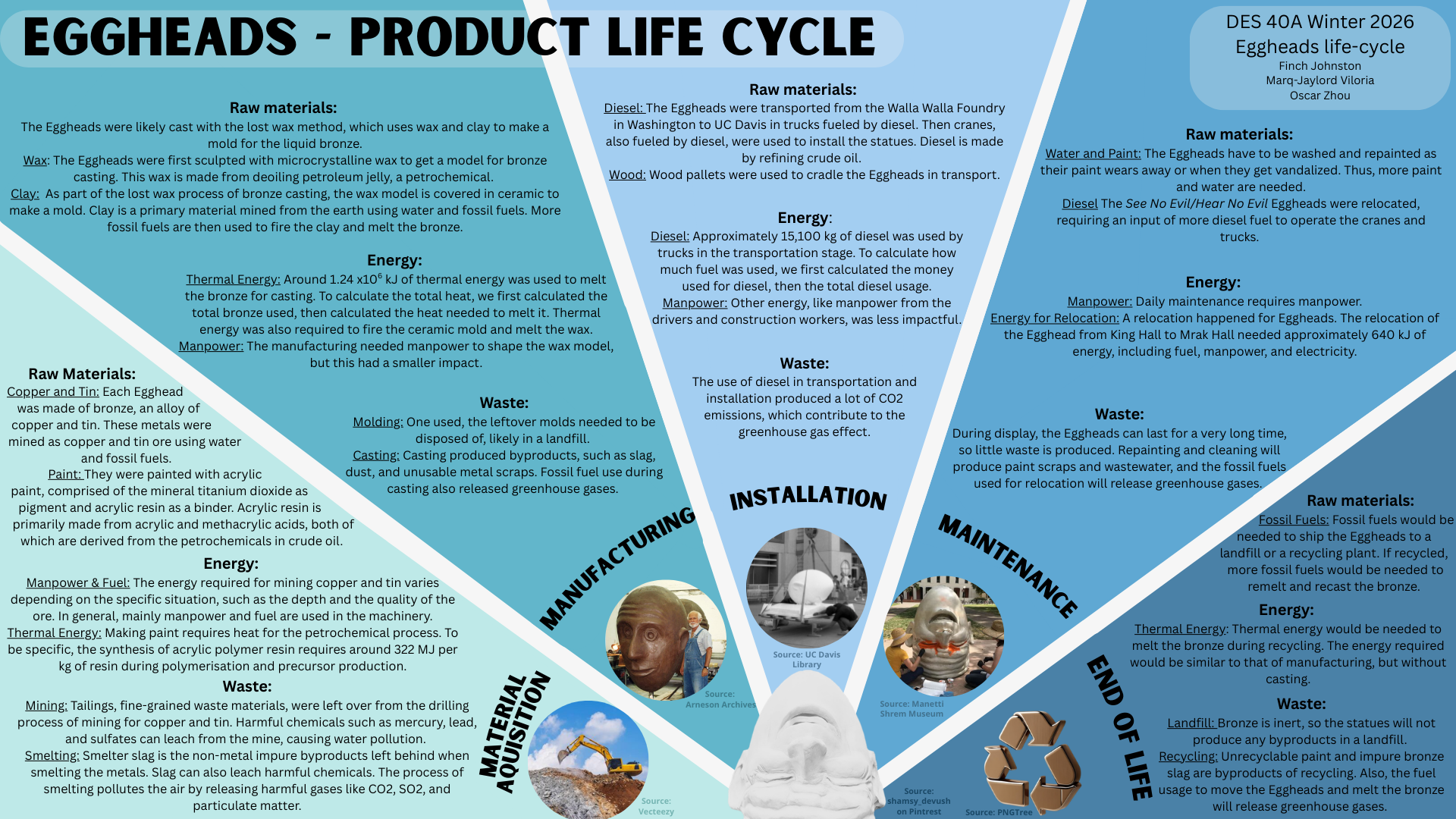
The Eggheads sculpture are iconic statue of UC Davis. As some reports have stated, they are very popular among the aggies. “They endure as a signature place where students take photographs to commemorate key moments in their college journeys, including graduation. During finals week, you’ll also find students carrying on the Aggie tradition of rubbing “Bookhead” for good luck.” (Chancellor 1). The main purpose of this paper is to analyze the energy usage in the lifecycle of the Eggheads. In particular, we will mainly explore the energy required at the manufacturing stage, as melting and casting bronze constitute the most energy during the production of the Eggheads. Additionally, the fuel required for transportation and the manpower will also be mentioned. We will analyze the Eggheads life-cycle from the following 5 parts: raw materials acquisition, manufacturing, installation, maintenance, and end of life.
To begin with, we need to talk about the energy consumption of raw materials acquisition, Including mineral excavation and pigment production. Due to the various types of raw materials we have, we will mainly focus on summarizing the energy required for mining bronze and then talk about the energy requirement for producing paint. It is very difficult to calculate the energy required for mining minerals specifically because there are a large number of unknowns. (Koppelaar 4) For example, on average, the energy cost of mining is 13.9MJ/kg, but for every 100 meters of mineral depth, an additional 4.6MJ/kg of energy is required. At the same time, different ore grades can also lead to changes in the energy required for mining. If the ore grade is too low, the required energy may increase several times. In addition, there are multiple options of the prime mover. If diesel engines are used, the required energy will be less compared to using pure electric engines. Therefore, for these three unknowns: depth, ore grade, and prime mover, we cannot determine specifically how much energy is required to mine the ore. However, for obtaining paint, we can find more accurate data. Making paint requires heat for petrochemical process. Due to our paint requirement for acrylic resin as a binder, we need to consider the energy required for producing acrylic resin. (Papasavva 5) To be specific, the synthesis of acrylic polymer resin requiring around 322 MJ per kg of resin during polymerization and precursor production. The chemical composition of titanium dioxide may also cost 21% extra energy. The vast majority of this energy is used to produce heat to assist in chemical reaction, and a small portion is also used as electricity to supply machines. With these raw materials, the next step is to process them.
In this paragraph, I will mainly explain the energy required for manufacturing. It is worth mentioning that I will estimate the specific heat required for casting bronze, as this is the main energy consumed during this stage. Other energy sources such as manpower and heat to melt wax have a smaller impact. We first need to find specific data on the Eggheads to calculate the total energy. Actually, there is no specific weight or volume data for the Eggheads on the official website, so I can only calculate it through other methods. Construction costs of the Eggheads mentioned in a newspaper are 25000$ (California Aggie 1992). But not all of this money is for raw materials. Cost of raw material bronze is about 37% of total fee (Mandolini 3). However, considering that this is data from 1992, we need to take into account inflation and the market value of bronze to obtain accurate weight data. We may use inflation calculator from US gov (U.S. Bureau of Labor Statistics), 25000$ in 1992 = 58879.80 in 2026. So total cost of bronze is 58879.80 × 0.37 = 21785. Price of bronze approximate 6 $/kg, so we have total weight of bronze is 3630 kg. Assume the room temperature is 25℃, then consider the melting point of bronze is about 1000 ℃, ΔT = 1000 - 25 = 975. Total heat of the bronze is: Q = mcΔT = 3630kg × 0.35kJ / (kg⋅K) × 975K=1.24 × 10 ^ 6kJ. Also, we need extra energy to make wax mode and melt wax. The petroleum based wax used by the Eggheads has a melting point of approximately 65℃. However, due to the lack of specific wax usage, we are unable to calculate the total heat. While, considering that the quality of wax is relatively low compared to bronze, this portion of energy can be considered to have minor impact compared to the heat required to melt bronze. Simultaneously making wax molds requires the artist's manpower, but compared to heat, manpower is often overlooked. After the production is completed, we still need to transport the the Eggheads to the required location.
We can calculate the fuel required for installation of the Eggheads, which are the main sources of energy. For other energy sources, for example manpower, make less impact. We have identified the specific funding required for transportation first to interpret the final diesel usage. The transportation fee of The Egghead is 34,000$ (California Aggie 1994), at the same time, the proportion of fuel should only account for 22% (Izadi 5). We also need to consider inflation and the market price of diesel. Then 34000$ = 75,640$ now (U.S. Bureau of Labor Statistics) and the value of diesel is 1.1$/kg. Therefore, we can get the following formula: 75,640 × 22% / 1.1 ≈ 15100kg diesel. This is our estimated diesel cost for transporting the Eggheads. Meanwhile, there are also other energy requirements. Manpower is an obvious source of energy; we need workers to transport the Eggheads and truck drivers to drive trucks. However, considering that the total work done by manpower itself should be relatively low, the energy provided by diesel should still account for the majority, and manpower may only occupy a small portion. While, even if the Eggheads is transported to the destination, we still need maintenance during subsequent usage.
Since the Eggheads is a long-term usage status, it seems like for the maintenance stage, we only need manpower. However, we found a newspaper that said that the Eggheads has experienced relocation during use, so in fact, a large amount of energy is spent on relocation rather than daily maintenance. Since we have not found specific information on how UC Davis maintain the Eggheads, we can only use a wide range of methods for maintaining the statue as a reference, such as daily cleaning, repainting, applying protective coatings or wax, and so on (Baer 4). We can see that the vast majority of energy usage for maintenance the Eggheads is manpower. As for the energy required to manufacture pigments, we have mentioned it before and will not repeat the calculation. However, the majority energy cost is not in this part. The newspaper mentions that there is a reinstallation of the Eggheads. This means the maintenance part also need diesel and manpower for reinstallation (California Aggie 2009). According to this report, the Eggheads has moved from King Hall to Mrak Hall. We don't have specific funding for this time, but we can estimate the total energy based on the distance traveled. Relocate from King Hall to Mrak hall about 60m. Weight of status is about 3630 kg from previous manufacturing part. Then we count friction for normal ground as μ=0.3. Then applies the formula: E = μmgd = 0.3 × 3630 × 9.8 × 60 ≈ 640 kJ. Considering that this is actually a short distance transportation, there may be the involvement of tools such as truck that require diesel, but there may also be other tools such as electrically driven machine or manpower assistance. Therefore, we cannot confirm what exactly 640 kJ of energy comes from, we can only calculate the total amount of energy needed. Our Eggheads may seem like they can stay there forever, but there will be one day that they might retire, so how can they be recycled?
It should be noted that the analysis of end-of-life stage is for future estimation. Since the Egghead is not yet retired, we are only estimating how much energy would be needed if it were to be recycled. The main energy required is still for melting bronze. The general process of recycling bronze is collection, size reduction, melting, and purification (Okon Recycling). Among them, the heat required to melt bronze accounts for the main part. However, considering that this part requires similar energy as the previous manufacturing part, we can omit the calculation of this part and directly use the previous data, which is it consumes 1.24 × 10 ^ 6kJ of thermal energy. At the same time, considering that purification may require electrolysis of substances and that the collection process include manpower, these are also the energy needed to recover bronze. However, these energies are not worth mentioning compared to the heat required to melt bronze. So far, we have analyzed all 5 parts of lifecycles, and we will summarize everything in the following paragraph.
We can see from our previous analysis that the main energy is the heat energy from melting bronze for manufacturing stage and end-of-life stage, then the diesel consumed during installation and maintenance stages. One could find that the specific energy consumption is very huge, but it doesn't have much impact. After all, there are only 5 the Eggheads statues in total, and the statues can still be long-term used, so they are relatively environmentally friendly. However, considering the practical value of the statue, it is more of an emotional value, therefore it is difficult to estimate whether it was a profit or a loss.
Bibliography
Academic Journal
Baer, Norbert. "Conservation notes: Maintenance of outdoor bronze sculpture." (1988): 71-75.
Fei, Tao, and Tong Wang. "A review of recent development of sustainable waxes derived from vegetable oils." Current Opinion in Food Science 16 (2017): 7-14.
Izadi, Amir, Mohammad Nabipour, and Omid Titidezh. "Cost models and cost factors of road freight transportation: A literature review and model structure." Fuzzy Information and Engineering 11.3 (2019): 257-278.
Koppelaar, Rembrandt HEM, and Henk Koppelaar. "The ore grade and depth influence on copper energy inputs." BioPhysical Economics and Resource Quality 1.2 (2016): 11.
Mandolini, M., et al. "An analytical cost model for investment casting." Proceedings of the Design Society: DESIGN Conference. Vol. 1. Cambridge University Press, 2020.
Papasavva, Stella, et al. "Characterization of automotive paints: an environmental impact analysis." Progress in organic coatings 43.1-3 (2001): 193-206.
Non-academic source
Chancellor Gary S. May, “Chancell-ing a Year with the Eggheads.” UC Davis News, University of California, Davis, 04 April 2024
“CPI Inflation Calculator.” U.S. Bureau of Labor Statistics
Okon Recycling. “Bronze Recycling: Process, Benefits, and How to Recycle Effectively.” 9 Oct. 2025
The California Aggie. “The California Aggie, 25 Sept. 1992.” California Digital Newspaper Collection, Center for Bibliographical Studies and Research, University of California, Riverside
The California Aggie. “The California Aggie, 6 June. 1994.” California Digital Newspaper Collection, Center for Bibliographical Studies and Research, University of California, Riverside
The California Aggie. “The California Aggie, 16 Nov. 2009.” California Digital Newspaper Collection, Center for Bibliographical Studies and Research, University of California, Riverside
Marq-Jaylord Viloria
DES40a
Professor Cogdell
Waste and Pollution of Eggheads
For anybody learning at the University of California Davis, it is inevitable that students will come across the bronze sculptures scattered around campus, known as the Eggheads. These sculptures with unusual shapes and expressions have become an icon to any student learning and passing by on their way to classes and they have instantly become part of the campus’ identity since installation. These bronze sculptures were created by the late artist Robert Arneson and have been on campus as far back as 1991. Aside from being a staple at the University of California Davis. Bronze sculptures, or bronze art in general, have been around for thousands of years now, standing through the test of time surviving and showing its durability against the forces of nature, with many ancient statues still surviving today, living in a plethora of museums around the world. A quick background about bronze is that it is a metal alloy composed of both Copper and Tin, natural metals mined from the earth. However, what people fail to see when admiring these bronze sculptures are the huge energy costs required during the mining operations, smelting process, and transportation of the bronze. Even though bronze sculptures, like the Eggheads, are made to withstand the forces of nature and will last for a very long time, the longevity does not counteract the waste and pollution produced spent to create these sculptures. A lot of energy is consumed before the bronze sculptures are even made, alongside many long lasting effects. The effects range from land destruction such as deforestation and huge habitat loss. Additionally, many mining techniques also produce a lot of greenhouse gases and toxic waste. More so, creating and smelting bronze itself creates even more greenhouse gases and toxic waste.
One core and very important material that makes up the majority of the Egghead statues is Bronze. Bronze is an alloy consisting of the metals copper and tin. The process alone (creating the bronze alloy from copper and tin) requires a large amount of energy which contributes to greenhouse gases, which in turn, contribute to climate change. Likewise, in order to obtain these metals, they must be mined from the ground. Areas in which mining occurs are also heavily affected by the process. For example, mining for iron ore in tropical rainforests often leads to deforestation and huge habitat loss. This also leaves the area incompatible with human settlement, often leaving such areas abandoned. Additionally, since copper and tin are natural finite resources, mining locations often change once an area has become completely depleted of its natural resources. Once the mining operation is done, one possibility that can happen is called mine reclamation which involves backfilling pits, stabilizing slopes, and replacing topsoil. Though there are many cases where planning for mine reclamation has begun before mining, reclamation still takes five to ten years. Or even longer depending on when reclamation begins or if it even begins at all. If reclamation does not happen, these mines are often abandoned, further polluting the environment with unstable tunnels and toxic gases. Aside from changes in the environment, there are additional resources used up during mining. One thing that goes into the mining process is an excess amount of water during extraction. Heavy machinery used in the mining process such as excavators and drills use a lot of water to simply just cool down the machinery from overheating. Water is also used in suppressing dust from roads and surrounding areas. Two physical byproducts of mining are called tailings and smelting slag. Mining tailings is material left behind after the processing of both copper and tin. Mining tailings are made from a combination of the materials left behind as well as chemicals, such as cyanide, mercury, and arsenic used in the mining process. This material is most times, nonrecyclable and toxic to the environment. However, it is sometimes saved because of the radioactive materials to be used again in the future. Reusing pre-existing radioactive materials minimizes the amount of new toxic material being made. Aside from being reused for the same process, mining tailings are not recyclable and stored in various disposal methods such as in-pit disposal or underground infill, to prevent seepage into the environment.
Bronze typically is an alloy made from around 88% copper and 12% tin. The melting point of copper is around 1084ºC (1983ºF) and the melting point of tin is much lower at around 177ºC (351ºF). The advantages of creating an alloy of both copper and tin is having a reduced melting point as well as being more malleable. The energy required to produce 1kg of copper is about 20-50 megajoules (MJ) of energy whereas the energy required to produce 1kg of tin requires about 60-100 MJ of energy. Even though tin has a much lower melting point than copper, tin is much rarer than copper, the extra MJ accounts for the additional energy spent finding and extracting tin. Producing bronze itself requires about 25-60 MJ of energy. Now if we were to look at the scale of bronze sculptures, they usually weigh around 100-500+ kg, which align with how much the Eggheads weigh (800-1000 lbs). Because of the large amount required to make bronze sculptures, hundreds to thousands of energy is used just to produce the metal needed for the Eggheads. To put these numbers in perspective, that is about 11,250 MJ of energy used.
Even though bronze sculptures are considered art and also valued for their longevity, their durability does not necessarily mean that they are environmentally stable. Looking back at all the facts given, so much goes into just producing a sculpture that has no real significance to life aside from a cultural one. For something students merely pass by on the daily on their way to class, or at most pose and take pictures with, it does not really have any positive benefits towards the environment, if not negative. The Eggheads have existed on campus for over 30 years now, proving their longevity, surviving through Davis' harsh summers and harsh rain floods, showing that they are resistant to corrosion and weathering. This could also be said about a myriad of other bronze sculptures around the world. Without a doubt we can expect to see the Eggheads on campus as long as the university continues to run. This however also means that bronze sculptures are not really expected to be recycled and turned into different sculptures, meaning any new bronze sculptures are used from newly produced bronze. Although not all of the produced bronze in the world is used art and sculptures, in fact less than 1% of all bronze is used to make new art or sculptures, that is still around 15,000,000 kg of bronze used for art every year. The environmental damage from mining will never actually counteract the longevity of bronze as long as we continue to fuel deforestation, habitat destruction, and land pollution to continue mining for copper and tin. Even though we can expect to see these bronze sculptures on display for over 30 years, mining impacts ecosystems that can last for decades. If these mining companies implement mine reclamation projects, it will take forests 20-100+ years to recover, and more so, tailings and smelter slag pollution in soil and water will persist for centuries. Even aside from the mining process, a lot of energy is used just to transport huge amounts of heavy metals.
Bronze sculptures, like the Eggheads, will last for hundreds of years, but this does not necessarily mean that their longevity means they are environmentally sustainable. One main point in why they are not sustainable is bronze acquisition. The mining process the get the alloy components, copper and tin, consume huge amounts of energy. Using heavy machinery to extract copper and tin requires huge amounts of water while also producing greenhouse gases and toxic waste. Even once they are extracted from the ground, purifying and producing the metals also consume a lot of energy while producing greenhouse gases and toxic waste. Aside from the byproducts, mining takes a huge toll on the environment and landscape, causing deforestation, habitat loss, and soil and water pollution, causing the land to become infertile. All of which would take decades to recover depending on whether mining companies decide on mine reclamation. Additionally, even though less than 1% of all bronze is used for sculptures annually, that 1% still amounts to over 15m kg, where each single kg already has a significant environmental cost. In conclusion, although the Eggheads may enrich our campus culture, the egghead’s longevity does not counteract the amount of waste and destruction during the production process.
Annotated bibliography
Raw materials acquisition
1) Ahmari, Saeed, et al. “Alkali Activation of Copper Mine Tailings and Low-Calcium Flash-Furnace Copper Smelter Slag.” Journal of Materials in Civil Engineering, vol. 27, no. 6, 2015, https://doi.org/10.1061/(ASCE)MT.1943-5533.0001159.
Peer reviewed: Tailings are byproducts of mining and Smelter Slag is a byproduct of smelting
2) Sammy Witchalls. “The Environmental Problems Caused By Mining.” earth.org, 2022, https://earth.org/environmental-problems-caused-by-mining/
Effects of over-mining the components of bronze (copper and tin).
Product manufacturing
3) Ochedi, Friday O, et al. “State-of-the-Art Review on Capture of CO2 Using Adsorbents Prepared from Waste Materials.” Process Safety and Environmental Protection [Rugby], vol. 139, 2020, pp. 1–25, https://doi.org/10.1016/j.psep.2020.03.036.
Peer reviewed: Byproducts of smelting (smelter Slag)
4) Sawai, Hikaru, et al. “Thermodynamic Study of the Acid-Induced Decontamination of Waste Green Sand Generated in a Brass Foundry.” Environmental Science and Pollution Research International [Berlin/Heidelberg], vol. 27, no. 16, 2020, pp. 20149–59, https://doi.org/10.1007/s11356-020-08512-x.
Peer reviewed: byproducts of the casting and molding process
Transportation and distribution
5) Jørgensen, Anne-Mette M., et al. "Transportation in LCA: a comparative evaluation of the importance of transport in four LCAs." The International Journal of Life Cycle Assessment 1.4 (1996): 218-220.
https://link.springer.com/content/pdf/10.1007/BF02978698.pdf
Peer reviewed: effects of truck transportation
6) Izadi, Amir, Mohammad Nabipour, and Omid Titidezh. "Cost models and cost factors of road freight transportation: A literature review and model structure." Fuzzy Information and Engineering 11.3 (2019): 257-278.
https://ieeexplore.ieee.org/stamp/stamp.jsp?arnumber=1047306
Peer reviewed: Driver wages 43%, fuel costs represent 22%. Which we can use for more precise calculation for the transportation
Use, reuse, maintenance
7) Bartuli, C, et al. “Prediction of Durability for Outdoor Exposed Bronzes: Estimation of the Corrosivity of the Atmospheric Environment of the Capitoline Hill in Rome.” Studies in Conservation [London], vol. 44, no. 4, 1999, pp. 245–52,
https://doi.org/10.1179/sic.1999.44.4.245.
Peer reviewed: Durability of outdoor exposed bronze
8) Rotax Metals. “Withstanding the test of time: Proofs of the Longevity of Bronze.” Rotax Metals, 2026,
https://rotaxmetals.net/withstanding-the-test-of-time-proofs-of-the-longevity-of-bronze/ Shows examples of bronze sculptures/statues that have lasted centuries (safe to assume true for the eggheads too)
Recycling and disposal
9) Bilal. “Embracing Sustainability: The Importance of Bronze Metals Recycling.” Auss Metals Recycling Pty Ltd, 2023,
https://aussmetals.com.au/embracing-sustainability-the-importance-of-bronze-metals-rec ycling/
Explains the conversation of finite resources (like metal), the energy efficiency of recycling bronze specifically (compared to other metals), economic benefits, and overall waste reduction.
10) Ciobanu, Mariana, et al. “Studies on the Possibility of Recycling Waste Bronze.” Advanced Materials Research [Zurich], vol. 1128, 2015, pp. 303–11,
https://doi.org/10.4028/www.scientific.net/AMR.1128.303.
Peer reviewed: Potential ways on different ways on recycling waste bronze (turning it into new machinery)