Design Life-Cycle
assess.design.(don't)consume
Anna Cai
Professor Cogdell
TA Elizabeth Kubey
DES 40A
Mar 12, 2026
LCA of Grip Tape Raw Material Final Paper
Introduction
Grip tape is a type of complementary sports equipment, more specifically, a thin adhesive tape wrapped around the handle of rackets such as tennis, badminton, or pickleball. Its primary purpose is to cushion the vibration when players play, enhancing the overall performance of players. It has functions like increasing friction between players’ hand and the handle, and absorbing sweat that could cause potential slipping during a game, that could decrease discomfort during gameplay.
Although grip tape is a small accessory compared to other main sports equipment like a racket, its size is not an appropriate measurement to the detriment it might bring to the planet across its life cycle. Its production involves complicated industrial processes that will bring significant environmental impact in general. A quantifiable method for evaluating the environmental impacts is a Life Cycle Analysis (LCA) – a systematic analysis of environmental impact over the course of the entire life cycle of a product, material, process, or other measurable activity (Whitebell). LCA evaluates each stage separately in great detail and quantifies the contribution each stage produces to the overall environmental burden of the product.
This paper will examine the material composition used in the life cycle of grip tape production, but most importantly the raw material extraction, the chemical processing of those Cai 2 for refinement because understanding the material properties and processing is particularly crucial in tackling the environmental impact it potentially will generate during its life cycle. In more detail, the material stage will be broken down into the three primary parts of analysis – the properties of raw materials, the chemical processing of those into polymers, and a secondary process for enhancing the final products’ performance. In order to take part in the progress in potentially making the production of grip tape more sustainable, it is particularly important to first understand the product’s traits regarding its recyclability, durability and material properties, so that environmental impact could be minimized during its production.
I. Raw Material Properties & Extraction
The first stage in the material phase of grip tape production involves the extraction of polymeric-based resources used to create synthetic polymers. Typically, grip tape consists of materials like polyurethane (PU), ethylene-vinyl acetate (EVA) foam, synthetic rubber, and other adhesive additives. The choice of synthetic polymers is crucial because of its special material property that ensures long-term performance. Polymers as macromolecules that are linked together by covalent bonds allow flexibility in its elasticity strength, durability to friction, and degradation resistance to outside substances (Sustainability Directory) – the one grip tape needed has generally average molecular weight and long chain length, which make up the soft and flexible layer of tape that wrap around a generic racket handle (Sustainability Directory).
In terms of the cushioning vibration and increasing friction properties of grip tape, the EVA foam plays an important role. The physical and mechanical properties of the foam are light-weighted, water-proof, flexible, ensuring the grip tape to be anti-slip; its softness allows it to return to its original shape after compression, cushioning lots of vibration caused by the shock between the racket and the ball, alleviating the pressure vibration caused to players’ wrists. When speaking of the function of cushion, polyurethane is another valued chemical component. Polyurethane foams (PUF) are one of the most prevalent forms of polyurethane – its lightweight and high-porous traits makes it stand out with qualities like high thermal-insulating, and excellent shock-absorbing properties (Wu, Shuang, et al., 3).
During extraction, a multitude of resources like fossil fuels, crude oils, steel, are drilled or used during the production for synthetic polymer: that includes both the material used in mechanical infrastructure, chemicals used while drilling for petroleum resources, and material depleted during transportation of resources. Starting from the very fundamental drilling infrastructure that could both be offshore and onshore – the drilling pipes and oil wells require large quantities of steel. The material steel carries innate environmental damage since it requires ore mining, large quantities of fuel used during smelting throughout its own LCA. These processes produce many material waste and gas emissions even before the production of synthetic polymers begins. Some minor chemical compositions used during extraction and the maintenance of drilling equipment are drilling fluids which fundamentally consist of water or oil mixing with additives like bentonite clay and barite; corrosion inhibitors that increase the longevity of steel; protective coatings such as polyethylene or epoxy to alleviate corrosion of material during the entire process (Andrady; Speight).
II. Polymer Material Production Processes
Once everything is acquired, manufacturing factories can start to perform chemical refinement and polymerization to create usable grip tape base materials to continue onto the next stage. During polyurethane production, not much new materials are added. Moreover, it’s the chemical reactions between already-existing components. The process typically involves the reaction between polyols and diisocyanates, which bond together through condensation polymerization, which produce long polyurethane chains with flexible properties (Andrady).
After the base polymers are synthesized, additional processing steps are needed to convert the polymers into usable form for further grip tape production. Polyurethane materials undergo a foaming process during which chemical blowing agents like water and carbon dioxide (Sunkist). Together they react during polymerization to create a cellular foam structure which is key to grip tape’s cushioning trait. In more detail, the foam structure is lightweight and porous enough to allow the tape to compress under pressure and recover to its original shape – in other words, to absorb shock produced during each hit.
Next up is EVA materials. The common processes EVA foam goes through is extrusion, compression molding, or hot melt adhesive molding into forming thin foam sheets, where additional chemical additives are added such as peroxide crosslinking agents in order to improve structural stability and elasticity. The fundamental theory behind compression molding and hot melt adhesive molding is to compress the EVA foam into an ideal shape under controlled heat and pressure, during which more resources like crude oil are exhausted during the heating process. Then, these processed polymer foam sheets are cut into well-shaped layers that suit the structure of grip tape. Lastly, in addition to the base polymers, a few more supplementary materials need to be added in later stages of manufacturing to further enhance grip tape performance before transported to the market places.
III. Product Refinement
Secondary materials and additives are added during later stages in production to enhance grip tape’s functionality. One key component is the crucial adhesive backing layer, which allows the tape itself to firmly stick to the handle of the racket during its entire lifespan while still allowing users to remove and replace it without leaving any traces. The major compositions of the adhesive backing layer are acrylic polymers or synthetic rubber adhesives, which both maintain flexibility and resistance to repeated friction (Benedek). In addition to adhesives, polymer additives such as plasticizers and stabilizers are added to improve mechanical performance. The addition of plasticizers allows the grip tape to remain soft and flexible so that it is elastic enough to attach around the racket handle, and at the same time, strong enough to ensure it could be tightly without cracking. Stabilizers help protect the polymer structure from degradation caused by physical stress like heat, oxygen, or UV rays (Wypych).
When done with the adhesive backing layer, surface treatments serve as the final touch to improve overall performance. These treatments often involve absorbent surface layers made from polyester microfiber or polyamide fibers, which absorb sweat that further increase friction between the hand and the handle. The moisture-absorbing trait may extend the functional lifespan and decrease the replacement rate of the tape by slowing wear (Horrocks & Anand). The addition of these functional additives ultimately determines the upper limit of grip tape performance before the product moves into the subsequent stages of packaging, marketing and waste disposal.
IV. Product Packaging and Transportation
Secondary materials are introduced during the packaging and transportation of finished grip tape. Individual grip tapes are sealed within protective packaging made from basic plastic film, more specifically, made up of polyethylene (PE) or polypropylene (PP) plastics. With the protection of a thin plastic film, it prevents grip tapes from getting contaminated before the product is being used by consumers. These lightweight plastic materials are chosen because of their durability, flexibility, and resistance to water vapor transmission (Robertson). Almost no new materials are added during the transportation process, except for potential larger secondary packaging materials and the innate fossil fuels used to propel the mode of transportation, whether it is on-land or by water.
Conclusion
The material stage is often neglected when thinking of the cradle-to-grave process of a product. Although it being the most taken-for-granted stage, this paper proved that such a seemingly simple process has a complex chain of stages, utilizing a multitude of physical, chemical, and mechanical materials. From the initial extraction of polymer-based resources, to the chemical polymerization, and finally to refinement and packaging materials – each step contributes to the special qualities of grip tape. Together, these resources illustrate that the material stage is not limited to solely the raw materials, but includes an entire network of resources used during manufacturing processes, ultimately influencing the all subsequent stages in the life cycle in grip tape’s energy output and waste disposal.
Works Cited
Andrady, Anthony L. Plastics and Environmental Sustainability. Wiley, 2015.
Benedek, István, and Melvin M. Feldstein. Technology of Pressure-Sensitive Adhesives and Products. CRC Press, 2008.
Horrocks, A. Richard, and Subhash C. Anand. Handbook of Technical Textiles. Woodhead Publishing, 2016.
Robertson, Gordon L. Food Packaging: Principles and Practice. 3rd ed., CRC Press, 2013.
Sipaut, C. S., Halim, H. A. and Jafarzadeh, M. (2017), Processing and properties of an ethylene–vinyl acetate blend foam incorporating ethylene–vinyl acetate and polyurethane waste foams. J. Appl. Polym. Sci., 134, 44708. doi: 10.1002/app.44708
Speight, James G. The Chemistry and Technology of Petroleum. 5th ed., CRC Press, 2014.
Sunkist. “What Is Polyurethane Foam? And How Is It Made?: Sunkist.” Sunkist Chemical Machinery Ltd., 31 Aug. 2021,
Sustainability Directory. “Polymer Material Properties → Term.” Pollution, 30 Nov. 2025. Whitebell, Chris. “What Is Life Cycle Assessment (LCA)?” RIT, 2 July 2020.
Wu, Shuang, et al. “A comprehensive review of polyurethane: Properties, applications and future perspectives.” Polymer, vol. 327, May 2025, p. 128361.
Wypych, George. Handbook of Plasticizers. ChemTec Publishing, 2017.
Sangey Palshertsang
DES 40A
Sec 001
Racket Grip Tape LCA
Embodied Energy and Lifecycle of Racket Overgrips
In the competitive sports field, specialised consumables frequently determine the marginal performance advantages in competitive athletics. For players of racket sports such as squash, badminton, and tennis, racket overgrips, commonly called "racket grip tape", have evolved from luxuries to necessities. The overgrip creates a thin, moisture-wicking, high-friction surface between the athlete and the racket for elite grip, comfort, and is essential to a player’s dexterity. However, a substantial environmental and energy cost is embodied by the widespread use of these synthetic material strips. The enormous amount of energy needed to synthesise, process, and disseminate the petroleum-based polymers(Polyurethane and Ethylene Vinyl Acetate) that make up overgrip, as well as the quick trash accumulation required by its remarkably short functional lifespan, gets overlooked as it's reduced in people’s minds to just a simple accessory. According to Dataintelo Consulting, reports that the global overgrip market size is projected to grow from USD 400 million in 2023 to up to 700 million by 2033, thanks to the trending growth of participation in racquet sports and recreational activities worldwide(Dataintelo).
The worldwide sports equipment market has seen a proportional rise in demand for polyurethane (PU) and ethylene-vinyl acetate (EVA), the major components of overgrips. While each overgrip weighs only a few grams, the total output is significant. In 2016, the US consumed "3700 kt of polyurethane," demonstrating the large volume of this commodity moving through the domestic economy (Liang et al. 14216). Manufacturers prioritise high-performance criteria over sustainability, resulting in a production cycle that uses metric tons of fossil fuel inputs. In general, these overgrips rely on the unique qualities of Ethylene Vinyl Acetate (EVA), a copolymer that combines "ethylene's strength and hardness along with the flexibility and elasticity of vinyl acetate" (Thermtest). In the past, racket grips were made from leather, but with advancements in technology that prioritise comfort, superior sweat absorption, and cost-effectiveness, it has been phased out. Direct data from overgrip factories is not available to the public; estimates of their environmental impact will be drawn from the overall lifecycle of their parent polymers. They are more significant in impact, but energy is still embodied in the rest of the industrial market processes of cost of running the factories, transportation of materials and then goods to retailers.
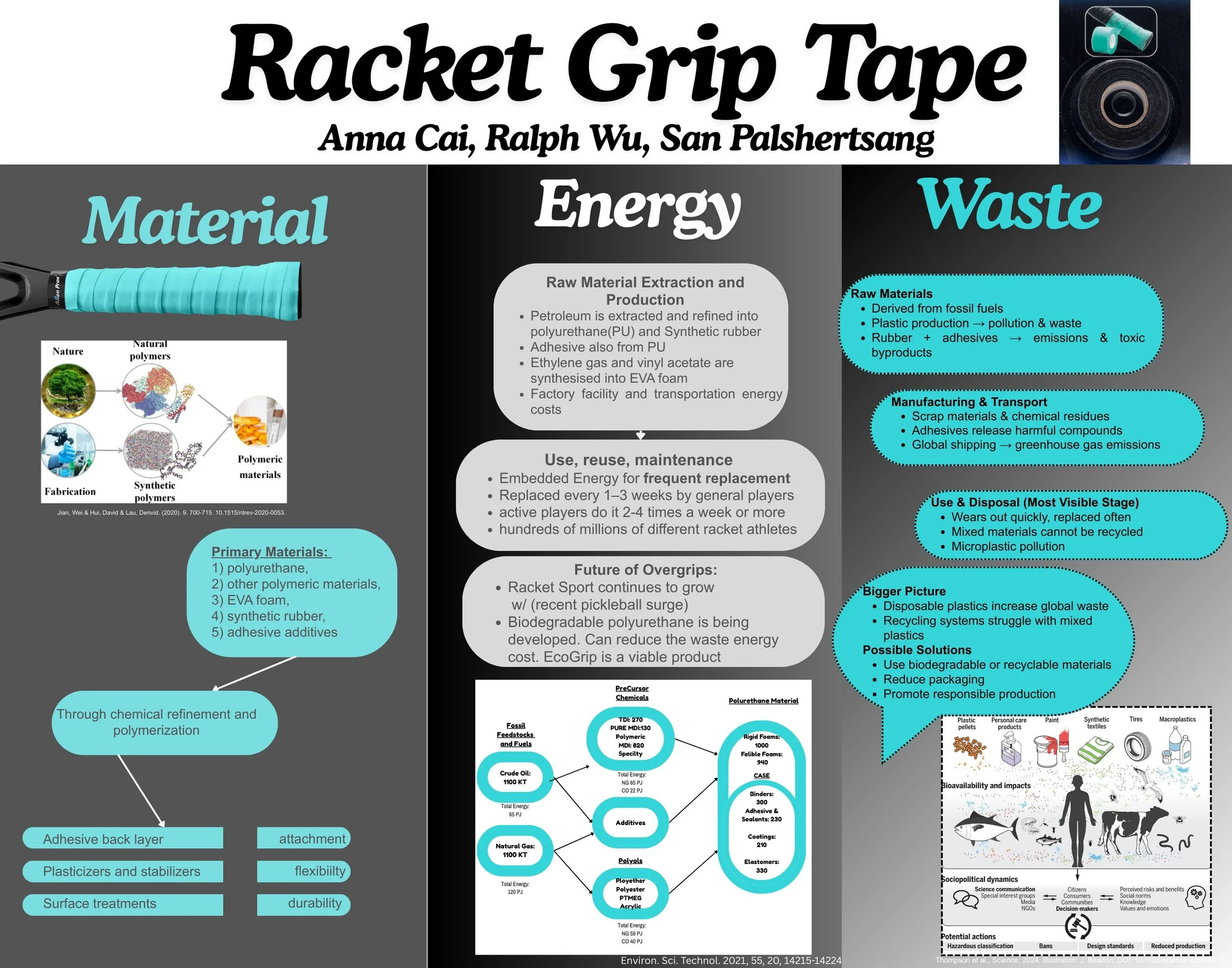
Polyurethane (PU), the polymer that defines the overgrip's surface, is essentially a "frozen" form of fossil energy. In a single year, the United States' domestic polyurethane manufacture "consumed 1100 kt of crude oil and 1100 kt of natural gas" (Liang et al. 14215). Manufacturers use energy-intensive chemical operations to produce the isocyanates and polyols required for a conventional overgrip coating. Furthermore, "most of polyurethane foam raw materials are petroleum-based," creating a strong demand for ecologically friendly alternatives as global greenhouse gas reduction objectives tighten (Kairytė et al. 761). Polyurethane is highly versatile as it is used in flexible foam for the overgrip form and also as the adhesive component to keep things together. An interesting alternative can be found by a group called EcoGrip, they have harnessed biodegradable polyurethane to create a commercially viable overgrip alternative that fully decomposes within one year after changeout, versus usual ones that may take centuries to(EcoGrip). This claim with biodegradable polyurethane has been tested by the US Department of Energy. The only thing standing against the industry switching is key issues, including premature degradation due to moisture or microbes, limited mechanical strength compared to industry alternatives, costly production due to needing a new manufacturing process, and potential toxicity during decomposition. But this is a great promise as we hope to fight against environmental pollution.
The second key component, EVA, takes a significantly more complicated and energy-intensive journey. Ethylene vinyl acetate is produced via a "relatively complex pathway" in which natural gas liquids are fractionated into ethane, cracked into ethylene, and then copolymerised with vinyl acetate monomer (Thunder Said Energy). This method is extremely energy-intensive; the total integrated carbon dioxide intensity for making ethylene vinyl acetate is estimated at "3.0 tons/ton" (Thunder Said Energy). As a result, the marginal cost of manufacturing these grips is closely related to the volatility of global energy markets. According to a standard formula, a "$0.1/gal increase in the price of ethane... results in a $100/ton increase in the marginal cost of ethylene, which in turn results in a $100/ton increase in the cost of EVA" (Thunder Said Energy, July 2009). This emphasises the overgrip's status as a direct result of the petrochemical industry, rather than just a mere accessory.
Beyond the energy required for the synthesis of materials, the overgrip's "use phase" provides a unique environmental conundrum. Unlike the racket frame or strings, an overgrip is sometimes discarded after one match because it loses its "tackiness." This results in a high replacement frequency, which promotes the transfer of embodied energy into the waste stream. Krzysztof Ejsmont, a management sciences professor at Warsaw University of Technology, estimates that the number of players in the world when it comes to racket sports significantly exceeded 300 million in 2016 (Ejzert and Ejsmont 46). That was much before the recent boom in popularity for
pickleball. As for the waste process, "polyurethanes are effectively not recycled and are made principally from nonrenewable, fossil-fuel-derived resources". In 2016, almost "2000 kt [of polyurethane] entered the postconsumer waste streams," with just a small fraction (390 kt) being reintroduced to the market as low-grade carpet underlayment (Liang et al. 14215). Furthermore, ethylene vinyl acetate is "non-biodegradable," which means that once discarded, an overgrip can remain in the environment eternally (Thermtest).
While innovations in "intelligent" sports products aim to extend the life of equipment, the overgrip remains a low-tech, throwaway commodity (Ejzert and Ejsmont 41). While the overgrip has transformed the ergonomics of racket sports, it also constitutes a huge, frequently neglected energy sink. Because both PU and EVA are made from non-renewable resources, each gram of overgrip contains a significant amount of embodied CO2. Research suggests that using bio-based overgrips can cut carbon dioxide emissions by up to "60.8%" (Kairytė et al. 768), making petroleum-based overgrips less disposable. As racket sports continue to boom, more sustainable options must be invested in to ensure the further environmental impact does not grow. We can create a better future by working with nature rather than against it, so that our materials have a good impact on the environment while also protecting our health.
Work Cited:
3M. “Bonding and Assembly- Double Sided Tape.” 3M US, 3M, www.3m.com/3M/en_US/bonding-and-assembly-us/double-sided-tape/.
’
Barbu, I., et al. "The influence of equipment manufacturing technologies on performance in sports." IOP Conference Series: Materials Science and Engineering. Vol. 400. No. 2. IOP Publishing, 2018. https://iopscience.iop.org/article/10.1088/1757-899X/400/2/022011/meta
Bioenergy Technologies Office. “How Biodegradable Polyurethane Could Solve the Microplastic Pollution Problem.” Energy.Gov, United States Department of Energy, 27 June 2024, www.energy.gov/eere/bioenergy/articles/how-biodegradable-polyurethane-could-solve-microplastic-p ollution-problem.
Cong, Lin, et al. "The energy consumption and emission of polyurethane pavement construction based on life cycle assessment." Journal of Cleaner Production 256 (2020): 120395. https://www.sciencedirect.com/science/article/pii/S095965262030442X
Dataintelo. “Overgrip Market Report: Global Forecast from 2025 to 2033.” Report | Global Forecast From 2025 To 2033, Dataintelo Consulting , 2024, dataintelo.com/report/global-overgrip-market.
Ejzert, Małgorzata, and Krzysztof Ejsmont. E2 SYSTEM AS AN EXAMPLE OF THE INTELLIGENT PRODUCT IN RACKET SPORTS. 03 2016.
EcoGRIP. “ECOGRIP - Technology Innovation - Win on & Off the Court.” ecoGripzone, Zone Sporting Goods, 19 May 2020, www.ecogripzone.com/ecogrip/#products.
Flannery, Brian P., and Jan W. Mares. "Greenhouse Gas Index for Products in 39 Industrial Sectors: Synthetic Rubber." Resources for the Future: Washington, DC, USA (2022): 1-16. https://media.rff.org/documents/WP_22-16_M23.pdf
Junkermann, Theresa. Environmental Sustainability in Sporting Goods Companies: The Case of Tennis Equipment, Universidade Catolica Portuguesa (Portugal), Portugal, 2023. ProQuest, https://www.proquest.com/dissertations-theses/environmental-sustainability-sporting-goods/docview/ 3085986214/se-2.
Kairytė, Agnė, et al. "Cleaner production of polyurethane foam: Replacement of conventional raw materials, assessment of fire resistance and environmental impact." Journal of Cleaner Production 183 (2018): 760-771.https://www.sciencedirect.com/science/article/pii/S0959652618304839
Kan, Tao, Vladimir Strezov, and Tim Evans. "Fuel production from pyrolysis of natural and synthetic rubbers." Fuel 191 (2017):
403-410.https://www.sciencedirect.com/science/article/pii/S0016236116312091
Liang, Chao, et al. ‘Material Flows of Polyurethane in the United States’. Environmental Science & Technology, vol. 55, no. 20, American Chemical Society, Oct. 2021, pp. 14215–14224, https://doi.org/10.1021/acs.est.1c03654.
Thermtest Instruments. “The Benefits and Uses of Ethylene Vinyl Acetate.” Thermtest, Thermtest Instruments, 3 Feb. 2025, thermtest.com/benefits-ethylene-vinyl-acetate.
Thunder Said Energy. Ethylene Vinyl Acetate Production Costs? - Thunder Said Energy, THUNDER SAID ENERGY, thundersaidenergy.com/downloads/ethylene-vinyl-acetate-production-costs/.
Ralph Wu
TA: Elizabeth Kubey
Professor Cogdell
Energy, Materials & Design Across Time March 11, 2026
The Environmental Waste of Tennis Grip Tape Across Its Life Cycle
Modern sport equipments are commonly used in daily basis, but have you ever wondered about their environmental impacts? For instance, grip tapes — thin strip of material wrapped around the handle of a racquet — are indispensable for racquet-played sports like tennis and badminton. While grip tapes are often cheap, they worn out quickly and end up being discarded. The main material of grip tapes consist of synthetic plastics, rubber materials, and chemical adhesives, which often aren’t recyclable. Moreover, grip tape generates waste at several stages of its life cycle, beginning with the extraction of raw materials and going through manufacturing, distribution, and final disposal. Although grip tapes appear puny in individuals, their ubiquity and low durability escalate the plastic waste and pollution. Through the life cycle of tennis grip tape, the most significant environmental burden comes from the production stage of fossil-fuel-based materials and the accumulation of non-recyclable waste after disposal stage. To reduce these impacts, more sustainable approaches such as using biodegradable or recyclable materials, minimizing packaging, and extending the product’s lifespan can be implemented.
Most grip tapes are composed of synthetic polymers, which are derived from fossil fuels — petroleum or natural gas. The production of the grip tape’s raw materials using those fossil fuels is where the environmental impacts begin, during which petrochemical processes are used to transform fossil fuels into polymer resins. According to the United Nations Environment Programme, global plastic production reaches as high as 400 million tons annually, in which a large portion of this material end up as waste (UNEP). Moreover, when extracting and refining petroleum, byproducts such as greenhouse gas and waste water are generated. If not properly managed, toxic substances like benzene can enter surrounding ecosystems. These outcomes demonstrate that during the early stages of production, much of the environmental impact of grip tape is already being dealt before it reaches the consumer.
Synthetic rubber is another major component used in producing grip tape. It functions as a soft and slightly textured surface to help improve the player’s grip on the racquet. Unlike natural rubber harvested from rubber trees, synthetic rubber is produced using petroleum-based chemicals such as butadiene and styrene. Chemical reactions that require large inputs of energies and release air pollutants into the atmosphere are often involved in the manufacturing process of those synthetic rubbers. Also, industrial facilities that produce them can generate contaminated wastewater, which must be treated before disposal to prevent harm, and will still produce sludge and other residual waste that needs further management. Therefore, the production of synthetic rubber contributes to both airborne emissions and solid waste. Although each individual strip of grip tape contains only limited rubbers, the environmental impacts accumulate through the millions of units produced globally.
Other than plastic and rubber, adhesives are also an essential ingredient of grip tape. It allows the grip tape to stay attached to the racquet, preventing it from falling off under the gripping and frictional force applied by the players. Unfortunately, like rubber, this material is, again, produced from petrochemical compounds that require energy-intensive chemical processing.
Volatile organic compounds (VOCs) are a major byproduct generated by the production of adhesives. VOCs are released during both the manufacturing stage and product assembly, and contribute to air pollution and smog formation. In some cases, the production of adhesives can also produce hazardous waste streams that must be disposed through specialized procedures.
Following the production stage is the manufacturing and assembly of grip tape, during which plastics and rubber materials are squashed into thin sheets, coated with adhesives and packaged for sale. Non-reusable waste materials such as scrap plastics or defective batches are often produced during manufacturing processes. One way for this to happen is through trimming and shaping the grip tape into standard sizes, which can leave behind excess plastic fragments. Although some manufacturing facilities try to recycle those leftover scrap materials, not all plastics used in sporting goods can be reprocessed easily, therefore a portion of these materials becomes solid waste that must be disposed of in landfills or incineration facilities.
During the manufacturing stage, the application of adhesives also produces environmental byproducts. When spraying or coating the adhesives onto the grip tape surface, small amounts of chemical vapor are being released into the air, contributing to the presence of volatile organic compounds in industrial environments. To alleviate the impact of those byproducts, many modern factories use ventilation and filtration systems. Other than harmful emissions, the process also generates chemical residues and contaminated materials such as cleaning solvents and protective equipment. To handle those products without harming any individuals, specialised environmental regulating procedures must be adhered, which can be very effort&time-consuming. In short, even with improved technology, the manufacturing stage still produces waste that contributes to environmental impact and requires specialised disposal to ensure safety.
Transportation and distribution are another stage where environmental impacts occur. The factories where the grip tapes production takes pace are often located in rural areas that are distant to the market where they are sold. Sporting goods are manufactured in large industrial sectors that are exclusive to certain countries, and then shipped across the globe to various destinations. Fuel consumptions are inevitable during the transportation of these products, often by cargo ships, trucks, and airplanes, releasing greenhouse gases such as carbon dioxide into the atmosphere. Same as the production stage, while transporting a single package of grip tape may contribute insignificant amount of emission, the cumulative effect becomes larger as we take the entire global trade system into account: millions of grip tapes are distributed each year to sporting stores, clubs, and online sellers all around the world. The amount of fossil fuels consumed during the process makes the transportation stage of tennis grip not to be neglected in terms of environmental impact.
The use and disposal stage of grip tape is where the most tangible environmental problems occur. If you’ve played tennis or badminton, you will notice that grip tape are often replaced frequently due to its constant exposure to friction and sweat. This is especially true for professional athletes, as they need to maintain maximum comfort on their grip to ensure optimal performance. Taking professional tennis players as example, their replacement of tennis grip may occur several times during a tournament, let alone an entire season. Consequently, worn-out grip tape accumulates as waste at a relatively fast rate compared to other sports equipment.
The sad news is, used grip tapes are rarely recycled due to its composition of multiple materials, being plastics, rubber, and adhesives, that are tightly bonded together during the production stage. Most recycling systems are generally capable of processing plastics of a monotonous material, such as plastic bottles. When a product consists of multiple materials, the separation process will be more technically difficult and expensive. Thus, the most economically efficient ways to dispose grip tape are to discard them into landfills or incinerate them. As we know, synthetic plastics can persist for decades or even centuries before fully degrading, during which
small fragments of plastic may enter the environment as microplastics. These particles can eventually accumulate in rivers, oceans, and even agricultural soils. Additionally, they might end up being ingested by animals and plants, and move up the food web, causing long term ecological damage to the ecosystem.
Despite numerous and seemingly insuperable challenges, there are several strategies that could alleviate the environmental impact of grip tape. One of them is the development of biodegradable or recyclable materials that can replace conventional plastics and synthetic rubber. The advancement of modern material science have brought the invention of bio-based polymers derived from plant sources such as corn starch or cellulose. Those materials are often broken down more easily in natural environments compared to petroleum-based plastics. This prevents the creation of micro plastics into ecosystems. Another approach aims to make recycling easier and cheaper for grip tapes by designing them with fewer mixed materials.
Minimizing packaging and improving product durability are other ways manufacturers can also reduce the environmental waste. Right now, many grip tapes are packaged and sold in plastic wrappers that are discarded immediately after they are unwrapped. In order to decrease the amount of plastic entering the waste stream, producers should focus on reducing or redesigning the package. At the mean time, it’s also necessary to figure out a way to manufacture more durable grip tapes. This reduces the frequency of replacement and in turn the rate of waste generated. Even if the improvements in durability is tiny, the effect could be significant for the total number of grip tapes discarded each year.
In conclusion, the environmental impact of grip tape extends far beyond its small size and lifespan. Waste and pollution start with the extraction of fossil fuels for plastics and synthetic rubber and continues through manufacturing processes, where scrap materials and chemical emissions are produced. Going down the line, the transportation stage contributes further fuel consumption and
greenhouse gas, while the most significant amount of waste are generated during usage and disposal, primarily by the accumulation of used grip tapes as plastic wastes that can last for centuries in landfill. Each stage shows the same pattern, that despite the small impact of a single tape, the worldwide use of this product can deal significant impacts to the environment. To reduce those impacts, solutions such as redesigning materials, reducing packaging and improving durability could be implemented. Overall, the example of grip tape tells us that even daily products should be worthy of attention and consideration when it comes to the topic of environmental protection.
Works Cited
Facanha, Cristiano, and Zongwei Lin. “Life-Cycle Analysis of Freight Transportation.” Transportation Research Part D: Transport and Environment, vol. 16, no. 8, Elsevier, 2011, pp. 544–551.
Geyer, Roland, Jenna R. Jambeck, and Kara Lavender Law. “Production, Use, and Fate of All Plastics Ever Made.” Science Advances, vol. 3, no. 7, American Association for the Advancement of Science, 2017, pp. 1–5.
Hopewell, Jefferson, Robert Dvorak, and Edward Kosior. “Plastics Recycling: Challenges and Opportunities.” Philosophical Transactions of the Royal Society B: Biological Sciences, vol. 364, no. 1526, The Royal Society Publishing, 2009, pp. 2115–2126.
Hosseini, Amirhossein, et al. “Environmental Impacts of Synthetic Rubber Production: A Life Cycle Perspective.” Journal of Cleaner Production, vol. 278, Elsevier, 2021, pp. 1–10.
“Packaging Waste and Sustainability.” United States Environmental Protection Agency, www.epa.gov/smm/sustainable-packaging.
Pizzi, Antonio, and Klaus L. Mittal. “Adhesives and Sealants: Environmental Impact and Waste Management.” International Journal of Adhesion and Adhesives, vol. 29, no. 3, Elsevier, 2009, pp. 287–295.
“Plastics and Microplastics in the Environment.” National Geographic, National Geographic Society, www.nationalgeographic.com/environment/article/plastics.
“Rubber Manufacturing and Environmental Impact.” International Rubber Study Group, www.rubberstudy.com.
“Sports Tape and Athletic Wrap Environmental Impact.” Sports Medicine Australia, www.sma.org.au/resources-advice/sports-tape-and-environment.
“Freight Transportation and Environmental Effects.” United States Department of Transportation, www.transportation.gov/mission/sustainability.