Design Life-Cycle
assess.design.(don't)consume
Michelle Benitez Ascencio
Professor Cogdell
DES 40A A02
March 12, 2026
Lifecycle of an Electric Fireplace– Materials
The modern electric fireplace is a synthesis of ancient geological history and contemporary engineering. By extracting raw materials such as iron ore, silica sand, and kaolin clay from their primary sources in the earth, humans transform billions of years of geological formation into household fixtures. This paper examines the raw material acquisition and secondary processing of cast iron, tempered glass and ceramic, tracing their transition from the ground through the manufacturing lifecycle to evaluate the environmental toll of sourcing these fundamental components.
The structural integrity and aesthetic weight of a modern electric fireplace rely heavily on cast iron, a material chosen for its superior heat retention and tactile haptics. The complex lifecycle of this component begins deep within the Earth's crust with the extraction of iron ore and limestone, the primary raw materials required to produce the fireplace's heavy external housing [1]. Geologically, these iron deposits originated billions of years ago; dissolved iron in ancient oceans oxidised and settled into massive “Banded Iron Formations”. To access these ancient layers, mining operations utilize heavy machinery, such as hydraulic excavators and electric rope shovels, to remove overburden and reach the ore. This extraction process represents the very first stage of the product lifecycle, where the material is pulled from its primary source in the ground. Once the ore is recovered, it must undergo an intense secondary process to become a finished product. This involves smelting the iron ore in a blast furnace alongside limestone and coke–a specialized fuel created by heating coal to temperatures as high as 2060 degrees F [2] in an oxygen-free oven until its volatile matter is released and it resolidifies into a hard, porous carbon. The limestone used in this process has an equally fascinating origin, originating primarily from the accumulations of marine organism skeletons and chemical precipitation in ancient seabeds. It is extracted through surface or underground quarrying, crushed, and then used as a “fluxing agent” to remove impurities from the molten iron. This transformation from raw geological sediment to industrial alloy where the majority of the environmental impact occurs. The extraction of iron ore, coal and limestone disrupts delicate ecosystems and results in significant solid waste pollution [3], furthermore, the manufacturing of cast iron requeries cast quantities of water for cooling and cleaning the heavy machinery and the molten metal itself. This wastewater often contains hazardous pollutants, including heavy metal, which can impact local water tables if not properly treated. By the time the molten metal is poured into a mold to form, the fireplace frame has already traveled through a high-energy intensity lifecycle. This weight not only provides the fireplace with its durability but also increases energy requirements for the distribution phase, as transporting such a heavy raw materials across global supply chains adds to the total carbon footprint of the finished household fissure. Iron only focuses on the heating element in an electric fireplace, but it is beneficial to understand the components that build it.
Ceramic technology serves as the functional soul of the electric fireplace, utilizing ancient minerals to replicate the organic glow of a traditional fire. To understand the raw material acquisition of these components we need to look deep into the geological history of kaolin clay [4] and aluminum ore. The high-temperature ceramic plates and decorative “timber” logs found in modern fireplaces are derived primarily from kalolin, a soft white clay mineral (kaolinite) formed over millions of years through chemical weathering of feldspar-rich rocks like granite. This primary source in the ground is often accessed via open-pit mining in regions like the southwestern United States, or the Kao-ling hill in China, where the minerals are extracted and then refined through a process called “beneficiation” to remove impurities like quartz and iron. The lifecycle continues through a secondary manufacturing process known as slip casting or plastic forming. The refined kaolin is mixed with water to create a slurry, poured into intricate molds, and dried to a "greenwater" state. To achieve the durability required for a fireplace, these pieces undergo a two-stage kiln firing process. The first stage occurs at temperatures reaching approximately 110 degrees C (2012 degrees F) [5], where the clay particles undergo dehydroxylation and sinter into a permanently solid, porous state. This porosity is essential for the haptic detailing of the product; it allows for the intricate hand-painting and glazing that preserves the “ancient” look of natural wood in a noncombustible form. However, this firing process is energy-intensive, requiring high electricity or natural gas consumption to maintain the external temperatures necessary for vitrification [6]. Complementing these ceramics are aluminum baffles, which are critical for the fireplace’s thermal management. The raw material for these bafflers is bauxite, a complex ore composed of aluminum hydroxides. Bauxite is mined from "laterite" soil covers, a process that involves clearing large areas of topsoil and vegetation, which can lead to significant land disturbance and soil erosion. The ore is then refined into alumina by using hot caustic soda and the high impact of this extraction is notable; for every ton of aluminum produced, roughly two tons of a highly alkaline solid waste are generated, posing risks to local water tables and ecosystems if not managed in a closed loop system. As these materials, kaolin and bauxite [7], move from earth through the production phase, they are eventually distributed globally. The finished ceramic logs and aluminum baffles are assembled into the fireplace unit, where their durability ensures a long use phase. Eventually, at the end of the product's lifecycle, these materials become waste. While ceramic can take thousands of years to degrade in a landfill, the aluminum components are highly recyclable, offering a path toward reducing the need for future raw materials extension. By tracing these fireplace elements from their Precambrian and Tertiary origins to their modern industrial forms, we see the significant geological environmental debt required to produce the comfort of the modern household fixture.
The most prominent feature of a modern electric fire palace is the transparent barrier that provides an unobstructed view of the internal, LED flames effects. This component is composed of tempered safety glass [8], a high-temperature material synthesized primarily from ancient silica sand. To understand its raw materials acquisition, one must trace silica to its primary source in the ground, typically found in high-purity quartz sand deposits. These deposits are often the result of millions of years of mechanical and chemical weathering of igneous rocks like granite. In the extraction phase, industrial sand mining–often occurring in open-pit mines– utilizes heavy equipment such as dredgers and front-end loaders to harvest the raw quartz. However, sand alone cannot become the glass found in a fireplace; it must be combined with other earth-mined minerals, especially soda ash and limestone. Soda ash [9], which lowers the melting point of the silica, is often sourced from trona ore mined deep underground, while limestone acts as a stabilizer to prevent glass from dissolving in water. The transition from these raw ancient artifacts to a finished product involves a complex secondary process known as the “float glass” method. The raw materials are fed into a furnace and melted at temperatures exceeding 1500 degrees C. The molten glass is then floated on a bed of molten tin to achieve a perfectly flat, uniform surface. To transform this into “tempered” glass suitable for a fireplace, the pane undergoes a specialized thermal treatment. It is reheated to approximately 620 degrees C, and then subjected to a rapid cooling process using high-pressure air blast. This creates a state of extreme compression on the surface, making the glass four to five times stronger than standard panes and ensuring it can withstand the heat cycles of the fireplace’s heating element. From an environmental perspective, the extraction of silica sand and trona ore can lead to habitat destruction and requires significant energy for the machinery involved. Furthermore, because glass is heavy and fragile, its distribution phase requires specialized packaging and high energy consumption for global transport [10]. By the time it is installed in a home, the glass has evolved from an ancient seatfloor sediment into a high-performance thermal shield, representing a significant journey through the industrial lifecycle.
The modern electric fireplace, while often viewed as a simple appliance of convenience and comfort, serves as a profound link between contemporary interior design and the Earth's deep geological past. By tracing the raw materials acquisition of cast iron,ceramics, and tempered glass, this paper has demonstrated that production of a single household fixture requires the extraction and transformation of resources formed over billions of years. From so many years ago of iron formations to the weathered granite that yields kaolin clay and silica, these primary sources in the ground represent a finite inheritance that is rapidly consumed by industrial manufacturing. Through the examination of secondary processing, such as high-heat smelting iron, of the energy-intensive vitrification of ceramics, and the thermal quenching of glass, it becomes clear that the soul of the fireplace is inextricably linked to a significant environmental cost. The disruption of ecosystems through open-pit mining and the generation of hazardous waste byproducts like “red mud” and heavy metal-laden wastewater highlight the hidden burden of material comfort. As the materials move through the distribution phase and eventually reach the end of their functional lifecycle, their physical properties determine their ultimate environmental debt inherent in modern consumption. By looking through the transparent glass of the fireplace, onesies not just see a flickering light, but a transformed piece of the Earth’s crust, reminding us of the immense physical work required to bridge the gap between ancient geology and modern domestic life.
Works Cited
[1]Frey, Perry A., and George H. Reed. “The Ubiquity of Iron.” ACS Chemical Biology, vol. 7, no. 9, Sept. 2012, pp. 1477–81. DOI.org (Crossref), https://doi.org/10.1021/cb300323q.
[2]Coal to Make Coke and Steel, Kentucky Geological Survey, University of Kentucky. https://www.uky.edu/KGS/coal/coal-for-cokesteel.php. Accessed 12 Mar. 2026.
[3] Panov, Alexey Gennadyevich, et al. "Environmental Impact of Cast Iron Production." Procedia Environmental Science, Engineering and Management 7.4 (2020): 515-521.
[4] Agnello, Louis, et al. “Kaolin.” Industrial & Engineering Chemistry, vol. 52, no. 5, May 1960, pp. 370–76. DOI.org (Crossref), https://doi.org/10.1021/ie50605a019.
[5] “The Basics of Firing Electric Kilns.” Soul Ceramics, https://www.soulceramics.com/pages/electric-kiln-firing-basics. Accessed 12 Mar. 2026.
[6]Sangwan, Kuldip Singh, et al. “Environmental Impact Assessment of a Ceramic Tile Supply Chain – a Case Study.” International Journal of Sustainable Engineering, vol. 11, no. 3, May 2018, pp. 211–16. DOI.org (Crossref), https://doi.org/10.1080/19397038.2017.1394398.
[7]Geoscience Australia. Aluminium. Australian Government, 14 May 2025, https://www.ga.gov.au/education/minerals-energy/australian-mineral-facts/aluminium
[8] Berenjian, Armin, and Gareth Whittleston. "History and manufacturing of glass." American Journal of Materials Science 7.1 (2017): 18-24.
[9] Kostick, Dennis S. "Soda Ash." United States Geological Survey (USGS) Minerals Yearbook 2000 (2000): 72-1.
[10] Kua, Harn Wei, and Yujie Lu. “Environmental Impacts of Substituting Tempered Glass with Polycarbonate in Construction – An Attributional and Consequential Life Cycle Perspective.” Journal of Cleaner Production, vol. 137, Nov. 2016, pp. 910–21. ScienceDirect, https://doi.org/10.1016/j.jclepro.2016.07.171.
Yao Lin
Professor Cogdell
DES 40A
Mar 12, 2026
Infinite Burn: The Embedded Energy of the Garvee Electric Fireplace
The transition to more sustainable heating options for households underlines the shift from using combustible fireplaces to electric ones. The Garvee 60-Inch In-Wall Recessed Electric Fireplace shows this trend at its finest, marketing for its 100% operational efficiency. However, a thorough Life Cycle Analysis (LCA) reveals that the energy consumption of such a product is not a plus-and-play device. From the perspective of an embedded energy researcher, this product is an energy-burning machine beginning from the iron mines in the southern hemisphere to the metal scrap yard next street down. For a better understanding of energy cost, 1 megajoule (MJ) of energy can run an average household for 20 minutes, and throughout the paper, there will be numeric values of the energy that each process of the life cycle uses. While the energy required to produce this product from raw material extraction, manufacturing, and transportation is significant, it doesn't come close to the “use phase” of the product, where operational electricity consumption over the ten-year lifespan far exceeds the total energy embedded in its physical construction.
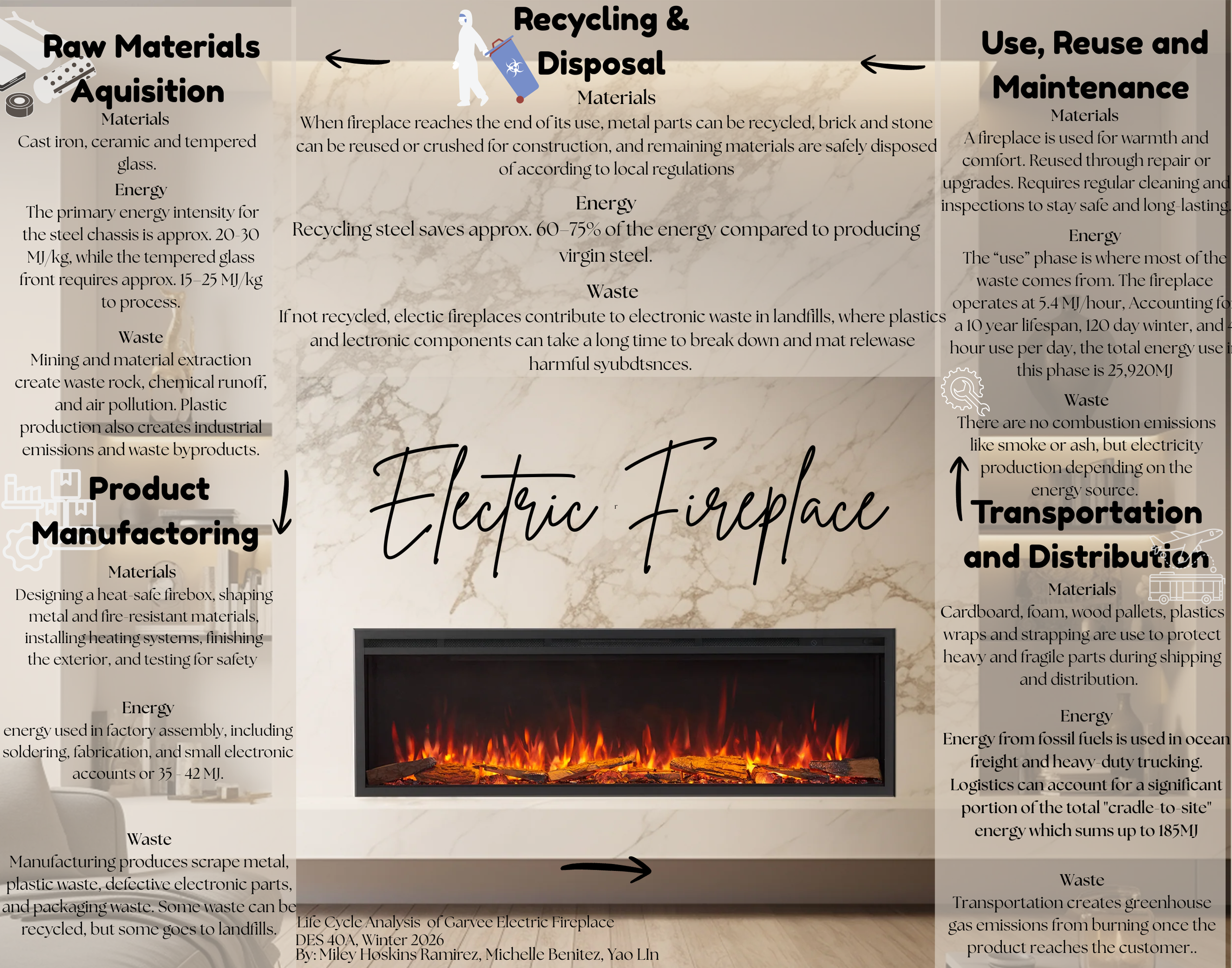
The life cycle of the Garvee Electric Fireplace begins with a massive energy bill that is welded to the product during the raw material acquisition phase. This stage focuses on the energy required to extract and process the material that makes up this 60-pound unit. The fireplace is primarily composed of steel for the chassis and tempered glass for the front panel. The extraction of iron ore to produce steel involves industrial mining machinery such as diesel-powered excavators and haul trucks that burn hundreds of gallons of gasoline per hour. According to Sunhunk, these massive hauling trucks consume about 30 to 50 gallons of gas per hour during peak operation (Sunhunk). For an average modern car, this amount of gas can last one for about 4-6 weeks. After the iron ore is extracted, it's then transported to factories, where it undergoes chemical purification and thermal transformation. The production of steel is one of the most energy-intensive industrial processes in the world. Using the Blast Furnace-Basic Oxygen Furnace (BF-BOF) route, the manufacturer must heat the iron ore to a temperature of 1500 Celsius to transfer the iron ore to liquid metal. Research indicates that this process takes about 20 to 35 MJ per kilogram of steel (World Steel Association). For a product that uses nearly 45 pounds of steel, the energy debt reaches approximately 400 to 700 MJ before a single screw can be put on the unit. Similarly, the production of the tempered glass for the front panel of the fireplace requires silica sand to be melted in a furnace that runs 24 hours a day, which is either powered by natural gas or fuel. The energy required to melt the sand and temper it, which is the process of rapid heating and cooling to achieve higher durability, accounts for an additional 15.4 MJ per kilogram (JICA report). In the Garvee Electric Fireplace, the front tempered glass weighs about 15 pounds, which adds another 105 MJ to the current energy debt. Looking back, this initial process already consumed more than 500 MJ of energy, equivalent to the energy required to power an average household for 168 hours, solely to produce the components necessary for assembling the product during the manufacturing phase.
Once the raw materials are refined, they move on to the manufacturing phase. This stage is highlighted for the use of secondary energy to shape, coat, and assemble the fireplace’s components. These manufacturing factories are mostly found in China, where the energy input is primarily electricity. A Computer Numerical Control (CNC) machine uses a fiber laser to make precise cuts into the sheet metal to form the chassis. These high-precision lasers are not only known for their precision but also for the amount of power they draw. A standard 4-Kilowatt fiber laser consumes about 13 kilowatts of power during operation. Accounting for the time it takes to cut out the frame, the cutting process alone takes about 12 - 15 MJ per unit. Furthermore, the matte coating on the frame requires an electrostatic painting process, which requires high-heat baking in an industrial oven to cure the finish. A traditional conventional gas curing oven is an energy burner, curing the surface of the 60-inch frame, which typically consumes about 11 - 14 MJ of energy. The Garvee Electric Fireplace also offers a stunning 3D flame effect. The small electronics, such as flame motor and LED strips that assemble this visual effect, consume more energy than one thinks. While these components are small in weight, the energy cost to produce one is more than 100 times that of producing 1 kilogram of steel due to these electronics' requires clean-room environment and high purity chemical processing (Andrae 45). In total, the fabrication and assembly of the fireplace consume approximately 35 to 42 MJ of electricity. Because these factories are located in a region where the electricity grid remains 60% reliant on coal burning, the carbon weight of this manufacturing energy is higher than if the unit were produced in a region with a greener grid (EIA).
The third stage of the LCA is the transportation and distribution stage, where it shifts the focus from “energy for making” to “energy for moving”. Because the Garvee unit is a 60-pound consumer good that is produced in Southwest Asia and travels thousands of miles to reach its market in North America, the logistics show a significant energy usage. The primary energy source used for this stage is fossil fuel-based. Container ships burn Heavy Fuel Oil (HFO), which is a carbon-dense petroleum product. Although sea transport is the most energy-efficient mode of transport per ton, the total fuel consumption is outrageous. Based on the consumption of a 14,000 TEU vessel, the energy needed for the unit for the trans-Pacific voyage (roughly 11,000 miles) is around 55 MJ (Geography of Transport Systems). After arriving at a port such as Long Beach, the unit enters the “last mile” delivery network, which involves transport via commercial trucks and eventually delivery vans. Trucks consume roughly 2 - 3 MJ per ton-kilogram. For a 1600 km or 1000 miles journey to a regional warehouse, the truck consumes about 130 MJ for a single unit. The total energy cost for a single unit from factories to doorsteps costs about 185 MJ. This stage proves that for every pound of steel and glass added to the unit, the fuel required for every mile of its global journey increases.
While the first four stages of the process generated massive energy debt, the use phase is where the product reveals its true impact. The Garvee fireplace is rated at 1500W on its “high heat” setting, which translates to 5.4 MJ of energy used every hour. In a 10-year analysis, if a consumer operates the fireplace for 4 hours a day for the 120-day winter season, the unit consumes about 2592 MJ of electricity per year. Over a standard lifespan of 10 years, the fireplace will consume a total of 25,920 MJ of electricity (Zheng et al). To compare, the total embedded energy from extraction to delivery is approximately 900 to 1000 MJ. This means that the use phase accounts for over 95% of the product's total life cycle energy consumption. During the 10 year use phase, the analysis has to account for maintenance. The product is designed as a “closed” consumer electronic, meaning it can't be repaired easily. If the flame motor fails or the LED strip burns out, the embedded energy of the entire unit is at risk of being lost to a scrapyard. Maintenance energy includes manufacturing and shipping the replacement parts, and having a technician at the site to repair the fireplace. However, the most significant energy-saving strategy in this phase is longevity. If a unit lasts 15 years instead of 5 years, “the embodied energy cost per year” is significantly reduced.
The final stage of the LCA occurs when the unit reaches its end of life. Deconstructing the fireplace requires a final energy input for transport and operation for industrial shredders, which roughly consume 1 - 2 MJ per unit. However, this stage provided the only opportunity for energy recovery. Steel is 100% reusable. Producing steel from scrap in an Electric Arc Furnace (EAF) requires 75% less energy than producing it from iron ore (EuRIC). By recycling the 45 pounds of steel in the Garvee unit, the industrial system “reclaims” about 450 MJ of energy. While this might help relieve some initial material debt, it doesn't come close to the 25,920 MJ of operational cost during the use phase, which remains a permanent sunk cost.
The comprehensive Life Cycle Analysis of the Garvee Electric Fireplace proves that its operational energy use far exceeds any other phase of the LCA. While the extraction of the iron ore and the logistics across the Pacific represent the “hidden” debt, totaling around 1000 MJ before the product is turned on, they only sum up to 5% of the total energy consumed by the product. The tracking of the megajoules throughout the life cycle confirms that the “use” phase is the center of energy waste, accounting for more than 95% of the unit’s lifetime impact. To achieve true sustainability, the industry must look beyond the 100% efficiency and focus on reducing operational costs through better insulation and heating zones, ensuring that the high energy price paid to build the fireplace is not squandered through inefficient use.
Work Cited
Andrae, Anders S.G. “Life-Cycle Assessment of Consumer Electronics: A Review of Methodological Approaches.” IEEE Consumer Electronics Magazine, vol. 5, no. 1, Jan. 2016, pp. 51–60, https://doi.org/10.1109/mce.2015.2484639.
This book provided the necessary information needed to know the energy intensity required for electronic components. It can be used in the essay as a way to explain that even though these electronic components are small in mass, their energy density is 100 times higher than that of steel.
Benjamin. “Shipping Routes from China to Usa.” Hong Ocean: Best Freight Forwarding Companies in China, 28 Nov. 2024, hongocean.com/shipping-routes-from-china-to-usa/.
This logistics defines the distances and typical routes used for trans Pacific transporatation, which can be used in the calculation in the transportation stage of the life cycle.
Bevilacqua, Maurizio, et al. “Life Cycle Assessment of a Domestic Cooker Hood.” Journal of Cleaner Production, vol. 18, no. 18, Dec. 2010, pp. 1822–1832, https://doi.org/10.1016/j.jclepro.2010.08.001. Accessed 16 May 2021.
This peer-reviewed article offers a comparative life cycle analysis of other household appliances similar to the fireplace. It helps establish a standard way of calculation for the energy consumption used in the manufacturing stage.
Crawford, Robert, and Murray Hall. “Embodied Energy | YourHome.” Yourhome.gov.au, Australian Government, 2020, www.yourhome.gov.au/materials/embodied-energy.
This resource provides a clear definition and context for embodied energy in household products. It helps define what “energy debt” is in the introduction and conclusion paragraphs.
design by www.jerei.com. “How Efficient Is a 500 Ton Haul Truck-NEWS-SUNHUNK-EN.” Sunhunk.com, 2025, www.sunhunk.com/about/groupnews-detail-622.htm. Accessed 12 Mar. 2026.\
This technical data report from a major equipment manufacturer provide real world consumption data for mining vehicles. It supports the claim that extraction is a high-energy process by noting that 30-50 gallons of diesel are consumed per hour by haul trucks.
EuRIC. Metal Recycling Factsheet. 2020.
This fact sheet provides details on the energy savings of using secondary production. It can be used in the “Recycling and Disposal” section to prove that recycling steel saves 75% of energy compared to iron ore production.
Garvee. “Garvee 60" Electric Fireplace In-Wall Recessed & Wall Mounted, Remote.” GARVEE, 2026, www.garvee.com/products/garvee-electric-fireplace-3d-flame-colors-pho-10p29zao?view=test-seemore&_abr=1. Accessed 5 Feb. 2026.
This is the office product site that provides the technical information, such as power usage, 1500W, and the weight of the unit, 60 pounds.
Hume, David. “Container Ship Fuel Consumption - the Liquid Grid.” The Liquid Grid, 9 Oct. 2024, theliquidgrid.com/container-ship-fuel-consumption/.
These sources compare the energy usage of different modes of transportation. It supports the claim that shipping is the most energy-efficient and that the “last mile” truck stage is an energy-burner due to its 2-3 MJ/tkm.
Kowalczyk, Zbigniew, et al. “Life Cycle Assessment (LCA) and Energy Assessment of the Production and Use of Windows in Residential Buildings.” Scientific Reports, vol. 13, no. 1, 13 Nov. 2023, p. 19752, www.nature.com/articles/s41598-023-47185-7, https://doi.org/10.1038/s41598-023-47185-7.
This study analyzes the energy required to produce and temper glass, which is used in the manufacturing stage to calculate the energy used to make the front panel of the fireplace.
Life-Cycle Assessment of Energy and Environmental Impacts of LED Lighting Products Part I: Review of the Life-Cycle Energy Consumption of Incandescent, Compact Fluorescent, and LED Lamps. 2012.
This source provided the information about the consumption of LED light, which is used in the fireplace to visualize the 3D flame effect.
Menzies, G. F., et al. “Life-Cycle Assessment and Embodied Energy: A Review.” Proceedings of the Institution of Civil Engineers - Construction Materials, vol. 160, no. 4, Nov. 2007, pp. 135–143, https://doi.org/10.1680/coma.2007.160.4.135. Accessed 11 Aug. 2021.
This peer-reviewed article provides the fundamental understanding of how to calculate embodied energy, which is used throughout the paper. Without, no true calculations of energy debt will be available at each stage of the life cycle.
Mohd Tayyab, et al. “Evaluating the Environmental Impact of a Home Appliances: A Life Cycle Assessment with a New Green Product Design Framework.” Educational Administration: Theory and Practice, vol. 30, no. 5, 2023, pp. 13135–13144, kuey.net/index.php/kuey/article/view/5674, https://doi.org/10.53555/kuey.v30i5.5674. Accessed 5 Feb. 2026.
This article introduces a framework for evaluating the environmental cost of producing consumer goods. It was used to utilize the energy waste from the use stage of the life cycle.
U.S. Energy Information Administration. “International - U.S. Energy Information Administration (EIA).” Www.eia.gov, 30 Sept. 2020, www.eia.gov/international/analysis/country/CHN.
The EIA provides necessary information on the carbon and energy intensity of the national power grid. It argues the fact that the Garvee Fireplace carries a high “carbon weight” due to its manufacturing region, where the grid remains 60% reliant on coal
Vitro. “Embodied Carbon in Glass | Vitro Architectural Glass.” Www.vitroglazings.com, www.vitroglazings.com/design-resources/sustainability/embodied-carbon-in-glass/.
World Steel Association. Energy Use in the Steel Industry Fact Sheet.
The factsheet provides the data on how much energy is used to produce virgin steel from iron ore and lays the foundation for the “Raw Material Acquisition” stage, quantifying the initial debt.
Miley Hoskins Ramirez
Professor Cogdell
DES 40A
March 12, 2026
The life cycle waste of electric fireplaces
Fireplaces have been an important part of homes for hundreds of years. In earlier centuries, fireplaces were mainly used for heating and cooking. Over time they became more advanced and efficient as new technologies were introduced. Traditional fireplaces burned wood or coal, which produced smoke and required constant fuel. Today, electric fireplaces are often advertised as a cleaner and more modern alternative to traditional wood burning fireplaces because they do not produce smoke inside the home. While this may seem environmentally friendly, it does not mean that electric fireplaces have no environmental impact. When a product is studied through a life cycle assessment, researchers look at all stages of the product's life, including manufacturing, transportation, use, and disposal. These stages can all contribute to environmental waste. This paper argues that although electric fireplaces are considered a cleaner alternative to traditional fireplaces, they still create significant environmental waste during the manufacturing, use, and disposal stages of their life cycle due to material production, energy use, and electronic waste.
Looking at the history of fireplaces helps explain why electric fireplaces are often viewed as improvements. Early fireplaces were simple open hearths built from stone or brick inside homes.These fireplaces allowed families to cook and stay warm, but they were inefficient and produced a large amount of smoke. Over time, improvements such as chimneys and cast-iron stoves helped make fireplaces safer and more efficient. According to Priscilla J. Brewer explains that heating technologies evolved as a part of larger changes in home design and domestic life in the United States (Brewer 42-45). These technological improvements made fireplaces easier to use and helped reduce smoke inside homes. Even though fireplaces became more advanced, they still required energy and resources to function.
Research has also shown that fireplaces can affect energy use in homes. A study by Ali Elnakat and Jose Gomez found that homes with fireplaces used about 31 percent more energy during winter compared to homes without fireplaces (Elnakat and Gomez 214-216). This happens because heat can escape through chimneys and ventilation systems. Even when fireplaces are not in use, warm air from inside the home can escape through these openings. As a result, heating systems must work harder to maintain indoor temperatures. While electric fireplaces do not use chimneys or burn wood, they still rely on electricity to create heat and visual flame effects. Because of this, they still contribute to energy consumption and the environmental impact.
The manufacturing stage of an electric fireplaces is one of the most important stages when considering waste. Electric fireplaces are made from many different materials, including metal, plastic, glass, wiring, and electronic components. Producing these materials requires natural resources and energy. Mining metals such as aluminum and copper can damage ecosystems and create pollution. Industrial processes used to produce plastics and electronics also release greenhouse gases into the atmosphere. Studies on lighting technologies show that manufacturing electronic components often accounts for a large portion of a product's environmental impact (Tuenge et al. 18-22). Even though electric fireplaces appear clean when they are used, the production of their materials can create significant environmental damage.
Electronic components such as LED lights are commonly used in electric fireplaces to create realistic flame effects. Life cycle research on LED lighting products shows that manufacturing LEDs requires specialized materials and energy intensive production processes (Franz and Wenzl 1009-1013). These processes involve the use of metals, chemicals, and industrial equipment. The environmental impact of these materials is often hidden from consumers because it occurs before the product reaches the store. According to the U.S. Department of Energy, the production stage of lighting technologies contributes significantly to the overall environmental footprint of the product (U.S. Department of Energy). Since electric fireplaces rely on similar electronic lighting systems, their production also contributes to environmental waste.
Another important stage of the life cycle is transportation and distribution. After electric fireplaces are manufactured, they must be transported from factories to warehouses and stores before being purchased by consumers. Many consumer electronics are produced in large manufacturing centers and shipped across long distances. Transportation methods such as trucks, ships, and airplanes burn fossil fuels and release carbon dioxide into the atmosphere. Packing materials such as plastic wrap, foam, and cardboard are also used to protect products during shipping. These materials are often thrown away once the product reaches the consumer, which adds to overall waste.
The use stage of electric fireplaces may seem environmentally friendly because they do not produce smoke or ash inside the home. However, they still use electricity to generate heat and create the visual effect of flames. In many places, electricity is still produced using fossil fuels such as coal or natural gas. This means that the environmental impact of using electric fireplaces depends partly on how electricity is generated. Research on lighting technologies has shown that energy consumption during use is a factor in life cycle assessments (Welz, Hischier, and Hiilty 119-121). If electricity comes from fossil fuels, the environmental impact of electric heating systems can still be significant.
Electric fireplaces are often used more for decoration than for heating. Many people turn them on to create a cozy atmosphere rather than to warm an entire room. Because of this, they may use electricity even when other heating systems are already operating. Studies on energy efficient lighting technologies show that consumer behavior plays an important role in determining environmental impact (“Consumer Behaviour” 91-96). When people use electronic devices for aesthetic or convenience reasons rather than necessity, overall energy consumption increases. This pattern can also apply to electric fireplaces, which are sometimes used mainly for visual effect.
The disposal stage of electric fireplaces creates another major environmental challenge. When electric fireplaces stop working or become outdated, they are often thrown away and replaced with newer models. Because these fireplaces contain electronic components, they become part of the growing problem of electronic waste, also known as e-waste. Electronic waste can be difficult to recycle because it contains many different materials that must be separated. Some components may contain toxic chemicals that can harm the environment if they end up in landfills.
Research on lighting technologies has shown that disposal and recycling are important parts of the life cycle of electronic products (Zhang, Burr, and Zhao 441-444). When electronic devices are not properly recycled, valuable materials such as metals are lost and harmful substances may enter the environment. Many landfills contain electronic waste that slowly breaks down and releases chemicals into soil and water. Because electric fireplaces include wiring, heating elements, and circuit boards, they contribute to the growing amount of electronic waste worldwide.
Comparative life cycle studies of lighting devices also show that environmental impact is not limited to a single stage of a product's life. Instead, impact occurs during manufacturing, use, and disposal (Chemical Engineering Transactions 521-523). This is why life cycle assessments are important tools for understanding sustainability. A product may appear environmentally friendly on one stage but still create significant waste in another stage. Electric fireplaces are a good example of this problem because they appear cleaner than wood burning fireplaces but still require materials, energy, and disposal processes that affect the environment.
There are several ways the environmental impact of electric fireplaces could be reduced in the future. One solution is improving product design so that fireplaces last longer and are easier to repair. Products that can be repaired instead of replaced help reduce waste and lower the demand for new materials. Another solution is increasing recycling programs for electronic devices. Recycling allows valuable materials to be recovered and reused instead of ending up in landfills. In addition, using renewable energy sources such as solar or wind power could reduce the environmental impact of electricity used to power electric fireplaces.
The use stage of electric fireplaces may seem environmentally friendly because they do not produce smoke or ash inside the home. However, they still use electricity to generate heat and create the visual effects of flames. In many places, electricity is still produced using fossil fuels such as coal or natural gas. This means that the environmental impact of using electric fireplaces depends partly on how electricity is generated. Research on lighting technologies has shown that energy consumption during use is a major factor in life cycle assessments (Welz, Hischier, and Hilty 337-338). If electricity comes from fossil fuels, the environmental impact of systems that power electric fireplaces can still be significant.
Another issue related to the life cycle of electric fireplaces is the extraction of raw materials used to build the electronic components. Many electric fireplaces include metals such as copper, aluminum, and steel, along with plastics and glass. These materials come from natural resources that must be mined or processed before they can be used in manufacturing. Mining operations often require large amounts of energy and can damage ecosystems by removing soil, vegetation, and wildlife habitats. In addition, the mining and processing of metals can create water pollution and release harmful chemicals into the environment. Research on the life cycle of electronic products has shown that raw material extraction is one of the earliest stages where environmental damage can occur (Franz and Wenzl 970-972). Even though consumers usually only see the finished electric fireplace in their homes, the environmental impact begins long before the product reaches the store.
A factor to consider is the role of manufacturing facilities and industrial production. Electric fireplaces are produced in factories that rely on machines, electricity, and transportation systems. Manufacturing plants often use large amounts of electricity to power equipment that shapes metal, molds plastic, and assembles electronic parts. These factories may also create industrial waste such as chemical byproducts or scrap materials. According to life cycle studies on lighting technologies, industrial manufacturing can contribute significantly to greenhouse gas emissions and other environmental impacts (Tuenge et al. 19-21). Because electric fireplaces include similar components such as LED lights, heating elements, and circuit boards, their production follows similar manufacturing processes. This means that even though the product appears simple, the manufacturing system behind it involves complex industrial activity that can affect the environment.
As well, environmental concern is the relatively short lifespan of many electronic consumer products. Unlike traditional fireplaces, made from brick or stone that can last for decades, electric fireplaces are consumer appliances that may only last for several years before needing replacement. Technology changes quickly, and newer models often include improved lighting effects or design features. Because of this, consumers may replace their electric fireplaces even if the other models are still somewhat functional. Studies in consumer behavior and energy efficient technologies show that people often replace electronic devices more frequently when new designs become available (“Consumer Behaviour” 91-96). This pattern increases production demand and leads to more electronic waste over time. As a result, the overall environmental impact of electric fireplaces is connected not only to their design but also to how consumers choose to use and replace them.
Another factor that contributes to the environmental impact of electric fireplaces is the amount of electricity they consume during everyday use. Even though they do not burn wood or produce smoke like traditional fireplaces, they still rely on electricity generated from fossil fuels such as coal or natural gas, which release greenhouse gases into the atmosphere. Because of this, the environmental impact of electric fireplaces is closely connected to the energy sources used to generate electricity. Life-cycle assessments of lighting technologies show that electricity use during the operation stage can be a major contributor to overall environmental impact (Welz, Hischier, and Hilty 337-338). This means that while electric fireplaces may appear cleaner than traditional fireplaces, their environmental footprint can still be significant when electricity production is taken into account.
Consumers also play an important role in reducing environmental waste. Choosing durable products, using appliances responsibly, and recycling electronics when possible can help lower environmental impact. When consumers are more aware of the life cycle of products they use, they may make more sustainable decisions about what they buy and how they use it.
In conclusion, electric fireplaces are often marketed as a cleaner and more modern alternative to traditional fireplaces. While they do reduce smoke and indoor air pollution, a life cycle assessment shows that they still create environmental waste. Manufacturing requires raw materials and energy, transportation produces emissions, electricity use contributes to energy consumption, and disposal adds to the problem of electronic waste. When all stages of the life cycle are considered, electric fireplaces are not as environmentally friendly as they may appear. Understanding the full life cycle of products is important for making better decisions about sustainability and environmental responsibility.
Works Cited
Brewer, Priscilla J. From Fireplace to Cookstove: Technology and the Domestic Ideal in America. Syracuse University Press, 2000.
“Comparative Life Cycle Analysis of Different Lighting Devices.” Chemical Engineering Transactions, vol. 45, 2015, pp. 521–526.
Elnakat, Ali, and Jose Gomez. “Energy Consumption and Efficiency of Residential Fireplaces.” Energy and Buildings, vol. 158, 2018, pp. 214–220.
Franz, M., and F. P. Wenzl. “Critical Review on Life Cycle Inventories and Environmental Assessments of LED Lamps.” Critical Reviews in Environmental Science and Technology, vol. 47, no. 10, 2017, pp. 965–1047.
“The Effect of Consumer Behaviour on the Life Cycle Assessment of Energy Efficient Lighting Technologies.” Procedia CIRP, vol. 40, 2016, pp. 91–96.
Tuenge, Jason R., et al. Life-Cycle Assessment of Energy and Environmental Impacts of LED Lighting Products. Pacific Northwest National Laboratory, 2013.
U.S. Department of Energy. “Life-Cycle Assessment of Energy and Environmental Impacts of LED Lighting Products.” Energy.gov, 2015, www.energy.gov.
Welz, Tobias, Roland Hischier, and Lorenz M. Hilty. “Environmental Impacts of Lighting Technologies.” Environmental Impact Assessment Review, vol. 31, no. 3, 2011, pp. 334–343.
Zhang, H., J. Burr, and F. Zhao. “Comparative Life Cycle Assessment of Lighting Technologies.” Journal of Cleaner Production, vol. 140, 2017, pp. 441–448.
“Fluorescent Lights — Design Life Cycle.” Design Life Cycle Project, www.designlife-cycle.com.