Design Life-Cycle
assess.design.(don't)consume
James Hedges
Professor Cogdell
Design 40A
Materials Used in the Life Cycle of an HDMI Cable
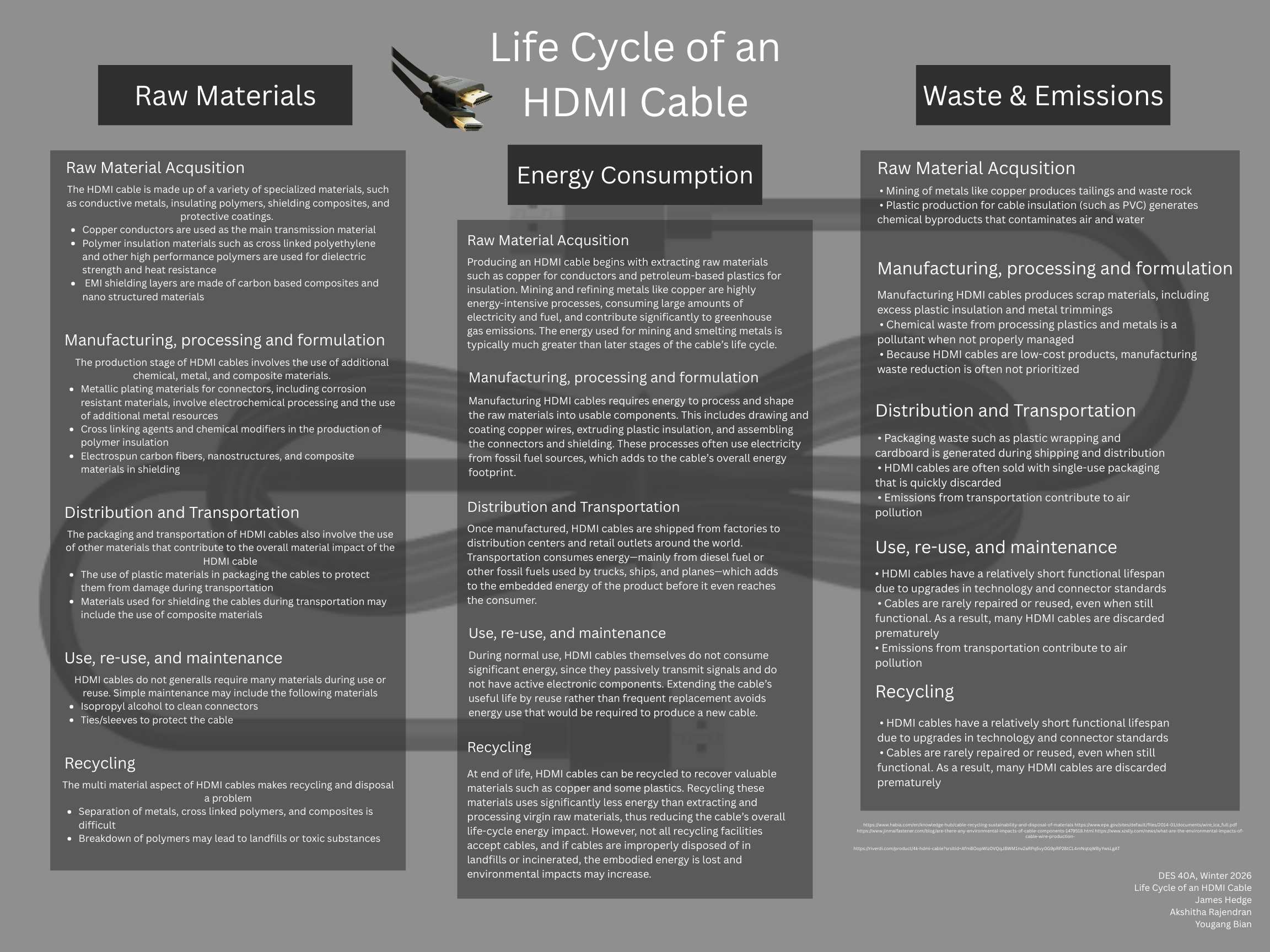
The HDMI cable is an everyday object that is commonly used to transfer digital audio/video signals between electronic devices. The HDMI cable enables an individual to transfer content that is currently being played on a device such as a laptop or gaming console to a much larger display such as a TV or monitor. Even though the HDMI cable is a commonplace object, the design and composition of the HDMI cable are much more complex than what many people would assume. A typical HDMI cable consists of various materials that are designed to transmit data at extremely fast speeds.
Due to the complexity of the process, the creation and utilization of HDMI cables require a myriad of materials that all have a specific role to play in the overall effect on the environment. The intent of this paper is to explore the materials used throughout the design process of an HDMI cable. By beginning with the initial process of materials extraction to the final point of materials disposal or recycling, what appears to be a relatively small device actually utilizes a multitude of materials. By examining the materials used throughout each step of the process for an HDMI cable, it is possible to understand the technological efficiency of HDMI cables while also considering their sustainability.
The composition of the HDMI cable includes different kinds of materials that serve different purposes. The different kinds of materials include conductive materials such as metals, insulating materials such as polymers, shield materials such as composites, and protective materials such as coatings. The material that makes the cable conductive is copper. The wires that make up the inside of the HDMI cable are copper wires, which is important since these wires make up the component that makes the cable capable of extreme efficiency in the conduction of data at extremely high speeds. The wires that make up the cable are doubly important since these wires can conduct data without the presence of substantial amounts of resistance. The flexible printed cables have played an important part in the miniaturization of the wires. This resulted in the development of efficient wires that could conduct substantial amounts of data (Arnquist et al.; Ratul Kumar Baruah et al.).
Another important factor that affects the performance of an HDMI cable is the connector materials. The metal connectors on the end of the HDMI cable must be able to make good electrical connections with the device that the cable is connected to. Additionally, the connectors must be able to withstand corrosion as well as wear and tear. The connectors are able to withstand corrosion due to the use of special materials that are applied to the connectors through a plating technique. The connectors are able to withstand corrosion due to the special materials that are applied to the connectors. Studies on the connector coatings on electrical harnesses indicate that the materials used to protect the connectors from corrosion can help extend the lifespan of the electrical connections (Adamczyk et al.). All of these metals have to be extracted from the earth and transported across the world to aid in the production of the HDMI cable, which takes its toll on the environment.
Apart from the materials used for the cable, the manufacturing stage of the HDMI cable involves the use of additional chemical and composite materials. The insulation materials used for the HDMI cable are often processed using special techniques that incorporate cross-linking agents and chemical modifiers. The chemical modifiers are used to improve the dielectric strength of the cable. However, the processing of the cross linked polymer insulation used for the HDMI cable is often a power intensive process, requiring high temperature processing and special processing machinery (Gao et al.; Syatirah et al.). This makes the manufacturing stage a contributor to the environmental impact of the production of the HDMI cable.
The production process for these shielded materials also requires complex processing techniques. The production of carbon fibers for EMI shielding involves electrospinning techniques that create very fine structures. The production of these nanostructured materials is very effective for EMI shielding but requires sophisticated processing techniques and additional energy requirements during the production process (Deeraj et al.). The production of polymer composites for EMI shielding using carbon nanostructures also requires sophisticated processing techniques that can optimize the performance while still being flexible (Verma et al.). While these materials greatly enhance the performance of HDMI cables, they require additional resources during the production process.
The process of connector plating also contributes to material complexity in the manufacturing of HDMI cables. In this process, thin layers of corrosion-resistant metals are plated onto the surfaces of the connectors through electrochemical processes. This process also requires additional resources of metals that are used in this process, as well as chemicals that are used during the electroplating process. This process is important in preventing corrosion, but it also poses a challenge in terms of environmental management, as explained in a study on coatings for electrical connectors (Adamczyk et al.).
After manufacturing, HDMI cables go through the distribution stage of their product life cycle, where other materials are introduced for packaging and transport. The packaging of HDMI cables is required for protection against damage during transport and storage. In this case, HDMI cables are packaged using various plastics that prevent damage during transport. The plastics are effective in preventing moisture damage and other forms of damage that could affect the cables during transport. Although these materials are not very heavy, they contribute to material consumption related to the product. Research on polymer durability indicates that plastics are commonly used for protective packaging of various products due to their strength (Lopez; Anghelescu et al.).
The transportation materials and infrastructures also contribute to the life cycle of HDMI cables. The transportation process of course involves a large number of the cables being transported from the manufacturing plant to the distributors and retailers. During transportation, additional protective materials might be added to the HDMI cable to ensure that tangling does not occur. The use of flexible electronic components and cable systems involves the use of composite materials and coatings that help in the maintenance of structural integrity during transportation (Arnquist et al.; Ratul Kumar Baruah et al.). Though these materials contribute to the quality of the product, they contribute to the overall environmental impact.
Another consideration in the transportation stage is the potential for reducing waste materials through enhanced recycling techniques. Studies on the recycling of cross-linked polyethylene cable materials show that some waste products can be recycled and reused for alternative purposes. For instance, recycled cross linked polyethylene can be recycled and reused for the production of conductive materials for electromagnetic shielding (Xie et al.). Such recycling techniques show that some of the materials used in cable production can be recycled and reused.
In spite of these potential opportunities for cable recycling, the final life stage for HDMI cables is a major concern for sustainability. In addition, HDMI cables are made from a variety of materials, each of which is integrated into a single product. It is difficult to separate copper wires, cross-linked polymers, composites for the shield, and coatings from each other, and as a result, HDMI cables are sent to landfills instead of being recycled. The degradation of polymers in landfills may result in the production of chemical byproducts, which are a source of pollution in the environment. In a study on the degradation of cable insulation polymers, it was found that polymers may degrade thermally, mechanically, and chemically, which may be dangerous in some cases (Anghelescu et al.).
Recycling of cable materials is further made difficult by the incorporation of cross linked polymers, which cannot be easily melted and reused like other plastic materials. Cross linked polymers are instead mechanically or chemically broken down in order for them to be reused. Research on different studies on recycled cross-linked polyethylene materials indicates that with the development of different recycling technologies, these materials can be reused as conductive composite materials or as shielding materials (Xie et al.).
In conclusion, while the HDMI cable is a technologically efficient device that is used extensively by people all over the world, it has a complex material life cycle that needs to be taken into account. From copper conductors and polymer materials used for insulation to nanostructured materials used for shielding and corrosion resistant materials used for coating connectors, HDMI cables make use of a wide variety of different materials that help them function efficiently. In addition to this, there are additional materials used during the course of manufacturing, packaging, and distributing the product. At the end of the product's life cycle, the complex material composition of the HDMI cable also creates problems for recycling the product.
Bibliography:
Adamczyk, Paulina, et al. “Evaluation of Materials Used for Coatings of Electrical Connectors Used in the Electrical Harness of Passengers Cars.” Combustion Engines, 7 July 2022, https://doi.org/10.19206/ce-150505. Accessed 25 Oct. 2022.
Anghelescu, Lucica, et al. “Degradation Pathways of Electrical Cable Insulation: A Review of Aging Mechanisms and Fire Hazards.” Fire, vol. 8, no. 10, 13 Oct. 2025, p. 397, www.mdpi.com/2571-6255/8/10/397, https://doi.org/10.3390/fire8100397. Accessed 19 Nov. 2025.
Arnquist, I J, et al. “Ultra-Low Radioactivity Flexible Printed Cables.” EPJ Techniques and Instrumentation, vol. 10, no. 1, 19 Sept. 2023, https://doi.org/10.1140/epjti/s40485-023-00104-6. Accessed 18 Oct. 2023.
Deeraj, B. D. S., et al. “A Brief Review on Electrospun Polymer Derived Carbon Fibers for EMI Shielding Applications.” Functional Composite Materials, vol. 5, no. 1, 20 Sept. 2024, https://doi.org/10.1186/s42252-024-00060-8. Accessed 14 Jan. 2025.
Gao, Jun-Guo, et al. “Dielectric Characteristics of Crosslinked Polyethylene Modified by Grafting Polar-Group Molecules.” Polymers, vol. 15, no. 1, 1 Jan. 2023, pp. 231–231, pmc.ncbi.nlm.nih.gov/articles/PMC9823466/, https://doi.org/10.3390/polym15010231. Accessed 17 Feb. 2025.
Lopez, Gérald. “High-Performance Polymers for Aeronautic Wires Insulation: Current Uses and Future Prospects.” Recent Progress in Materials, vol. 3, no. 1, 25 Feb. 2021, https://doi.org/10.21926/rpm.2101005.
Ratul Kumar Baruah, et al. “Interconnection Technologies for Flexible Electronics: Materials, Fabrications, and Applications.” Micromachines, vol. 14, no. 6, 27 May 2023, pp. 1131–1131, https://doi.org/10.3390/mi14061131. Accessed 31 Oct. 2023.
Syatirah, M N, et al. “A Review: Polymer-Based Insulation Material for HVDC Cable Application.” IOP Conference Series. Materials Science and Engineering, vol. 932, no. 1, 1 Sept. 2020, pp. 012064–012064, https://doi.org/10.1088/1757-899x/932/1/012064.
Verma, Pawan, et al. “Electromagnetic Interference Shielding Performance of Carbon Nanostructure Reinforced, 3D Printed Polymer Composites.” Journal of Materials Science, vol. 56, no. 20, 7 Apr. 2021, pp. 11769–11788, https://doi.org/10.1007/s10853-021-05985-0.
Xie, Yeping, et al. “Electrically Conductive and All-Weather Materials from Waste Cross-Linked Polyethylene Cables for Electromagnetic Interference Shielding.” Industrial & Engineering Chemistry Research, vol. 61, no. 10, 3 Mar. 2022, pp. 3610–3619, https://doi.org/10.1021/acs.iecr.1c04813. Accessed 2 Dec. 2024.
Yougang Bian
Des 040
Professor Christina Cogdell
Embodied Energy in the Life Cycle of an HDMI Cable
High-Definition Multimedia Interface (HDMI) cables are used to transmit digital video and audio signals between televisions, computers, gaming consoles, and other electronic devices. Although HDMI cables appear to be simple accessories, their production requires substantial energy throughout multiple stages of their life cycle. From the extraction of raw materials to manufacturing, transportation, and disposal, each stage contributes to the total embodied energy of the product. Embodied energy refers to the total amount of energy required to produce, transport, and manage a product throughout its life cycle (Rankin).
It is important to understand embodied energy of common consumer electronics is important because billions of cables and electronic accessories are produced each year. Even small products can contribute a lot into global energy consumption when manufactured at large scales. Although HDMI cables themselves do not consume electricity during normal operation, the energy required to produce the materials and manufacturing processes represents a hidden environmental impact. The majority of this energy occurs during raw material extraction and manufacturing processes, particularly copper mining, metal refining, and plastic production, while transportation and disposal add additional energy demands. Examining the complete life cycle of HDMI cables demonstrates that extending product lifespan and improving recycling systems are key strategies for reducing the total energy of these widely used electronic components.
Raw material
The life cycle of an HDMI cable begins with the extraction of raw materials used to manufacture its components. HDMI cables primarily contain copper conductors, aluminum or copper shielding, and plastics such as polyvinyl chloride (PVC) or polyethylene used for insulation and protective jacketing. Producing these materials requires large amounts of energy before manufacturing of HDMI cable itself even begins.
Copper production is particularly energy-intensive because it involves several stages of mining, refining, and purification. Copper ore must first be extracted from mines using heavy machinery powered by fossil fuel. The ore is then crushed, ground, and processed using flotation techniques to separate copper minerals from surrounding rock. After concentration, the material undergoes smelting and electro-refining processes that require extremely high temperatures and large quantities of electricity (Liu et al.). These refining steps are necessary to produce copper with the high level of conductivity required for electronic wiring. And even more, research on the life-cycle energy consumption of copper production shows that electricity use during mining and smelting operations represents a major contributor to the environmental impact of copper materials (Wu, Yang, and Zhao).
Plastic insulation materials also add to the embodied energy of HDMI cables. Plastics such as PVC are derived from crude oil or natural gas extracted from underground reserves. Extracting petroleum requires drilling operations, pumping equipment, and transportation infrastructure that consume additional energy. Once crude oil is extracted, it must be refined and chemically processed into polymer resins used in insulation and cable jackets. These petrochemical processes require both thermal energy and electricity, further increasing the total energy demand of cable production.
Because HDMI cables depend on both metal and petroleum-based materials, the raw material stage of their life cycle typically accounts for one of the largest portions of total energy consumption. Even before manufacturing begins, substantial energy has already been invested in producing the materials required to build the cable.
Production
After raw materials have been produced and refined, they are transported to cable manufacturing facilities where they are assembled into finished HDMI cables. The manufacturing process involves several energy-intensive steps including wire drawing, insulation extrusion, shielding installation, and connector assembly.
The first stage in cable production is the creation of thin copper wires through a process known as wire drawing. In this process, copper rods are pulled through progressively smaller dies to reduce their diameter while maintaining structural integrity. Electric motors and specialized industrial equipment are required to perform this process efficiently at large scales.
Following wire production, plastic insulation is applied to protect the conductors. Insulation is typically created through extrusion processes in which plastic pellets are heated until molten and then forced through molds surrounding the wire. Industrial extrusion machines require continuous electrical power as well as heating systems capable of maintaining high temperatures. These energy requirements contribute to the overall embodied energy of the finished cable.
Additional manufacturing steps include installing shielding materials that prevent electromagnetic interference and assembling HDMI connectors at the ends of the cable. Automated manufacturing equipment performs these tasks, requiring further electrical energy during production. Studies examining the environmental impacts of industrial metal processing show that fabrication and processing stages can account for a significant portion of total industrial energy consumption (Strezov, Zhou, and Evans).
The amount of energy required during manufacturing can vary depending on the efficiency of factory equipment and the energy sources. Facilities that rely heavily on electricity generated from fossil fuels may indirectly contribute to higher greenhouse gas emissions.
Transportation
Once HDMI cables are manufactured, they must be transported through global supply chains before reaching consumers. Most consumer electronics accessories are produced in large manufacturing hubs located in Asia, where electronics production infrastructure is highly developed. From these locations, cables are shipped internationally to markets around the world.
Transportation energy comes primarily from the fuel used by cargo ships, trains, and trucks. Long-distance shipping commonly relies on large container ships powered by heavy fuel oil. Although maritime transport is relatively efficient when compared to air freight, the long distances involved in global trade still require substantial amounts of fuel.
After arriving at ports, HDMI cables are transported to distribution centers and retail stores using trucks powered by diesel fuel. These additional transportation steps add further energy consumption and emissions. Packaging materials also contribute indirectly to transportation energy use because producing packaging materials requires energy and increases shipping weight. Life-cycle assessments of metal and industrial products indicate that transportation can represent a noticeable portion of total embodied energy when materials and products travel long distances between production stages (Rankin).
Use Re-Use
Unlike many electronic devices, HDMI cables do not actively consume energy during use. Instead, they function as passive transmission components that carry digital signals between electronic devices such as televisions, computers, and gaming consoles. Because HDMI cables contain no powered electronic circuits, their operational energy consumption is essentially zero.
However, the lifespan of the cable still affects the overall energy impact of the product. If cables are frequently replaced due to damage, compatibility changes such as change in plug shape, or consumer habits such as improper storage, additional cables must replace them. This increases total energy consumption.
Extending the useful life of HDMI cables can therefore reduce the overall energy demand associated with their production. Durable construction, compatibility with multiple device generations, and reuse across different devices can help.
Recycle
At the end of their useful life, HDMI cables may be recycled, or disposed of as electronic waste. Recycling offers one of the most effective ways to reduce the embodied energy associated with cable production because valuable materials such as copper can be recovered and reused.
Copper recycling requires significantly less energy than extracting copper from raw ore. Recycling processes typically involve shredding cables, separating metals from insulation materials, and melting the recovered copper to produce new metal products. Because these processes avoid the energy-intensive mining and smelting operations required for primary copper production, they can dramatically reduce total energy consumption.
Life-cycle studies of copper production demonstrate that recycled copper requires far less energy and produces fewer environmental impacts than copper obtained through mining and refining (De Soete et al.). Recovering copper from discarded cables therefore represents an important opportunity to conserve energy and reduce environmental impacts.
However, recycling cables presents technical challenges because the metal conductors are often tightly bonded with plastic insulation materials. Specialized equipment is required to separate these materials efficiently. When cables are disposed of in landfills or incinerated rather than recycled, the valuable metals they contain are lost and the embodied energy invested in producing them is wasted.
The life cycle of an HDMI cable demonstrates that even small consumer electronics accessories require significant energy resources to produce and distribute. The largest portion of this embodied energy occurs during raw material extraction and manufacturing processes, particularly during copper mining, metal refining, and plastic production. These stages require large amounts of electricity, fuel, and industrial infrastructure.
Transportation across global supply chains adds additional energy consumption as products travel thousands of kilometers between factories, warehouses, and retail markets. Although HDMI cables themselves do not consume energy during use, their production represents a hidden environmental cost that is often overlooked by consumers.
Recycling and reuse provide important opportunities for reducing the total embodied energy of these products. Recovering copper and other valuable materials from discarded cables can significantly reduce the need for energy-intensive mining and refining operations. Extending the lifespan of cables through reuse and durable design can further decrease the energy demand associated with producing new products.
Bibliography
De Soete, Wouter, et al. “Environmental Assessment of Copper Production in Europe.” International Journal of Life Cycle Assessment, 2022.
Liu, Lingchen, et al. “Life Cycle Energy Consumption and Greenhouse Gas Emissions of Copper Production.” Processes, 2022.
Rankin, W. J. Life Cycle Assessment of Copper and Nickel Production. Australasian Institute of Mining and Metallurgy, 2000.
Strezov, Vladimir, Xiaoteng Zhou, and Tim J. Evans. “Life Cycle Impact Assessment of Metal Production Industries.” Scientific Reports, 2021.
Wu, Xiaohan, Xinbo Yang, and Fu Zhao. “Life Cycle Assessment of Cathode Copper Production.” ACS Sustainable Chemistry & Engineering, 2025.
United States Environmental Protection Agency. Life Cycle Assessment of Copper Wire Production.
Habia Cable. “Cable Recycling: Sustainability and Disposal of Materials.”
Jinmai Fastener. “Environmental Impacts of Cable Components.”
XZXL Cable. “Environmental Impacts of Cable Wire Production.”
Akshitha Rajendran
DES 040
Professor Christina Cogdell
Life Cycle Waste Analysis of HDMI Cables
Introduction
HDMI cables are a widely used household staple that appears inconspicuous in the context of electronic waste and environmental degradation. These cables connect televisions, computers, gaming consoles, and many other devices, making them a fundamental part of everyday digital technology. Because they are small and relatively inexpensive, HDMI cables rarely receive attention in conversations about environmental sustainability or electronic waste. However, contrary to its seemingly insignificant size, HDMI cables are substantial contributors to mass electronic waste when one examines them at scale. Millions of these cables are manufactured, sold, replaced, and discarded every year as consumer electronics continue to evolve and new display standards emerge (Statista Research Department). This paper will contextualize HDMI cables’ overall role in the waste ecosystem by identifying the various ways waste is produced throughout their entire life cycle. We will do so by examining waste produced as a result of raw materials acquisition, product manufacturing, transportation, use/reuse, and especially its disposal and recycling. HDMI cables are a significant contributor to electronic waste, due to their material composition and their low recycling rates (United States Environmental Protection Agency). Their small size and cost lead many to disregard the recycling and disposal stage of their life cycle, however, this neglectful rhetoric dangerously propagates more careless disposal of HDMI cables.
Raw Materials Extraction
Waste starts accumulating at the raw materials extraction stage, where local ecosystems are disturbed. One of the primary materials used in HDMI cables is copper. The internal wiring for cables is formed of copper, which allows electrical signals to pass through the cable. Copper mining generates significant amounts of waste in the form of tailings and waste rock. These materials are often left behind near mining sites, and can subsequently alter the surrounding landscape. Mining operations also demand that a large amount of soil and rock is removed to access the copper deposits. The displacement and reshaping of land also disturb local microecosystems. Mining activities also contaminate nearby soil and water resources with heavy metal runoff. These pollutants may spread through local rivers and groundwater systems, thus destroying local underwater habitats and making water undrinkable for nearby communities. Another raw material that plays a substantial role in the production of HDMI cables is petroleum, which is used for plastic insulation for the cable. The extraction of petroleum is an incredibly energy-intensive and environmentally disruptive practice (International Energy Agency). Drilling operations, transportation infrastructure, and associated extraction equipment use up huge amounts of energy, reshape the landscape, and thus devastate local ecosystems. Beyond extraction, additional waste is produced as these materials are processed and assembled during manufacturing.
Material Processing
Once raw materials are extracted, they must be processed into usable components such as copper wiring, protective shielding, and plastic insulation. The manufacturing stage of HDMI cables generates substantial waste due to material processing, industrial scrap, and chemical byproducts. One of the most environmentally significant aspects of manufacturing HDMI cables is the production of plastic insulation, especially polyvinyl chloride (PVC). PVC production requires chemical processes that release emissions and hazardous byproducts. These byproducts contribute to air pollution and require specialized waste management systems to process and prevent contamination (International Energy Agency). In addition to chemical waste, manufacturing and assembling the cables themselves also produce excess physical scrap material. During the process of cutting and assembling copper wiring and metallic shielding, metal trimmings and excess scrap are left behind (iFixit). Corporations and large-scale manufacturing systems often prioritize cost efficiency and are not economically incentivized to minimize their waste and environmental impact. As a result, waste reduction technologies and environmentally sustainable manufacturing methods are not prioritized. This exacerbates many environmental concerns, since companies turn a blind eye to these issues to maximize profit.Although manufacturing creates substantial industrial waste, environmental impacts continue to cumulate dangerously as HDMI cables are brought to the consumer market.
Consumer Use
The consumer phase significantly adds to HDMI cables’ waste footprint due to technological turnover and limited reuse. As HDMI cables are distributed to consumers, each cable is packaged in plastic or cardboard packaging. This is designed to protect the product during transportation and make the product appear more finished and professional. However, this packaging is discarded immediately after purchase, and packaging waste accumulates with each purchase. Another factor that contributes to consumer stage waste is the rapid pace of technological innovation. Rapid innovations to technological capabilities and updates to display standards drive consumers to replace cables with updated cables (International Energy Agency). Many existing cables remain fully functional but they get replaced simply because they are perceived as outdated. Consumers rarely seek out repairing their HDMI cables because they are difficult to fix, inexpensive, and easier to simply replace. Households accumulate unused cables over time, and they are eventually discarded during cleaning or relocation. Ultimately, the most waste occurs when HDMI cables reach their end-of-life stage.
Disposal and Recycling
End-of-life management is the most pressing waste challenge for HDMI cables since it is systematically overlooked by governments, consumers, and sustainability initiatives alike. Their small size and cost lead many to disregard the recycling and disposal stage of their life cycle. However, this neglectful attitude toward small electronic accessories dangerously propagates careless disposal practices. This blind eye to small electronic waste enables governments, corporations, and any other responsible systems to avoid responsibility and accountability. HDMI cables present unique challenges for recycling infrastructure because they are composed of mixed materials. These cables are made of a tight combination of copper wiring, plastic insulation, and metallic shielding (iFixit). To efficiently separate these materials, we require specialized equipment and labor. Many recycling facilities don’t accept small cables or accessories, however, they are still discarded by consumers as such (United States Environmental Protection Agency). These recycling facilities rarely process HDMI cables because their small size offers limited valuable materials to be recovered by recycling facilities. Many recycling facilities prioritize larger electronic devices such as computers and televisions. Smaller accessories, such as HDMI cables, are often excluded from recycling programs because they are economically impractical. Essentially, the cost of processing them may exceed the value of the materials that can be recovered. When HDMI cables enter landfills, the plastic insulation degrades extremely slowly and persists in the environment for decades, slowly releasing toxins and emissions (International Energy Agency). Incineration is sometimes used as a method of waste reduction, but burning plastic components releases harmful concentrations of emissions. Overall, our current waste management systems are not properly equipped to handle small electronic accessories like HDMI cables.
Conclusion
The various stages of the Life Cycle reveal the alarming magnitude of the cumulative impact HDMI cables have on the environment. This paper summarizes how waste is generated at each stage: extraction, manufacturing, consumer use, and disposal. This reinforces that HDMI cables create environmental harm disproportionate to their size, primarily because of underdeveloped recycling infrastructure and plastic-heavy construction. HDMI cables are a reflection of a broader issue regarding sustainability in consumer electronics, wherein convenience and rapid innovation are optimized at the cost of environmental responsibility. As electronic devices continue to evolve, the accessories that support them will continue to contribute to growing levels of electronic waste. Urgent recognition of the life-cycle impacts of HDMI cables and small electronic waste is important to sustainable development. There must be reform of our present recycling and disposal infrastructure, more encouragement of recycling, and more sustainable design and manufacturing processes.
Bibliography
Birt, J., Stromberga, Z., Cowling, M., & Moro, C. (2018). Mobile mixed reality for experiential learning and simulation in medical and health sciences education. Information, 9(2), 31.
Birt, James, et al. “Mobile Mixed Reality for Experiential Learning and Simulation in Medical and Health Sciences Education.” Information, vol. 9, no. 2, 2018, p. 31.
Radianti, J., Majchrzak, T. A., Fromm, J., & Wohlgenannt, I. (2020). A systematic review of immersive virtual reality applications for higher education. Education and Information Technologies, 25, 287–327.
Radianti, Jussi, et al. “A Systematic Review of Immersive Virtual Reality Applications for Higher Education.” Education and Information Technologies, vol. 25, 2020, pp. 287–327.
Rizzo, A. A., & Koenig, S. T. (2017). Is clinical virtual reality ready for primetime? Neuropsychology, 31(8), 877–899.
Rizzo, Albert A., and Steven T. Koenig. “Is Clinical Virtual Reality Ready for Primetime?” Neuropsychology, vol. 31, no. 8, 2017, pp. 877–899.
Slater, M., & Sanchez-Vives, M. V. (2016). Enhancing our lives with immersive virtual reality. Frontiers in Robotics and AI, 3, 74.
Slater, Mel, and Maria V. Sanchez-Vives. “Enhancing Our Lives with Immersive Virtual Reality.” Frontiers in Robotics and AI, vol. 3, 2016, p. 74.
Makransky, G., Petersen, G. B., & Immersive Learning Research Group. (2019). Immersive virtual reality and learning A meta-analysis. Educational Psychology Review, 31, 1011–1037.
Makransky, Guido, and Gustav B. Petersen. “Immersive Virtual Reality and Learning A Meta-Analysis.” Educational Psychology Review, vol. 31, 2019, pp. 1011–1037.
Meta Platforms, Inc. Meta Quest Product Environmental Report. Meta, 2023.
Meta Platforms, Inc. Meta Quest Product Environmental Report. Meta, 2023.
International Energy Agency. Digitalisation and Energy. IEA, 2017.
International Energy Agency. Digitalisation and Energy. IEA, 2017.
Statista Research Department. Virtual Reality (VR) Headset Market Size Worldwide. Statista, 2024.
Statista Research Department. Virtual Reality (VR) Headset Market Size Worldwide. Statista, 2024.
iFixit. Meta Quest 2 Teardown. iFixit, 2021.
iFixit. Meta Quest 2 Teardown. iFixit, 2021.
U.S. Environmental Protection Agency. Electronics Donation and Recycling. EPA, 2023.
United States Environmental Protection Agency. Electronics Donation and Recycling. EPA, 2023.