Design Life-Cycle
assess.design.(don't)consume
Olivia Tiongson
Professor Cogdell
DES 040A
12 March 2026
Tiffany & Co: HardWear Pearl Lock Necklace in Silver Materials
Tiffany & Co. Jewelry is made up of an abundance of different materials sourced from various areas in the world. Tiffany’s HardWear Pearl Lock Necklace in Silver is made of raw materials from mines, underwater sea creatures, and caves that significantly pave our natural environment. The silver metal and pearls that are extracted have a domino effect from the mines or rivers they originate from all the way to the toxic sludge and dead mussels that come out of the production. By taking a closer look at the life cycle of Tiffany's pearl necklace, we see major improvements from Tiffany as they change the way they source their raw materials to help create a safer environment which positively influences the jewelry industry as a whole.
To begin, Tiffany’s pearl lock necklace visibly uses pearls as a garnish and jewelry piece, but what do we know about their source and what kinds of pearls they use? Unlike many other jewelry companies who use synthetic glass or plastic pearls, Tiffany uses authentic pearls from mussels in smaller bodies of water like lakes, ponds, and rivers. The main variations of pearls used in Tiffany jewelry are Japanese Akoya, freshwater, South Sea, and Tahitian. For the HardWear necklace specifically, freshwater pearls are the main variant for production. To obtain their pearls, Tiffany partnered with Mr. Hussein Al Fardan who sources his pearls from the Arabian Gulf. His family lineage has dealt with pearl farming for “over 300 years” (Khoury 1990). These pearls are harvested harmlessly by gently stimulating the mussel’s tissue to produce pearls and some are farmed without human intervention at all to minimize any possible ecological damage to the mussel and their living space. Naturally formed pearls are more irregularly shaped and textured which gives a unique and desired style to consumers. The popularization of natural pearl jewelry can help to steer customers away from buying plastic, mass produced pearls. By partnering with a long-term and reliable pearl source for the HardWear Pearl Lock Necklace, Tiffany moves forward towards keeping their products more eco-friendly and safer for the environment.
Though Tiffany’s freshwater pearls have a more natural sourcing approach, the metals used for the Tiffany pearl lock necklace require more human intervention with labor filled mining and manufacturing. The necklace our group has chosen uses silver for its main design instead of gold or any other metal. Tiffany’s silver products always use 92.5% sterling silver which are marked on the tag charm illustrated with the phrase “925” or “sterling” (Hudson 2025). Of course, other various metals like copper, palladium and platinum are inevitably incorporated during manufacturing for extra durability and strength. These metals are sourced from mines throughout America. Rio Tinto’s Bingham Canyon Mine in Utah near Salt Lake City is the main and most significant silver and metal source for Tiffany. “About half of all the silver mined” at the Bingham Mine was purchased by Tiffany (Lee 2012). The Bingham Mine is considered “one of the largest open-pit mines in the world” which gives Tiffany plenty of metals to excavate for years and years to come (Logreira 2026). Of course other production materials are used for manufacturing equipment like computers, electric lasers, welders, polishers, metal cutting tools, and many more machines. These machines have much more complex materials used like gasoline, uranium, silica sand, resin, fiberglass, lithium, and many more raw materials that significantly impact the environment in their own ways. So much thought and detail is put into the production of every Tiffany Jewelry piece, but certain environments can cause negative impacts such as toxic material and unsafe working conditions.
In their early years, Tiffany had been using shortcuts and polluting ways to source their materials purely with convenience in mind instead of thinking of its impact on the environment. Before the shift to a sustainable approach for jewelry manufacturing, Tiffany had an averagely toxic approach just like most companies did. They did not care much about the mines they used or the impact it had on the environment as long as they received their metals. One of the old mines they used to work with was the Cerrillos Hills Mines in New Mexico. The company was actively using this mine for turquoise and other metals around the 1800’s-1900’s. Toxic waste was still present, but benign in comparison to other more hazardous mines. The main problem with the area was that the mine was too close to two mill-site locations that had concerning levels of lead, cadmium and arsenic (Cerrillo Hills 2026). These substances can lead to long term health problems such as cancer, kidney damage and much more if entering the bodies of living beings. Currently the mine is being watched by the Environmental Protection Agency and abandoned of all work. Tiffany had also been participating in “modern slavery” where they created products that “came from a mine where workers only made pennies per day” (Kowalski 2024). The conditions of the mine itself was also physically dangerous as it was filled with extreme dips, faults, and embankments that frequently endangered the lives of anyone who worked there (Beaumont 1979). These actions and outcomes have added to the world's increase in climate change effects and human rights concerns which were in great need of addressing.
As time passed by, however, new owners of Tiffany had started to change the way the jewelry was sourced to transition to a more green mindset and help reduce pollution and unethical working conditions. Michael J. Kowalski, the former Chairman and CEO of Tiffany & Co, was one of the driving forces behind the environmentally conscious changes of Tiffany’s sourcing of raw materials. He was the CEO of the company for around 16 years from 1999-2015 and was a known environmental activist. To combat unethical mining, Kowalski collaborated with Earthworks, a company that strives to “stop destructive mining and oil and gas projects” (Earthworks 2026), to promote full page ads in The Washington Post. These ads called out to other companies to stop mining projects in places of ecological importance. The two companies started the Initiative for Responsible Mining (IRMA) movement which helped to bring other mining companies, labor groups, and separate supporting companies to come together and set up good standards for how mining projects should be conducted. Not only did Kowalski help change their own metal sourcing, but he also led Tiffany to support the “No Dirty Gold” campaigns which inspired other companies to join or start supporting social human rights and environmental standards for gold, silver, and other metal extraction methods. This was very impactful as Tiffany was one of the first high end jewelry companies to go to such lengths to promote and join hands with Earthworks for unethical mining activism. Kowalski set the precedent for the future Tiffany presidents to continue more ethical practices of harvesting pearls and mining silver for not only the pearl lock necklace, but all of Tiffany’s jewelry and more.
Overall, Tiffany&Co. has transformed into a very economically friendly company as seen with their Pearl Lock necklace’s ethical material makeup and the company’s continuous development to reform a lot of their resources and actions regarding the mining, working conditions, and toxic pollutants to be safer for the environment. With the leadership of former CEO, Micheal J. Kowalski, Tiffany was able to transform into a company not only known for their prestige, but also for their sustainable practices.. From their jewelry materials all the way to their beautiful packaging, Tiffany strives to promote recyclable and sustainable products. With our current product of interest, we see the metals of the Pearl Lock necklace can be re-melted and reused for more jewelry and other items. Its packaging is also made of paper based materials that can be recycled as well to reduce even more waste. Tiffany actively demonstrates how a company can be environmentally responsible with raw material sourcing whilst still maintaining status and keeping up with every changing style trends.
Works Cited
Lee, Jasen. “Kennecott Mining Silver, Gold for Tiffany & Co..” KSL.Com, ksl.com, 13 Mar. 2012, www.ksl.com/article/19560938/kennecott-mining silver-gold-for-tiffany--co.
Khoury, Eileen. “Saudi Aramco World : Servants of the Pearl.” AramcoWorld, 1990, archive.aramcoworld.com/issue/199005/servants.of.the.pearl.htm.
Scheyder, Ernest, and Erica Solano. “How Tiffany & Co.. Helped Make Mining More Sustainable.” Time, Time, 18 Jan. 2024, time.com/6556277/tiffany-sustainable-mining/.
“The Land of the Park.” The Land of the Park | Cerrillos Hills, www.cerrilloshills.org/history/natural-history#:~:text=The%20nature%20of%20the%20mining,%2C%20cadmium%2C%20and%20arsenic.). Accessed 11 Mar. 2026.
Logreira, Diana. “Bingham Canyon Mine, Utah - NASA Science.” NASA, NASA, 22 Oct. 2007, science.nasa.gov/earth/earth-observatory/bingham-canyon-mine-utah-8144/.
Beaumont, Edward C. New Mexico Geological Society, 1979, nmgs.nmt.edu/publications/guidebooks/downloads/30/30_p0269_p0274.pdf.
Serdari, Thomaï, and Jennifer Levy. "A framework that describes the challenges of the high jewelry market in the US." Luxury 5.3 (2018): 245-263.
“Pearl Jewelry | Tiffany & Co.. US.” Tiffany & Co., LVMH Moët Hennessy Louis Vuitton, www.tiffany.com/jewelry/pearl/. Accessed 4 Feb. 2026.
Lin, Yunzhi, and Na Sai. "Ethics and Sustainability in The Jewellery Industry." Ethics 7.3 (2023): 2023.
Hume, Jody. “Tiffany & Co.. Jewelry: How to Spot the Real Deal.” The RealReal, 21 July 2023, realstyle.therealreal.com/how-to-authenticate-tiffany-co-jewelry/.
Kayla Krulak
Professor Cogdell
DES 040A
12 March 2026
Tiffany HardWear Pearl Lock Necklace in Silver: Life Cycle Energy Analysis
Introduction
The product being researched is the Tiffany HardWear Pearl Lock Necklace in Silver and the embodied energy portion is extremely crucial to the environmental impacts that happen due to silver and pearl components of the jewelry. It leaves quite an impact on the environment from the sourcing of the pearls to the production of the silver portion of the necklace, primarily due to the waste that is left from the silver and the invasive and extensive process that is needed to acquire pearls for production . To improve the sustainability on the production end would be to target the waste left from the silver by repurposing it whether it be put into other pieces or donated, using sustainable packaging, and finding more ethically sourced pearls. In addition, targeting the greenhouse gases would greatly reduce the harm that is done to the environment as that is the main contributor to the issues this necklace creates. The amount of greenhouse gasses emitted and fossil fuels needed to produce this necklace is quite concerning.
Analysis
The production of this particular necklace releases over 428 million kilograms of greenhouse gasses into the atmosphere which is severely damaging and contributes to our carbon footprint as a whole. Before mentioning the effects that this necklace has on the environment it is important to mention what exactly are greenhouse gases. Greenhouse gasses are any kind of gas in the atmosphere that absorbs and re-emits heat which will keep the planet's atmosphere warmer than intended. The most recurrent gases that do this are carbon dioxide, methane, nitrous oxide, and ozone (Brander). This creates the greenhouse effect which is created by carbon dioxide and carbon dioxide is seen frequently in the production of fossil fuels. All of this greatly impacts our environment and planet because it contributes to global warming, destruction of habitats, and extinction of animals (Bhattacharya and Yadav). These greenhouse gasses are produced all throughout the production of the Tiffany & Co necklace and are created as early as the production of pearls. Producing 1 kilogram of pearls emits 4.98 kilograms of carbon dioxide and this is primarily emitted during the “grow out stage” of the pearls and this stage can last up to 2 years (Dheanara Pinka and Kazuyo Matsubae). In addition to the production of this necklace emitting mass amounts of greenhouse gas energy, an important thing to note is that when farming for these pearls to create the necklace the process is abrasive and invasive to the oyster as to make a standard quality pearl necklace it can take up to 100,000 oysters and this creates a lot of waste. Due to the rarity of finding a pearl, thousands of shells are open and discarded which leads to the death of an oyster and extracting these pearls are painful to the oyster (Jain). Acknowledging the importance of greenhouse gasses, its effect, and the lack of ethicality in the production of the pearl component in this necklace introduces other issues that come to the surface with the production of this necklace, which include the construction of the silver component in the jewelry piece.
The silver component of the jewelry piece creates massive amounts of waste as the fragments and pieces that are left unused get discarded and put out for waste. Producing silver jewelry uses masses of water and releases copious amounts of sulfur oxides into the created wastewater or environment in the material processing stage (Jiang et al.). During production, steps like casting, stamping, polishing, and assembly relies on fossil fuels quite a bit to get this stage done and the finishing process that contains alkaline solutions and chemical solvents can be mismanaged. In turn these harmful chemicals can impact local environments and communities due to the waste being carelessly thrown out and not properly and safely disposed of (Jiang et al.). With the mix of the metal fragments that are left, the production of the silver component of the jewelry there is a large amount of pollution created that can become extremely dangerous for human exposure (Thammaraksa et al.). These issues can be fixed with something as easy as recycling as much as possible or green mining and reducing the amount of electricity used during production (Thammaraksa et al.). Silver is an extremely malleable metal that can be repurposed and given a new life multiple in several different ways and finding different methods that can be done is by far extremely more efficient rather than leaving the fragments to waste.
Although the greenhouse gasses emitted are massively released and the silver creates unnecessary waste Tiffany & Co have greatly improved on the packaging aspect of production. Every necklace comes with a Tiffany blue bag, jewelry box, and white ribbon (“The Ultimate Unboxing”). They have made great efforts to make this portion more sustainable with packaging being made out of recycled paper and cardboard and it being 76% recycled content. In addition with transportation they have switched to 100% electric vehicles to limit the amount of greenhouse gasses produced during the distribution process (“Tiffany & Co. 2024 Sustainability Report”). They have put great effort to move to more sustainable packaging and are taking steps to move towards more sustainable mining of pearls, gems, and silver by finding more ethically run mines (Scheyder et al.). With a major company like Tiffany & Co identifying their problem areas and finding ways to improve creates such a splash and acknowledges that despite being a luxury jewelry brand it is possible to move towards more ethical and sustainable practices without jeopardizing quality of the product. Putting in effort to decrease the amount of waste contribution greatly helps the impact the company has on the environment and leads it to a more positive green outcome.
The brand still has a lot of improvement that can be done to help create a greener company but it is very possible. They aim to significantly cut the greenhouse gasses emitted by 90% by 2040 which would create quite the impact (“Tiffany and Co Sustainability Report”). As mentioned, the production of silver hardware can be made more sustainable if recycled and repurposed to be given a new life instead of left to waste and this also helps limit the dangerous chemicals and vapors emitted by the silver production process (Shaik). In addition it is important to have a product traceability system made publicly available for users that show where every component was traced so consumers are aware of where their jewelry is coming from. It would push the company to find more cleaner and ethical distributors even though they may just be a manufacturer. The problem starts at the root which is where these products are acquired and can trickle down to the production and go as far as distribution so by eliminating the problem right where it starts can significantly reduce the issues caused during production since there will be a push to keep the whole process more sustainable. They have a great future ahead if they follow through and create a more sustainable product that has less of a footprint on its life cycle. Tiffany & Co has already been a trail blazer in the jewelry industry for having more sustainable packaging and extending sustainability to the carbon footprint of production and the physical product will help greatly and set expectations for other companies.
Conclusion
The overall consensus is that the energy created in the sense of green house gasses and carbon footprint, the Tiffany necklace is moving more towards ethical sustainability, especially with their packaging. But there is still a lot more work that needs to be done to move towards a mostly sustainable product and company. Identifying the leading factors of why there is a lack of sustainability is very important because it shows where and how they can improve. It also shows how simple it can be to find the problem areas and create solutions while simultaneously bringing awareness to certain parts in the jewelry's lifecycle that a lot of people or consumers may not be aware of. Diving into the production aspect of jewelry is extremely important because if there is a lack of sustainability and ethicality with the sourcing of the materials it most likely does not stop there and will carry out through the whole process of the life cycle.
Works Cited
Bhattacharya, Tapas, and Aditya Yadav. A TEXTBOOK of CLIMATOLOGY.
Brander, Matthew. Greenhouse Gases, CO2, CO2e, and Carbon: What Do All These Terms Mean? Ecometrica, Aug. 2012.
Dheanara Pinka, and Kazuyo Matsubae. “Global Warming Potential and Waste Handling of Pearl Farming in Ago Bay, Mie Prefecture, Japan.” Resources, vol. 12, no. 7, 27 June 2023, pp. 75–75, https://doi.org/10.3390/resources12070075.
Jain, Neeru. IMPACT of WILDLIFE PROTECTION LAWS on the JEWELLERY INDUSTRY and THEIR INFLUENCE on SOCIETY. 1 Jan. 2025, papers.ssrn.com/sol3/papers.cfm?abstract_id=5136225, https://doi.org/10.2139/ssrn.5136225.
Jiang, Anqi, et al. “Optimizing Eco-Friendly Jewelry Design through an Integrated Eco-Innovation Approach Using Artificial Neural Networks.” Scientific Reports, vol. 15, no. 1, 22 Feb. 2025, www.researchgate.net/publication/389256093_Optimizing_eco-friendly_jewelry_design_through_an_integrated_eco-innovation_approach_using_artificial_neural_networks, https://doi.org/10.1038/s41598-024-84477-y.
Satayapaisal, Achara. A product classification and production traceability system for women silver jewelry products. Diss. Tesis Post grado, 2007.
Scheyder, Ernest, et al. “How Tiffany & Co. Helped Make Mining More Sustainable.” TIME, Time, 18 Jan. 2024, time.com/6556277/tiffany-sustainable-mining/.
Shaik, Carla. “How Ethical Is Tiffany & Co. Jewelry? A Supply Chain Analysis | Impactful Ninja.” Impactful.ninja, 13 Jan. 2024, impactful.ninja/how-ethical-is-tiffany-and-co-jewelry/.
Thammaraksa, Chonlawan, et al. “Corporate Environmental Assessment of a Large Jewelry Company: From a Life Cycle Assessment to Green Industry.” Journal of Cleaner Production, vol. 164, Oct. 2017, pp. 485–494, https://doi.org/10.1016/j.jclepro.2017.06.220. Accessed 11 Dec. 2019.
“The Ultimate Unboxing.” Tiffany.com, 2025, www.tiffany.com/world-of-tiffany/heritage/blue-box-story.html.
“Tiffany & Co. 2024 Sustainability Report.” Tiffany, 5 Aug. 2025, press.tiffany.com/2024-sustainability-report/#chapter-5-section-1. Accessed 12 Mar. 2026.
“Tiffany & Co. Stakes Bold Position on Responsible Mining - Earthworks.” Earthworks, 27 Oct. 2021, earthworks.org/releases/tiffany_co_stakes_bold_position_on_responsible_mining/. Accessed 5 Feb. 2026.
“Tiffany and Co Sustainability Report.” Ditchcarbon.com, DitchCarbon, 2025, ditchcarbon.com/organizations/tiffany-and-co.
“Tiffany HardWear Pearl Lock Necklace in Silver, 9-10 Mm.” Tiffany & Co. US, 2026, www.tiffany.com/jewelry/necklaces-pendants/tiffany-hardwear-sterling-silver-freshwater-pearl-necklaces-pendants-1155257567.html. Accessed 5 Feb. 2026.
Isaac Rauda Flores
Professor Cogdell
DES 040A
March 12, 2026
Tiffany HardWear: Pearl Lock Necklace: Waste
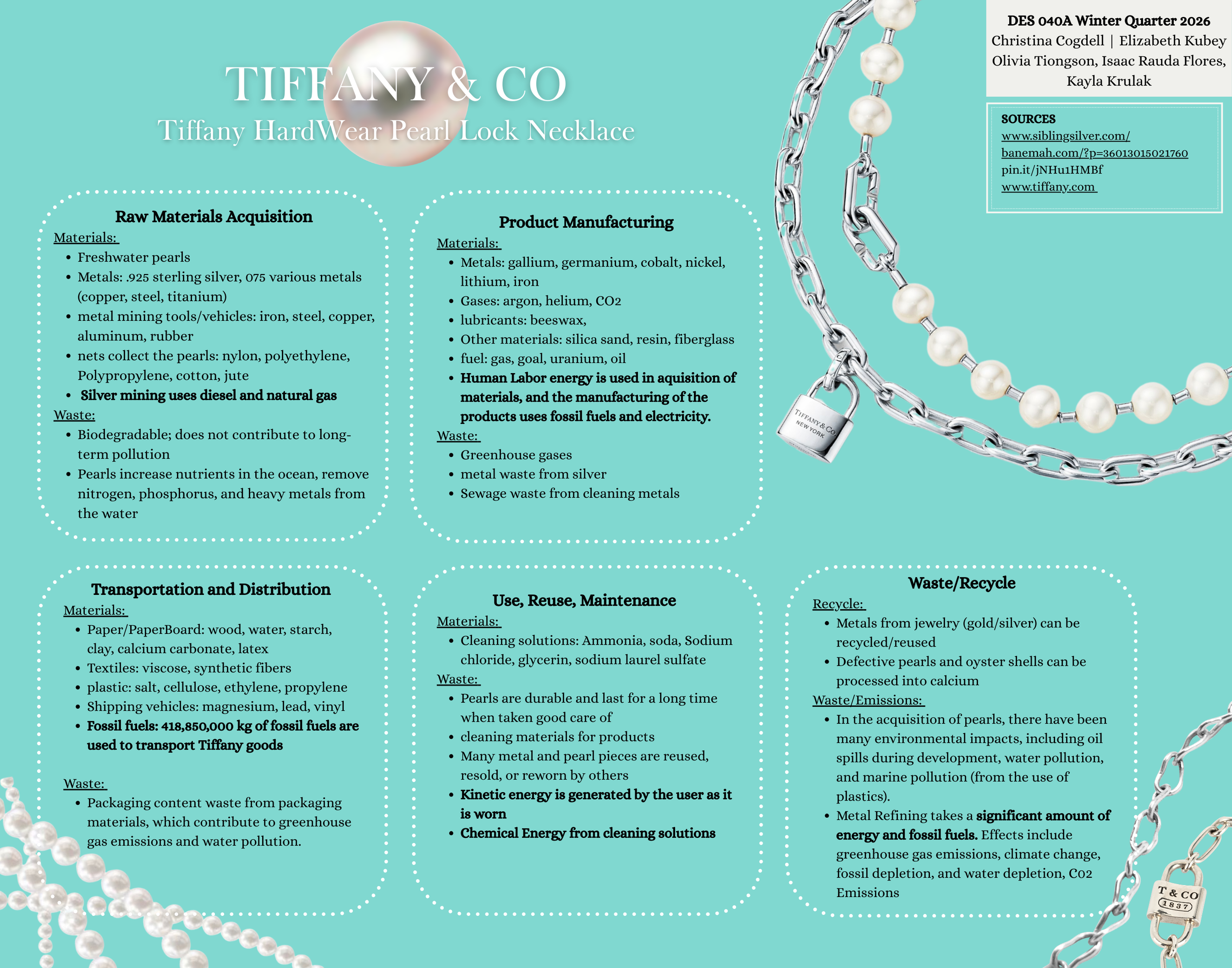
Tiffany & Co. is a jewelry company known for its extravagant luxury pieces. Their jewelry ranges from a variety of materials, but mostly silver, pearls, and diamonds. In the manufacturing of their products, they have vastly impacted the environment. This paper will analyze the waste produced in the life cycle of the Tiffany HardWear: Pearl Lock Necklace in Silver, most importantly, the product manufacturing, raw materials acquisition and use, reuse, and maintenance stages. Along with how the jewelry industry contributes to the significant environmental and social impacts of water pollution, greenhouse gas emissions, and discussing the changes it makes as it strives towards sustainability.
Many materials go into making the Tiffany HardWear: Pearl Lock Necklace; the acquisition of these materials is an extensive journey to end in the product. The materials that go into making the product are mainly freshwater pearls and the metals included are: .925 sterling silver, 075 various metals (copper, steel, titanium). It may sound simple, the necklace is made of pearls and silver, but it's actually a lot more than that. In order to acquire those metals, there is an extensive process of metal mining, which requires tools and vehicles made of iron, steel, copper, aluminum, and rubber. Along with the process of acquiring pearls, which is called pearl farming. This is a multi-billion-dollar industry, with great economic value, which contributes to its suppliers; in this instance, the pearls used in jewelry are usually sourced in Asia, China, and Japan (Pinka). Materials that go into pearl farming are nets that collect the pearls made of nylon, polyethylene, Polypropylene, cotton, and jute. During the acquisition of these materials, Silver mining uses diesel and natural gas, which emit greenhouse gases into the atmosphere, along with pearl farming waste, including. Pearls are used to increase nutrients in the ocean and remove nitrogen, phosphorus, and heavy metals from the water. This relates to the manufacturing of the products by having a large amount of waste.
The Manufacturing process of Jewelry has its own impacts on the environment, with companies often using heavy amounts of fossil fuels to achieve the final product. In the process of refining metals, there is a result of metal and plastic dust from the product. Metal waste from silver contributes to pollution in the ocean, but it also contributes to a loss of profit because of scraps from the metal. Many other forms of waste include chemical waste and sewage waste from the cleaning of metals in the jewelry workshops (Firat). The waste from pearls includes the most obvious, which is the oyster shell waste; about 600kg of shell waste is produced in one batch of pearl farming. Also in the process of pearl farming, we talked about using nets and cages for oysters, which results in a large amount of plastic waste, specifically microplastics, which have a long lifespan and result in many different environmental damages, like pollution. The overall process of pearl farming contributes mostly to greenhouse gases and CO2 emissions to the atmosphere. What Jewelry companies do to achieve the development of their products is to source materials from companies that use human labor. This results in poor working conditions, low pay, and poor treatment. The workers are exposed to many toxic chemicals, which result in health issues. With the manufacturing of products and managing waste, there are lots of materials that harm the environment, but also can be reused in the process.
In many cases, the industry strives to reuse metals, and with pearl farming, there is a possibility for repurposing them. Pearls are often reused in jewelry because once they are sourced and manufactured, they are durable and last for a long time when taken good care of. Tiffany & Co. provides cleaning services for this to be achieved, including cleaning materials for products. Real jewelry isn't something that is usually disposed of like many other products. They obtain a second life, many metal and pearl pieces are reused by being resold and reworn by others, giving them a larger life span. The metals can also be reused in the process, being used to create other jewelry products; in fact, a big portion of the metals used to create the products are recycled metals. Overall, a lot of the products of the Tiffany HardWear: Pearl Lock Necklace can be developed into something else in their lifespan. The materials that cannot be reused are most often moved onto attempting to be recycled, but most of the time, the jewelry products themselves don't lead to a vast amount of waste.
Through all the waste in the manufacturing process, acquisitions of raw materials, the main impacts that the waste has on the environment and humanity include greenhouse gases, climate change, fossil depletion, and water depletion. Humans are affected by consuming toxic materials in the mining process, and the plastics used in the process are contributing to long-term health issues due to pollution. As the Jewelry Industry Aims for sustainability, the steps they are taking to achieve this goal are the following. I've mentioned that in the acquisition of metals, there is a big use of human labor, which includes many risks in endangering their lives and health in the process. As Tiffany & Co and the jewelry industry strive to be more sustainable in the development process, one way they work towards combating this issue is by only sourcing materials from companies that obey the Human Rights Watch (Manlow).
As well as there being a shift from developing “gemstones” to being artificially grown instead of mining and extracting these materials from the earth. Since pearls are considered the gemstone in this scenario, the pearl farming industry is shifting to trying to create artificial pearls by creating artificial oysters (Pinka). Waste is also managed by defective pearls being produced into calcium, which can be used in lots of products in the health and beauty industry, such as cosmetics and skin care. Along with the oyster shells being incorporated into other products in the agriculture and construction industries, such as fertilizers. The pearl farming industry still strives towards finding new ways to recycle and repurpose the shells since they are the main result of waste. In the acquisition of pearls, the specific environmental impacts include oil spills during development, water pollution, and marine pollution from microplastics. They intend to combat this issue by well managing the materials used in the process of acquiring the pearls. Imposing stricter regulations and using less plastic by using biodegradable materials, such as polymers in the extraction process, and natural materials. Overall, the aim for sustainability is to use less harmful materials that affect the environment.
The process of metal refining takes a significant amount of energy and fossil fuels. The machines used in the process of refining and collecting the scraps of metals create long-term greenhouse gas emissions, climate change, fossil depletion, and water depletion, C02 Emissions in the disposal processes of these materials used when recycling and upcycling. Jewelry companies are trying to improve their manufacturing process to be more environmentally friendly by attempting to only use 100% recycled metals in their jewelry. Along with using “In-house” techniques for the recovery of scraps, this is a process of purifying gold, silver, and other metals in the same manufacturing process and location to control and limit the spread of waste (Corti). As mentioned in the process of manufacturing the products, the result is lots of metal scraps left over. By doing this, they are allowing for there to be more quality control in their products, causing less environmental impacts.
In summary, the disposal and recycling process of jewelry consists of separating the gemstone and the metals. The gemstones, in this case, pearls having their own expanded use in the life cycle, depending on their quality. Defective and contaminated pearls are processed, and well-maintained ones are reused. The metals are sorted, purified, and refined in the recycling process. Finally, the industry works towards improving the human labor process in manufacturing by maintaining human rights and creating a safer environment for workers.
Ultimately, the analysis of the Tiffany HardWear: Pearl Lock Necklace life cycle shows that the process is an extensive journey. This includes the acquisition of materials, product manufacturing, and recycling, focusing on the waste of the life cycle. It shows how the jewelry industry has contributed to many harmful effects on the environment in the manufacturing process. Overall, the global impacts include greenhouse gases, CO2 emissions, and pollution, but the jewelry industry aims to resort to a more sustainable process, such as using less plastic, better manufacturing practices, and expanding the lifecycle of their products by keeping them well-maintained, with the intent that the products are built to last. The necklace may seem like a simple piece of jewelry that consists of a pearl and silver, but in the process of making these products, Tiffany & Co. and other jewelry companies create long term impact in every piece of jewelry. Jewelry itself is already a more lasting product than the average one, and hopefully, if they continue to strive towards sustainability, they will create change that the world needs to see, eliminating the amount of waste produced.
Work Cited
Chonlawan Thammaraksa, Annuwat Wattanawan, Trakarn Prapaspongsa, “Corporate environmental assessment of a large jewelry company: From a life cycle assessment to green industry”, Journal of Cleaner Production, Volume 164, 2017, Pages 485-494, https://www.sciencedirect.com/science/article/pii/S0959652617313896
Corti, Dr. Christopher W. “Recovery and Refining of Gold Jewellery Scraps and Wastes.”
The Santa Fe Symposium on Jewellery Manufacturing Technology, 2002, pp. 1-20, https://www.researchgate.net/profile/Christopher-Corti/publication/237462783_Recovery_and_Refining_of_Gold_Jewellery_Scraps_and_Wastes/links/00b49533af304a5808000000/Recovery-and-Refining-of-Gold-Jewellery-Scraps-and-Wastes.pdf.
Eng, C., & Fusco, M. “Fish Scales and Faux Pearls: A Brief Exploration into the History of Manufacturing Faux Pearls. Textile History, 43(2), 250–259. (2012) https://doi.org/10.1179/0040496912Z.00000000013
Firat Burat, Hüseyin Baştürkcü, Mustafa Özer, “Gold&silver recovery from jewelry waste with combination of physical and physicochemical methods” Waste Management, Volume 89, 2019, Pages 10-20, https://www.sciencedirect.com/science/article/pii/S0956053X19301941
Neeru, Dr. Neeru Jain, and Phophalia, Swati, The Beauty of Sustainability: Exploring the Design and Material Innovations in Eco-Friendly Fashion Jewellery (August 12, 2023). https://ssrn.com/abstract=4538900
Perret, Jens Kai, et al. “Navigating the High Jewelry Industry’s Future: Sustainability and Brand Diversification.” Businesses [Hawthorn], vol. 5, no. 4, 2025, p. 49, https://doi.org/10.3390/businesses5040049
Pinka, D.; Matsubae, K. Global Warming Potential and Waste Handling of Pearl Farming in Ago Bay, Mie Prefecture, Japan. Resources 2023, 12, 75. https://doi.org/10.3390/resources12070075
Shor, Russell. "FROM SINGLE SOURCE TO GLOBAL FREE MARKET: THE TRANSFORMATION OF THE CULTURED PEARL INDUSTRY." Gems & Gemology 43.3 (2007). https://www.gia.edu/doc/Fall-2007-Gems-Gemology-Cultured-Pearl-Industry.pdf
Tenuta, L.; Testa, S.; Antinarelli Freitas, F.; Cappellieri, A. Sustainable Materials for Jewelry: Scenarios from a Design Perspective. Sustainability 2024, 16, 1309. https://doi.org/10.3390/su16031309
Veronica Manlow (2021). Jewelry Design in the Luxury Sector: Artistry, Craft, Technology, and Sustainability. In: Coste-Manière, I., Gardetti, M.Á. (eds) Sustainable Luxury and Jewelry. Environmental Footprints and Eco-design of Products and Processes. Springer, Singapore. https://doi.org/10.1007/978-981-16-2454-4_8
Zhu, Di, and Lingfei Jin. "Research on the Historical Origin and Development of Pearls." International Journal of Aquaculture, vol. 13, no. 10, 2023. ProQuest, https://www.proquest.com/docview/3076925008/fulltextPDF?pq-origsite=primo&accountid=14505&RAO=true&searchKeywords=development%20of%20pearls&sourcetype=Scholarly%20Journals