Design Life-Cycle
assess.design.(don't)consume
Richie Huang
Professor Cogdell
DES 40A: Energy
11 March 2026
Oura Ring: Materials
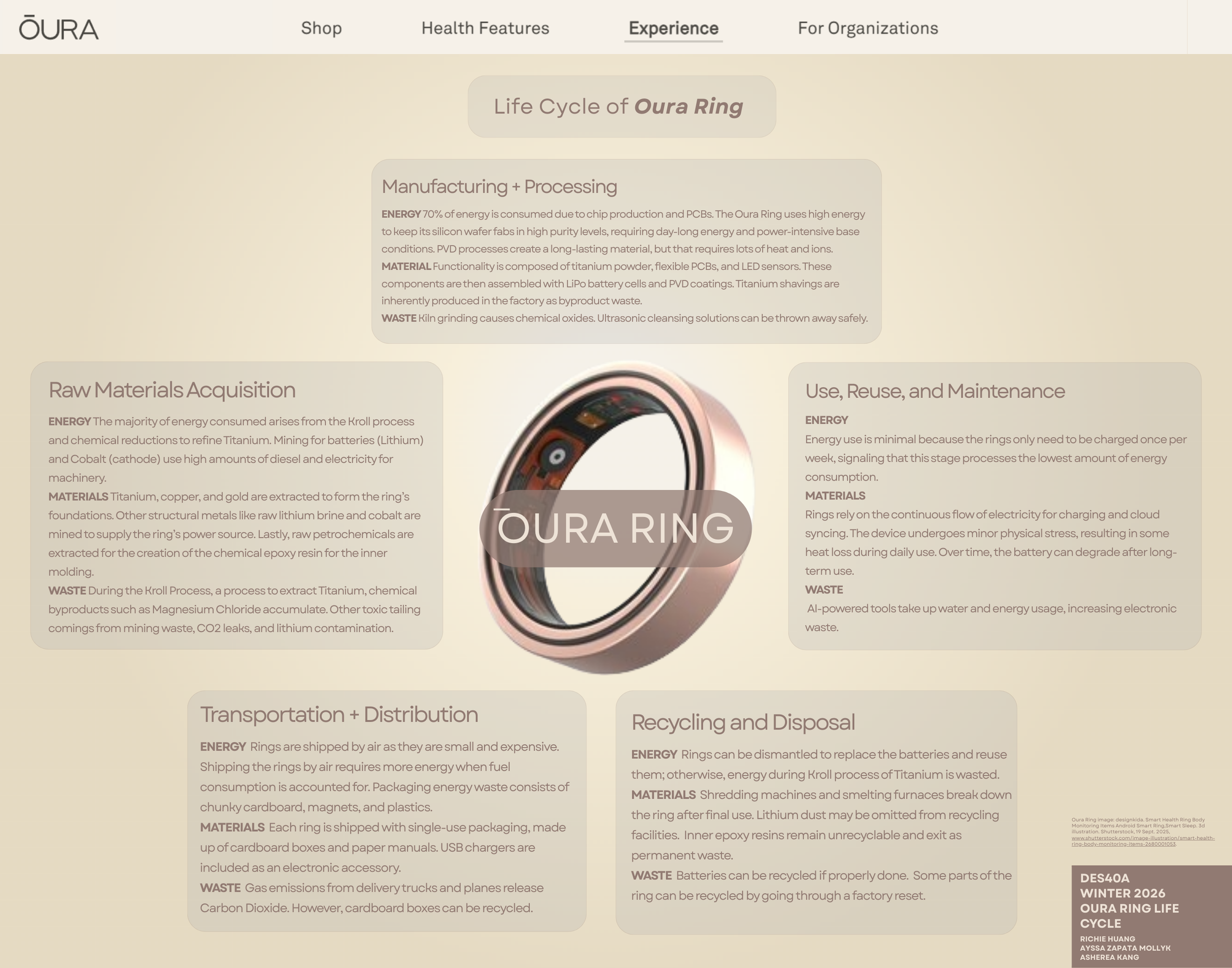
The Oura Ring, a simple, yet innovative band of metal, has quickly become a go-to smart device for millions of individuals who are actively following emerging trends to better improve their physical health. At the forefront of this phenomenon are wearable technologies, which have completely redefined how humans monitor, manage, and care for their personal health. The Oura Ring has quickly become a hot commodity in this specific market, as it serves as a smart technology for tracking personal metrics on sleep quality, heart rate, and overall wellness. Despite how popular the ring is, there is a complex paradox behind how it is created. While the health benefits to humans is undeniably high, the creation of this device extracts a devastating toll on our planet, deeply impacting the global supply chain by requiring an immense amount of resources with how the raw materials are both extracted and acquired. To truly understand the environmental cost of the Oura Ring, there needs to be a consideration for a Life Cycle Assessment (LCA). This section focuses on the “Raw Materials Acquisition” phase of how the Oura Ring is developed as a product. This stage analyzes how various components, like ores, minerals, and chemicals, are stripped from our planet in order to create this device. These components are typically extracted through harmful extraction methods that cause the planet to pay a heavy price. Therefore, this stage poses the question of whether the ring’s product benefits outweigh the ecological cost of producing it. Although the Oura Ring is a smart wearable device that is sleek, convenient and praised for its premium quality, the extraction and refinement process of its finite resources raises a severe environmental concern that inevitably precedes the manufacturing of the product.
The primary structural component of the Oura Ring is aerospace-grade titanium, a material that is known for its lightweight properties. While the ring’s durability is a core reason as to why the ring is so appealing, the extraction process for this material requires immense amounts of energy and chemical inputs for it to transition it from a raw ore to a usable form of metal. Firstly, raw titanium is a non-renewable resource; it is locked within mineral sands, such as rutile and ilmenite, that must be aggressively mined and separated. Clearly, there is a sheer volume of mines that must be processed and excavated for just one yield of titanium ore. Thus, once the raw ore is extracted, the ring necessitates the Kroll Process, an intense industrial method that involves treating the ore with harsh chemicals, such as chlorine gas and carbon, at blistering temperatures to create titanium tetrachloride. From there, it is then reduced with molten magnesium in a high-temperature environment to finally create a usable form of titanium powder. Additionally, refining titanium ore in this manner results in heavy consumption of both energy and natural resources, which leaves a hefty carbon footprint for the metal before it is ever shaped (Landi et al. 319). Magnesium chloride exits the chemical refinement stage as a highly toxic byproduct that poses risk to the refineries and local ecosystems. As a result, the structural transition from raw ore to functional casing poses a severe environmental impact early on in the product’s life cycle. Ultimately, the sleek quality of the ring’s shell is developed from a chemically hazardous and energy-consuming extraction process.
When we break down the Oura Ring’s exterior, there seems to be mostly a reliance on energy and chemical inputs. However, the ring’s interior conveys a different ecological challenge due the scarcity of the extracted materials. To power the Oura Ring, it requires a miniature Lithium Polymer (LiPo) battery, a component that requires two critically finite minerals: lithium brine and cobalt. These minerals possess positive and negative electrodes that help to power the ring’s battery. Lithium brine acts as the positive electrode, while graphite acts as the negative electrode. Further, obtaining these materials is highly destructive to local communities and the geographies in which these individuals inhabit. For instance, lithium is typically pumped from deep underground reservoirs into man-made, artificial brine evaporation pools, pulling millions of gallons of water away from local ecosystems. As a result, this method of extraction frequently leads to severe droughts and collapse in agricultural production in these surrounding indigenous communities (Siwec et al. 50). In a similar manner, cobalt mining occurs in large, open-pit mines that scar the earth. The result is a heavy ecological footprint and higher use of carbon emissions, with the expansive need for more land, decimation of ecosystems, and mining machinery to distribute the extraction for the ring’s exterior.
Next, the ring’s smart features necessitate more minings of the aforementioned minerals: lithium brine and cobalt. The same extracted materials are now refined and transformed into functional components. The ring uses delicate internal sensors and flexible printed circuit board (PCBs) to transmit health data from device to user. These components use little amounts of these precious metals but continue to stretch the environmental cost due to the difficult nature of extracting them. One highly conductive material for the ring’s motherboard is gold palladium, which requires rocks to be blasted, crushed, and treated with toxic cyanide leaching just to yield a single ounce of gold (Kagelüken, et al. 203). To add, the physical amounts of these metals for just one single ring has led to physical teardowns of the device, which is confirmed by the small, yet impactful graceful amounts throughout the microscopic, flexible circuit board (Stern). Furthermore, microscopic permanent magnets and semiconductors require cradle-stage mining, which undergoes a similar process of extraction to the other components. Consequently, the extraction of rare earth elements produces a frequent amount of radioactive wastewater and toxic tailings, leading to permanent contamination of soil and groundwater at mining sites.
Upon the development of these core metallic components, they are then sourced to the manufacturing, which are protected by synthetic, non-metallic materials. To protect the sensitive electronics from potential pollutants like sweat and moisture, the ring uses a thermoset epoxy resin, which relies on petrochemicals for its plastic shell. More specifically, the inner shell uses Epoxy Molding Compounds (EMC), engineered from non-metallic phenolic resins and fine silica fillers (Teo et al. 23). The extraction for these materials requires raw crude oil and natural gas, which involves offshore drilling and fracking, which both historically lead to microplastics seeping into marine environments (Wang et al. 126). However, the company does sedate environmental degradation slightly by using high-quality polymers to resist standard plastics and protect the user’s skin when they are wearing the ring. Despite this effort, engineering this type of plastic requires more intensive chemical processes at this stage that locks fossil fuels as extracted materials, which is a non-renewable energy source, leading to more environmental degradation. To add fuel to the fire, the ring’s exterior is also treated with Physical Vapor Deposition (PVD) coatings to achieve its color, which often requires high-energy plasma and even greater consumption of target materials (Mativenga et al. 46). These materials combined to create these chemical layers ensure long-lasting quality, but do guarantee that long-term destruction to the environments in which they are extracted from.
Conclusively, after analyzing the impact of the Oura Ring’s raw materials, there is an undeniable truth: smart products create large ecological footprints. The raw materials life cycle assessment proves how procuring such materials require industrial methods that are both destructive to the environment and resource-dependent. While this product absolutely promotes positive benefits to personal health and is as advertised, it does blindly follow unsustainable practices for its raw materials acquisition as other products in the digital/electronics sector. It goes to show how sometimes the smallest devices can carry the heaviest burdens on our environment, highlighting the hidden cost of wearable technology.
Works Cited
Batteries, Grepow. “Different Types of Lithium Polymer Batteries.” Grepow Blog, 24 May 2019, www.grepow.com/blog/different-types-of-lithium-polymer-batteries.html.
Hagelüken, Christian, et al. “The Electronics Recycling Landscape.” Metal Recycling: Opportunities, Limits, Infrastructure, United Nations Environment Programme, 2013, pp. 200-218.
Landi, Daniele, Christian Spreafico, and Davide Russo. “LCA of Titanium Powder: Empirical Evidence vs Data from Patents, Possible Future Applications.” Procedia CIRP, vol. 116, 2023, pp. 318-323.
Mativenga, P.T., et al. “Energy Consumption in Physical Vapor Deposition (PVD) Coatings.” CIRP Annals, vol. 63, no. 1, 2014, pp. 45-48.
Siwiec, Dominika, et al. “Analysis of the Ecological Footprint from the Extraction and Processing of Materials in the LCA Phase of Lithium-Ion Batteries.” Sustainability, vol. 16, no. 12, 2024, art. 5005. MDPI, https://doi.org/10.3390/su16125005.
Stern, Becky. “Oura Ring Teardown (Gen 3 and Gen 2).” Becky Stern Blog, 17 Apr. 2022, beckystern.com/2022/04/17/oura-ring-teardown-gen-3-and-gen-2/.
Teo, A.J.T., et al. “Thermomechanical Analysis of Epoxy Molding Compounds for Electronic Packaging.” Microelectronics Reliability, vol. 83, 2018, pp. 22-31.
"Titanium: Light, Strong, and White." Chemistry World, Royal Society of Chemistry, 22 Aug. 2018, www.chemistryworld.com/podcasts/titanium/3009395.article.
“Rare Earths Statistics and Information.” U.S. Geological Survey, National Minerals Information Center, 2024, www.usgs.gov/centers/national-minerals-information-center/rare-earths-statistics-and-information.
Wang, Xu, et al. “Atmospheric Microplastic over the South China Sea and East Indian Ocean: Abundance, Distribution and Source.” Journal of Hazardous Materials, vol. 389, 2020, art. 121846. ScienceDirect, https://doi.org/10.1016/j.jhazmat.2019.121846.
Ayssa Zapata Mollyk
Professor Codgell
DES 40A
13 March 2026
Oura Ring: Embedded Energy
Wearable technologies have evolved into reliable sources that serve as health-monitoring devices used to track lifestyle. The most prominent of them is the “Oura Ring,” a sleek titanium smart ring designed to provide personalized insights into metrics such as daily life, activity, sleep, recovery, and more. The company creates a beneficial technology, health optimization for individuals but despite these efforts, the small wearable device with its miniature nature encompasses a shocking amount of embedded energy “all the energy that is used to produce a material or product, including mining, manufacture and transport” (YourHome), representing the hidden environmental damage and strong ecological weight that a miniature device can have. Starting from the hidden cost due to the materials used, including gold, which is mined and extracted in small quantities, but damaging large lots of land, and going all the way to high heat use by the Kroll process utilized for Titanium refinement. Furthermore, manufacturing and production processes involve higher energy use, chemical processes, and specific fabrication conditions that require significant energy. Consequently, making the product very difficult to disassemble for repair or reuse, generating permanent waste and degrading the environment when the battery stops working, and leading the small device to be finally discarded by the consumer. For that reason, while the Oura Ring is a smart device that tracks individuals' sleep and physical activity, the embedded energy's impact on the environment is costly due to its harmful methods of material extraction and complex manufacturing process.
Raw Material extraction and refining consume the most energy because of the specific materials used to ensure a durable, efficient product. Starting with the primarily used material, titanium, a durable but costly material due to the Kroll process done in countries like Japan and China, powered by coal-heavy electrical grids, natural gas, and nuclear power. The Kroll process is an energy-intensive, high-temperature refining process that involves removing titanium from its ore and converting it at 1000°C to a purer form. The outcome is a titanium sponge that is now compatible with other metals, but that absorbed so much energy due to the high temperatures it underwent that the material needs further processing. In addition, the ring aesthetic also requires energy due to the materials it uses, including the gold and specific ring final touches. When talking about gold the extraction process is massively damaging for the environment as it involves intensive material processing of ore after its extraction by shattering explosives into land to get minimum amounts of the metal the process does not finish in that instance as the Oura Ring is coated using Physical Vapor Disposition that vaporizes materials to ensure a non scratch and hypoallergenic product but by using a high energy process as materials need to be vaporized to ensure this durable coats. The “brain” of the Oura Ring, the semiconductor sourcing and processing, also uses purification to generate ultra-pure silicon for sensors and microcontrollers that exceed 1400°C. All the raw materials are further processed and refined to ensure they are moved and precise during the manufacturing process.
Energy usage during manufacturing is driven by the compact nature of the Oura Ring, as its oval form and miniature complexity require developed technology and extenuating levels of precision. The Printed Circuit Boards (PCBs) for the wearable technology need to be fabricated in clean room environments, with locations in European countries such as Finland and Estonia. The clean rooms require specific temperatures and constant particle filtration to ensure a smooth process. In addition to these sanitary rooms, energy also comes from the heavy use of water and energy intensive chemical etching processes that produce flexible miniature circuit boards. When addressing the mounting component, the Oura Ring uses surface-mount technology (SMT) to solder minuscule components, in particular sensors, using advanced robotic methods. This solder method entails a higher environmental cost than large technological devices; the ring requires greater precision and meticulousness to unify all components in such a compact device. Energy is also consumed during the manufacturing of batteries to power the Oura Ring, as the company uses lithium ion batteries that require concentrated energy for cathode coating and electrolyte filling (Oura Ring Review). Batteries need super clean ecosystems that prevent any source of outside contamination. After all the manufacturing and production processes are complete to assemble the ideal prototype, the cost of energy does not cease, as distributing the product worldwide also increases the environmental “debt”.
Oura rings have a worldwide, decentralized supply chain, resulting in significant energy consumption from embedded energy use in transport and travel logistics. Due to its elevated cost and lightweight nature, the Oura Ring is transported by air, meaning that one ring can travel more than 15 000 miles. The semiconductors likely depart from Taiwan by flight, 6000 miles, to be assembled in America (Global Taiwan Institute). The embedded energy used by airplanes is much higher than that of sea or land transport. Air transport has high energy consumption, linked to higher speeds and the specific fuel consumption of each cargo. The ring's total footprint continues to increase due to the luxury packaging the company offers its consumers. In the retail sector, the company still opted to use high-quality multi-layer paper and plastic to package the tiny device, which still adds energy to the product's lifecycle, despite several efforts to make the packaging more sustainable and environmentally friendly. The energy consumed during the final stages of transportation occurs when the freshly produced device is transported from warehouses to consumers. Land transport, and with it fossil fuel consumption, ends up being the final cost in transporting the product. The footprint of the Oura Ring is massive despite its miniature nature. When considering its impact, we also need to account for the cost of energy for use and ring charging.
A comparison is necessary to analyze not only the energy used during consumption but also the embedded energy used throughout the ring’s total lifespan. Regardless of the perception that products might require more energy during their lifespan, this is not the case with the Oura Ring, as the final stage is only around 10% of the total energy, very low compared to manufacturing, delivery and production that are around 90% of the embedded energy of the ring given the wearable technology a relative daily low energy cost. To prove this, an average calculation of energy can be made if a normal period of the ring's use is considered, a (lifespan 3 years) multiplied by the amount of times the ring needs to be charged (only needs to be charged once per week), this will result in an almost insignificant use of energy to keep the device properly functioning. An additional operational cost also needs to be considered when evaluating energy use in this stage, namely the energy used by Oura Ring servers as they sync with each device via the cloud to track health metrics, each person's information, and habits. Data centers require significant energy for processing analytics and cooling, meaning that every time a customer gets their readiness or sleep tracker, the ring symbolizes more energy waste for the environment. Analyzing the pros and cons of the embedded energy utilized by Oura Rings in depth is necessary and fundamental for customers in order to analyze if it is a worthy purchase that is not only efficient and a good alternative but also a sustainable product for the planet.
The lifecycle analysis of the ring demonstrates that, despite its miniature size, it still has a significant environmental footprint. The embedded energy of refining at high temperatures, mining gold, and executing high-energy processes contributes to the irreparable carbon debt that the ring produces and cannot be eliminated. Analyzing the prototype from a sustainable viewpoint raises awareness of the inefficiencies the ring company faces in developing an environmentally friendly product that uses green materials and pays close attention to its procedures, aiming to use renewable sources and be waste-conscious. These companies, instead of focusing on aesthetics, should allocate their efforts in order to solve the materials, production, and transportation inefficiencies, looking for a modular architecture that can use recyclable materials, especially in the case of Titanium, renewable energy in the process of building the product, and less transportation to avoid the increase of fossil fuels in the air. The customers should analyze if the impact the ring has on their lives is greater than the total cost of embedded energy the ring implies, not only for charging and while using it, but mostly the total cost of the ring to be produced from when it starts as a raw material until its final delivery standpoint, including its logistics.
Works Cited
“Embodied Energy.” YourHome, Australian Government, 2021, https://www.yourhome.gov.au/materials/embodied-energy.
Gidman, Jennifer. “Oura Ring Review: Is This Smart Ring Worth the Hype?” Saatva, 15 June 2023, https://www.saatva.com/blog/oura-ring-review/
“Gold Processing.” Britannica, 2024, https://www.britannica.com/technology/gold-processing
“How Is Titanium Produced? The Kroll Process.” Kyocera SGS Precision Tools, 2024, https://kyocera-sgstool.co.uk/titanium-resources/titanium-information-everything-you-need-to-know/titanium-production-processes/.
Rodrigue, Jean-Paul. “Transportation and Energy.” The Geography of Transport Systems, 5th ed., Routledge, 2020, https://transportgeography.org/contents/chapter4/transportation-and-energy
“What Is PVD Coating?” Semicore Equipment, Inc., 2024, https://www.semicore.com/what-is-pvd-coating
“Nature Paper on Wearable Health Electronics – Fengqi You Research Group.” Fengqi You Research Group – PEESE @ Cornell University, 6 January 2026, https://www.peese.org/nature-paper-on-wearable-health-electronics/. Accessed 4 February 2026.
“Global Taiwan Institute: Taiwan’s Energy Mix and Its Impact on Semiconductor Manufacturing.” Global Taiwan Institute, Jan. 2026, https://globaltaiwan.org.
Yin, Yilong. “Sustainable Transition of the Global Semiconductor Industry: Challenges, Strategies, and Future Directions.” MDPI, https://www.mdpi.com/2071-1050/17/7/3160. Accessed 4 February 2026.
Rabost-Garcia, Genis, et al. “Early-Stage Life Cycle Assessment for Sustainable Design of Wearable Microfluidic Sweat Sensor: Continuous Dehydration Monitoring.” Frontiers, Frontiers, 4 Feb. 2026, www.frontiersin.org/journals/lab-on-a-chip-technologies/articles/10.3389/frlct.2025.1688689/full.
Asherea Kang
Professor Christina Cogdell
DES 040A Section 02
13 March 2026
Lifecycle of Oura Ring and its Wastes and Recycling
In the early 2000s, when competition within the electronic market began to grow, Oura released its first generation of Oura Rings, a device that can track sleeping conditions and heart rates, in March of 2015 (Hughes). Ever since, Oura has released many generations of models, enhancing their previous ones with new features. However, despite the company’s goal to benefit society, taking a deeper dive into its life cycle allows customers and the environment to determine if the ring is worth the cost of harming the environment. This section will cover the outcome of wastes and byproducts, such as carbon emissions and fossil fuels, during raw material acquisition, manufacturing, distribution, use and maintenance, to see how they are efficiently recycled or expanded in its lifecycle, to ensure that the consequences of the Oura Ring are safe for the environment.
The earliest accumulation of chemical wastes occurs during the extraction of raw materials and specifically during the acquisition of the Oura Ring’s main component, titanium. Titanium metal is mainly produced with ilmenite and rutile and goes through the Kroll process to extract its materials (El Kphalloufi). The first steps of the Kroll process does not result in any waste because “titanium oxide feed gets chlorinated with carbon to create titanium chloride”, and is a process for all the materials to react to each other (Takeda). During the second step of the Kroll process, titanium sponge undergoes a vacuum distillation in order to separate magnesium chloride and unreacted magnesium metals from removal. Even though magnesium chloride may seem like a waste, the goal of the vacuuming process is to evaporate the byproducts safely (Takeda). With engineering and strategic layouts of how the titanium should extract magnesium chloride and its remaining particles, particles should not be misplaced when evaporating, keeping the process environmentally safe. Moreover, at the final step of the Kroll process, the material flow of titanium results in high-grade and low-grade scraps that can be recycled by being remelted for reuse.
The Oura Ring varies in its production of manufacturing, meaning its byproduct will vary due to not just factory based causes, but from the consequences of AI generated programs as well. To begin with factory based byproducts, kiln grinding causes chemical oxides, carbon dioxide, and overall greenhouse gas production. After titanium is mixed with other minerals that make the outer layer of the Oura ring, the mixture goes through sintering by kiln grinding (Oura Ring 4). Kiln grinding releases chemical oxides and waste powder into the atmosphere. Next, the ring undergoes ultrasonic cleansing, which is usually reused until the solution turns cloudy. Once it does, it is an indication that the solution needs to be thrown away in a safe container to be removed, but cannot be recycled or reused. In the end, the actual electronic components of the Oura ring assemble together, but fossil fuels from factories add to carbon dioxide emission. Electronically, AI-powered tools in the Oura Ring’s app add up to water usage and energy consumption. According to Forbes, an estimated 17 billion gallons of water were used by U.S. data centers in 2023, with one data center estimated to use “300,000 gallons of water per day” (Silverstein). With AI advancing, the cost of functioning the ring is a drawback to its high water usage. To add on, in order to keep up with the growing demand for Oura Rings, the company delivers its products through truck and plane delivery, like every business today, which may seem to be unethical to the environment.
In transportation, carbon dioxide is inevitably released by gas emissions from land and air transportation. Oura Rings are mainly shipped with DHL, a delivery service company that provides transportation for their lightweight products from Finland to reach worldwide markets (Shipping FAQ). In addition, Oura has plans to establish more manufacturing locations, beginning in Texas, decreasing aviation emissions because air transportation would not produce as many emissions (HLTH). However, on DHL’s website, innovation strategies, such as DHL’s GoGreen Solutions, are created for businesses to target decreasing aviation emissions by analyzing logistics and strategies to drive for a lower carbon footprint on cargo without compromising on services (DHL). Furthermore, a study found that freight transportation takes up “8% of global greenhouse gas emissions,” while land transportation can “emit more than 100 times as much carbon dioxide as ships to carry the same amount of freight the same distance” (Greene). This evidence in statistics makes it essential for businesses, such as Oura, to participate in either expanding the lifespan of how carbon dioxide gets redirected or lowering the production of emissions in their delivery processes. In spite of efforts to reduce carbon emissions, fossil fuel is hard to tackle as delivery trucks are the main source of land transportation for shipping. Moreover, Oura tries to be environmentally friendly by using cardboard boxes for their packages that can later get recycled. Nevertheless, according to “How Corrugated Cardboard is Made,” manufacturing the cardboard boxes themselves is another greenhouse process that does not get accounted for, as industrial factories, machines, and electricity are needed to make the packaging. There are going to be drawbacks to every approach, but manufacturing recyclable packages allows customers an easier strategy for materials to reduce landfills. Today, it is especially important in addressing how products can try to eliminate or extend the lifespan of each byproduct in hopes of being efficient and reducing the speed of its negative environmental impact, and where it ends up.
During the ring’s maintenance, waste is not produced. Nonetheless, energy consumption can be taken into account when using the ring itself, as it requires AI and code to be processed. In order to recycle the ring, Oura has a recycling program and ensures that customers who want to send their devices back do not have to pay for shipping. This provides an efficient way for the devices to be recycled or replaced with an upgraded device. However, if customers no longer wish to upgrade or leave it untouched, customers need to safely recycle their device (Device Recycling Program). Despite Oura’s easy features for convenient recycling options, ultimately, it can only be accomplished if customers are motivated to do so. As for the lithium battery, the Oura Ring’s main charger is made up of lithium-ion batteries that can last up to three years (Hyuntae). However, there has been less focus on extracting the lithium out of batteries and other materials, such as cobalt, because they are more expensive. In order to efficiently recycle lithium, it has to be separated from the packed battery or chemically separated.
Deciphering the role and impact of waste as it goes through the creation of the Oura Ring helps redirect which components can and can not be recycled to reduce existing wastes. To target these wastes even further, it is essential to find solutions to how the byproducts can be recycled or repositioned to span the life cycle of it. As briefly mentioned in transportation, delivery trucks inevitably create a lot of the fossil fuel, as well as factory manufacturing, due to the high consumer demand for local and global business (Dombrowski). As of today, because reducing land transportation of supplies is hard to tackle, constructing strategies to expand the life cycle of fossil fuels, such as coal, and natural gas, is an efficient and alternative approach in trying to reduce its negative impacts. An example could be using renewable energy sources, such as sunlight and wind powered energy, because they emit only a little greenhouse gas and primarily no air pollutants. Resorting to similar procedures allows for fossil fuels to slow down the pace in air pollution.
Ultimately, assembling a high technological device such as the Oura Ring requires a lot of industrial and chemical processes that result in byproducts, but may seem like they are difficult to recycle. However, with the ongoing development of technology and reusable strategies, the long-lasting consequences of the Oura Ring’s chemical and physical secondary products can be redirected and extended in its life cycle to reach a goal in sustainability, reducing its impact on the environment.
Footnotes
https://dtsc.ca.gov/electronic-hazardous-waste/#:~:text=What%20is%20e-waste?,Radios
https://www.un.org/en/climatechange/raising-ambition/renewable-energy
https://www.dhl.com/us-en/home/global-forwarding/products-and-solutions/gogreen-solutions.html
http://www.theseus.fi/bitstream/handle/10024/874757/Haapala_Niko.pdf?sequence=2&isAllowed=y
Works Cited
Bae, Hyuntae, and Youngsik Kim. “Technologies of Lithium Recycling from Waste Lithium Ion Batteries: A Review.” Mater.Adv, 27 Apr. 2021, pubs.rsc.org/en/content/articlehtml/2021/ma/d1ma00216c. Accessed 4 Feb. 2026.
Dombrowski, U., and S. Ernst. “Effects of Climate Change on Factory Life Cycle.” Procedia CIRP, vol. 15, 2014, pp. 337–342, https://doi.org/10.1016/j.procir.2014.06.012
El Khalloufi, Mohammed, et al. “Titanium: An Overview of Resources and Production Methods.” MDPI, 16 Dec. 2021, www.mdpi.com/2075-163X/11/12/1425. Accessed 4 Feb. 2026.
Greene, Suzanne. “Freight Transportation.” MIT Climate Portal, 3 Feb. 2023, https://climate.mit.edu/explainers/freight-transportation#:~:text=2:55,of%20freight%20the%20same%20distance
“How Corrugated Cardboard Is Made- Material, Manufacture, Making, Used, Processing, Parts, Structure, Procedure.” https://www.madehow.com/Volume-1/Corrugated-Cardboard.html#:~:text=From%20the%20paper%20mill%2C%20rolls,and%20glued%20to%20make%20boxes
Hughes, Locke. “Inside the Ring: The Making of Oura Ring 4.” ŌURA, The Pulse Blog , 3 Oct. 2024, ouraring.com/blog/inside-the-ring-oura-ring-4/. Accessed 4 Feb. 2026.
Machado, Pedro G., et al. wires.onlinelibrary.wiley.com/doi/full/10.1002/wene.395. Accessed 4 Feb. 2026.
“Oura Opens Texas Manufacturing Facility to Support U.S. Department of Defense Partnership.” HLTH, 28, Aug. 2025, https://hlth.com/insights/news/oura-opens-texas-manufacturing-facility-to-support-u-s-department-of-defense-partnership-2025-08-28 Accessed 7 Mar. 2026.
ŌURA. “Oura Ring 4 Ceramic Factory Field Trip.” YouTube, 1 Dec. 2025, www.youtube.com/watch?v=eUoM3LsT22s. Accessed 5 Feb. 2026.
ŌURA “Device Recycling Program.”
ŌURA “Shipping FAQs.” support.ouraring.com/hc/en-us/articles/360025439494-Shipping-FAQs. Accessed 4 Feb. 2026.
Silverstein, Ken. “America’s AI Boom Is Running Into An Unplanned Water Problem.” Forbes, 11 Jan. 2026, https://www.forbes.com/sites/kensilverstein/2026/01/11/americas-ai-boom-is-running-into-an-unplanned-water-problem/. Accessed 7 Mar. 2026
Takeda, O., Ouchi, T. & Okabe, T.H. Recent Progress in Titanium Extraction and Recycling. Metall Mater Trans B 51, 1315–1328 (2020). https://doi.org/10.1007/s11663-020-01898-6
“Titanium.” Britannica, edited by Britannica Editors, 2 Jan. 2026, www.britannica.com/technology/titanium-processing. Accessed 4 Feb. 2026.