Design Life-Cycle
assess.design.(don't)consume
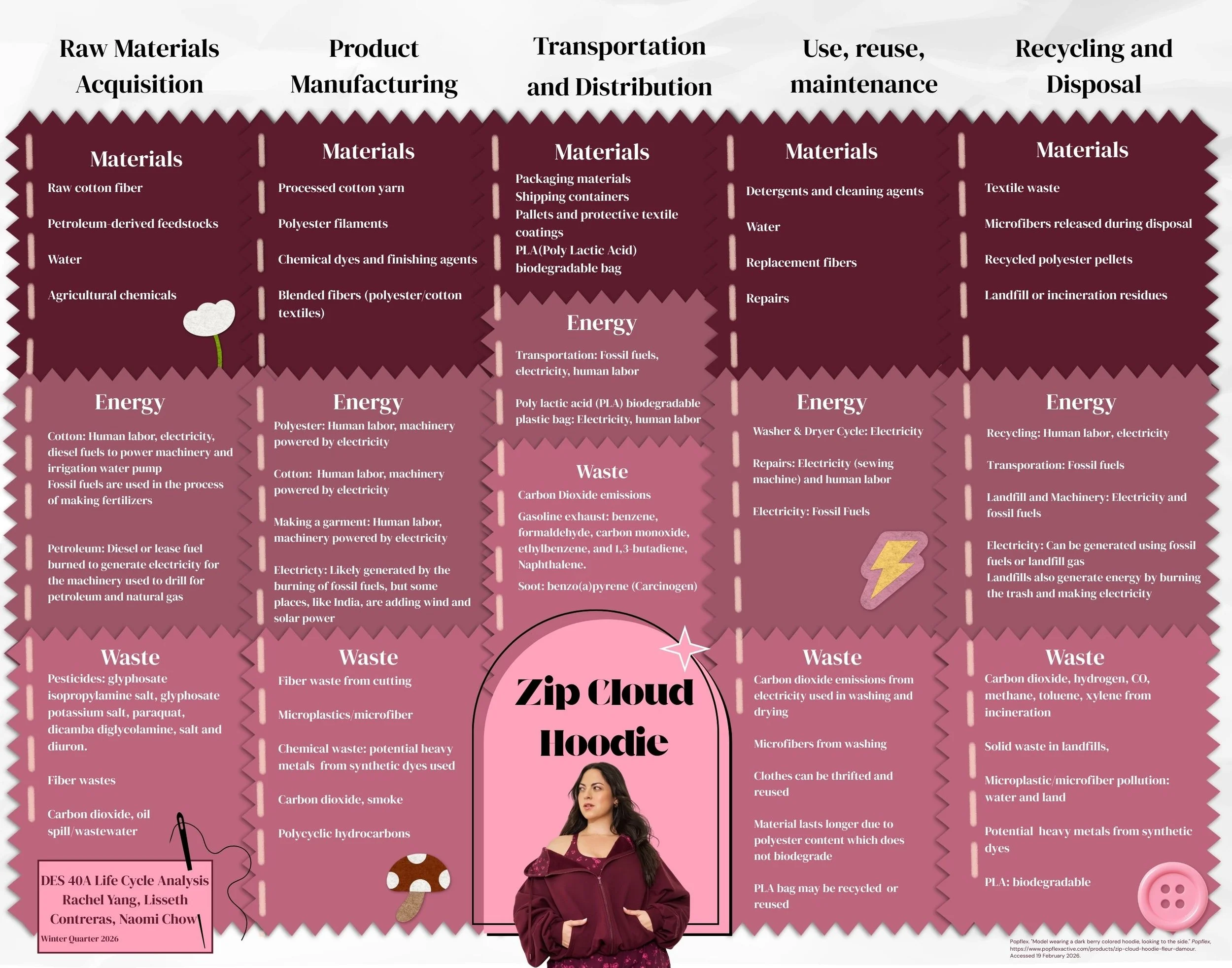
Materials
Rachel Yang
March 8, 2026
Professor Codell
T.A. Elizabeth6
Life Cycle Analysis of the Popflex Cloud Hoodie (Materials)
Introduction
The modern fashion caused environmental impacts, becoming increasingly important as clothing production continues to expand worldwide. The fashion industry continues to rely heavily on both natural and synthetic fibers, which contribute to environmental effects throughout the lifecycle of a garment. The Life-Cycle Analysis (LCA) evaluates the environmental impacts by examining each stage of a product’s life; raw material extraction, manufacturing, consumer use, and disposal. The Popflex Zip Cloud Hoodie presents a common modern clothing product made from cotton and polyester fibers. Polyester has become one of the most common and widely used materials in modern fashion. Anneke Smelik explains that polyester is “the most ubiquitous fabric for textiles” and the most produced fiber or textile that is used in clothing worldwide (Smelik 280). Cotton is also an imperative textile fiber in global production. Researchers emphasize that “cotton is not only the world’s most important natural fiber crop” but also an important research subject for studying plant genetics and fiber development (Huang et al. 437). Smith agrees, as “cotton is the most important natural fiber used in the textile industry worldwide.”Analyzing garments and textiles made from these materials provides information on the sustainability challenges associated with modern fashion production.
Raw Material Extraction
The Life Cycle of the Popflex Zip Cloud Hoodie begins with the extraction of raw materials; cotton and polyester fibers. Cotton is a plant-based fiber made from plants of the genus Gossypium. According to Cotton Production and Uses, cotton is “a delicate, soft staple fiber that develops in a boll… around the seeds of the plants of the genus Gossypium” (Khan et al. 1). Since cotton comes from a plant, it is often seen as environmentally friendly. Gordon also states that “cotton fibers are the purest for mof cellulose, nature’s most abundant polymer.” However, the cultivation of cotton requires significant resources from agriculture.
Environmental research has shown that cotton cultivation can have multiple ecological impacts. A broad review of cotton production notes that cotton cultivation involves “water use, toxicity, eutrophication and greenhouse gas emissions” across different stages of its lifecycle (Zhang et al. 703). Cotton farming regularly requires irrigation systems that consume large amounts of water, particularly in dry regions where water and rain are limited. Also, cotton crops often require pesticides and fertilizers to protect against pests and disease. These chemicals may contaminate nearby ecosystems through agricultural runoff, contributing to environmental pollution.
Polyester production shows a different set of environmental concerns because it is a synthetic fiber made from petroleum. Polyester fibers are made through a chemical processes that transform petroleum-based compounds into long polymer chains. Textile research explains that polyester is “a manufactured fiber composed of synthetic linear macromolecules… at least 85% by mass of an ester” (Ketema and Worku 1). The most common polyester used in clothing is polyethylene terephthalate (PET), which is produced through chemical reactions involving terephthalic acid and ethylene glycol. Because polyester depends on fossil fuels and energy-intensive manufacturing processes, it contributes to greenhouse gas emissions and resource depletion. Against these environmental costs, polyester has become popular in the fashion industry due to its durability, low cost, and versatility.
Manufacturing and Textile Processing
Once raw materials are taken out, they must go through several manufacturing processes before becoming garments. Textile production involves fiber spinning, yarn formation, weaving or knitting, dyeing, and finishing treatments. Cotton fibers must be washed and spun into yarn before they can be turned into fabric. Polyester fibers are produced through polymer extrusion, where melted polymers are forced through small openings to form fibers.
Dyeing is an important stage in textile production because it controls the color and appearance of the final fabric. Polyester fabrics require unique dyeing methods due to their chemical structure. Research on polyester dyeing explains that dyes attach to polyester fibers through physical interactions like “hydrogen bonds, dipole-dipole interactions, and van der Waals forces” (Ketema and Worku 2). These processes often require high temperatures and chemical additives to allow dyes to penetrate into the fabric. “These polyesters are deposited as water-insoluble inclusions within microbial cells and have diverse industrial applications(Rehm 16).” Cotton and polyester tend to combine with each other to improve the fabric's performance. When they combine and blend together, the durability and comfort perform well. Cotton provide soft and breathability, while polyester gives strength and wrinkle resistance. But, this can cause the increase of complexity of the textile and can further complicate the recycling process later on in the hoodie’s lifecycle.
Use Phase and Performance
The impact of the environment on clothing is not only influenced by production, but is also influenced by how the garment is used. Washing process and frequency, drying system, and garment lifespan all contribute to the environmental issues in clothing. Cotton fabrics are sought after for their softness and comfort, but they often have downsides due to absorbing moisture and requiring frequent washing.
Polyester fabrics also react differently due to the synthetic fibers being resistant to shrinking and stretching. These qualities allow fabrics to maintain their shape even after washing repeatedly. Research on the comfort of textiles demonstrates that the clothing performance depends on both fiber properties and fabric structure. A study on polyester-cotton blends found that “both the fabric construction and the constituent fiber properties affect thermal transport” in clothing materials (Yoon and Buckley 289). Since blended fabrics like cotton and polyester, they provide a balance between comfort and durability. These qualities are able to prolong the lifespan of the fabric, most likely reducing the need for replacement of the clothing or being thrown away.
End-of-Life and Disposal
The final stage of the fabric lifecycle occurs when clothing is thrown away or, more preferably, recycled. Both polyester and cotton react very differently at this stage of the lifecycle. Fortunately, cotton fibers are biodegradable under the right and appropriate conditions that is good for the environment, and is able to break down over time naturally. Polyester fibers, on the other hand, are synthetic and they degrade very slowly.“Polyester materials are widely used due to their durability and low cost but present significant environmental challenges due to limited biodegradability(Wang).”
Environmental worries related to polyester have risen due to microplastic pollution. Smelik notes that polyester has moved from an era of enthusiasm and concerns for synthetic materials to modern environmental concern because of its “negative impact on the environment, by not being degradable and shedding microfibers into the earth and water” (Smelik 283).
Another challenge arose when garments combine natural and synthetic fibers. The blends of the two are very difficult to recycle due to the separation of the fibers, which demands specialized technologies. Therefore, many blended fabrics are disposed of in landfills rather than recycling bins or storage.
Conclusion
The Life Cycle Analysis of the Popflex Zip Cloud Hoodie shows the environmental complexity and the tradeoffs that are accompanied by modern fashion production. The cultivation of cotton raises several environmental concerns, including water use, pesticide application, and the resource of agricultural demands. The production of polyester relies, unfortunately, on fossil fuels and high-energy chemical manufacturing processes. The manufacturing of textiles brings additional importance of dyeing and finishing treatments, whereas the durability of the blended fabrics influences garment lifespan. At the end, the tenacity of synthetic fibers and the difficulty of recycling blended fabrics create more sustainability impacts and challenges. Understanding these lifecycle stages is important for designers and consumers striving to reduce the environmental impacts of clothing production. The Popflex Zip Cloud Hoodie illustrates how modern garments embody the tensions between comfort, durability, affordability, and environmental responsibility in the global fashion industry.
Bibliography
Ahmad, S., & Hasanuzzaman, M. (2020). Cotton production and uses. https://doi.org/10.1007/978-981-15-1472-2
C Wayne Smith, and Joe Tom Cothren. Cotton : Origin, History, Technology, and Production. New York, Wiley, 1999.
Gordon, Stuart, and You-Lo Hsieh. Cotton : Science and Technology. Boca Raton, Fla., U.S.A., Crc Press, 2007, www.elsevier.com/books/cotton/gordon/978-1-84569-026-7.
Huang, G., 1, Huang, J.-Q., Chen, X.-Y., & Zhu, Y.-X. (2021). Recent advances and future perspectives in cotton research. Annual Review of Plant Biology, 437–462. https://doi.org/10.1146/annurev-arplant-080720-113241
Ketema, A., & Worku, A. (2020). Review on Intermolecular Forces between Dyes Used for Polyester Dyeing and Polyester Fiber. Journal of Chemistry, 2020, 1–7. https://doi.org/10.1155/2020/6628404
Rehm, B. H. A. (2003). Polyester synthases: natural catalysts for plastics. In Biochemical Society, Biochem. J. (pp. 15–33).
Smelik, A. (2023). Polyester: a cultural history. Fashion Practice, 15(2), 279–299. https://doi.org/10.1080/17569370.2023.2196158
Wang, Y., Van Putten, R.-J., Tietema, A., Parsons, J. R., & Gert-Jan M. Gruter. (2024). Polyester biodegradability: importance and potential for optimisation. Green Chemistry, 26, 3698–3716. https://doi.org/10.1039/d3gc04489k
Yoon, H. N., Buckley, A., & Celanese Research Company. (290 C.E.). Improved comfort polyester part I: transport properties and thermal comfort of Polyester/Cotton blend fabrics. In Celanese Research Company. Celanese Research Company.
Zhang, Z., Huang, J., Yao, Y., Peters, G., Macdonald, B., La Rosa, A. D., Wang, Z., Scherer, L., National Key Laboratory of Cotton Bio-breeding and Integrated Utilization, Institute of Cotton Research, Chinese Academy of Agricultural Sciences, Western Agricultural Research Center, Chinese Academy of Agricultural Sciences, College of Life Science and Engineering, Southwest University of Science and Technology, Center for Industrial Ecology, Yale School of the Environment, Yale University, Department of Technology Management and Economics, Chalmers University of Technology, Agriculture and Food, Commonwealth Scientific and Industrial Research Organisation (CSIRO), Department of Manufacturing and Civil Engineering, Norwegian University of Science and Technology (NTNU), & Institute of Environmental Sciences (CML), Leiden University. (2023). Environmental impacts of cotton and opportunities for improvement [Review article]. Nature Reviews Earth & Environment, 4, 703–715. https://doi.org/10.1038/s43017-023-00476-z
Energy
Naomi Chow
Rachel Yang, Lisseth Contreras
DES 40A
Professor Cogdell
Zip Cloud Hoodie Energy Paper
The Zip Cloud Hoodie from Popflex is a uniquely designed jacket by Cassey Ho, an entrepreneur, fashion designer, inventor, and social media fitness influencer (Wikipedia). She became a well known internet personality through her Youtube Channel Blogilates. In 2009, she started making fitness and workout videos in the early days of Youtube. This made her one of the OG Youtubers who “made it” on the platform as people were discovering that you could do Youtube as a job.
Throughout her sixteen years of being a Youtuber and influencer she has come out with a variety of products, most of them geared towards the active exercise community that she has cultivated. In 2016, she launched Popflex, an activewear brand, where she worked to design women’s exercise clothing to meet women’s needs better. She very intentionally looked at previous designs of something (ie. leggings being see through when you squat in them, camel-toe) and saw where things weren’t working and innovate new ideas to fix them (ie. making the fabric thicker and purposely squat proof, anti-camel toe seams/pattern). Some of her designs have even been patented.
Within the last few years, Cassey has shifted from tackling problems in women’s activewear to women’s clothes in general. Her company presents itself as super transparent, environmentally friendly, and ready to listen to feedback. This was what made our group interested in researching the life cycle of a Popflex product. We were curious if their practices were as transparent and environmentally friendly as the company says they are.
This paper will discuss the energy used in the life cycle of the Popflex Zip Cloud Hoodie (Color: Fleur d’amour). It will mainly concentrate on the energy used to produce the raw materials, and then the energy used to turn the raw materials into a garment, because those are the areas that use the most energy. This paper will then give a brief overview of the energy utilized in the active usage of a garment, and then the disposal of the garment when no longer wearable.
The product we are researching is the Zip Cloud Hoodie, this product is unique due to a few features that are not in traditional hoodies. The main difference of this hoodie is the pattern of the garment. While most hoodies have a rectangular shape in the body of the jacket, the Cloud Hoodie is shaped like an upside down triangle with a dropped shoulder and puffy sleeves (blogilates). This means that it is wider at the top and cinches in at the waist giving the “illusion of an hourglass figure,” but even if it doesn’t give hourglass it definitely gives more shape to the garment. The fabric of the Cloud Hoodie is also supposed to be unique in that it is extremely soft and the fabric is thicker than the average hoodie. No one else has specifically studied the Popflex hoodie so it required digging around in their website to figure out what this “Cloud Fabric" was made of and then more general research for all the elements that go into making a garment like this.
An issue we came across was that different colors of the Zip Cloud Hoodie named different fabric blends. For example the color Deep Plum has “Cloud Fabric: 85% Cotton, 15% Polyester” in the description of the item. While the color Fleur d’amor said “Fleece: 88% Cotton, 12% Poly.” This required us to look into the Life Cycle Analysis for one specific color of Cloud Hoodie to be the most precise. We chose Fleur d’amor, a color of the Zip Cloud Hoodie that recently came out for Valentine’s Day. Since this is a new product we can get an idea on the most recent process of making a Zip Cloud Hoodie.
Raw Materials Acquisition
Starting first with the acquisition of the raw materials to make this hoodie. The description of the product says that the hoodie is made from a cotton and polyester blend. This section will talk about the energy used to grow cotton and to make polyester.
Cotton comes from the cotton plant which is a crop that must be grown and harvested. The three largest uses of energy according to Kazemi et al. are diesel fuels used to power machinery, diesel fuels for the irrigation pump and fertilizers. The paper by Kazemi et al. analyzes the energy used in cotton production in two different areas of Iran for a clearer idea of energy used in different climates. Consistently between the two locations they studied the main energy source used for the farming of cotton was fossil fuels (Kazemi et al. pgs 729-730, 732-733). Outside the two specific fields they gathered data from they also mention previous research touching on energy use in the farming of cotton in other places like Greece, etc. and they also follow the trend of using fossil fuels as a main power source. Fossil fuels are used to plow, seed, and weed the fields. Fertilizers also require a substantial amount of energy to be made because they require high heat and pressure (Manthiram and Gribkoff). This energy is usually supplied by the burning of fossil fuels. A smaller portion of the energy is made up of electricity and human labor.
The cotton plant is actually a more straightforward process than the process to make polyester. However, that might be because I have no background in chemistry and therefore can only rudamentally understand the process that occurs. Human labor is one source of energy used in this process as humans are overseeing and using the machinery throughout this entire process. The chemicals, para-xylene and ethylene glycol, that make polyester come from petroleum or natural gas, meaning that one must drill for oil to get the raw materials. The machinery used to drill for petroleum and natural gas mainly uses combustion engines powered by diesel or lease fuel. This means that fossil fuels are burned as fuel to generate electricity which is then used to power the motors in the oil rigs (King). After the crude oil is collected it still needs to be distilled to become usable petroleum. A process is used where you heat the oil up in a distillation tower and different parts/materials in the crude oil have different boiling and evaporation temperatures allowing one to separate them and rise to different levels of the tower before condensing back into a liquid (Turgeon and Morse). Finally we have refined petroleum to use in our chemical reaction to make polyester. The unprocessed cotton and petroleum then needs to be transformed into usable fibers to weave clothes out of.
Product Manufacturing
There are a few steps to touch on in the product manufacturing process. First we must harvest, clean, and separate our cotton into cotton fibers. This in itself uses a lot of electricity and fossil fuel energy that was taken into account in the earlier section regarding cotton production. The cotton is then spun into thread and woven into cloth by machinery running on electricity. This electric powered spinning and weaving will be further expanded on after explaining the production of polyester.
For polyester to be made, para-xylene and ethylene glycol has to be extracted from the petroleum. The para-xylene then has to be put through a chemical process that turns it into terephthalic acid (Hester and Luttrell pg 49). Then the ethylene glycol is combined with terephthalic acid in a chemical process called polymerization that creates the polyester. There are machines called Melt Spinning Machines that take polyester, melt it down, and then extrude it through tiny holes creating thin continuous fibers. Looking at various sources on the power source for spinning machines (not specifically the melt spinning one), it can be inferred that these types of machines are mostly based on electrical power. They have motors that require electricity in order to work(Textile School). Furthermore, it is likely that this process requires the use of electricity to power lights and air conditioning in the factories that the spinning is happening in.
After the fibers are created they must be spun into thread that can then be woven in fabric. Most likely Popflex is using manufacturers that have power looms to keep the cost lower and because most companies are not handweaving fabric. Modern power looms usually run on electricity and while they are generally automated they still require human labor to “set up, maintain, and troubleshoot” (Weavetech). The fabric is then cut and sewn into the actual garment using human labor and industrial sewing machines that are run by direct drive motors powered by electricity. Throughout this process there is also the added energy use of fossil fuels to generate the electricity for these machines. While this amount can change depending on how reliant a country is on fossil fuels it is unlikely for fossil fuels to be completely out of this picture. However, in India, they have started using wind and solar power to generate electricity for making textiles (Goyal and Nayak pgs 50-51). Therefore there are other sources of electricity being considered and implemented. After a garment is finished it may be shipped to warehouses and then to customers.
Transportation and Distribution
Transportation energy use can be very broad as we do not know what kind of vehicle is transporting the goods for Popflex (and that might change depending on where you are ordering from), however it is safe to say that they likely use all of the main forms, since Popflex’s products are made in Asia and then imported to the United States and to the rest of the world. According to the US Energy Information Administration, petroleum based fuels are the main sources of energy powering our transportation (89% of the US transportation sector). Cars, trucks, trains, boats, and planes use gasoline, diesel, and jet fuel, which are all petroleum derived fuels.
When shipping to customers, Popflex uses a biodegradable polylactic acid (PLA) bag, a plastic like material made from corn. The process to make this is similar to polyester (and other plastics) as this is also a polymer, it uses chemical reactions to create PLA. This material has many of the same properties of plastic, which is what makes it such a good plastic substitute. For example, it can also be heated and then extruded/cast into the shape you want (Taib, Nur-Azzah Afifah Binti, et al pg 1187). PLA can also save energy compared to traditional plastics because it uses 35% less energy in the production because it uses lower temperatures. The main benefit is that this material will decompose much quicker than plastic. Now the garment has been received by the customer! This paper will analyze the energy used in the use and maintenance of the hoodie.
Use, Reuse, Maintenance
Use and maintenance of the Zip Cloud Hoodie is not much different from any other clothes one would have. The care instructions say the following: “Machine cold wash with like colors using mild detergent. Hang dry or tumble dry low.” The machine washing will use electricity from the grid that is likely generated by fossil fuel power plants. However, there is energy saved because the garment is washed in cold water. According to SolarTech, washing your clothes in cold water can reduce your energy consumption 75-85%. There would be further electricity used during the drying cycle, as it turns out electrical dryers are the most energy intensive part of doing your laundry (SolarTech). A person would be able to save electricity on that by just hang drying their jacket.
There can also be a little energy used when and if clothes are donated with the transportation and continued washing of the clothing. In cases where the garment is damaged people could hypothetically mend it on their own, which would use human labor, or they could take it to a tailor or seamstress. This would also use human labor and possibly electricity if one uses a sewing machine to fix the garment. However, it seems rare nowadays for people to actually mend their old garments instead of buying a new one. When the garment can no longer be used anymore, or more likely when a person can’t see themselves wearing it anymore it is then discarded to the landfill.
Recycling and Disposal
There appear to be few options when recycling polyester garments into new polyester. There is the process where you physically break down/separate the garment and then melt and reform the fibers. There is also a chemical process where you chemically break down the polyester into its original monomer state to be reacted with again to make polyester (Weavabel). While clothing can be made by using recycled polyester it is almost always using other sources of plastic, mainly plastic bottles (Tamm). Polyester garments tend to be blended with other fibers which make them harder to recycle and reuse. Recycled polyester has drawbacks because it tends to require a mix of new polyester to retain quality and still degrades every time it is recycled (Weavabel). This process would take less energy than the creation of new polyester fibers as it would not contain the first part of this life cycle analysis with the energy required for drilling the oil. It would however have energy added to the process of deconstructing the old polyester, likely through the use of machinery that runs on electricity, however further investigation would be required for me to verify that. This process would then continue following the rest of the life cycle in this paper from spinning the fibers into thread and then weaving it into fabric, these are almost completely dependent on electricity and fossil fuels, with the outlier of renewable wind or solar energy being used here or there.
Landfills and their operations are powered by electricity, some electricity can be generated using landfill gas (U.S. Energy Information Administration). Landfill gas is the gas (mainly methane) that is created by the decomposition of trash in the landfill which can be extracted and burned as a fuel source (California Energy Commission). Some landfills will also burn the garbage to generate energy and reduce waste that needs to be buried (U.S. Energy Information Administration). There is also human labor used in this part of the life cycle as the landfills require human operation of machinery and supervision to keep running (Society of Exploration Geophysicists). This brings our trip through the energy used in the Life Cycle of the Popflex Zip Cloud Hoodie to a close.
Conclusion
Through this paper one can see how energy is used in the life cycle of the Popflex Zip Cloud Hoodie (Color: Fleur d’amour). Starting with production of raw materials, cotton uses human labor, electricity, diesel fuels, and irrigation water. Polyester requires the drilling of oil to get petroleum for the chemical reaction that makes the plastic material. Machinery running on electricity generated by fossil fuels is used to melt and extrude the polymer into long thin strands that can be spun into thread. Electricity runs many of the machines necessary for the fibers to become a garment. This includes spinning, weaving, sewing and all these processes require human labor to supervise and run the machines. After production when garments are shipped to customers there is energy used in the production of the PLA bags used to package the hoodies and fossil fuels used in the transportation of the goods. Use and maintenance requires more electricity to wash and repair the garment. Finally, fossil fuels are used to transport the garment to the landfill and there is human labor and electricity used in the operation of the landfills. Landfills are able to generate electricity by burning landfill gas and there is energy that can be recovered from the burning of the trash itself to generate heat and electricity.
Bibliography
The American Cleaning Institute. “How Cleaning Works | The American Cleaning Institute (ACI).” American Cleaning Institute, https://www.cleaninginstitute.org/understanding-products/science-soap/how-cleaning-works. Accessed 6 February 2026.
blogilates. I designed a hoodie that hoodies harder than all the hoodies that have ever hoodied... Cassey Ho explains what makes the Zip Cloud Hoodie fit in all the right ways and still be comfortable. 24 October 2023. YouTube, https://youtube.com/shorts/lwf5uuL73lo?si=0FjjrKh_Bpqf1tdW. Accessed 11 March 2026.
blogilates. The perfect hoodie...comes in 22 different colors!? Youtube video of Cassey Ho explaining the construction of the Zip Cloud Hoodie. 25 October 2024. YouTube, https://youtube.com/shorts/r7sbYOVNjFs?si=WsqeLds4-G5PmJ4Z. Accessed 11 March 2026.
Britannica Editors. “Agrochemical.” Encyclopedia Britannica, 30 April 2024, https://www.britannica.com/technology/agrochemical. Accessed 11 March 2026.
California Energy Commission. “Landfill Gas Power Plants.” California Energy Commission, https://www.energy.ca.gov/data-reports/california-power-generation-and-power-sources/bioenergy/landfill-gas-power-plants. Accessed 12 March 2026.
Chowdhury, Tanveer, and Golam Kabir. “Life Cycle Assessment (LCA) of Package Deliveries: Sustainable Decision-Making for the Academic Institutions.” Green and Low-Carbon Economy, vol. 2, no. 1, 2024, pp. 1-13, https://ojs.bonviewpress.com/index.php/GLCE/article/view/824. Accessed 29 January 2026.
Edward Huang and Prof. Jennifer Weiser, The Cooper Union – Electrospinning section, et al. “Fiber Spinning.” Visual Encyclopedia of Chemical Engineering Equipment, The Regents of the University of Michigan, https://encyclopedia.che.engin.umich.edu/fiber-spinning/#:~:text=Electrospinning-,General%20Information,manufactures%20long%20and%20continuous%20nanofibers. Accessed 11 March 2026.
Farrant, Laura, et al. “Environmental benefits from reusing clothes.” The International Journal of Life Cycle Assessment, vol. 15, 2010, pp. 726-736, https://doi.org/10.1007/s11367-010-0197-y. Accessed 5 February 2026.
Goyal, Ashvani, and Rajkishore Nayak. “Sustainability in yarn manufacturing.” Sustainable Technologies for Fashion and Textiles, 2020, pp. 33-55, https://doi.org/10.1016/B978-0-08-102867-4.00002-5. Accessed 5 February 2026.
Hester, Robert L., and William E. Luttrell. “Terephthalic acid.” Journal of Chemical Health and Safety, vol. 23, no. 6, 2016, pp. 49-52, https://www.sciencedirect.com/science/article/pii/S1871553216300780. Accessed 11 March 2026.
Jaffe, Michel, et al. “8 - Polyester Fibers.” Edited by Michael Jaffe and Joseph D. Menczel. Thermal Analysis of Textiles and Fibers, 2020, pp. 133-149. Science Direct, https://www.sciencedirect.com/science/article/pii/B9780081005729000082. Accessed 11 March 2026.
Jameco. “DC-Direct-Drive-Motors.” Jameco, https://www.jameco.com/c/DC-Direct-Drive-Motors.html?srsltid=AfmBOopHvhaVmgBGHEMEi7FsH9YzNp5BJntSXqiugAMQ1s6Kn2DpwGvy. Accessed 11 March 2026.
Just Energy. “Waste to Energy Systems: Landfills Be Used for Electricity?” Just Energy, 16 February 2023, https://justenergy.com/blog/waste-to-energy-systems-landfills-electricity/. Accessed 12 March 2026.
JWELL. “Polyester Spinning Machine.” JWELL, https://www.jwellextrusions.com/products/polyester-spinning-machine/#:~:text=Polyester%20Spinning%20Machine%20Application,insulation%2C%20and%20resistance%20to%20mildew. Accessed 11 March 2026.
JWELL. “Yarn Spinning Machine.” JWELL, https://www.jwellextrusions.com/products/yarn-spinning-machine/. Accessed 11 March 2026.
Kazemi, Hossein, et al. “Analysis of cotton production by energy indicators in two different climatic regions.” Journal of Cleaner Production, vol. 190, 2018, pp. 729-736, https://www.sciencedirect.com/science/article/pii/S0959652618312319. Accessed 5 February 2026.
King, Gregory. “9.2.1: The Power System.” PNG 301 Introduction to Petroleum and Natural Gas Engineering, The Pennsylvania State University, https://www.e-education.psu.edu/png301/node/705. Accessed 5 February 2026.
Lutz, R. C. “Petroleum Extraction and Processing | Mining and Mineral Resources | Research Starters.” EBSCO, 2024, https://www.ebsco.com/research-starters/mining-and-mineral-resources/petroleum-extraction-and-processing. Accessed 12 March 2026.
Mahmud, Kazmir. “Melt Spinning (Polyester) machine & equipment manufacturing scope in Bangladesh.” Textile Today, 3 February 2026, https://www.textiletoday.com.bd/melt-spinning-polyester-machine-equipment-manufacturing-scope-in-bangladesh. Accessed 11 March 2026.
Mamun, Abdullah Al, et al. “Energy consumption modeling in industrial sewing operations: A case study on carbon footprint measurement in the apparel industry.” Manufacturing Letters, vol. 41, no. Supplement, 2024, pp. 1635-1644, https://doi.org/10.1016/j.mfglet.2024.09.190. Accessed 5 February 2026.
Manthiram, Karthish, and Elizabeth Gribkoff. “Fertilizer and Climate Change.” Climate Portal MIT, 31 July 2025, https://climate.mit.edu/explainers/fertilizer-and-climate-change. Accessed 6 March 2026.
Pointing, Charlotte. “Recycled Polyester Doesn’t Fix Fast Fashion’s Over-Production Problems.” good on you, 19 January 2023, https://goodonyou.eco/recycled-polyester-fast-fashion/. Accessed 5 February 2026.
popflexactive. There’s average hoodies and then there’s the ☁️Cloud Hoodie☁️ @blogilates. Cassey Ho explaining on the Popflex account why the hoodie is the perfect hoodie. 8 February 2024. YouTube, https://youtube.com/shorts/J88LwZZ9Vts?si=Onfr5PUY8ar__Vb7. Accessed 11 March 2026.
Society of Exploration Geophysicists. “Solid Waste Landfill Technician Overview.” Society of Exploration Geophyisists, https://careers.seg.org/career/solid-waste-landfill-technician. Accessed 12 March 2026.
SolarTech. “How Much Electricity Does A Washer And Dryer Use In 2025?” SolarTech, 6 February 2026, https://solartechonline.com/blog/how-much-electricity-washer-dryer-use/. Accessed 12 March 2026.
Taib, Nur-Azzah Afifah Binti, et al. “A review on poly lactic acid (PLA) as a biodegradable polymer.” Polymer Bulletin, vol. 80, 2023, pp. 1179–1213, https://link.springer.com/article/10.1007/s00289-022-04160-y. Accessed 29 January 2026.
Tamm, Sander. “What Is Recycled Polyester Fabric: Overview & Sustainability.” Ecolife, 2 February 2025, https://www.ecolife.com/learn/what-is-recycled-polyester-fabric. Accessed 12 March 2026.
Textile School. “Energy consumption of chosen spinning mill.” Textile School, 7 December 2011, https://www.textileschool.com/205/energy-consumption-of-chosen-spinning-mill/. Accessed 11 March 2026.
Textile School. “Power Consumption in Ring Spinning Mills.” Textile School, 7 December 2011, https://www.textileschool.com/192/power-consumption-in-ring-spinning-mills/#:~:text=Two%20types%20of%20energy%20can,such%20as%20fixation%20of%20yarns. Accessed 11 March 2026.
Turgeon, Andrew, and Elizabeth Morse. “Petroleum.” National Geographic Education, 2 July 2025, https://education.nationalgeographic.org/resource/petroleum/. Accessed 6 February 2026.
U.S. Energy Information Administration. “Biogas-Renewable natural gas.” EIA, https://www.eia.gov/energyexplained/biomass/landfill-gas-and-biogas.php. Accessed 12 March 2026.
U.S. Energy Information Administration. “Use of energy for transportation.” EIA, 16 August 2023, https://www.eia.gov/energyexplained/use-of-energy/transportation.php. Accessed 12 March 2026.
U.S. Energy Information Administration. “Waste-to-energy (MSW).” EIA, 19 November 2024, https://www.eia.gov/energyexplained/biomass/waste-to-energy.php. Accessed 12 March 2026.
U.S. Environmental Protection Agency. “Basic Information about Landfill Gas | US EPA.” EPA, 12 September 2025, https://www.epa.gov/lmop/basic-information-about-landfill-gas. Accessed 12 March 2026.
U.S. Environmental Protection Agency. “Municipal Solid Waste Landfills | US EPA.” EPA, 2 March 2026, https://www.epa.gov/landfills/municipal-solid-waste-landfills. Accessed 12 March 2026.
U.S. Environmental Protection Agency. “Nondurable Goods: Product-Specific Data | US EPA.” U.S. Environmental Protection Agency, 23 October 2025, https://www.epa.gov/facts-and-figures-about-materials-waste-and-recycling/nondurable-goods-product-specific-data#ClothingandFootwear. Accessed 5 February 2026.
van Winkle, T. Leo, et al. “Cotton versus Polyester: Surprising Facts on Energy Requirements for the Production and Maintenance of Clothing Made of These Two Kinds of Fibers Suggest Priorities for the Utilization of Energy and Land.” American Scientist, vol. 66, no. 3, 1978, pp. 280-290, https://doi.org/27848638. Accessed 5 February 2026.
Weavabel. “What are the Pros and Cons of Recycled Polyester?” Weavabel, 27 March 2024, https://www.weavabel.com/blog/what-are-the-pros-and-cons-of-recycled-polyester. Accessed 12 March 2026.
Weavetech. “What Is a Power Loom Machine? A Beginner’s Guide for Textile Entrepreneurs.” Weavetech, https://www.weavetech.com/what-is-a-power-loom-machine-a-beginners-guide-for-textile-entrepreneurs/#:~:text=A%20power%20loom%20is%20an,way%20for%20modern%20textile%20manufacturing. Accessed 11 March 2026.
Wikipedia. “Agrochemical.” Wikipedia, 25 November 2025, https://en.wikipedia.org/wiki/Agrochemical. Accessed 12 March 2026.
Wikipedia. “Cassey Ho.” Wikipedia, 4 January 2026, https://en.wikipedia.org/wiki/Cassey_Ho. Accessed 26 February 2026.
Wikipedia. “Petroleum refining processes.” Wikipedia, 10 February 2026, https://en.wikipedia.org/wiki/Petroleum_refining_processes. Accessed 11 March 2026.
Wikipedia. “p-Xylene.” Wikipedia, 11 March 2025, https://en.wikipedia.org/wiki/P-Xylene. Accessed 11 March 2026.
Waste
Lisseth Contreras
Des 040
Professor Cogdell
March 11, 2026
Zip Cloud Hoodie Wastes
The Zip Cloud hoodie is a large and spacious hoodie designed by Popflex as part of its active line.(Popflex) When analyzing the wastes of the Zip Cloud hoodie we can see that sustainability is limited when it comes to polyester blends even if efforts are made by the brand Popflex to limit the impact of plastic packaging by using Polylactic acid (PLA) packaging, and creating an app that allows customers to exchange and resell popflex products called POPCYCLE(Popflex). Overall, Popflex does not publish a lot of data on its supply or production chain or the specific types of dyes used in its products, so it is difficult to truly assess how sustainable Popflex's specific process may be. However, even without such specifics, an analysis of the wastes involved in a polyester based product can give us an understanding of how difficult sustainability can be overall.This paper will discuss the Zip Cloud Hoodie from the perspective of wastes in its lifecycle with an emphasis on the collection of raw materials and disposal due to the large variety of wastes that accumulate in these stages including, microplastics and CO2, and the large impact these can have on the environment, including waterways, and wildlife.
To begin with, wastes in the production of a Zip Cloud Hoodie begin with the collection of its raw materials: oil and cotton. Oil needs to be extracted and refined. Extraction has several risks including oil spills. (Palacios) Refining crude oil traditionally involves breaking down crude oil to PET(Polyethylene Terephthalate) which can be used to make polyester yarn and this process releases CO2 and other hydrocarbons like benzene, toluene and xylene, all of which can contribute to air pollution.(Palacios ) Cotton also contributes a lot of waste. This includes various pesticides and fiber waste. Pesticides include: “glyphosate isopropylamine salt, glyphosate potassium salt, paraquat, dicamba diglycolamine, salt and diuron.” (Giuseppe)Fiber waste is also created but this is biodegradable. Pesticides are not and these can have negative impacts on workers’ health and the environment (Giuseppe) The impact of oil and the wastes released in refining it into a usable form contribute to a lot of Carbon dioxide from the beginning. While the wastes at this stage cannot be erased, there are other ways to reduce waste in other parts of the Zip Cloud Hoodie’s lifecycle.
In product manufacturing, we encounter traditional wastes found in the textile industry: fiber waste, dye pollution, and microplastics.(Palacios) Before the cotton may be dyed it may be bleached using Hydrogen Peroxide.(Cotton from Field to Fabric) And although the specific dyes used in the cloud hoodie are not known, the textile industry uses several dyes; the most popular are “azo, anthraquinone, indigo, xanthene and triarylmethane.”(Ardila-Leal) These dyes are synthetic and making them and using them may produce runoff that is toxic, or may even include heavy metals like “chromium arsenic or zinc” which can harm the environment (Ardila- Leal). The amount of energy involved in the production of polyester clothes may go up to “125 MJ/kg polyester fiber as well. Which translates to the release of 27.2 kg CO2 eq/kg polyester woven fabric.” (Palacios) The combined impact of dyeing, and the energy used in manufacturing can contribute negatively to the Zip Cloud Hoodie’s sustainability. However since we do not know the specific dyes that they used. This stage can definitely have some variability in its environmental impact.
Next, we will consider what the wastes are in transportation. Since the Zip Cloud Hoodie is made in Asia we know that a combination of either freight, plane or delivery vehicles may be involved. (Popflex) Traditionally, these modes of transportation use fossil fuels and the emissions from these fuels include smoke and carbon dioxide emissions.(OEHHA) Gasoline exhaust in particular may contain different types of compounds such as benzene, formaldehyde, carbon monoxide, ethylbenzene, and 1,3-butadiene, Naphthalene. (OEHHA)These compounds may contribute to poor air quality. The soot emitted by gasoline exhaust may also release benzo(a)pyrene which is a known carcinogen and may be harmful to people in the area.(OEHHA) Overall, these wastes can have a negative impact on our air quality, but they are not unique to The Zip Cloud Hoodie since many products are transported in this way.
Next, we will consider what the wastes are released during the use, reuse and maintenance of the Zip Cloud Hoodie. Popflex actually has an App to swap and resell clothes called POPCYCLE.(Popflex)This can extend the life of the product. Since the product is made from a polyester base it may also last longer and put off its disposal by sometime time.(Sewport)Having stated that, a lot of polyester clothes also release microplastics as microfibers during the washing due to the “vibration inside the washing machine and the friction it creates with other clothes.” (National Park Services) Unfortunately, these microfibers can end up in our waterways where fish and other wildlife may consume them.(National Park Services) Carbon dioxide may also be released indirectly through the use of electricity by the consumer. Ultimately, the Zip Cloud Hoodie can last pretty long due to the materials that it is made from. However once a product is in the hands of a consumer it may head off into the landfill, be donated to someone else or even be posted on POPCYCLE where other clients may reuse a product. The amount of time the Zip Cloud Hoodie is in use can extend its lifespan which is good for sustainability, but the shedding of microfibers during washing makes the product harmful to the environment which adds another layer of complexity to the wastes it produces.
Next, we will consider what the wastes are in the Zip Cloud Hoodie’s recycling and disposal. This step is in a way a small mixture of all the stages before it. In a landfill, a polyester blend will remain without degrading for a long time due to its high polyester content which is “not biodegradable” (Sewport)Recycling polyblends has also had varying degrees of success. Some methods have explored chemical recycling where the product is broken down into other useful products, but there haven’t been any forms of recycling that can get a “high yield” of both cotton and polyester currently. (Lenders) It is also not the most popular form of disposal. Polyester blends usually end up in a landfill or they may often be incinerated elsewhere which can release: “Carbon dioxide, hydrogen, CO, methane, toluene, xylene.” (Enking) The solid waste may also remain in landfills where it will struggle to decay since it is not biodegradable as was mentioned above. This may ultimately result in widespread microplastic/microfiber pollution in water and land. The dyes in the product may also contribute to the waste though at a far smaller scale than industrially and in the manufacturing process. The packaging used by Popflex however is biodegradable and lowers the carbon footprint of the product compared to using plastic packaging that is made from fossil fuels.(Swetha) Overall, the disposal or recycling of a Zip Cloud Hoodie can be difficult since it's not biodegradable and incineration is harmful for the environment, but the biodegradable PLA packaging used by Popflex does help reduce some of the harm in this stage.
Overall, the lifecycle of cloud hoodie in regards to waste is greatly impacted by its collection of raw materials and disposal. Polyester allows for the production of clothes that are cheap to produce. (Enking)In terms of making sportswear, polyester is very useful since it’s stretchy and durable.(Sewport) But is it sustainable? It is not, but the efforts made by Popflex are good for the industry. Biodegradable packaging can reduce plastic waste in landfills and having an app that allows customers to swap clothes can extend the lifecycle of a product. Even then, all the CO2 that is emitted in the manufacturing of the product can be hard to ignore. Ultimately Popflex has definitely separated themselves from other brands, but until there are better ways to recycle polyblends or limit the large amounts of wastes involved in its manufacturing and disposal, it is not sustainable overall.
Bibliography
(1)Palacios-Mateo, Cristina et al. “Analysis of the polyester clothing value chain to identify key intervention points for sustainability.” Environmental sciences Europe vol. 33,1 (2021): 2. doi:10.1186/s12302-020-00447-x
(2)Giuseppe Salvatore Vitale, Nicolò Iacuzzi, Silvia Zingale, Sara Lombardo, Teresa Tuttolomondo, Paolo Guarnaccia, Environmental sustainability of cotton: a systematic literature review of life cycle assessments,Journal of Agriculture and Food Research, Volume 22, 2025, 102069, ISSN 2666-1543, https://doi.org/10.1016/j.jafr.2025.102069.(https://www.sciencedirect.com/science/article/pii/S2666154325004405)
(3)Ardila-Leal, Leidy D et al. “A Brief History of Colour, the Environmental Impact of Synthetic Dyes and Removal by Using Laccases.” Molecules (Basel, Switzerland) vol. 26,13 3813. 22 Jun. 2021, doi:10.3390/molecules26133813
(4)Jana Enking, Amrei Becker, Gilbert Schu, Marcel Gausmann, Stefano Cucurachi, Arnold Tukker, Thomas Gries,Recycling processes of polyester-containing textile waste–A review, Resources, Conservation and Recycling, Volume 219, 2025, 108256, ISSN 0921-3449, https://doi.org/10.1016/j.resconrec.2025.108256.(https://www.sciencedirect.com/science/article/pii/S0921344925001351)
(5)Leenders, N., Moerbeek, R.M., Puijk, M.J. et al. "Polycotton Waste Textile Recycling by Sequential Hydrolysis and Glycolysis." Nature Communications, vol. 16, no. 1, 2025, pp. 738. ProQuest, https://www.proquest.com/scholarly-journals/polycotton-waste-textile-recycling-sequential/docview/3161306722/se-2, doi:https://doi.org/10.1038/s41467-025-55935-6.
(6) Xiaotong Wang, Huan Liu, Jianing Zhang, Xinyi Fu, Dongsheng Chen, Weiwei Zhang, Wen Yi, Zhaofeng Lv, Qiang Zhang, Kebin He,
Global shipping emissions from 1970 to 2021: Structural and spatial change driven by trade dynamics, One Earth, Volume 8, Issue 4, 2025, 101243, ISSN 2590-3322, https://doi.org/10.1016/j.oneear.2025.101243.
(https://www.sciencedirect.com/science/article/pii/S2590332225000697)
(7)“Cotton: From Field to Fabric- Fabric Manufacturing.” The National Cotton Council,
https://www.cotton.org/pubs/cottoncounts/fieldtofabric/fabric.cfm.
(8)Sewport. “What Is Polyester Fabric: Properties, How Its Made and Where | Sewport.” Sewport, Sewport,
https://sewport.com/fabrics-directory/polyester-fabric.
(9)“Freight Transportation | MIT Climate Portal.” MIT Climate Portal, https://climate.mit.edu/explainers/freight-transportation. Accessed 4 Feb. 2026.
(10) “Social Responsiblity – POPFLEX®.” POPFLEX®, https://www.popflexactive.com/pages/social-responsiblity. Accessed 29 Jan. 2026.
(11)“Reducing Laundry Microfibers (U.S. National Park Service).” NPS.Gov Homepage (U.S. National Park Service), https://www.nps.gov/articles/000/laundry_microplastics.htm. Accessed 4 Feb. 2026.
(12)“Gasoline-Related Air Pollutants in California - Trends in Exposure and Health Risk, 1996 to 2014.” State of California OEHHA, Office of Environmental Health Hazard Assessment, https://oehha.ca.gov/air/report/gasoline-related-air-pollutants-california-trends-exposure-and-health-risk-1996-2014. Accessed 3 Feb. 2026.
(13)“Step-by-Step Guide: How Shipping from China to USA Works.” Global Logistics & Shipping Solutions | Bertling Group, https://www.bertling.com/news-pool/blog/shipping-from-china-to-usa/.
(14)“Our Sustainability Journey – POPFLEX®.” POPFLEX®, https://www.popflexactive.com/pages/ethics-sustainability. Accessed 08 Feb. 2026.
(15) T. Angelin Swetha, V. Ananthi, Abhispa Bora, Nallathambi Sengottuvelan, Kumar Ponnuchamy, Govarthanan Muthusamy, A. Arun,A review on biodegradable polylactic acid (PLA) production from fermentative food waste - Its applications and degradation,International Journal of Biological Macromolecules, Volume 234,2023,123703,ISSN 0141-8130, https://doi.org/10.1016/j.ijbiomac.2023.123703.(https://www.sciencedirect.com/science/article/pii/S0141813023005962)