Design Life-Cycle
assess.design.(don't)consume
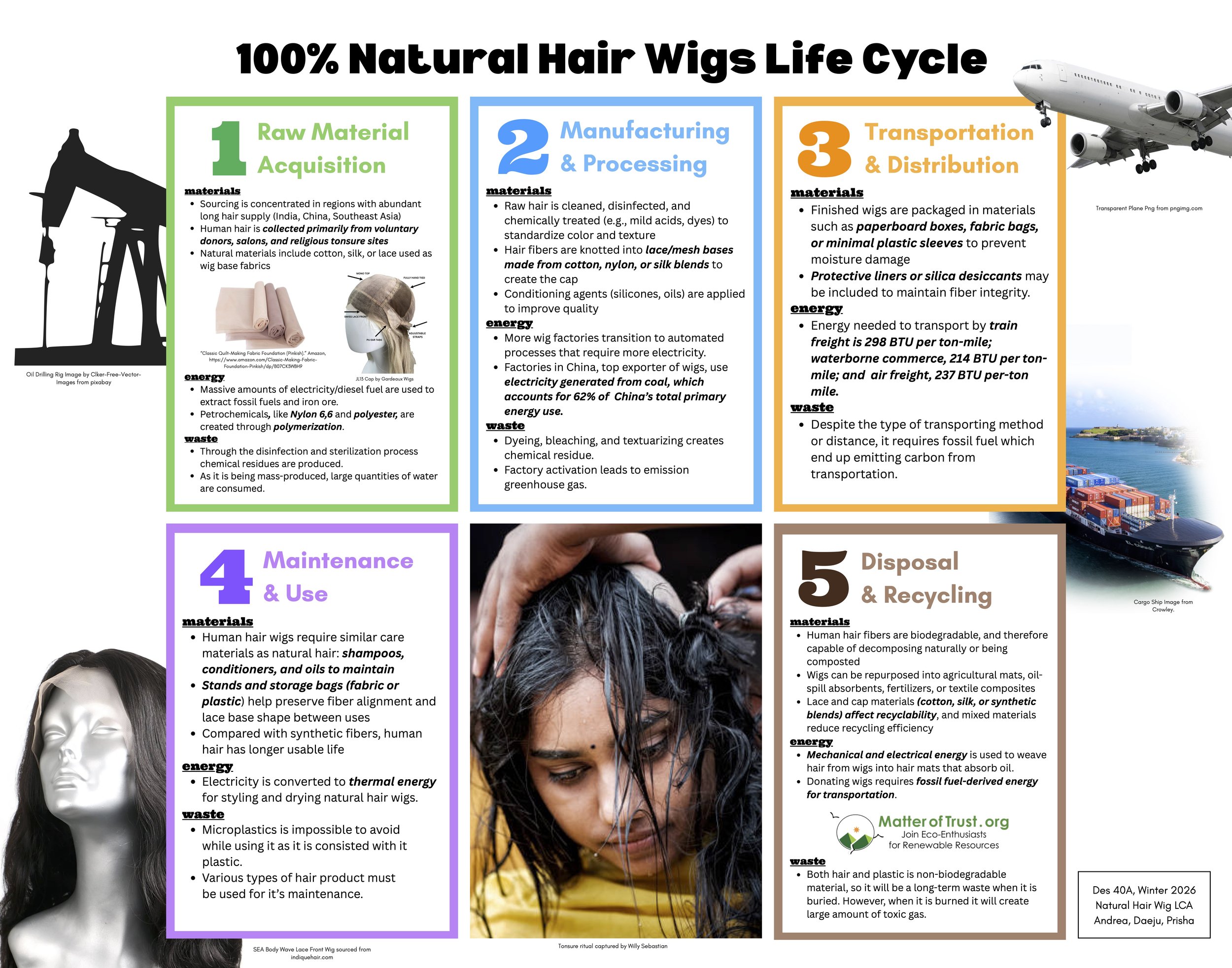
Natural Hair Wigs Life Cycle By Andrea Solis, Daeju Kim, and Prisha Rai
Andrea Solis
Professor Cogdell
DES 40A
12 March 2026
Life Cycle: Natural Hair Wigs
Wigs have existed for centuries, used for various purposes throughout history. Wigs may be used by people with medical conditions, such as alopecia, to help cover bald or thinning spots. Others may use wigs to enhance their beauty. Regardless of their purpose, wigs help to boost the confidence of many. Even so, we must consider the environmental cost of consuming natural hair wig products on a large scale. This life-cycle assessment will demonstrate that each stage of human hair wigs, from cradle to grave, consumes substantial amounts of energy, with energy consumption peaking during the transportation and distribution phase. While the energy needed to collect the primary material, human hair, is low, a substantial portion of the wig industry's embedded energy is attributed to distribution, predominantly from China to markets worldwide, and raw material extraction. This heavy reliance on fossil fuels to transport the product globally by land, air, and sea, and to extract materials from the earth, is only expected to grow as the industry expands.
The energy required for the raw material acquisition stage varies widely. Collecting human hair is the least energy-intensive step in this stage. One documentary, Good Hair, directed by Jeff Stilson, provides insight into the collection of hair, particularly in India (Good Hair). Many travel by foot or other modes of transportation to temples to partake in tonsure, a ritual in which people shave their heads for religious purposes. Since hair is a natural byproduct of humans, the energy input is minimal. However, the stainless steel razors used in cutting hair require much more energy to produce. Obtained from “All India Status Report on Safety Razor Blades Industry”, Sampathkumar describes the technical and complicated process in which blades are made. Creating a small razor requires energy for iron ore and coal extraction, blast furnace and casting processes, and energy for coating, packaging, and distributing (Sampathkumar). This step requires significant amounts of fossil fuels and electricity. Similarly, the energy needed to extract and process natural and synthetic fibers, plastic tabs, dyes, and other tools requires large amounts of energy as well. In the article, “Evaluating environmental impact of natural and synthetic fibers: A life cycle assessment approach,” the authors focus on the energy consumption of processing different fibers, such as cotton. Cotton needs 0.63 to 0.95 MJ of electricity to grow and harvest one kilogram (Gonzalez). According to “Life Cycle Assessment of Polysaccharide Materials: A Review”, the authors share data that points out that Nylon 6,6, another common fiber used to make wig caps and thread, uses 154 MJ per kilogram from cradle to gate (Shen et al.). Polyester is less energy-intensive than nylon, consuming 95 to 109 MJ per kilogram, while other plastics that are found in plastic tabs and product packaging take anywhere from 80 to 89 MJ per kilogram (Shen et al.). While collecting raw human hair is sustainable, the process becomes more energy-intensive when accounting for the materials needed for the final product, such as natural and synthetic materials for fabric, plastic tabs, chemical dyes, and the various tools used in manufacturing. Overall, the energy required to extract and process these fossil fuel-derived and other raw materials creates a significant environmental impact.
The manufacturing stage, which largely occurs in China, consumes even more energy than the material acquisition stage. Consider the energy needed to extract more metals and plastics to create the machinery, such as sewing machines, washing machines, and dryers, for factories. Large exports of wigs come from China, so we will look into the energy sources that power their factories. China’s primary energy source is coal, accounting for 62% of its total primary energy use (“U.S. Energy Information Administration - EIA - Independent Statistics and Analysis.”). This signifies that coal-fired electricity is the key input for these factories. As the industry expands and transitions toward more automated manufacturing, energy demands will only increase. This trend is noted in Applied Research of Cleaner Production Evaluation System in Wig Industry, where the author, Xiaofang, mentions how processes like combing, washing, drying, bleaching, and sewing have become automated (Xiaofang). Yet, a significant amount of hand labor remains. The Ultimate Fit by Daniel Alain, a wig company, demonstrates workers ventilating, or knotting hair onto the wig cap, by hand and also using electricity to sew and secure pieces together (Alain). The manufacturing process of wigs consists of many processes: combing, washing, drying, bleaching, dying, sewing, and styling. The manufacturing phase combines energy-intensive automated processes with manual labor, contributing significantly to its embedded energy.
Undoubtedly, the most energy-intensive stage of a wig's life cycle is the transportation and distribution phase. Collected from the UN Comtrade, India exported 3,485,744 kg of raw human hair, and China exported 11,734,099 kg of wigs, false beards, and other processed human hair products in 2024 (“UN Comtrade”). Transportation of these items is by land, sea, and air. Davis et al. explain in the Transportation Energy Data Book: Edition 40, the specific energy intensities of these different transportation modes. From this data, specifically from Tables 2.14-16, we see how much energy is consumed in British Thermal Units per ton per mile, or BTU per ton-mile (Davis et al.). In “Case 27: Port of Shanghai,” B. Rajesh Kumar stated in 2022 that the Port of Shanghai is the “second busiest seaport in the world” (Kumar). For context, the Port of Shanghai has three container ports: Wusongkou, Waigaoqiao, and Yangshan. According to the case study, one specific port “has 147 container handling equipment and machinery, 36 RTG, 10 quay cranes, 73 container trucks and 11 forklifts” (Kumar). These machines use diesel, propane, and other fossil fuels, consuming massive amounts of energy daily. Not only that, but more energy is needed to actually transport the goods globally. China exported thousands of tons worth of wigs and other human hair products; over 7,000 tons were exported to the USA alone in 2024 (“UN Comtrade”). The energy needed to transport by train freight is 298 BTU per ton-mile; waterborne commerce takes 214 BTU per ton-mile; and air freight needs 237 BTU per ton-mile (Davis et al.). The distance from the Port of Shanghai to the Port of Los Angeles is approximately 6,000 miles. Using that data, it can be roughly estimated that transporting 7,000 short tons a distance of 6,000 miles consumes 9 billion British Thermal Units of energy (calculated from waterborne commerce, 214 BTU per ton-mile x 7000 tons x 6000 miles), which is roughly 65,000 gallons of diesel fuel – enough fuel for a semi-truck to travel half a million miles with 7 miles per gallon (1 gallon of diesel provides 137,381 BTU) (“U.S. Energy Information Administration - EIA - Independent Statistics and Analysis.”). This just accounts for waterborne commerce; more energy is needed to deliver the product to its final destination. Overall, the energy consumed in transporting wigs globally is very high.
The energy needed to use and maintain wigs is essentially the same as caring for our own hair. Meaning you can wash, dry, and style it with styling tools. However, natural hair wigs and synthetic wigs differ in energy consumption in this stage, as the energy for maintenance and use in synthetic wigs is less. Many women and men use electricity to style their hair, requiring electricity to be converted into thermal energy. Human hair possesses the "versatile quality... to be styled with hair styling tools utilizing heat (e.g., blow dryers and curling irons),” while synthetic wigs "cannot withstand high temperatures and should be kept away from heat" (Banka et al.). The synthetic wigs' permanent hairstyle created during the manufacturing process eliminates the need for styling. Other than that, both wigs require the same energy to wash and dry; natural hair allows for electricity-powered blow dryers, however. The energy needed to use and maintain wigs is relatively low compared to other stages.
The final stage of disposal and recycling is often overlooked, as specific data on wig disposal is scarce. It is likely that most wigs end up in landfills if they are not recycled or donated. However, optimistic paths towards creating a more circular life cycle for this industry are out there. Eco-friendly organizations, such as Matter of Trust, have developed programs to repurpose human hair by creating hair mats used to clean up oil spills. Wigs are taken apart, then mechanical and electrical energy can be used to weave hair from wigs into hair mats that absorb oil, as seen in videos by Matter of Trust. Also, a quick online search will reveal the many organizations that accept wig donations to give to those with medical conditions that cause hair loss. The energy required for this, however, comes from fossil fuels, as the wigs need to be transported. As for the synthetic plastics in wig caps, these petrochemicals can be repurposed again using the feedstock energy stored in synthetic materials (Hamman).
In conclusion, natural hair wigs can be perceived as a better alternative to synthetic wigs and remain the preferred choice for many consumers. Even so, their environmental impact is concerning. Hair loss continues to be a problem for many, which is likely to increase wig production and, ergo, energy consumption. While factories develop more energy-efficient processes in production, the main concern lies in the dependence on fossil fuels for electricity and global transportation. This is an issue that requires a more innovative approach to create a more sustainable wig industry.
Bibliography
Alain, Daniel. The Ultimate Fit, video.danielalain.com/watch/j2PqtibEXzgmy7mfVhdqbs.
Banka, Nusrat, et al. “Wigs and Hairpieces: Evaluating Dermatologic Issues.” Dermatologic Therapy, vol. 25, no. 3, May 2012, pp. 260–66, https://doi.org/10.1111/j.1529-8019.2012.01506.x.
“CNA Correspondent - on the Trail of ‘Black Gold.’” CNA, 15 Nov. 2023, www.channelnewsasia.com/watch/cna-correspondent/trail-black-gold-3921001.
Davis, Stacy C., and Robert G. Boundy. Transportation Energy Data Book: Edition 40. Oak Ridge National Laboratory, 2022, https://doi.org/10.2172/1878695.
Gonzalez, Victoria, et al. “Evaluating environmental impact of natural and synthetic fibers: A life cycle assessment approach.” Sustainability, vol. 15, no. 9, 7 May 2023, p. 7670, https://doi.org/10.3390/su15097670.
Good Hair. Directed by Jeff Stilson, performances by Chris Rock. Icon Film, 2009.
Hamman, W. C. "Energy for Plastic." Introduction to the Physics of Energy; Stanford University: Stanford, CA, USA (2010): 3.
“How India’s Human Hair Factory Helps Africa.” BBC News, BBC, www.bbc.com/news/av/world-asia-india-36023361. Accessed 1 Feb. 2026.
Kumar, B. Rajesh. “Case 27: Port of Shanghai.” Project Finance: Structuring, Valuation and Risk Management for Major Projects, edited by B. Rajesh Kumar, Springer International Publishing, 2022, pp. 227–31, https://doi.org/10.1007/978-3-030-96725-3_31.
Reck, Barbara K., et al. “Global Stainless Steel Cycle Exemplifies China’s Rise to Metal Dominance.” Environmental Science & Technology, vol. 44, no. 10, May 2010, pp. 3940–46, https://doi.org/10.1021/es903584q.
Sampathkumar, K. "All India Status Report on Safety Razor Blades Industry." (2003).
Shen, Li, and Martin K. Patel. “Life Cycle Assessment of Polysaccharide Materials: A Review.” Journal of Polymers and the Environment, vol. 16, no. 2, Apr. 2008, pp. 154–67, https://doi.org/10.1007/s10924-008-0092-9.
“Synthetic Fibers, Nylon and Rayon.” Encyclopaedia Britannica Films, 1949.
“UN Comtrade.” United Nations, United Nations, comtradeplus.un.org/TradeFlow?Frequency=A&Flows=X&CommodityCodes=0501&Partners=0&Reporters=all&period=2024&AggregateBy=none&BreakdownMode=plus. Accessed 30 Jan. 2026.
“U.S. Energy Information Administration - EIA - Independent Statistics and Analysis.” International - U.S. Energy Information Administration (EIA), www.eia.gov/international/analysis/country/CHN. Accessed 3 Mar. 2026.
“Welcome to the Federal LCA Commons.” Welcome to the Federal LCA Commons | Life Cycle Assessment Commons, www.lcacommons.gov/. Accessed 2 Mar. 2026.
Xiaofang, L. I. U., Y. U. Luji, and W. A. N. G. Yanpeng. "Applied Research of Cleaner Production Evaluation System in Wig Industry." Advances in Sciences and Engineering 10.2 (2018).
Daeju Kim
Professor Christina Cogdell
DES 40A
10 March 2026
LCA Research Paper
This paper analyzes the waste and pollution occurred throughout the entire life cycle of the hundred percent human hair wigs. Wigs are used for various purposes such as for fashion, convenience, and medical hair loss. Human hair wigs are often considered as natural products. However, it causes waste and pollution throughout the entire stages in its life cycle analysis, it causes waste and pollution throughout the entire stages. LCA is method applied to evaluate the products impact across its entire life cycle (Raw material requisition, Manufacturing, Transportation, Use, Disposal)
Raw Material Acquisition
The first stage of the life cycle of hundred percent human hair wigs is raw material acquisition. Human hair which is the most significant material is wigs are mainly imported from India and Southeast Asia. These collected hair must be sterilized and disinfected in order to remove all the possible contaminants before it is being processed. During the process of disinfecting and sterilization, large amounts of water and chemical cleaning products are being used, and this cleaning process produces wastewater and chemical residues. Research of cosmetic wastewater indicates that hair treatment and beauty industries produce waste water that contains detergents, dyes, and numbers of chemical substances which needs to be properly treated before releasing into the environment. If waste water and chemical residues are being released into the environment without a treatment system, it can cause harmful pollution and damage to nearby ecosystems and water sources. Not only waste water but large amounts of water consumption for disinfection also cause environmental harm.
Manufacturing Stage
The stage of manufacturing is the stage where collected hair is being transformed into wigs. The human hair wigs require several mechanical and chemical processes in the stage of manufacturing. After the collected hair is disinfected and sterilized, it needs to be treated with bleaching, dyeing, and chemical agents in order to produce each different color and texture in order to meet the customers’ demand. But, these processes produce chemical contaminations.. According to the research of hair related industries’ effluent shows that contaminated waste water with chemical hair agents can have toxic effects on water systems and aquatic environments if it is not appropriately treated. In addition to chemical contamination, the manufacturing process consumes large amounts of energy, and industrial facilities require electricity in order to operate their machinery and production equipment. From the research about the textile industry, the process of manufacturing significantly contributes to greenhouse gas emissions due to their high energy consumption. So that manufacturing process of hundred percent human hair wigs cause environmental pollution through not only chemical residues but also through the high energy consumption and greenhouse gas emissions. Furthermore, solid waste can be also produced, while collected hair is being processed cutted hair are potential long-term waste because they are non-biodegradable material. Upon that, wigs include synthetic materials such as plastic wigs cap, band, and lace front which are fundamental components of wigs but it affects the number of plastic wastes.
Transportation and Distribution
Transportation and distribution have the most impact on environmental damage. Human hair wigs business in general is being operated in large sizes. Human hair is being collected from Southeast Asia and India, and manufactured in China. After the manufacturing the products are transferred to the American and European countries market. This structure requires several countries to be involved in the production. In this process, various transportations are being used such as aircraft transportation, maritime transportation, and land transportation which lead to huge amounts of carbon emissions. Moreover, packaging materials are also one of the factors that pollutes the environment. The packaging materials are plastics and synthetic fibers to protect the wigs from the transporting process. Packaging waste can be recycled but only a minor portion of it can be recycled, and plastics and synthetic fibers are non-biodegradable materials which cause a long-term disposal problem.
Use, Reuse, Maintenance
Human hair wigs can be used for a long time, but it needs spontaneous treatment and care, and the treatment and care includes washing, styling, and conditioning. Products used for this care such as hair spray, conditioner, and hair gel are mainly compost with chemicals. And using this product for any reason can lead chemical residues to enter the water system. Research from hair and beauty industries also mentions that these chemical residues must be treated in order to avoid the water system and water quality pollution. In addition, although it can be a small amount of water consumption compared to the stage of manufacturing, it can still affect the environment in long-term usage of water to clean the wigs.
Disposal
Most wigs are being thrown away after a certain period of time of usage. Human hair wigs are made out of hundred percent of human hair, but it also includes plastic lace and other synthetic materials. These materials are not naturally decomposed in the short-term. Recent fiber industry shows that clothing and fiber waste are increasing by the year and those wastes are being sent to landfills. In addition, some synthetic materials can be decomposed into microplastic by the time. This microplastics can negatively affect the soil and water.
Conclusion
In this paper, waste and pollution occurred during the hundred percent human wigs’ life cycle is analyzed. Through the LCA , every single stage (Raw material requisition, Manufacturing, Transportation, Use, Disposal) causes environmental damages in various ways. In the stage of material acquisition, chemical waste is being produced from disinfecting a collected hair, and micro fiber and waste water from the manufacturing process. Plastic packaging waste and carbon emission from transporting and distributing stage. In the stage of using and maintenance, residues from styling products and microplastics are incurred. Finally, in the stage of disposal it takes a long period of time to be dissolved naturally because it consists of plastic and human hair. The fact that it is compost with human hair made it seem to be an ecofriendly product, but according to LCA it does cause numerous environmental harm.
Works Cited
Chen, Xuandong, et al. “Circular Economy and Sustainability of the Clothing and Textile Industry.” Materials Circular Economy, vol. 3, 2021.
https://pmc.ncbi.nlm.nih.gov/articles/PMC8257395/.
Gkika, Despoina A., et al. “Cosmetic Wastewater Treatment Technologies: A Review.” Environmental Science and Pollution Research, 2022.
https://pmc.ncbi.nlm.nih.gov/articles/PMC9553780/.
Gonçalves, Letícia C., et al. “Toxicity of Beauty Salon Effluents Contaminated with Hair Dye.” Toxics, 2023.
https://pmc.ncbi.nlm.nih.gov/articles/PMC10674561/.
Niinimäki, Kirsi, et al. “The Environmental Price of Fast Fashion.” Nature Reviews Earth & Environment, 2020.
https://www.nature.com/articles/s43017-020-0039-9.
Wilson, Nicky, et al. “Capturing the Life Cycle of False Hair Products to Identify Opportunities for Remanufacture.” Journal of Remanufacturing, vol. 9, no. 2, 2019, pp. 99–113.
https://link.springer.com/article/10.1007/s13243-019-0067-0.
Wang, Chao, et al. “Evolution of Structural Characteristics and Its Determinants of Global Human Hair Waste Trade Network.” Resources, Conservation and Recycling, vol. 203, 2024.
https://www.sciencedirect.com/science/article/abs/pii/S0921344923004391.
United Nations Environment Programme.
Sustainability and Circularity in the Textile Value Chain: Global Stocktaking. 2020.
https://wedocs.unep.org/items/2769638e-ab44-4d60-8236-b527328ade61.
United States Environmental Protection Agency. “Textiles: Material-Specific Data.” U.S. EPA.
https://www.epa.gov/facts-and-figures-about-materials-waste-and-recycling/textiles-material-sp
United States Environmental Protection Agency.
“Textile and Fashion Waste Facts.” 2022.
https://www.epa.gov/facts-and-figures-about-materials-waste-and-recycling/textiles-material-sp
“How Hair Color Can Affect Climate Change.” Earth Endeavours.
https://earthendeavours.org/how-your-hair-color-can-effect-climate-change/.
Prisha Rai
Professor Cogdell
Des 40A
13 March 2026
Human Hair Wigs Life Cycle Analysis: Raw Materials
Life cycle analysis is a method used to determine the impact that a product has on the environment from the time that the extraction of the raw materials occurs to the eventual disposal. LCA allows researchers to identify where the greatest environmental costs occur and where improvements may be possible by examining each stage of the product’s life. Increasingly, companies in the personal care industry have applied LCA to products such as wigs, which consist of both biologically derived and man-made materials. While human hair wigs are marketed as more environmentally sustainable than synthetic wigs because of their reliance upon renewable biological materials rather than petroleum-based fibers (BGFashion; "Eco-Friendly Choices"), this evaluation is misleading since environmental impacts often begin well before the point of sale. The earliest stages of the supply chain, especially those involving the procurement and processing of raw materials, create most of the environmental impacts. Consumer product researchers stress the importance of assessing the environmental implications of a product through an evaluation of the entire life cycle from raw materials extraction and preparation through to end-of-life (Smith and Chen). Faux hair products offer an example of how early-stage production influences the environmental performance of a product as well as the possibility of recycling the final product (Wilson et al.). Thus, although 100 percent human hair wigs are generally described as renewable and eco-friendly relative to synthetic wigs, their true environmental performance is greatly influenced during the raw material phase including the sourcing of human hair globally, the process of sorting hair and the incorporation of other base materials into the wigs which affect durability and recyclability. Thus, a thorough assessment of the raw material life cycle is required to truly evaluate the sustainability of human hair wigs.
The primary component of human hair is keratin, a structural protein that provides strength and flexibility to human hair giving human hair wigs an inherent material advantage over synthetic alternatives. According to Ankush Gupta, "human hair is a unique biological fiber that consists mainly of keratin proteins providing strength and structural integrity" (Gupta). Keratin forms strong flexible fibers that allow human hair to remain durable while still appearing natural. Since hair grows continuously, it can be viewed as a renewable resource whereas many industrial fibers must be extracted from limited supplies of raw materials. The unique combination of biological characteristics and keratin content of human hair makes it highly desirable for wig production. On the other hand, many synthetic wigs are made from petroleum-based polymers including acrylic and polyester fibers. These fibers are created using fossil fuel extraction and energy-intensive chemical manufacturing processes (BGFashion). The significance of this difference in terms of raw materials is substantial because petroleum-based fibers result in the consumption of non-renewable resources and emissions of greenhouse gases during their manufacture (Smith and Chen). Human hair wigs are also highly regarded for their realistic appearance and durability. For instance, human hair wigs are frequently used in medical applications to treat patients who experience hair loss due to conditions like alopecia or chemotherapy treatment because they closely mimic the feel and motion of real hair (Anastassakis). Additionally, human hair wigs can last longer than synthetic wigs when properly cared for, potentially resulting in less frequent replacement (Wilson et al.) and demonstrating that human hair has multiple benefits as a raw material. However, having a single renewable fiber does not automatically indicate that a product is sustainable. Instead, the overall environmental implications of human hair wigs will largely depend on how the hair is acquired and managed in a global supply chain.
A great deal of the environmental and material implications of human hair wigs start with the global systems that provide and collect the hair itself. Unlike agricultural fibers such as cotton or wool, human hair is not cultivated through farming but is instead collected through various human activities. A major portion of the human hair used in making wigs comes from the Asian region, primarily India and China, where large amounts of hair are collected and then sent to other countries for manufacturing (WIFI Talents). The global trade in human hair for wigs and hair extensions is largely due to increasing global demand for them in the fashion, entertainment, and medical fields. Over the past decade or so, the wig industry has grown significantly, resulting in a very complex supply chain that sends raw hair from country to country to arrive to the consumer (WIFI Talents). There are several ways that human hair is collected. Some human hair is obtained from hair salons, where hair is cut off during normal grooming and then sold to suppliers. Other human hair is donated to charitable organizations that manufacture medical wigs, with donors contributing their own hair. In addition, a significant amount of commercially valuable hair comes from religious tonsures, in which people shave their heads as part of a spiritual practice, and the collected hair is sold through organized systems (Gupta). These sources of hair provide a continuous source of materials for wig manufacturers, while creating very long supply chains in terms of collecting, transporting, and storing the hair. As the demand for wigs increases, the supply chains will continue to increase as well. Statistics about the industry show that the global wig market has increased dramatically over the last few years, as have many of the beauty trends and medical needs that drive the demand for them (WIFI Talents; “2025 Environmental Sustainability Practices”). Therefore, the distances that the hair travels and the scale at which the hair is processed will continue to be environmentally relevant factors in the raw material stage of the life cycle of a wig. In addition to the geographical origins of the hair, the processing of raw hair is also an important factor in determining the quality of the final product.
After collection, human hair undergoes extensive sorting and grading processes to determine durability, resistance to tangling, and product lifespan. The main distinction made by wig manufacturers is between Remy and non-Remy hair. Remy hair is defined as hair that has been collected and processed in such a manner that maintains the natural orientation of the cuticle layers of the hairs. Therefore, the hairs remain in the same root-to-tip direction when they were on the person's head. Preserving the orientation of the hairs is critical, since it greatly minimizes the amount of friction and tangling that occurs in the finished wig product. Research regarding false hair products states that Remy hair "retains the natural direction of the cuticle layer, which enhances durability and minimizes matting during wear" (Wilson et al.). Non-Remy hair, by contrast, is collected in large volumes, and the cuticle direction of the hair is not preserved. It therefore requires chemical treatment to make the hair usable in wigs. Once the hair reaches the processing facility, it is sorted by length, color, and texture before being cleaned and prepared for use. Cleaning the hair involves washing the hair to remove oils, dirt, and biological contaminants. Bleaching and/or dyeing may be applied to the hair to ensure consistency in color and to prepare the fibers for styling (Wilson et al.; Xiaofang et al.). Although the cleaning and preparation steps are required to produce consistent products, they also add additional processing stages to the raw material phase of the life cycle of a wig. Researchers examining cleaner production practices in the wig industry highlight the need to improve efficiencies in the cleaning and preparation process to minimize waste and environmental damage (Xiaofang et al.).
While much of the evaluation of raw hair is done manually through visual inspection and sorting, many manufacturers today use scientific testing methods to assess the composition and authenticity of the hair fibers. Techniques such as near infrared spectroscopy are used to identify the structural characteristics of the hair fibers and to detect the presence of synthetic components in hair fibers that have been labeled as human hair. Researchers studying wig materials point out that the use of these analytical techniques allows for the "qualitative and quantitative determination of human hair fibers in commercial wig products" (Jia et al.). By using these analytical techniques, manufacturers can enhance transparency about the materials used in their products and ensure that wigs marketed as human hair products actually do contain the advertised materials. Additionally, the use of these analytical techniques further illustrate how complex the raw material preparation process has become, incorporating both the traditional labor-intensive sorting and the newer scientific verification methods. Beyond the hair fibers themselves, there are a number of other materials involved in the preparation and construction of the final wig product, and all of these materials have an effect on the overall environmental sustainability of the final product.
Although most "100% human hair" wigs contain other types of base material that affect recyclability and the overall environmental implications of the wig, most wigs are produced on a cap structure that holds the hair fibers in place so that the wig fits comfortably on the wearer's head. Most cap structures are made of materials like lace, silk, cotton, or synthetic mesh fabric, which provide support and ventilation for the wig (Anastassakis). The individual strands of hair are then attached to the cap using techniques such as hand-tying or machine-stitching. Even though the base materials comprise a relatively small percentage of the total weight of the wig, they do create significant environmental considerations. Materials used in products that consist of multiple materials are usually less likely to be recycled than those that are single-material products, since each component must be removed prior to processing each component individually (Wilson et al.). Therefore, while human hair fibers found within false hair products are biodegradable, many wigs ultimately find their way into landfills when their usable lifespan ends. Consequently, in an effort to respond to consumer concerns over the environmental issues created by these products, several manufacturers have explored cleaner production methods and more environmentally-friendly materials for producing wigs. These efforts include increasing the efficiency of their manufacturing process, reducing the amount of waste generated during the manufacturing process, and developing new materials that are more easily recyclable (Xiaofang et al.). Industry-wide discussions of sustainability have indicated an increased desire among consumers for greater transparency into how and where materials are sourced. This has been shown through an increase in consumers seeking information about how wigs are manufactured ("2025 Environmental Sustainability Practices"). However, the success of these initiatives vary greatly depending upon the company and region involved.
Examining the raw material stage of the life cycle shows that the sustainability of human hair wigs cannot be determined only by renewability. The human hair fibers that make up wigs demonstrate several advantages that synthetic fibers do not due to the biological characteristics of keratin; specifically, human hair fibers are durable and appear more naturally than synthetic fibers. However, human hair fibers are obtained globally through international supply chains, which introduces additional environmental considerations related to global supply chains. The sorting, cleaning and grading of human hair fibers after they are collected determines the quality and duration of use of the final product. Additionally, the inclusion of materials such as lace or synthetic mesh caps complicate the ability to recycle wigs and affects the ultimate method of disposal of wigs at the end of their useful life. These factors collectively show that the raw material stage of human hair wigs sets the foundation for the entirety of the life cycle of human hair wigs and determines the durability, waste generation, and environmental impact of wigs. A major challenge to researching the environmental impacts of wigs is the lack of available data on sourcing practices and supply chain operations in the wig industry, which creates challenges to quantifying environmental impacts early in the production phase. If sourcing practices, grading standards, and material selection are managed responsibly, human hair wigs may present a more environmentally friendly option compared to synthetic alternatives. However, responsible management of these practices is needed for this goal to be realized.
Works Cited
Anastassakis, Konstantinos. “Wigs and Hair Prosthesis.” Androgenetic Alopecia From A to Z, Springer, Cham, 2023, pp. 737–760, https://doi.org/10.1007/978-3-031-10613-2_45.
“Are Wigs Eco-Friendly? A Look at Sustainability in the Hair Industry.” BGFashion, https://www.bgfashion.net/article/19796/81/Are-Wigs-Eco-Friendly-A-Look-at-Sustainability-in-the-Hair-Industry.
“Eco-Friendly Choices: Human Hair Wigs & Sustainability.” UniWigs, https://www.uniwigs.com/blog/eco-friendly-choices-human-hair-wigs-sustainability.html.
Gupta, Ankush. “Human Hair ‘Waste’ and Its Utilization: Gaps and Possibilities.” Journal of Waste Management, vol. 2014, 2014, pp. 1–17, https://doi.org/10.1155/2014/498018.
Jia, Kaikai, Zhaoyi Zhou, and Lihui Xu. “Qualitative and Quantitative Analysis of Human Hair in Wig Products by Near‑Infrared Spectroscopy.” Journal of Industrial Textiles, vol. 55, 2025, pp. 1–20, https://doi.org/10.1177/15280837251331213
Smith, Laura, and Aaron Chen. Consumer Behavior and Product Lifecycle in Beauty and Personal Care. Emerald Publishing, 2023.
“2025 Environmental Sustainability Practices in the Human Hair Wig Industry.” West Kiss Hair, 2025, https://www.westkiss.com/blog/2025-environmental-sustainability-practices-in-the-human-hair-wig-industry/.
“Wig Industry Statistics.” WIFI Talents, 2025, https://wifitalents.com/wig-industry-statistics/.
Wilson, Nicky, et al. “Capturing the Life Cycle of False Hair Products to Identify Opportunities for Remanufacture.” Journal of Remanufacturing, vol. 9, 2019, pp. 235–256, https://doi.org/10.1007/s13243-019-0067-0.
Xiaofang, L. I. U., Y. U. Luji, and W. A. N. G. Yanpeng. "Applied Research of Cleaner Production Evaluation System in Wig Industry." Advances in Sciences and Engineering 10.2 (2018).