Design Life-Cycle
assess.design.(don't)consume
Adam Zechiel
Professor Cogdell
DES 040A
3/13/26
Electromagnet Life Cycle (Raw Materials)
Electromagnets are an essential and complex product in modern life. As global demand for modern technologies grows, so does concern over the environmental consequences associated with their production and use. A life cycle assessment, focusing on the raw materials aspect, provides a comprehensive framework for understanding the unprocessed components of electromagnets and why they are such an impactful part of the product. Although transportation emissions and manufacturing processes such as molding, induction smelting, and heat treatment contribute to environmental damage, the mining and processing of raw materials such as iron, copper, and cobalt represent the largest source of environmental impact in the life cycle of an electromagnet.
The raw materials acquisition stage of an electromagnet’s life cycle generates significant environmental impact due to the intensive mining and processing of metals. Metals required for electromagnets include iron, copper, titanium, nickel, aluminum, cobalt, and silicon, all of which must be extracted through large-scale mining operations. For example, in choosing a core material “alloying iron with silicon presents advantages mainly for AC applications due to the increased electrical resistivity” (V. Pricop, 5). Similarly, “alloys of iron with cobalt provide the highest saturation level, but due to the prohibitive price of cobalt…these alloys are used only when their properties are detrimental. The alloys of iron with nickel provide the highest permeability and the smallest coercivity but the lowest saturation level” (V. Pricop, 7). In addition to magnetic alloys, conductor materials are necessary for the function of all electromagnets, and “conductor materials which are most commonly used for the construction of normal-conducting are aluminum and copper” (Zickler, Th., 93). The extraction of these metals requires extensive mining operations that can release toxic substances into surrounding soil and water systems, contributing to environmental contamination and ecosystem damage. However, many of these metals also have a very strong potential to be recycled and reused, which could reduce the need for additional mining in the future and save a significant amount of energy and emissions from being used or created. While the base raw material extraction forms the foundation of an electromagnet’s environmental footprint, these raw materials must next undergo manufacturing processes that further their impact.
During the product manufacturing stage, raw materials continue to contribute substantially to environmental harm through highly intensive processes. These processes include molding, induction smelting, and heat treatment, all of which require additional materials and large amounts of energy. For example, sand is often needed for molding, while smelting requires materials that assist in reducing metal oxides as well as flux substances to remove impurities. In addition, fuel sources such as gas or coal are necessary to reach the extremely high temperatures required for smelting and heat treatment, “To create the necessary temperatures required for smelting, a fuel source such as coal, coke, natural gas or electricity is required… To assist reducing metal oxides (i.e. iron oxide) into their elemental form, a reducing agent such as charcoal or coke is often utilized… In order to remove the impurities from the metal, a flux substance, such as limestone, silica, or borax, is introduced to the furnace” (Metal Supermarkets, 4). Finished electromagnets also require significant quantities of polymer and insulation materials to properly contain and protect the conductive components. Together, these manufacturing steps release large amounts of emissions due to the fuels burned and materials processed during production, as well as waste materials formed in the processes such as slag which can be toxic to the environment. Once materials have been transformed into usable components, they must be transported to assembly sites and markets, extending their material usage and environmental impact beyond the factory.
The transportation and distribution stage further amplifies the environmental footprint of an electromagnet. While it was not possible to find sources on the distribution of electromagnets specifically, we can assume that like any other product, transporting raw materials and finished electromagnet components requires significant amounts of fuel, including gasoline, diesel, and jet fuel, depending on the distance and method of transportation. The sustainability of transportation can vary greatly depending on regional factors, energy sources, and the mode of transport used. For example, differences in energy grids and transportation technologies can significantly influence environmental outcomes, “energy sources, vehicle technologies, and use patterns—can influence environmental outcomes. In Reykjavík, EVs showed the lowest GHG emissions due to Iceland’s renewable energy grid supplied by geothermal and hydroelectric energy production… In contrast, Bogotá's buses performed better overall, primarily because of their higher occupancy rates, reducing per-passenger emissions” (Jacid Montoya-Torres, 22). These variations demonstrate that transportation impacts are highly dependent on local infrastructure and efficiency. However, regardless of the specific system used, transporting heavy raw materials and industrial components can contribute significantly to global warming, particulate matter formation, and human toxicity through fuel combustion and emissions. However, the influence of raw materials does not end with delivery, as their life cycle and raw material use continues during the use and maintenance of electromagnets.
Even in the use, reuse, and maintenance stage, raw materials influence environmental impact through the resources required to sustain an electromagnet’s operation over time. One of the primary factors during this stage is the need for continuous cooling while the electromagnet is operating, which often requires significant amounts of water or air to prevent overheating. As explained by one source, “The electrical power which is dissipated in the coils has to be removed from the magnets otherwise overheating can seriously damage the coil insulation and cause short circuits between the coil conductor and the surrounding equipment… In the field of normal-conducting magnets, we distinguish between two different cooling techniques: air cooling and water cooling” (Th. Zickler, 92). These cooling systems are necessary to maintain safe operation but require ongoing resource use throughout the electromagnet’s lifespan. Although physical wear on electromagnets is relatively rare, failures can still occur, which can lead to insulation degradation or damage to conductive components, which may require the replacement of metals, polymers or other materials. Compared to earlier stages of the life cycle, the raw material impact during use, reuse, and maintenance is relatively low. However, the continuous demand for cooling resources, particularly water, can accumulate over time and still contribute to environmental impact.
Overall, a comprehensive life cycle analysis shows that raw materials are a primary source of environmental impact in an electromagnet. The mining of metals creates the greatest burden through resource depletion and toxic poisoning. Manufacturing processes further increase this impact by requiring additional materials and producing significant pollution, while transportation extends these effects through fuel use and air emissions. Although the use and maintenance stage contributes less to material impact, continued water use and occasional material replacement demonstrate that environmental costs persist throughout the entire electromagnet’s life cycle. These findings support the conclusion that although all stages contribute to environmental damage, the mining and processing of raw materials represent the largest environmental impact in an electromagnet’s life cycle.
Bibliography
Zickler, Th. “Basic Design and Engineering of Normal-Conducting, Iron-Dominated Electromagnets.” arXiv.Org, 6 Mar. 2011, arxiv.org/abs/1103.1119.
How Electromagnets Work by Marshall Brain & Lance Looper, www.johnbowne.org/ourpages/auto/2018/5/28/32241532/How%20Electromagnets%20Work%20_%20HowStuffWorks.pdf.
V. Pricop, et al. “Magnetic Materials for Accelerator Electromagnets.” Bulletin of the Transilvania University of Brasov. Series I - Engineering Sciences, 2021, pp. 81–88, webbut.unitbv.ro/index.php/Series_I/article/view/5302.
Jacid Montoya-Torres, et al. “Life-Cycle Environmental Impacts of Passenger and Freight Transport: A Comparison between the Global North and South.” Circular Economy and Sustainability, 20 June 2025, https://doi.org/10.1007/s43615-025-00612-5
Hicks, Andrea, et al. “Using Historical U.S. Copper Data to Consider Future Copper Recovery from Post-Consumer Electronic Waste.” Npj Materials Sustainability, vol. 3, no. 1, 4 Mar. 2025, www.nature.com/articles/s44296-024-00048-2, https://doi.org/10.1038/s44296-024-00048-2.
Factora. “ How Magnet Is Made.” YouTube, YouTube, 16 Feb. 2024, www.youtube.com/watch?v=YYmV0Y622Z4.
Crabb, George. “Recycling Magnets: What You Need to Know - First 4 Magnets US.” First 4 Magnets, 1 May 2023, www.first4magnets.com/us/blog/recycling-magnets-what-you-need-to-know/.
Robbins, Ben. “How Do Electromagnets Work & How Are Dings Electromagnets Unique?” Dings Magnetic Group, 21 June 2024, dingsmagnets.com/how-do-electromagnets-work-and-how-are-dings-electromagnets-unique/.
Jaume. “Magnet Waste and Its Environmental Impact.” MagnetPlastic.Com, 8 Jan. 2025, magnetplastic.com/en/magnets/magnet-waste-and-its-environmental-impact/.
Metal Supermarkets. “Smelting Metal: How It Works.” Metal Supermarkets, 28 June 2023, www.metalsupermarkets.com/smelting-metal/.
Long Phanguyen
Professor Christina Cogdell
DES 40A
13 March 2026
Electromagnet Energy Life Cycle Assessment
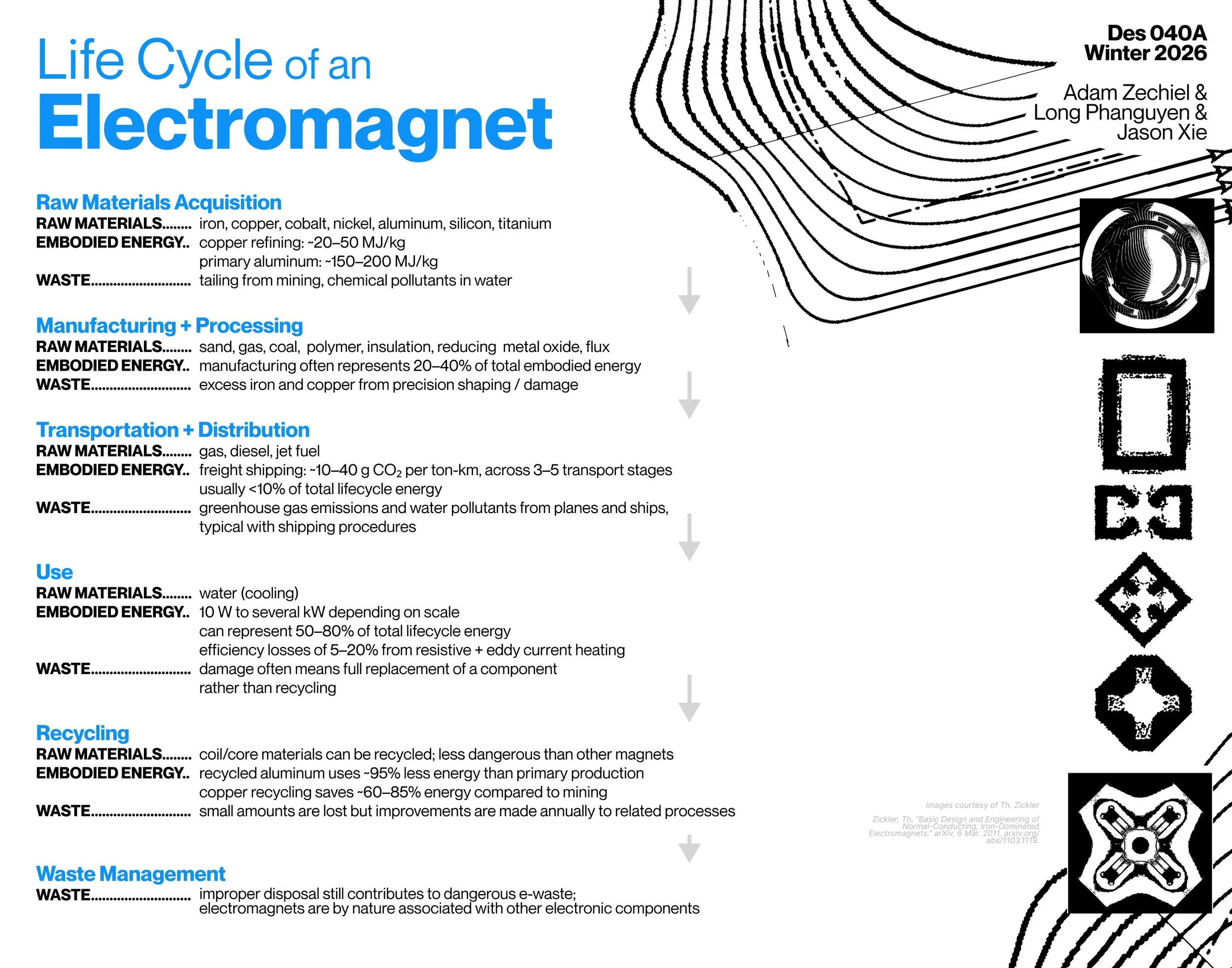
When people think of electromagnets, they first think of magnets, and while they are similar in some ways, they are also very different in others. Electromagnets are very important components in modern technologies from industrial lifting cranes, transportation infrastructure to medical imaging devices all the way to consumer electronics. Unlike normal permanent rare earth magnets, electromagnets generate a magnetic field only when electric current flows through a wire coil that is wound around a ferromagnetic core. This makes magnets controllable and easily adaptable unlike regular magnets, but that also means that they require a continuous supply of energy during their operation. With global industries moving towards more sustainable practice, understanding the full energy footprint of devices and materials that our society uses every single day and depends on is essential for learning how we can improve this framework. When looking at the Life Cycle Assessment or LCA for electromagnets, we can see that the total embedded energy or embodied energy actually extends further beyond the electricity that is used for powering the electromagnet during operation. When analyzing the LCA of electromagnets, we can look at the manufacturing and operational stages which are the primary sources of embedded energy, but also the transportation and recycling that is often overlooked.
The life cycle of an electromagnet beings long before it can be seen on cranes or inside of phones or medical devices, and is made primarily of two materials. The first is conductive metals for things like winding wire, which is most commonly copper as well as ferromagnetic materials for the electromagnetic core, like iron, steel or specialized metal alloys. Each of these metals need to be extracted from the earth, refined and then processed into usable forms that can then be shaped and manufactured into electromagnets. The extraction process is actually one of the most energy intensive phases of the life cycle. Rötzer and Schmidt's comprehensive study of copper’s cumulative energy demand or CED for short report that global copper production currently requires around 69 gigajoules of energy equivalent per tonne of copper cathode produced (Rötzer and Scmidt). While this number is very large, it is an improvement in technology over the 1930s, to put this into perspective, ores are approximately 0.7% copper and it would require 143 tonnes of ore to make one tonne of copper. In the 1930s when copper was 1.7% of the ore it would take around 70 gigajoules of energy per tonne which is still more than what it would take today with over 2 times the copper density in the ores (Rötzer and Scmidt).
Copper is not always mined up and refined from the ground, Hong et al. provide a detailed life cycle assessment of the copper production in China, which is the world’s largest producer and consumer of refined copper. Their study found that if they reclaimed copper instead of producing it from ore helped about 59% to 99% of the environmental effects (Hong et al.). Song et al. further explain the specific environmental burdens of copper production, saying that different smelting technologies like flash and bath processes produce different life cycle results but the energy consumption remains relatively constant across all the different processing routes (Song et al.).
The core material of an electromagnet also carries a decent amount of the embodied energy, while not as much as the refined copper it still requires around 20 gigajoules of energy to produce one tonne of steel according to the World Steel Association. If the more efficient method of using an electric arc furnace to recycle scrap, it would cost around half of that to produce one tonne of steel (World Steel Association). There are different types of steel that are used for electromagnets and using specific steel alloys would minimize energy losses during manufacturing and use (Leuning et al.) It has also been found by Mahmouditaber et al. that depending on the manufacturing process of the steel, it will affect the energy expenditures at other parts of the electromagnet’s lifespan especially during use (Mahmouditaber et al.).
Material selection and manufacturing at this early stage will have consequences and ripple effects that can be seen later on in the life cycle of these electromagnets, Mao et al. observes that early decisions about the core’s composition and conductor type shape the operation efficiency of the final electromagnet (Mao et al.). Some newer sustainability frameworks are advocating for addressing these problems at the beginning of the life cycle so that it will not become a problem later on, which would proactively make the total energy cost of the electromagnets better for the environment. This would primarily be: sourcing metals from recycled materials rather than from ore, and selecting electric steel alloys that are optimized for better efficiency and performance so that it would reduce the embodied energy of these electromagnetic devices.
Once the raw materials are acquired, the manufacturing process actually turns copper and iron/steel/alloys into functional electromagnets. This stage is done by winding the copper wire into coil configurations and then shaping and treating the core materials and eventually put into its intended application or tool. Manufacturing is one of the more energy intensive stages of the life cycle as it demands thermal energy for processing and electrical energy for the precise machinery. Dexter Magnetic Technologies talks about key considerations that need to be taken into account when manufacturing electromagnets including: coil geometry, wire gauge selection, core material specification and thermal management (Dexter Magnetic Technologies). Olivia and Faranda’s study of electromagnets and electro-permanent lifting systems document how electromagnets designed for industrial lifting require very precise coil winding, insulation application and assembly procedures (Olivia and Faranda).
One example that electromagnets are commonly used for are MRI machines. When looking at the production costs of an MRI or Magnetic Resonance Imaging machine’s production consumes approximately 2.73 million megajoules or about 753,000 kilowatt-hours of fossil fuel energy (Chaban et al.) This is equivalent to the yearly fossil fuel consumption of around 70 cars. While this is on the upper end of complexity, this illustrates just how energy intensive producing these machines are.
After the manufacturing and production of these electromagnetic devices, it needs to be transported from production facilities to the locations where they are integrated into their necessary systems. The embedded energy of this phase of the life cycle is primarily through fuel consumption from vehicles such as trucks, cargo ships, freight trains and aircrafts which all burn fossil fuels. While the embedded energy that is associated with transportation is much lower than raw material acquisition or production, it is not negligible either and can be improved and viewed.
Mao et al. explains the global supply chains and how it can involve multiple transportation steps between raw materials acquisition and production as well (Mao et al.). For example, copper is usually mined from South America, then smelted in China, which processes the copper and then refined into wire and then transported to the production line, when is then transported to Europe or North America to be delivered to its consumer (Hong et al.). Each of these specific transfers require fuel consumption and Rötzer and Schmidt explain that there are transportation costs associated with the mining stage alone, moving the copper from the bottom of the mine site to the top to be shipped off (Rötzer and Schmidt). Having all of these transportation costs carry a relatively large footprint: heavy trucks consume approximately 1.3 megajoules per tonne-kilometer, while freight rail requires roughly 0.2 megajoules per tonne-kilometer, and air freight is even more than that at around 16 megajoules per tonne-kilometer (Grüber et al.). Considering the distances that these materials need to be transported, moving one tonne of refined copper by ocean would consume approximately 50 to 2,100 megajoules of energy based on ocean freight intensities (Grüber et al.) and then the copper will be shipped across North America adding another 3,900 megajoules of energy leading to a proper total of around 5,000-6,000 megajoule per tonne which is a lot less than the 69,000 megajoules that is required in production (Rötzer and Schmidt) it is still a very large amount of embedded energy.
The use and operational phase of electromagnets are usually what people think about when they think about electromagnets and since they are very different from regular magnets, they require a continuous electrical current through their coils to create and sustain a magnetic field. An MRI scanner which uses electromagnets consumes around 82,000 to 134,000 kilowatt-hours of electricity per year with around 6 to 7 kilowatts just to maintain the cooling for the superconducting magnets (Heye at el.; Chaban et al.). During active scanning, power consumption can spike to numbers like 25 and 80 kilowatts and the annual use of an MRI machine is roughly equivalent to 26 four people households (Chaben et al.)
Industrial electromagnets that are used to lift things use the same sustained energy demand but do not require as much energy as MRI machines. Oliva and Farada explain that this continuous power draw is necessary in these settings. In industrial applications like scrap yards, steel mills and shipping facilities these electromagnets are active for large portions of every day which use a very large amount of energy that outweighs even the large numbers that we saw in both the raw materials and manufacturing combined. Dexter Magnetic Technologies writes that design factors such as coil resistance, duty cycle and electromagnetic thermal limitations influence how much power an electromagnet needs to consume during its operation and that these numbers are determined by the design and manufacturing phase of the electromagnets (Dexter Magnetic Technologies)
When looking at other inefficiencies of electromagnets, we can see that power is lost to heat due to the electrical resistance of the coil wire known as Jooule’s law, as well as more heat through eddy currents. These losses can be addressed in the manufacturing process of the electromagnets Leuning et al.) and Mahmouditabar et al. states that the processes in the manufacturing such as cutting and stamping can degrade the steel or steel alloy’s magnetic properties which increases more losses during the use and lifespan of electromagnets (Mahmouditabar et al.)
The final stage of an electromagnetic is it’s disposal and sometimes its recycling of its main materials. Copper wire can still be recovered and refined again, and the ferromagnetic core materials can also be melted down and recasted into different things. According to the International Copper Association, recycling copper saves around 85% of the energy when compared to producing copper from ore (International Copper Association). So copper production uses roughly 69 gigajoules per tonne, recycled copper can be produced for a fraction of that energy (Rötzer and Scmidt; International Copper Association) Hong et al. also seems to be in line with this advantage, stating that reclaimed copper has a 59% to 99% environmental advantage over refined copper ore in all impact categories (Hong et al.)
Recycling steel is roughly the same in energy savings, the World Steel Association states that producing steel form recycled scrap in an electric arc furnaces uses roughly half the energy when compared to generating steel from ore (World Steel Association). Since electromagnets are mostly made of copper and steel, a lot of energy can be saved by recycling the main components and with this recycling process in mind, the future production of electromagnets could be improved across the future generations of electromagnet production.
Designing electromagnets with higher efficiency and recyclability in mind is necessary, and standardizing the process of creating electromagnets could help aid in that process. These added stages of designing and using standardized approaches and components will add more complexity and cost to the electromagnets but will pay off by being more efficient in both use and material recovery. With this in mind, it is also important to see that recycling is not energy free, it requires collecting, transportation, sorting and reprocessing end of life magnets that all require energy. When looking at copper recycling of the whole world, only 40% of end of life copper is actually recycled while 95% of it being able to be recycled and the rest is just lost to landfills (Chaban et al.) Having a better infrastructure for collection and recycling is a key factor for reducing the overall energy burden that electromagnets have on the environment (Song et al.)
In conclusion, the lifecycle of an electromagnet is a complex process of acquiring, transporting, processing, transporting, use and disposal or recycling. There is still a lot of loss in this system that we have now and that could be improved. We need to set better guidelines and design for the entire process of electromagnets so that they can be both more efficient in use and recycling.
Works Cited
Chaban, Yuriy, et al. “Environmental Sustainability and MRI: Challenges, Opportunities, and a
Call for Action.” Journal of Magnetic Resonance Imaging, vol. 60, no. 4, 2024, pp. 1149–
1166. Wiley Online Library, doi.org/10.1002/jmri.28994.
Dexter Magnetic Technologies. “Electromagnet Design Considerations.” White Paper on Magnet
Performance, rev. 6/23/23.
“Eddy Current.” Wikipedia, Wikimedia Foundation, en.wikipedia.org/wiki/Eddy_current.
Accessed 20 Feb. 2026.
Gholikhani, Mohammadreza, et al. “Effect of Electromagnetic Energy Harvesting Technology
on Safety and Low Power Generation in Sustainable Transportation: A Feasibility
Study.” International Journal of Sustainable Engineering, Taylor & Francis, 2020.
doi.org/10.1080/19397038.2019.1688890.
Grübler, Arnulf, et al. “Energy and Economic Benefits from Economies of Scale in Intercity
Freight Transportation.” npj Sustainable Mobility and Transport, vol. 4, article 12, 2025.
doi.org/10.1038/s44333-025-00028-6.
Heye, Tobias, et al. “The Energy Consumption of Radiology: Energy- and Cost-Saving
Opportunities for CT and MRI Operation.” Radiology, vol. 295, no. 3, 2020, pp. 593–
605. doi.org/10.1148/radiol.2020192084.
Hong, Jinglan, et al. “Life Cycle Assessment of Copper Production: A Case Study in China.”
The International Journal of Life Cycle Assessment, vol. 23, 2018, pp. 1814–1824.
doi.org/10.1007/s11367-017-1405-9.
Hu, Chengbo, et al. “Electromagnetic Vibrational Energy Harvester with Targeted FrequencyTuning Capability Based on Magnetic Levitation.” Nanotechnology and Precision
Engineering, AIP Publishing, 2024. pubs.aip.org/tu/npe/article/7/4/043003/3293187.
Humar, Iztok. “Embodied Energy of Communication Devices.” Green Communications:
Principles, Concepts and Practice, Wiley, 2015.
onlinelibrary.wiley.com/doi/book/10.1002/9781118759257.
International Copper Association. Copper Recycling. 2022.
Leuning, Nora, et al. “Material Design for Low-Loss Non-Oriented Electrical Steel for Energy
Efficient Drives.” Materials, vol. 14, no. 21, 2021, article 6588.
doi.org/10.3390/ma14216588.
Lu, Jiayu, et al. “Optimal Design of an Integrated Electromagnetic Linear Energy Regenerative
Suspension System Based on a Hybrid Optimization Objective.” Energy, vol. 327, 2025,
article 136176. doi.org/10.1016/j.energy.2025.136176.
Mahmouditabar, Farshid, et al. “A Review on the Effect of Electrical Steel Manufacturing
Processes on the Performance of Electric Machines.” Energies, vol. 16, no. 24, 2023,
article 7954. doi.org/10.3390/en16247954.
Mao, Yihui, et al. “A Review of Smart Integrated Energy Systems towards Industrial Carbon
Neutrality: Opportunity and Challenge.” npj Thermal Science and Engineering, vol. 1,
article no. 4, 2026. doi.org/10.1038/s44435-025-00003-0.
Oliva, Francesca, and Roberto Sebastiano Faranda. “Energy Efficiency in Electromagnetic and
Electro-Permanent Lifting Systems.” Energies, vol. 16, no. 8, 2023, article 3550.
doi.org/10.3390/en16083550.
Rötzer, Nadine, and Mario Schmidt. “Historical, Current, and Future Energy Demand from
Global Copper Production and Its Impact on Climate Change.” Resources, vol. 9, no. 4,
2020, article 44. doi.org/10.3390/resources9040044.
Song, Xiaolong, et al. “Identification and Assessment of Environmental Burdens of Chinese
Copper Production from a Life Cycle Perspective.” Frontiers of Environmental Science
& Engineering, vol. 8, 2014, pp. 580–588. doi.org/10.1007/s11783-013-0599-8.
“Sustainable Electromagnetics.” Sustainability Directory,
energy.sustainability-directory.com/term/sustainable-electromagnetics/. Accessed 20 Feb.
2026.
World Steel Association. Energy Use in the Steel Industry. 2021.
Jason Xie
Professor Cogdell
DES40A
13 March 2026
Waste and Byproducts of Electromagnets Through an LCA Lens
Unlike permanent magnets, the magnetic field of an electromagnet is controllable, and it is generated by passing different-strength currents through the electromagnet. This level of control makes electromagnets extremely versatile. As such, they’ve become important components in a variety of modern technologies, ranging from engines to medical equipment to consumer electronics. However, while electromagnets are acknowledged for improving efficiency and safety in various ways, their environmental impacts receive less of a spotlight, despite such impacts presenting significant sustainability concerns. A life-cycle analysis examines a product from raw material acquisition to manufacturing, transport, usage, and disposal. With this in mind, reviewing electromagnets’ life cycles reveals potentially hefty consequences at each stage, particularly regarding waste and pollution. Through their energy use and disposal, electromagnets contribute significantly to both material waste and e-waste, negatively impacting greenhouse gas emission and water pollution.
It’s important to first understand what electromagnets are made of, and generally what benefits they have brought to society. In fact, electromagnets have been cited as being integral to renewable energy resources and having less of a potentially toxic impact on the environment as the rare-earth metals found in permanent magnets. Electromagnets typically consist of copper coiled around a ferromagnetic (typically iron or steel) core, which produces a magnetic field when electrical current passes through the wire. Other lesser common forms of electromagnets include Bitter electromagnets, the strongest recorded on the planet, but which consist overwhelmingly of copper; and superconducting electromagnets, a stronger and more recent discovery used in MRI machines, and which often use niobium and titanium (less common, but typically non-toxic in waste) (Chen and Zheng). These metals, especially copper and iron, are relatively common and distinguish electromagnets from permanent magnets, which rely on rare-earth metals such as neodymium and dysprosium. These heavier rare-earth elements are far more toxic and harmful when released as waste. However, there are many cases where technologies that harness electromagnets utilize stronger permanent magnets, such neodymium-iron-boron (NdFeB, and one of the strongest permanent magnets on the planet) (Zhao et al.); the importance of this point will be clarified later. Ultimately, however, understanding the composition of electromagnets provides strong insights into the waste that may be generated via material acquisition and manufacturing.
The life cycle of an electromagnet begins with raw material acquisition, where mainly copper and iron but also other metals are extracted from the earth, via mining. Although these metals are far more common compared to rare-earth elements, their extraction can still produce large amounts of waste. Copper mining, for example, can generate high amounts of mine tailings, which are the materials leftover after the valuable minerals of ore are separated and removed. These tailings can contain toxic chemicals that contaminate soil and water if not properly managed. Beyond potential mismanagement of waste, the copper mining process faces an evolving challenge with declining ore grades, which means that more energy is required to extract the same amount of metal from the earth. This increased energy demand combined with rising global production has led to a continual growth in greenhouse gas emissions; currently, the copper production (mining to refining) process accounts for about 0.3% of total global emissions, but is set to reach 2.7% by 2050, which is severe (Watari et al.). Water pollution is another major concern during this stage, as chemical leaching and ore processing can release toxic chemicals into nearby bodies of water (Singh et al.). Even though electromagnets rely on more common materials than many permanent magnets, the environmental footprint of mining in general still bears weight as a major source of pollution within the overall life cycle.
Moving to the second stage of the life cycle, manufacturing involves taking raw materials and processing then assembling them into electromagnets. Since electromagnets are not used on their own, this stage also concerns preparing them to be incorporated into other, larger products, meaning there is precision and calibration in getting their size and shape correct. Energy consumption to power machinery in factories producing electromagnets contributes to greenhouse gas emissions. In ferromagnetic electromagnets, manufacturing typically entails winding copper around an iron or steel core, then combining them with a shell and base, which may result in excess scrap metal as a result of cutting, heating, and reshaping. To minimize waste and improve the power density of finished electromagnets, recent improvements in the manufacturing process utilize simulations to optimize exact measurements (Chen and Zheng). Furthermore, most of the iron or copper that goes unused (whether it’s cut off from other components or a result of faulty / poorly-made components) can be melted down and reused. In fact, due to a constant high demand for such metals as iron, steel, and copper, (Forti et al.). While some material loss is inevitable, the industry is moving towards a 95% fabrication yield by improving such manufacturing processes (Watari et al.). Generally, the manufacturing stage certainly has impacts on waste and pollution, but modern processes as well as continuing optimizations have helped to not only reduce the generation of waste but also close the loop (in some cases) in the form of recycling.
Following the manufacturing stage, electromagnets need to be transported and distributed to wherever they may be needed. Because electromagnets are often integrated pieces of larger systems, they are frequently traded and transported worldwide in semi-finished stages. Distribution routes can be complex, with multiple stops, and are certainly global; for example, large volumes of electrical equipment are shipped from major manufacturing centers in Europe to major ports in Africa (Forti et al.). Electromagnets, alongside whatever other components they may be shipped with, can sometimes be delicate and prone to damage, so transportation packaging such as styrofoam is used; typically after arrival this is discarded, and being a difficult-to-degrade plastic, this contributes physical waste to landfills. Beyond this, airborne and waterborne pollution are major factors, as is the case usually with long-distance shipping. Transportation emissions are a major contributor to the overall “acidification potential (AP), global warming potential (GWP), marine aquatic ecotoxicity potential (MAETP), ozone depletion potential (ODP)” (Zhang et al.) of an electronic product's life cycle, which by nature includes electromagnets. Ships and planes emit sulfur dioxide, nitrogen oxides, and lots of carbon dioxide, while ships in particular generate high amounts of water pollution through dumping of sewage and (illegally) toxic waste chemicals. Thus, even the movement of materials and semi-finished products contributes to the environmental effects of electromagnets. Ultimately, the waste created as a result of transportation of electromagnets is associated with the greater impacts of general electronics shipping, which continues to be a global environmental concern.
After being transported to the necessary locations, and typically following some final assembly or modification, electromagnets are ready to enter use and maintenance. This stage represents the largest portion of an electromagnet’s life cycle, and resultantly is most important in examining their environmental impact. Compared with earlier stages, however, direct waste generation during use is relatively limited. One of the primary environmental impacts during this stage is energy consumption, as a result of electromagnets requiring “a continuous supply of electricity to maintain their magnetic field, [which contributes] to the overall demand for energy.” This means greenhouse gas emissions and air pollution are tied to electromagnet use when their sources of electricity generate power via non-renewable resources, such as burning coal or fossil fuels (Li). Furthermore, electrical resistance with electromagnetic systems produces heat, representing lost energy that has to be supplied by power generation systems. Efforts have been made to reduce this lost energy, especially in superconducting electromagnets which are cooled to reach near-zero resistance states (Chen and Zheng). Another major aspect of electromagnets’ waste profile in this stage is their role in e-waste, or electronic waste; if part of a system is damaged or broken, it is uncommon to fix that part individually, and common practice instead is to replace the part or even the entire device. Electronic waste is loosely defined as anything that involves discarded electronic parts (broken phones, computers, fridges, etc.), and it is currently the world’s fastest growing waste stream. If disposed of in normal waste bins rather than through specific collection systems, e-waste can frequently pile up in landfills, where toxic fumes and corrosive chemicals can be released into the local air, soil, and water systems (Cui and Zhang); it’s important to note that while electromagnets themselves consist of non-toxic metals, they are innately tied to e-waste because of their almost-unavoidable usage alongside components that do generate e-waste. If an electromagnet somehow breaks down, it can be the reason for these heavy, dangerous metals being thrown into a landfill. In high-tech realms that are still evolving such as renewable energy and electric vehicles, electromagnets often utilize NdFeB, which contains rare-earth elements essential for performance but which are extremely difficult to extract from the waste stream, resulting in them being left in landfills and posing risks through release of toxic particles, as well (Zhao et al.). E-waste, however, also functions as a valuable "urban mine" in certain cases (and if caught early enough), due to it including important metals like gold, silver, and copper. Digging through e-waste to extract and reuse these materials (circular economy) has become an objective for companies aiming to improve sustainability (Zhang et al.).
While touched on at decent length just previously, the final stage of the life cycle is recycling and disposal. Significant sustainability challenges are associated with electromagnets due to an uncertainty in how people may reuse or dispose of them safely. Other than e-waste, some electromagnets use or are used alongside systems that involve permanent magnets, which are inherently toxic if disposed of improperly, seeping dangerous chemicals into soil and water similar to e-waste (Amato et al.) Recovering both electromagnetic metals and these rare-earth materials proves difficult given they are often designed to be used at length and then discarded; essentially, they are glued or combined in such a way that there is no way to cleanly extract them from the systems they are embedded within. As a result, many valuable metals still are lost through both improper disposal and unsustainable design techniques (“Metals in E-Waste”). Subsequently, the end-of-life stage for electromagnets remains one of the most environmentally problematic phases of their life cycle, and has posed a difficult challenge for engineers to resolve.
Ultimately, examining electromagnets through the framework of a life-cycle analysis reveals that waste and pollution occur at every stage of their life cycle, and contribute much to environmental impacts that are often overlooked. Toxic byproducts are generated during the mining process, and through their usage and association with heavier and more toxic metals, electromagnets play a major role in the incredibly rapid-growing global e-waste stream. Furthermore, the recycling and disposal of electromagnets and related systems highlights the difficulty of recovering materials from e-waste, and reflects a need to re-assess how electronic devices are designed and what measures are in place to ensure proper disposal practices by consumers. While electromagnets are essential and extremely promising to modern technologies and renewable energy applications, without improvements made considering their environmental impact, they will continue to play a large and likely growing role in greenhouse gas emissions and water pollution.
Works Cited
Amato, Alessia, et al. “Life Cycle Assessment of Rare Earth Elements-Free Permanent Magnet Alternatives: Sintered Ferrite and Mn–Al–C.” ACS Sustainable Chemistry & Engineering, vol. 11, no. 36, 2023, pp. 13374–13386.
This article presents a LCA comparing traditional rare-earth permanent magnets
with alternative magnet materials. The study evaluates environmental impacts
such as greenhouse gas emissions and resource depletion. It is useful for
understanding how magnet material choices influence pollution and waste
generation, particularly in electromagnet-related applications.
Chen, Yanli and Yuqing Zheng. “Design and Characteristics Analysis of Electromagnets Based on ANSYS Maxwell.” IEEE Xplore, 12 Dec. 2024, ieeexplore.ieee.org/document/10779827.
This article discusses new-age design considerations related to electromagnets,
contributing to understanding of how electromagnetic systems are engineered for
specific applications, alongside the process behind their production. This is
particularly useful for us because of its quality and deep-dive nature, allowing for
us to better understand not only what goes into designing an electromagnet
system, but what materials generally are involved and how they are handled after
the matter.
Cui, Jirang, and Lifeng Zhang. “Metallurgical Recovery of Metals from Electronic Waste: A Review.” Journal of Hazardous Materials, vol. 158, no. 2–3, 2008.
This review focuses on pollution risks during metal recovery from electronic
waste. It includes copper and iron recovery processes relevant, among other
products, to electromagnets, as these metals constitute a large amount of the
material that goes into electromagnet production and disposal.
Forti, Vanessa, et al. The Global E-waste Monitor 2020: Quantities, Flows, and the Circular Economy Potential. United Nations University, 2020.
This report discusses global shifts and changes, positive and negative, in the e-waste stream. It talks at length about experimenting with and adopting a circular economy strategy to help encourage recycling and reduce e-waste. Otherwise, it discusses statistics about e-waste pollution and what specific materials are contributing most, which can help in discussion with electromagnet-related e-waste.
Li, Clara. “How Do the Two Types of Magnets Affect the Environment?” Yixing Magnetic, 12 May 2025, www.yixingmagnetic.com/blog/how-do-the-two-types-of-magnets-affect-the-environment-7585.html.
This article from a professional magnetics firm analyzes the environmental impacts of both permanent magnets and electromagnets, comparing and contrasting the two. It discusses the pros and cons of each, and how to best address health and safety concerns. It presents a lot of information for how energy consumption is a major factor for electromagnets.
“Metals in E-Waste: Occurrence, Fate, Impacts and Remediation Technologies.” Process Safety and Environmental Protection, vol. 163, 2022.
This scholarly article examines how metals from electronic waste contribute to
environmental pollution. It goes through contamination pathways and remediation
technologies, which are directly applicable to electromagnets. The source
supports analysis of pollution caused by discarded electromagnetic components.
Singh, Satyendra Pratap, et al. “Environmental Impact of Metal Extraction and Processing for Electrical Engineering Applications: A Literature Survey.” Conference presentation, May 2024. https://www.researchgate.net/publication/385629671_Environmental_Impact_of_Metal_Extraction_and_Processing_for_Electrical_Engineering_Applications_A_Literature_Survey.
This literature survey reviews the environmental consequences of extracting and processing metals commonly used in electrical engineering, including materials found in electromagnets such as copper and iron. The authors summarize pollution effects from mining, smelting, and refining, highlighting emissions, waste, and toxic by-products. This source is valuable for understanding upstream environmental impacts that contribute to the overall waste related to electromagnet LCA.
Watari, Takuma, et al. “Global copper cycles and greenhouse gas emissions in a 1.5 ◦C world.” Resources, Conservation and Recycling, vol. 179, 2022, article 106118. https://doi.org/10.1016/j.resconrec.2021.106118.
This paper analyzes the global copper supply chain and its associated greenhouse gas emissions under scenarios that limit warming to 1.5°C. It emphasizes the environmental impact of copper demand and how copper contributes to waste and pollution globally across mining, processing, and trade. Overall, this provides data useful for understanding sustainable metals management.
Zhang, Tianwei, et al. “Life Cycle Assessment (LCA) of Circular Consumer Electronics Based on IC Recycling and Emerging PCB Assembly Materials.” Scientific Reports, vol. 14, 2024, article no. 29183. https://doi.org/10.1038/s41598-024-79732-1.
This paper analyzes the life cycle of important consumer electronics, such as a fridge and a smart watch. It goes into detail about the various stages of their life cycles and what goes in and out of each stage, providing strong insights towards how electromagnets may be involved. Electromagnet materials are often found in consumer electronics, so the processes behind those devices parallel the life cycle of electromagnets.
Zhao, Fu, et al. “Dynamic Life Cycle Assessment of NdFeB Magnet Production: Case for Carbon Emission Intensity.” Frontiers in Energy Research, vol. 13, 2025, article 1713982, doi:10.3389/fenrg.2025.1713982.
This article displays an LCA of neodymium-iron-boron (NdFeB) magnets, which
are widely used in electromagnet systems and growing in popularity. The study
shows that greenhouse gas emissions are primarily driven by rare earth element
extraction and processing. However, new mitigation strategies are arising, and this
article provides critical insight into how the environmental footprint of
electromagnet materials can be reduced.