Design Life-Cycle
assess.design.(don't)consume
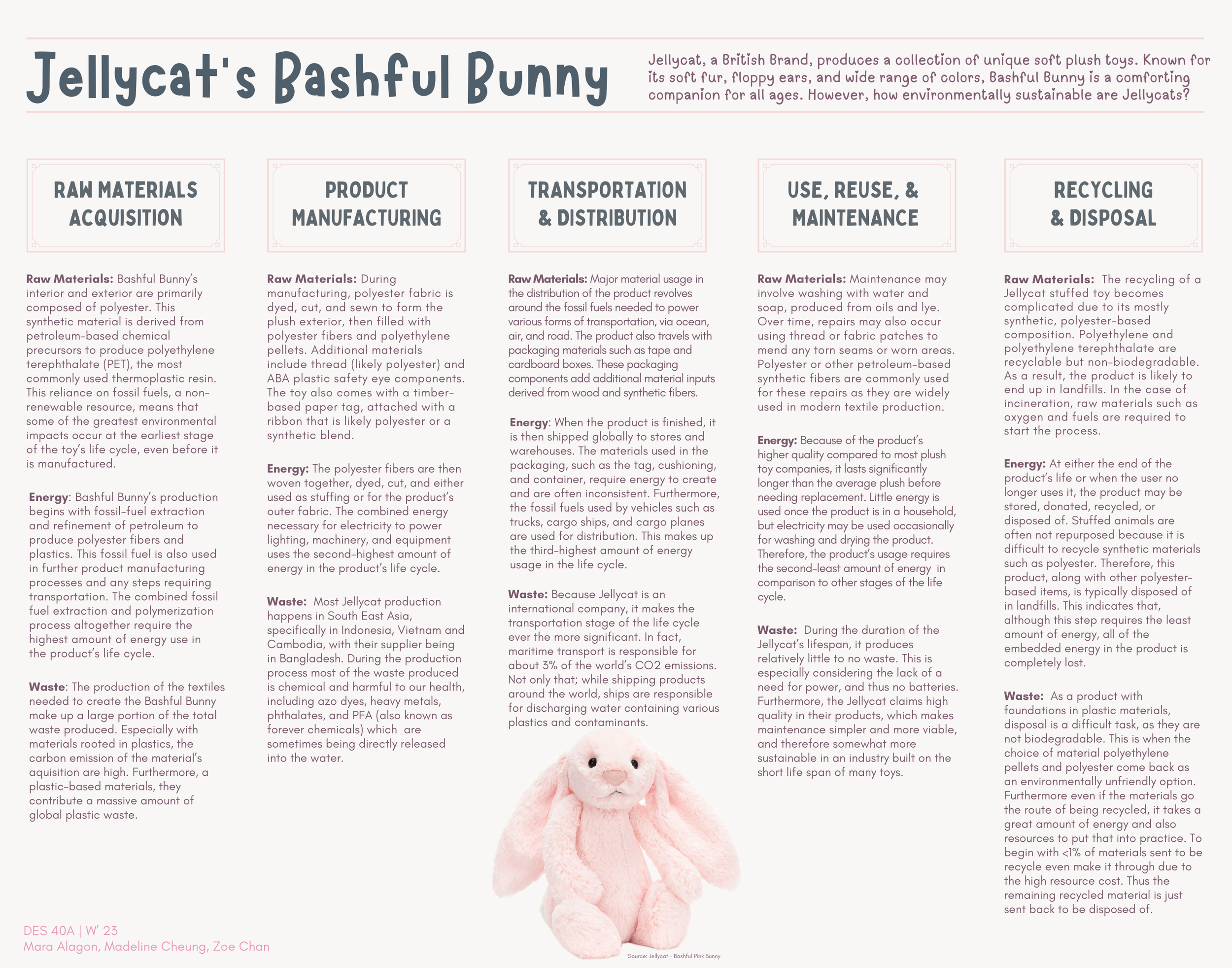
Jellycat Bashful Bunny Lifecycle - Mara Alagon, Madeline Cheung, Zoe Chan
Mara Alagon
Professor Christina Cogdell
DES 40 A04
13 March 2026
Jellycat Plush Toys: Raw Materials Throughout Their Life Cycle
The Amuseables Tennis Ball, Amuseables Espresso Cup, and Bashful Bunny represent just a few of the whimsical plush toy designs produced by Jellycat. As a preschool teacher, I have watched countless toy trends pass through classrooms over the past several years, yet few stand out aesthetically the way Jellycat plush toys do. Their simplified forms and distinctive character designs give them an immediately recognizable visual identity. Often sold in independent bookstores and specialty gift shops, Jellycat is positioned as a slightly more premium plush toy brand compared to many other stuffed toys on the market. Many of the company’s products feature playful designs such as plush versions of everyday foods and animals. In recent years, the brand has gained popularity online through viral videos of in-store employees theatrically “preparing” plush food items for customers, pretending to cook and package them before purchase. These experiences add to the brand’s charm and perceived value. Yet this sense of premiumness does not necessarily extend to the environmental impacts embedded in the materials and overall life cycle of these toys. Jellycats are primarily composed of fossil-fuel-derived polyester and plastic components, whose extraction and processing have significant environmental impacts. When examined through a life-cycle perspective, the raw materials acquisition stage emerges as a main source of environmental burden, with impacts that continue through manufacturing and later stages of their life cycle.
Jellycat presents itself as a thoughtful and quality-driven brand. However, detailed information about specific materials and manufacturing processes used in its products is relatively limited in sources available to the public. The company provides only a small amount of information about its sustainability practices. Many aspects of their production, such as their supply chain or textile processes, are undisclosed (“Corporate Responsibility”). As a result, analyzing the environmental impacts of their plush toys requires drawing on broader research about the materials and processes commonly used in the life cycle of a more general “stuffed toy” category. Therefore, this paper draws from literature on stuffed toy manufacturing and polyester and textile life cycles to infer which materials and processes are likely involved. This approach seems to reflect a broader challenge in textile life-cycle research. Datasets are sometimes proprietary or incomplete, and researchers are required to piece together environmental information from multiple sources (van der Velden et al. 332). Though even with limited data, available research strongly suggests that plush toys made from polyester depend heavily on fossil-derived materials, whose processes negatively impact the environment.
At first glance, Jellycat plush toys appear soft and simple in form. Yet, looking closer reveals that they are composed of several materials with origins that can be traced to fossil fuel extraction. The product details section of a listing on the official Jellycat website reads “Main Materials: Polyester” and “Inner Filling: Polyester Fibers, PE beans” (“Bashful Cream Bunny”). Commonly used in stuffed toys, polyester textiles dominate the global textile market and are manufactured from polyethylene terephthalate (PET), a synthetic polymer derived from petroleum (Palacios-Mateo et al.1). The same listing also includes the phrase “Hard Eye,” but does not specify the material used for this component. In the context of stuffed toy production, these “hard eyes” are typically known as plastic safety eyes. These molded plastic pieces lock into fabric and cannot be detached during use. They are commonly made from acrylonitrile butadiene styrene (ABS) or polypropylene (PP), two petroleum-based plastics, which adds another fossil-derived material to the composition of a Jellycat toy (Davis). Taken together, these details show that even a small plush toy contains multiple synthetic materials, including polyester fabric, polyester fiber filling, polyethylene beans, and molded plastic components.
These materials come from processes that begin with crude oil extraction. Through refining and chemical processing, crude oil is converted into the chemical precursors required to produce the PET polymer, primarily ethylene glycol and terephthalic acid. When combined, these substances can later be melted and extruded into synthetic polyester fibers used for textiles and fabrics (Tamoor et al. 2). The environmental consequences of polyester, however, begin way before the fiber is spun into fabric. Extracting crude oil requires drilling and pumping from underground. These activities both consume energy and disrupt surrounding ecosystems. Furthermore, refining the petroleum releases pollutants like benzene, nitrogen oxides, sulfur dioxide, and particulate matter, all of which contribute to air pollution and ocean acidification, (Palacios-Mateo et al. 3). On a global scale, polyester production places additional pressure on fossil fuel resources. More than ninety-nine percent of plastics originate from fossil fuels. Thus, the expansion of plastic products is tied directly to the extraction of nonrenewable materials (Tamoor et al. 2).
Because polyester fiber production relies on fossil fuel extraction and energy-intensive chemical processing, the raw materials stage holds a major share of the environmental burden associated with polyester products. Life cycle analyses on polyester find that the largest environmental impacts occur during the early “pre-consumer” stages of production, including raw material extraction and polymer processing (3). Raw material processing also involves large quantities of water, chemical additives, and colorants that are later used in textile dyeing and finishing processes (Palacios-Mateo et al. 5). By the time polyester fibers reach the stage where they can be spun into fabric, much of the environmental footprint of the final product has already taken shape. The materials that give a Jellycat plush toy its softness and weight begin as fossil resources drawn from the ground, and the environmental effects created during their extraction continue to travel with the material throughout the remaining stages of the toy’s life cycle.
Once the polyester fibers and plastic components are produced, they enter the manufacturing stage where they are transformed into the textiles and components that make a finished Jellycat plush toy. The fibers are spun into yarn and knitted or woven into fabrics, and shift form from petroleum-based polymer into the familiar soft texture of plush textiles (van der Velden et al. 332-334). This process requires industrial equipment, electricity, and other chemical treatments that continue the environmental impacts already introduced during the extraction of the initial raw materials. Additionally, the fabric is dyed and finished with treatments that give it color and softness, before it is ready for toy production. Plush toys utilize the range of colors afforded by these dyes, especially as products designed as playful characters. Textile dyeing processes require significant amounts of water and involve chemical additives that help pigments bond to the synthetic fibers (Palacios-Mateo et al. 5). The Jellycat company states that the dyestuffs used in their products comply with OEKO-TEX Standard 100 certification (“Corporate Responsibility”). This standard addresses chemical safety for consumers, but it does not negate the environmental impacts associated with water use and chemical processing during textile dyeing.
The stuffed toy starts to take shape once the finished textile materials are received at Jellycat’s manufacturing locations. Fabric is cut and sewn to form the toy’s outer shell. It is then filled with polyester fiberfill and polyethylene beans that give the plush its soft weight and structure. Additional plastic components such as safety eyes are attached to complete the character’s features. Each Jellycat toy also includes a product tag made from timber-based paper that is fastened with ribbon (“Corporate Responsibility”). The company does not disclose the type of thread or ribbon used, but given the toy’s overall material composition, they are likely synthetic or polyester-based. At this point, the toy finally resembles the playful object seen in stores. Even so, the materials used in its construction draw from the same synthetic substances introduced earlier in the life cycle. By the time the toy finally leaves the factory, much of its environmental footprint has already been determined by the fossil-derived materials required to produce it.
The transportation and distribution of Jellycat products continue to move their environmental impacts across geographies while introducing additional raw material inputs into their life cycle. After leaving the factory, Jellycat plush toys are internationally transported before reaching retailers and consumers. Jellycat notes that its products are manufactured through supply chain partners in Asia and distributed to markets including Europe and the United States (“Modern Slavery Statement”). The products move through various transportation systems–ocean or air freight across international routes, and inland shipments through rail or truck systems– all of which are powered by fossil fuels (Stern). These stages of transport require the continued extraction and consumption of nonrenewable fossil fuels. The plush toys also travel with packaging materials that protect them during shipment and distribution. Cardboard boxes and plastic tape and wrapping introduce further material inputs derived from wood resources and synthetic polymers. They are used only briefly before being discarded but still require energy and raw resources to produce. In this way, transportation extends the environmental impacts associated with the plush toy by adding new inputs and more fossil fuel consumption to its life cycle.
Once purchased, a Jellycat plush toy might remain at home or in classrooms where it serves as a comforting object or item for play. Occasional cleaning and maintenance may still involve additional material inputs. Plush toys are commonly washed with water and soap, introducing consumption of water and cleaning agents derived from oils and lye (Davidson). Over time, repairs may also occur using thread or fabric patches to mend any rips or worn areas. While many types of thread or fabric can be used, polyester or other petroleum-based synthetic fibers are commonly chosen because they are widely available and widely used in modern textile production. This stage seems small in scale compared to manufacturing or transportation, but still demonstrates that the materials used to produce the toy remain environmentally active throughout its lifespan. Even while sitting on a shelf or being carried, a plush toy continues to embody the fossil-derived fibers and other synthetic components introduced in earlier stages of its life cycle. Their environmental impacts continue to persist during the use phase.
At some point, Jellycat plush toys reach the end of their life. Because they are made primarily from polyester textiles and fillings, and other plastic components, the materials that form them persist in the environment and do not easily biodegrade. Polyester textiles can be mechanically or chemically recycled into secondary materials, but recycling rates remain very low. Less than one percent of discarded textiles are currently recycled into new fibers (Horn et. al 2). Additionally, its construction of mixed plastics makes the product difficult to recycle, as waste management systems are not designed to separate these materials that are recombined into a single product. As a result, they often end up in landfills or possibly waste incineration systems (Guberman). Even after disposal, the petroleum-derived materials used to make the toy remain present in the environment. This ultimately extends the environmental consequences of the raw resources from which the plush toy was originally made.
This analysis demonstrates how the environmental footprint of a product is determined long before it reaches consumers. For Jellycats, the majority of environmental impacts occur during the extraction and processing of petroleum-derived raw materials, which are used to create polyester fibers and other plastic components. These materials continue to shape the product’s environmental footprint through manufacturing, distribution, use, and disposal. Looking at a Jellycat plush toy through a lifecycle perspective reveals how an object designed for comfort and play rarely invites consideration of the industrial systems and processes that produce it. Writing this paper provided an opportunity to look at those systems more closely.
Full Bibliography
Albritton, Katie. “8 Tips for Choosing the Perfect Stuffed Animal.” Hazel & Fawn, Hazel & Fawn, 14 May 2025, hazelandfawn.com/blogs/8-tips-for-selecting-the-perfect-stuffed-animal/8-tips-for-choosing-the-perfect-stuffed-animal.
“Bashful Cream Bunny - Official Jellycat.” Official Jellycat Store, us.jellycat.com/bashful-cream-bunny/. Accessed 26 Jan. 2026.
Bataineh, Khaled M. "Life-Cycle Assessment of Recycling Postconsumer High-Density Polyethylene and Polyethylene Terephthalate." Advances in Civil Engineering, vol. 2020, 2020, pp. 15. ProQuest, https://www.proquest.com/scholarly-journals/life-cycle-assessment-recycling-postconsumer-high/docview/2381585761/se-2, doi:https://doi.org/10.1155/2020/8905431.
“Corporate Responsibility - Official Jellycat.” Official Jellycat Store, us.jellycat.com/corporate-responsibility/. Accessed 29 Jan. 2026.
Costa, Andréa F. S., José V. S. Aragão, Armando D. Duarte, Jacqueline S. Macêdo, Claudio J. S. Galdino Jr., Victória F. A. Milanez, Gilson L. Silva, and Leonie A. Sarubbo. “Analysis of the Environmental Life Cycle of Dyeing in Textiles.” Chemical Engineering Transactions, vol. 86, 2021, pp. 727-732, https://www.cetjournal.it/cet/21/86/122.pd
Davidson, A.S. “Soap and Detergent | Chemistry, Uses, Properties, & Facts | Britannica.” Britannica, www.britannica.com/science/soap. Accessed 27 Feb. 2026.
Davis, Clara. “Exploring Plastic Safety Eyes Toys: Material Grades, Properties, and Uses.” Alibaba.Com, www.alibaba.com/product-insights/plastic-safety-eyes-toys.html. Accessed 29 Feb. 2026.
Guberman, Ross. “The Complete E-Waste Recycling Process: RTS.” Recycle Track Systems, 12 Oct. 2020, www.rts.com/blog/the-complete-plastics-recycling-process-rts/. Accessed 01 Mar. 2026.
Holmes, Gillian S. “Bean Bag Plush Toy.” How Bean Bag Plush Toy Is Made - Manufacture, Making, History, Used, Parts, Industry, Machine, History, Raw Materials, The Gale Group Inc., www.madehow.com/Volume-5/Bean-Bag-Plush-Toy.html. Accessed 26 Jan. 2026.
Horn, Susanna, et al. “Environmental Sustainability Assessment of a Polyester T-Shirt: Comparison of Circularity Strategies.” Science of the Total Environment, vol. 884, 2023, article 163821, https://doi.org/10.1016/j.scitotenv.2023.163821
“Modern Slavery Statement - Official Jellycat.” Official Jellycat Store, us.jellycat.com/modern-slavery-statement. Accessed 23 Feb. 2026.
Palacios-Mateo, Cristina et al. “Analysis of the polyester clothing value chain to identify key intervention points for sustainability.” Environmental Sciences Europe vol. 33,1 (2021): 2. doi:10.1186/s12302-020-00447-x. Accessed 26 Jan. 2026.
Pennsylvania Department of Health. Benzene, Toluene, Ethylbenzene & Xylenes (BTEX). Commonwealth of Pennsylvania, https://www.pa.gov/content/dam/copapwp-pagov/en/health/documents/topics/documents/environmental-health/BTEX.pdf. Accessed 03 Mar. 2026.
“Safety & Care - Official Jellycat.” Official Jellycat Store, us.jellycat.com/safety-care. Accessed 26 Jan. 2026.
Stern, Melanie. “Port to Warehouse Logistics: The Process.” WSI, Warehouse Specialists, 28 Feb. 2025, www.wsinc.com/blog/the-journey-from-port-to-warehouse/.
Tamoor, Muhammad et al. “The Cradle-to-Cradle Life Cycle Assessment of Polyethylene terephthalate: Environmental Perspective.” Molecules (Basel, Switzerland) vol. 27,5 1599. 28 Feb. 2022, doi:10.3390/molecules27051599. Accessed 26 Jan. 2026.
“What is Polyester? A Complete Guide.” Apex Mills, 18 Feb. 2025, www.apexmills.com/media_post/what-is-polyester/.
“Why Is PET Sometimes Called Polyester?” Packageall.Com, www.packageall.com/support/why-is-pet-sometimes-called-polyester. Accessed 26 Jan. 2026.
van der Velden, Natascha,M., et al. "LCA benchmarking study on textiles made of cotton, polyester, nylon, acryl, or elastane." The International Journal of Life Cycle Assessment, vol. 19, no. 2, 2014, pp. 331-356. ProQuest, https://www.proquest.com/scholarly-journals/lca-benchmarking-study-on-textiles-made-cotton/docview/1491925160/se-2, doi:https://doi.org/10.1007/s11367-013-0626-9. Accessed 26 Jan. 2026.
Madeline Cheung
Professor Christina Cogdell
Energy, Materials & Design Across Time
9 March 2026
Life Cycle Analysis (LCA) of a Jellycat Bashful Bunny: Embodied Energy
Driven by a desire for both comfort and nostalgia, adults on social media have recently begun purchasing children's plushes regardless of age. Jellycat remains a staple of this trend because of the company’s variety of unique plush designs and materials that are both long-lasting and high-quality. However, many children’s plush companies, such as Jellycat, are not fully transparent about the materials and energy that are used in the product’s creation. One method of analyzing a product’s environmental sustainability lies in its embodied energy, the cumulative energy used in each stage of the product’s life. The most popular Jellycat, the Bashful Bunny, can serve as an example of how a small, everyday product can hold a significant amount of embodied energy after all stages of production. Through assessing the Bashful Bunny’s Life Cycle, the series of phases a product undergoes from raw material extraction, product manufacturing, transportation, household use, and finally disposal, one can determine how much energy is used in each stage and how that impacts the product’s environmental footprint.
Like most Jellycat plushes, the Bashful Bunny is primarily made of polyester, a synthetic material that is derived from fossil fuels. Polyester makes up the outer fabric, and polyethylene pellets (PE beans) are used for weighing, the internal stuffing, and plastic safety eyes (Jellycat). In addition to the product’s materials, it is also important to note the packaging materials used for all transportation between stages and distribution, such as tags, cardboard boxes, bubble wrap, and the gas used by vehicles. Because Jellycat is a private company, the LCA for its products must be conducted by analyzing embodied energy from other LCA studies of the main polyester and plastic components.
The sourcing of the raw materials to make the plush is the first stage in a plush's life cycle, and it is typically the largest contributor to the embodied energy of a plush. In this Jellycat, the polyester fibers are made from polyethylene terephthalate (PET), a plastic polymer made from chemical reactions using fossil fuel-based products. Producing PET involves multiple high-energy industrial processes, including extracting fossil fuels from the ground, processing them, and converting the raw hydrocarbons into polymers by using a process called polymerization. When considering the total energy used to manufacture synthetic fibers, a large amount of energy is required to convert fossil fuels into usable polyester fibers (Gonzalez et al.). These initial stages of material manufacturing consume a large amount of energy that is already in the textile product at the time of manufacturing.
After the polymer-making process, the polyester will be assembled into fibers using the fiber extrusion and spinning method, which requires intensive energy use. The melted polyester will be forced through small holes to create long synthetic strands. They are then cooled down, pulled out, and cut into smaller pieces for use as textiles or stuffing. Research into different polyester production methods indicates that polyester yarn production will consume large amounts of electrical and thermal energy during both mechanical processing and chemical stabilization (Berger and Pfeiffer). The yarns will then be transported to textile companies, where they are woven or knitted into fabric for the exterior of the Jellycat. Therefore, because polyester is used extensively in the production of Jellycat’s products, the energy used to produce the synthetic fibers largely contributes to the product’s total environmental footprint.
The polyethylene pellet filling inside the Jellycat, also known as plastic beans or PE pellets, provides weight and stability, preventing the plush from falling over when placed upright. Through the polymerization process, ethylene gas from petroleum refining is used to produce polyethylene. According to Avery et al., energy is used throughout particle formation and polymerization, which includes heating, pressurizing, and cooling, making this part of the manufacturing process rather energy-intensive. Research such as that performed by Saleem et al. indicates that plastic recyclables take an extraordinary amount of energy to be processed back into their original form into a plastic pellet during melting, purifying and creating the final product; therefore, while the overall mass of plastic pellets used inside the Jellycat are small, the energy used to produce the plastic polymers contributes to the total amount of embodied energy within that plush.
Small pieces of plastic safety eyes used in plushes are another example of items made with petrochemical energy-intensive industrial processes. Injection molding is one of the most common methods of manufacturing these small plastic parts. The process of injection molding uses thermal energy and electricity to melt polymer pellets, forcing them into molds as a liquid, and cooling them in the mold to a solid. The plastic safety eyes make up a small percentage of the total material composition; however, they have higher embedded energy in manufacturing processes used to create them.
After producing raw materials, the next significant phase in the product life cycle is manufacturing and assembly. Polyester fibers are made into plush fabric using processes such as spinning, knitting, or weaving, and finishing. A life-cycle assessment of the textile manufacturing process shows that spinning and finishing operations have the highest energy use. This is because a significant amount of electricity in the textile manufacturing process is largely used by the industrial machines (Abagnato et al.). The energy used to create the fiber transforms the fabric, making it ready to be assembled with other components to create the final product.
When plushes are created, they typically start as raw materials such as fabric and thread. Once the fabric is created, the Jellycat goes through the next step of assembly: cutting, sewing, and stuffing. During this stage of production, the pieces of fabric will be cut, sewn together with industrial sewing machines, and filled with polyester fiber stuffing and polyethylene pellets. Also at this time, the plastic safety eyes and the sewn label tags will be attached to the plush. The energy used to conduct the assembly process is lower than that needed to create synthetic polymers and produce textile products. However, the total embodied energy in a product is affected by the cumulative energy used for electric sewing machines, fluorescent fixtures, and other equipment. Although many assembly operations require relatively small amounts of energy, in high-volume manufacturing facilities that make thousands of plushes, these small amounts can add up to a significant total energy for the plush.
Once manufactured, the Jellycat goes through the transportation and distribution phase of the plush Life Cycle. Most plushes are made in large textile manufacturing areas, and then are sent internationally to retailers and/or warehouses. This is usually done using shipping containers moved by cargo ships, cargo planes, and delivery trucks. These systems use fossil fuels to transport plushes, contributing to the life cycle’s energy. Furthermore, transporting components between stages of the Life Cycle is difficult because they are sourced from multiple companies, factories, and manufacturers. It is impossible to determine the cumulative transportation distance from production to dispersion. Although the energy consumed in transportation is less than the energy required to produce the raw materials, the global distribution of the plush adds a significant portion of the total embodied energy.
Embodied energy is used in the fuel that transports goods and in producing the packaging materials. Plushes generally arrive in shipping containers made of cardboard, plastic, and protective materials to prevent damage in transit. The energy used to create cardboard boxes includes energy for processing wood pulp, making the paper, and forming the cardboard box. Likewise, plastic packaging materials are made using polymer manufacturing processes similar to those used to produce the plush’s plastic components. Although most packaging materials are disposed of shortly after purchase, the energy used in their creation is embedded in the packaging and the plush throughout its entire life cycle.
The phase of using plushes during their life cycle uses less energy than previous items. The only exception to this is the potential use of energy if the item is laundered, which would include the cost of using hot or warm water and electricity to power the washing machine and the dryer. Laundering a plush requires energy, but the energy it uses is relatively less than what is used for the manufacturing and production of the materials to make the plush. Although washing a plush may use less energy, it contributes to the total energy use.
One of the largest contributors to a product’s overall environmental impact is how long it has been owned. Many of the stuffed animals that children receive as gifts or purchases are kept for years or decades. Since energy is accumulated throughout the total life of a product, the longer the plush is owned, the more it can be spread out over the total energy used to make the plush for the entire life of the stuffed animal. Plushes can also be used multiple times after their original use by donating them to a charity, selling them, or giving them to another young child. Each of these options can extend the product’s life and keep it out of the waste stream for longer. Reuse is therefore one of the most effective ways to reduce a product’s overall environmental impact.
When a product reaches the end of its useful life, it may be stored, recycled, or disposed of. Jellycats such as the Bashful Bunny have a particularly difficult time being recycled because they are made from various material types that are difficult to separate. Plushes are made of multiple components: polyester fabric, polyester stuffing, polyethylene pellets, plastic eyes, and sewing thread, which are all sewn together as a single product. Research on common textile LCAs shows that recycling systems struggle to recycle products made from mixed or blended materials because specialized technology for separating these materials is not commonly available at the scale required by most recycling systems (Tekin et al.). Therefore, most plastics end up in landfills because they cannot be recycled.
Synthetic petroleum-based materials, such as polyester and polyethylene, are also extremely slow to break down. Products containing synthetic materials lose energy and resources for production due to the breakdown process. New recycling technologies using polyester fibers may eventually reduce this problem. Most recycling systems currently require clean, single-material inputs rather than complex, assembled products for success.
The primary energy used in the Jellycat Bashful Bunny plush is during its production, specifically in the early stages, such as fuel extraction and polymer manufacturing. The highest levels of energy use are found in processing polyester fiber, processing polyethylene pellets, and molding plastic parts. Additional energy consumption results from industrial machines and factory operations that complete the manufacturing and assembly of the plush. Compared to the distribution of the final product, transportation and packaging of plushes consume much more energy. Therefore, despite the minimal energy consumed during the use phase, the product’s material makes the recycling process difficult, and most of the cumulative embodied energy throughout the cycle is likely lost.
As both designers and manufacturers of children’s toys strive to improve product design and manufacturing processes, they should consider using recycled polyester fibers as raw material, incorporating less plastic, and considering all aspects of a product's life cycle during the design phase. Overall, this will help reduce the energy footprint of children’s toys while maintaining their quality and durability.
Works Cited
Abagnato, Samuele, et al. “Life Cycle Assessment Applications to Reuse, Recycling and Circular Practices for Textiles: A Review.” Waste Management, vol. 182, no. 74-90, Elsevier BV, June 2024, pp. 74–90, https://doi.org/10.1016/j.wasman.2024.0r4.016.
Avery, Elizabeth, et al. “Polyethylene Packaging and Alternative Materials in the United States: A Life Cycle Assessment.” The Science of the Total Environment, vol. 961, no. 0048-9697, Feb. 2025, p. 178359, https://doi.org/10.1016/j.scitotenv.2024.178359.
“Bashful Beige Bunny.” Jellycat, 2024, us.jellycat.com/bashful-beige-bunny/.
Berger, Nathaniel J., and Christoph Pfeifer. “Comparing the Financial Costs and Carbon Neutrality of Polyester Fibres Produced from 100% Bio-Based PET, 100% Recycled PET, or in Combination.” Biomass Conversion Biorefining. vol. 15, no. 6251–6268, Springer Nature, Feb. 2024, https://doi.org/10.1007/s13399-024-05362-2.
CHEN, FANGLI, et al. “A Review: Life Cycle Assessment of Cotton Textiles.” Industria Textil, vol. 72, no. 01, Feb. 2021, pp. 19–29, https://doi.org/10.35530/it.072.01.1797. Accessed 30 Aug. 2021.
Gonzalez, Victoria, et al. “Evaluating Environmental Impact of Natural and Synthetic Fibers: A Life Cycle Assessment Approach.” Sustainability, vol. 15, no. 9, Jan. 2023, p. 7670, https://doi.org/10.3390/su15097670.
Kalliala, Eija M., and Pertti Nousiainen. “Life Cycle Assessment.” AUTEX Research Journal/AUTEX Research Journal, vol. 1, no. 1, De Gruyter Open, Apr. 2024, pp. 8–20, https://doi.org/10.1515/aut-1999-010102.
Levesque, Sarah, et al. “A Life Cycle Assessment of the Environmental Impact of Children’s Toys.” Sustainable Production and Consumption, vol. 31, no. 2352-5509, Mar. 2022, https://doi.org/10.1016/j.spc.2022.03.001.
Li, Deli, et al. “Optimizing Sustainability in Textile Recycling: Life Cycle Assessment of Recycled Polyester Staple Fibers with a Focus on Carbon Emissions, Energy Efficiency, and Water Conservation.” ACS Sustainable Chemistry & Engineering, vol. 12, no. 47, American Chemical Society, Nov. 2024, pp. 17347–56, https://doi.org/10.1021/acssuschemeng.4c07598.
Saleem, Junaid, et al. “Assessing the Environmental Footprint of Recycled Plastic Pellets: A Life-Cycle Assessment Perspective.” Environmental Technology & Innovation, vol. 32, no. 2352-1864, Nov. 2023, p. 103289, https://doi.org/10.1016/j.eti.2023.103289. Science Direct.
Tekin, Pırıl, et al. “A Life Cycle Analysis of a Polyester–Wool Blended Fabric and Associated Carbon Emissions in the Textile Industry.” Energies, vol. 17, no. 2, Multidisciplinary Digital Publishing Institute, Jan. 2024, pp. 312–12, https://doi.org/10.3390/en17020312.
Zoe Chan
Madeline Cheung, Mara Alagon
DES 40A
Professor Cogdell
Jellycat Design Life Cycle Analysis: Waste
Claiming to spread the joy of companionship to those all around the world through their products, Jellycat has been a rising figure in the toy industry. They are most well known for their soft plush toys, which come in a variety of shapes (both animals and objects) and sizes. They claim to consistently ship products of irresistible charm, made with materials they claim to be ever more soft and long lasting. But with Jellycat’s growing popularity, it’s important to consider the impacts of creating such well loved toys. Despite Jellycat stuffed toys being a well known product that champions sustainability initiatives, many aspects of its life cycle from the very first step of obtaining raw materials to its recycling and disposal caused a substantial amount of waste. Ultimately, even endeavors in expanding the lifespan of the materials and product itself end up creating a significant amount of waste.
The first stage of a product's life cycle is raw materials acquisition. In the case of Jellycat, this means getting the fabric and stuffing which are primarily composed of polyester and/or cotton. First we will look at the effects of cotton production. Cotton originally comes from the cotton plant and is then processed to become usable in the textile industry. However, during this process, there are two main types of waste to be mindful of: physical byproducts and chemical/toxic waste. The first type of waste, physical byproducts, refers to “gin trash”, solid waste that is created while the cotton is ginned to separate the fiber from the seeds. It is mostly composed of leaves, sticks, burrs, soil, and immature seeds, and if left alone can become a fire hazard and cause of strong odors. However, it can be taken care of by being upcycled into things such as livestock feed or even bioenergy. The second type of waste is chemical/toxic waste. Cotton often gets referred to as the “dirtiest crop” because it uses an immense amount of chemicals to grow, including pesticides and insecticides, fertilizer, and dyes, which often get into water sources. For instance pesticides and insecticides frequently leach into groundwater or run off into local rivers and streams. Similarly, fertilizers go through runoff, causing release of nitrous oxide, a greenhouse gas, and excess nutrients into local water sources, which often leads to algae blooms. Additionally, as a major aspect of the textile industry, it’s dyed before being turned into products, but textile dyeing is actually the second largest polluter of water, with toxic waste water frequently being dumped into local ecosystems. (Yu).
The other main textiles used to make Jellycat stuffed toys are polyester and polyethylene (for the pellets to stuff the toys). Despite its wide use for short term purposes, polyethylene is very harmful to the environment as a non-biodegradable material. In fact, it generates a massive amount of global plastic waste every day. Something to consider is its lack of ability to be reused, which causes its accumulation in landfills. (Iwuozor). However, that would be a relatively better scenario of where the plastic ends up; an article by Kat Kerlin from UC Davis recently discussed the large consequences of using such tiny beads in toys. In said article, they describe it as ‘a microplastics bomb’, because when toys filled up with hundreds of beads of this material explode, their glittery contents spill out to pollute aquatic and human environments. (Kerlin). Similar to polyethylene in its roots in plastic, polyester is a synthetic fiber that’s made from petroleum. Thus, polyester is a major player in the release of microplastic pollution. Furthermore, it generates several times more carbon emissions than cotton, and like cotton also pollutes water sources with the waste water attributed to textile dyeing and finishing, which releases heavy metals and toxins into local waterways. This shows the heavy impact of the production of textiles to produce Jellycat products alone, but the waste only increases with the rest of the product’s life cycle.
The next stage of the product’s life cycle is production. While Jellycat does not publicize the locations of their factories, we know the general location of their product manufacturers. According to their Modern Slavery Statement on the Jellycat webpage, they operate mostly in South East Asia, specifically in Indonesia, Vietnam and Cambodia, with a few products also being manufactured in China. Additionally, starting in the beginning of summer 2024, Jellycat’s supplier was based in Bangladesh.
This information does not come to a surprise, especially considering Southeast Asian countries’ significant role in the production of the world’s textiles. However, this position comes at a large cost, as the textile industry is one of the most chemical-intensive. As it is now, they are major producers of not just children’s stuffed toys, but also other hazardous substances including azo dyes, heavy metals, phthalates, and PFA (also known as forever chemicals). This leads to large amounts of water contamination, as it isn’t uncommon for untreated substances to be directly discharged into rivers. Some local impacts include increased rates of cancers and hormonal disorders to the human population, and devastation to local aquatic ecosystems and thus small-scale agriculture and fisheries. In Bangladesh, where Jellycat’s supplier is located, several major textile regions report heavy metals (chromium, cadmium, and lead) and PFAs. While they do pose a significant degree of threat to local health, and though Bangladesh’s Environmental Conservation Rules contained stricter discharge standards years ago, many factories lack Effluent Treatment Plants that actually work. (Khandaker).
This closely ties onto the next stage of the product life cycle: Transportation and Distribution, which begins in Asia and expands to the rest of the world. Jellycat, as an international company, boasts of their abilities to reach consumers all around the world with their quality products, but behind this claim lies a great cost paid in waste production. Maritime transport accounts for about 3% of the world’s carbon dioxide emissions and transports 90% of global trade. That barely scratches the surface of the degree of environmental harm the shipping industry is causing. In addition to carbon dioxide, sulfur oxides, nitrogen oxides, and black carbon are all being emitted in significant amounts. This contributes to global warming and causes many yearly deaths from heart/respiratory diseases each year. Furthermore, ships are responsible for discharging 250 million tons of sewage and greywater, which often carry plastics and contaminants. There may even be accidents where oil gets spilled into the sea, and heavy fuel oil usage is responsible for damaging coral reefs and/or other marine life.
The impact of the transportation sector especially in certain areas of the world is so great that the effects have even begun to reach the ozone layer. One study found that shipping emissions primarily lead to a decrease in ozone concentration in the Yellow Sea and East China Sea as a result of ozone titration. While this does differ depending on the region in which it takes place, it’s important to note that the shipping emissions in East Asia are acting to change the natural amount of ozone through titration, and is further impacted by seasonal weather patterns and regional chemical sensitivities. (Choe). Therefore, by the combined efforts of the production and transportation stage of the life cycle, there are many chemical and other pollutants that are being released into the environment.
This leads into the next phase of the life cycle which is focused specifically on reducing the environmental impact the product causes. While I was unable to find specific information on Jellycats being used, reused, and maintained, I looked into the typical lifespan of similar toys in the industry. As a stuffed toy, Jellycat is a relatively waste-free product during its use and re-use phase. Additionally on their product webpage, Jellycat claims to make long lasting products of high quality, which sets them apart from their competitors. However, it is still important to note a trend of products to be made with short term use in mind. Similar to the trend of fast-fashions in the textile industry, toys tend to be similarly manufactured to last for a short period of time. In one study of which toys had the highest amount of environmental impact it was shown that plastic, battery-powered toys were the most unsustainable toys. Furthermore, it is recommended for consumers with the environmental impact of the toy in mind to pay attention to the longevity, material choice, whether or not the toy was locally purchased, and simplicity. (Klimas). This would make a Jellycat a relatively neutral product in terms of its sustainability. While it is made of materials that, as mentioned before, are not the greenest, nor is the product locally sourced, they do steer clear of needing to be powered by any battery or charge. Additionally, assuming that Jellycat’s claims of good quality and long lasting durability are true, that makes it somewhat more sustainable than many other toy options.
The final stage of the life cycle of a product is recycling and disposal. As mentioned before while discussing the materials in the Jellycat, disposal is a bit complicated, as it is made primarily of plastic based materials. Breaking it down again, the Jellycat’s polyethylene pellets, used as stuffing, are not the best for the environment. Should the end of the Jellycat’s lifespan come, the plastic pellets will remain fully composed for many years to come. That is the price of being non-biodegradable. Furthermore polyester, which is also plastic based, has a hard time decomposing; rather, it causes the release of microplastics. Additionally, while the process to recycle polyester material continues to give the material some use, it is found that the recycling process actually increases water depletion. This means that to recycle polyester we actually need to expend resources, maybe even more so than if we just disposed of it. It’s also important to note that even among all the material recollected in the textile industry, less than 1% is actually reused/ recycled. Therefore, even if recycling is typically done with the best interest of keeping a material in use for longer, it’s relevant that the process to recycle also contributes a fair share of damage.
The Corporate Responsibility page on the Jellycat website contains a section, Sustainability & Environment. In it, they make several claims and testaments to the way they are an environmentally minded company, which include durability for an extended product lifespan, increased use of recycled polyester, constant waste reduction initiatives, removal of single-use plastic, and even the use of FSC recycled paper. However, as we have seen through an in-depth review of each stage of the product life cycle, there are many aspects of Jellycat which are ultimately environmentally unsustainable. While they are not made to be environmentally friendly, and while Jellycat has made various attempts to become green, not all of the actions they make with this in mind actually serve the purpose that was intended, which renders them ultimately unsustainable.
Bibliography
Choe, Hyeonsik, et al. “Assessing the impact of shipping emissions on ozone concentrations in East Asia: Insights from KORUS-AQ and SIJAQ 2021 campaign periods.” Atmospheric Environment, vol. 320, Mar. 2024, p. 120339, https://doi.org/10.1016/j.enpol.2025.114627. Accessed 6 Feb. 2026.
Fois, Flaminia, et al. “Environmental Impacts of Cotton and Polyester Textile Management Strategies: Comparison of Separate Collection for Reusing and Textile Waste Recycling.” Environmental Impact Assessment Review, vol. 116, Elsevier, July 2025, p. 108088, https://doi.org/10.1016/j.eiar.2025.108088.
Iwuozor, Kingsley O., et al. “Expanded Polyethylene Circularity Potentials: A Comprehensive Overview of Production Process, Applications, and Recycling Techniques.” Chemistry Africa, vol. 7, Springer Science+Business Media, July 2024, https://doi.org/10.1007/s42250-024-01037-7.
Kerlin, Kat. “Plastic “Pool” Toy Pollution in the Wild.” UC Davis, 29 July 2021, www.ucdavis.edu/climate/news/plastic-pool-toy-pollution-wild.
Levesque, Sarah, et al. “A Life Cycle Assessment of the Environmental Impact of Children’s Toys.” Sustainable Production and Consumption, vol. 31, no. 2352-5509, Mar. 2022, https://doi.org/10.1016/j.spc.2022.03.001.
Li, Ziyi, et al. “Decarbonizing Photovoltaic Glass Manufacturing in China: A Factory-Specific Carbon Footprint Analysis.” Environmental Technology & Innovation, vol. 40, Nov. 2025, p. 104669, https://doi.org/10.1016/j.eti.2025.104669. Accessed 6 Feb. 2026.
“Maritime Shipping - ClimateWorks Foundation.” ClimateWorks Foundation, 2 Sept. 2025, www.climateworks.org/programs/transportation/maritime-shipping/.
Pereda, Paula Carvalho, et al. “Carbon Tax in the Shipping Sector: Assessing Economic and Environmental Impacts.” Energy Policy, vol. 204, Sept. 2025, p. 114627, https://doi.org/10.1016/j.enpol.2025.114627. Accessed 22 Jan. 2026.
Rahman, Mursalin. “Toxic Threads: Southeast Asia’s Textile Pollution Poses a Growing Security Threat.” New Security Beat, 2025, www.newsecuritybeat.org/2025/08/toxic-threads-southeast-asias-textile-pollution-poses-a-growing-security-threat/. Accessed 2 Sept. 2025.
Slater, Keith. “Environmental Impact of Polyester and Polyamide Textiles.” Polyesters and Polyamides, 2008, pp. 171–99, https://www.sciencedirect.com/science/chapter/edited-volume/abs/pii/B9781845692988500067?via%3Dihub.
United Nations. “From Petroleum to Pollution: The Cost of Polyester.” United Nations Western Europe, 17 Dec. 2024, unric.org/en/from-petroeum-to-pollution-the-cost-of-polyester/.
Yadou, Chen, et al. “Analyzing Product Design System Application Children’s Toys Based on Sustainable Materials and Processes.” Entertainment Computing, 29 Mar. 2025, p. 100947, www.sciencedirect.com/science/article/pii/S1875952125000278, https://doi.org/10.1016/j.entcom.2025.100947.
Yu, Zhuhong, and Yi Yang. “Carbon Footprint of Global Cotton Production.” Resources, Environment and Sustainability, 7 Mar. 2025, p. 100214, www.sciencedirect.com/science/article/pii/S266691612500026X, https://doi.org/10.1016/j.resenv.2 025.100214.
Zhao, Saiyu, et al. “Life Cycle Assessment of Recycled Polyester and Analysis of Key Emission Sources.” The International Journal of Life Cycle Assessment, Mar. 2025, https://doi.org/10.1007/s11367-025-02440-z.