Design Life-Cycle
assess.design.(don't)consume
Kite Man
DES 40A
Professor Cogdell
7 March 2026
Material Lifecycle of HotHands Hand Warmers
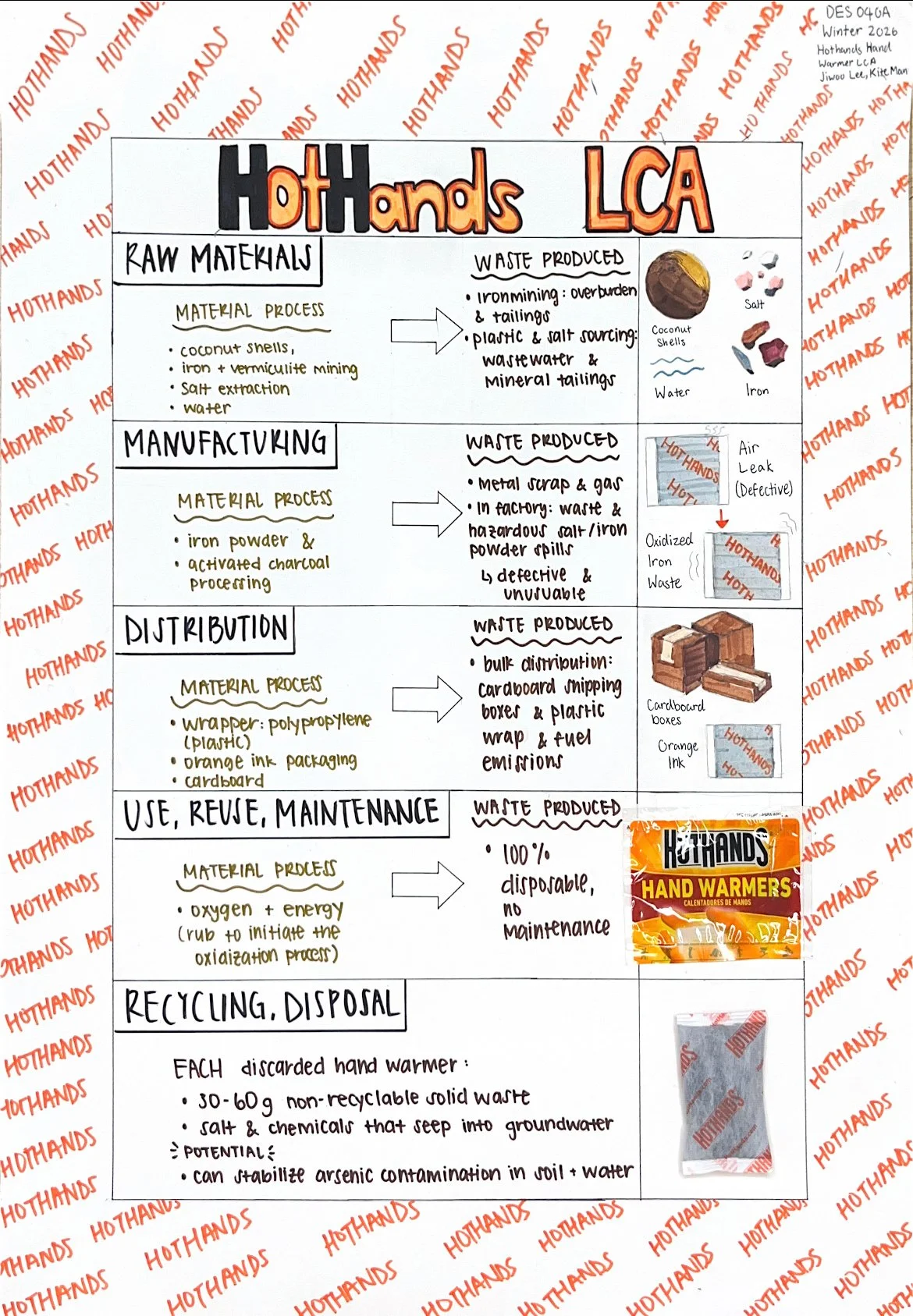
Disposable hand warmers are widely used, with a key selling point being their accessibility and ease of use. The most prominent brand of disposable hand warmers is HotHands, which manufactures a variety of warmers for different areas of the body. HotHands’ website has an FAQ page, which provides the following ingredients list: iron powder, water, salt, activated charcoal and vermiculite. However, they seem to deliberately omit the materials used to create the wrappers and packaging for the hand warmers, which include ingredients such as polypropylene plastic. They position their products and brand as environmentally friendly, stating on their website that their products are “made of natural ingredients and safe for the environment”. In reality, the warmers can be harmful to the environment for a multitude of reasons. From the unrenewable raw materials to the copious amounts of technology and fuel needed to process them, HotHands’ disposable hand warmers are more wasteful in comparison to reusable alternatives. Although some of the raw materials used in HotHands’ hand warmers are renewable, the processing of these materials into the hand warmers’ components renders them unsustainable.
The HotHands’ hand warmers are made of several disclosed ingredients. But the extraction, processing, and manufacturing of these ingredients and the effects of these processes are left unsaid. The raw materials used to create these ingredients are iron ore for the iron powder, coconut shells for the activated charcoal, and vermiculite ore for the processed vermiculite. According to the Essential Minerals Association, two main methods for salt extraction that might be used for this product are solar extraction and solution mining. Solar extraction is done by creating salt evaporation ponds and leaving the water to evaporate. Solution mining involves pumping freshwater into underground salt beds for an easier extraction process. Vermiculite extraction and processing is detailed by the US Environmental Protection Agency (EPA). It is mined using open-pit methods, then blended and put into a mill before being dried. Iron ore is usually extracted directly out of iron ore reserves, but can also be mined from open-pit mines similarly to vermiculite. According to the Metal Powder Industries Federation, there are four methods of processing a metal into powder form: solid-state reduction, atomization, electrolysis, and chemical treatments. It should be noted that electrolysis is generally used for copper powderization due to the demand of high-conductivity copper powder, but can still be used for iron powderization. Solid-state reduction is more varied in quality, as there is no process to purify the metals in the process. Attempts to find research on mass water extraction and coconut shell harvesting for industrial usage proved difficult, and therefore could not be included. Beyond extraction, the renewability of the various raw materials is also important to take into account. As it is an organic material, coconut shells are a renewable resource. The same cannot be said of iron, water, vermiculite and salt.
The ingredients listed on the packaging excludes the materials used for the plastic wrapping and the packaging itself, which cause a large part of the waste once disposed of. The warming ingredients are stored in a packet made of polypropylene plastic, and the company's name and website is printed onto the packet in orange ink. Before being packed, they are tested for effectiveness to ensure the chemical warming process hasn’t already occurred. Once they have passed this check and are packed for distribution, they are transported in cardboard boxes and shipped out. Plastic Practical explains that the polypropylene plastic is “manufactured through polymerization of propylene monomers, primarily using Ziegler-Natta and metallocene catalysis methods”. It then undergoes either gas- or liquid-polymerization, depending on the intended usage. Unfortunately, this plastic packet is necessary, as it has the feature of being able to withstand the heat from the chemical warming process, holding the ingredients together, and acting as a barrier between oxygen and the iron powder. This is to ensure that the chemical warming process does not happen earlier than intended. For the manufacturing of cardboard, wood is processed into pulp, which then undergoes pounding, pressing, and draining. In the case of cardboard boxes used for transportation, they are then corrugated, coated, winded and calendared. The last step in creating the boxes is adding flutes to fortify the layers of cardboard. The amount of orange ink used is relatively insignificant, and the materials used to make it are not disclosed. The outer packet made of polypropylene plastic and orange ink is unrenewable, but the cardboard boxes are renewable and recyclable.
The processing of the raw materials into the specific ingredients requires many kinds of unique, precise machinery. Vermiculite requires a mill and rotary drier for processing, and bins for storage. It then needs to go in a bucket elevator and through a gas- or oil-fired vertical furnace for exfoliation. The processing of iron into iron powder using the solid-state reduction method requires the use of a continuous furnace. Fuel oil is needed for the rotary drier to work. Sunseeta Carbons, an activated carbon manufacturing company, explains how activated charcoal is manufactured through steam activation. First, the raw materials are put into a mud-pit, brick kiln or metallic portable kiln, to be converted into “shell charcoal”. This is then put into a rotary kiln to be activated. It should be noted that this account may leave out details that would bring harm to the company or industry, but the materials needed and basic steps of the process are accurately described. The Compactor Management Company put a post on their website detailing the materials, technology and processes needed to create cardboard. The process of turning wood pulp into cardboard requires a Fourdrinier machine, wool felt rollers, steam heated cylinders and a wheel for corrugating. In the case of all of these processes, the machines and other kinds of technology used in the manufacturing process require either human labor or fuel to work, adding material costs that cannot easily be taken into account. There are also the materials needed to build the facilities the machines are housed in, as well as the resources needed to keep the facilities running.
The distribution of the hand warmers requires fuel for the vehicles used to transport them, as well as the vehicles themselves, making the materials needed for distribution difficult to track. Distribution methods encompass shipment to warehouses and store chains, but include delivery and shipment to consumers as well. Depending on what methods are used for distribution, the materials needed for it could vary greatly. However, usage of the handwarmers requires very few materials. Once the handwarmers are successfully within the hands of consumers, some kinetic energy is needed to kickstart the chemical warming process. The consumer must rub the hand warmer, most often done between the hands, in order to cause oxygen to interact with the iron powder. The reason the hand warmers are disposable is because this interaction oxidizes the iron powder and causes it to release heat, an effect which cannot be reproduced or undone once it has occurred. Once activated, Travel Panders claims the hand warmers “can provide heat for several hours”. No extra materials are needed to properly dispose of them once they are no longer usable.
HotHands’ hand warmers mainly consist of secondary raw materials, which makes tracking the ingredients more difficult. This, combined with the omission of packaging materials, minimizes the amount of available information on the materials used to create them. It also lowers the perceived environmental pollution caused by disposable hand warmers. Despite technically being renewable and recyclable, the hand warmers are functionally unrenewable because consumers are instructed to throw them away. Taking into account all the materials used to create and fuel the technology for processing of all the ingredients would drastically increase the list of materials needed for the manufacturing of the hand warmers. Most of these materials would likely be unrenewable, or processed in a way that makes them unsustainable. Bringing awareness to the known raw materials used to create the hand warmers may discourage consumers from overusing them, or encourage the creation of a recycling system. However, the designing of a recycling system is highly unlikely, as it requires separating out the ingredients within the packet. This process would likely be impractical at best, and a waste of energy and resources at worst. Reusable hand warmers are a much more sustainable alternative, and more attention should be given to the reusable and/or recyclable alternatives, as is the case with any product.
Works Cited
“Contact & Faqs.” Hothands, hothands.com/contact-faq/. Accessed 13 Mar. 2026.
Martin, Jenny. “How Do We Get Salt? Exploring Different Salt Production Methods.” Essential
Minerals Association, 27 July 2025, www.essentialminerals.org/blog/salt-production-methods/.
Carlos. “A Deep Dive into Production: How Is Polypropylene Manufactured?” Plastic Practical,
17 Dec. 2024, plasticpractical.com/a-deep-dive-into-production-how-is-polypropylene-manufactured/.
Compactor Management Company (former Northern California Compactors). “What Is
Cardboard Made of? How Is Cardboard Made?: CMC.” Compactor Management Company, 6 Mar. 2024, www.norcalcompactors.net/what-is-cardboard-made-of/.
“Activated Charcoal Manufacturing Process.” Suneeta Carbons,
www.suneetacarbons.com/process.html. Accessed 12 Mar. 2026.
“11/95 Mineral Products Industry 11.28-1 11.28 Vermiculite Processing.” US Environmental
Protection Agency, 2020, www.epa.gov/sites/default/files/2020-10/documents/c11s28.pdf.
Stace, R. “Iron Ore Extraction Techniques - Sciencedirect.” ScienceDirect, 2022,
www.sciencedirect.com/science/chapter/edited-volume/abs/pii/B9780128202265000252.
“Making Metal Powder.” Making Metal Powder,
www.mpif.org/IntrotoPM/MakingMetalPowder.aspx. Accessed 13 Mar. 2026.
Hassan. “Hot Hands Hand Warmers: Do They Expire? Effectiveness, Storage, and Faqs
[Updated on: March 2026].” TravelPander, 8 May 2025, travelpander.com/do-hot-hands-hand-warmers-expire/.
Jiwoo Lee
DES 040A
Professor Cogdell
13 March 2026
The Hidden Cost of Heat: A Life Cycle Analysis of HotHands’ Disposable Hand Warmers
As temperatures drop and the weather gets colder, more and more disposable hand warmers are added to landfills. Hand warmers are convenient for their one-time use, as they heat up almost instantly after opening and shaking them up. While its disposal feature is an effective advantage, it is also its biggest disadvantage, as the waste produced by discarded hand warmers contributes to general pollution and can harm aquatic life or contaminate soil. Additionally, the limited lifespan of the hand warmers can lead to more waste when accidents occur, either during packaging or when consumers accidentally open one. Nonetheless, HotHands is the leading company in the disposable hand warmer market, and it has addressed environmental concerns by stating on its site that the hand warmers are made of natural materials and are safe for the environment. Although HotHands claim their hand warmers use natural, environmentally friendly materials, a full life cycle analysis depicts their “cradle-to-grave” journey, from the waste generation from raw material extraction to the massive build-up of non-recyclable solid waste, contributing to a huge environmental burden. Their acquisition and manufacturing, such as iron powder, salt, and plastic, also contribute to pollution, adding to the waste produced to make hand warmers. HotHands’ site also addresses the disposal process, recommending consumers to dispose of them after each use. The lack of maintenance available due to its one-time use is an issue that leads to each discarded hand warmer contributing to mass pollution, even if the product itself is safe during use. However, there is potential for used handwarmers to effectively support the environment, as the used powder can help stabilize arsenic contamination in soil and water. Manufacturing and disposal processes contribute heavily to landfills, since the hand warmers are one-time use.
The HotHands’ hand warmers are made of several components, such as iron powder, plastic, salt powder (sodium chloride), that contribute to waste that is produced during the materials acquisition and the production phase in factories. Iron powder, which is the primary material needed to generate heat from HotHands’ hand warmers, is derived from iron ore. This process consists of mining and refinement. Iron ore extraction is considered waste-intensive, as for every ton of usable iron produced, the miners generate large amounts of overburden, the rock and soil removed to acquire ore deposits, and tailings, the finely, chemically processed residue left after metal is separated from the ore (Hall-Geisler). Tailings are a waste byproduct, as they often contain heavy metals and acidic elements that seep into nearby groundwater or waterways, polluting aquatic ecosystems or potentially contaminating drinking water. Salt, which is another significant material needed for the hand warmers’ creation, is typically obtained through evaporation of seawater or by mining underground salt deposits. While the salt itself is not a harmful or polluting substance, the extraction process can create brine wastewater and mineral tailings that affect the salinity and chemical composition of local water sources. While the iron powder and salt is used to create the powder inside the hand warmers, materials to create the plastic outer pouch is needed as well in the manufacturing process. The plastic is created from petroleum-based polymers, which requires naphtha, a hazardous hydrocarbon of crude oil that creates risks to workers and generates volatile organic compound (VOC) emissions during the processing (Wang, Linda). Additionally, activated carbon, which is used to help regulate the oxygen flow during the hand warmers’ oxidation process, is an energy intensive material itself. The production of activated carbon requires energy-intensive steps, such as carbonization and activation that use large amounts of heat, emitting emissions during manufacturing (Gu et al.). According to Vilén et al.’s comparative life cycle assessment of active carbon production from several raw materials, the manufacturing process produces significant greenhouse gas emissions and water-borne pollution regardless of whether or not the carbon is from coal or biomass material. Similar findings are further supported by Li et al., as their life cycle sustainability assessment of activated carbon production technologies found that both coal-based and biomass-derived sources use a significant amount of energy and produce harmful emissions that contribute to air pollution. Altogether, the extraction and initial processing of each raw material needed to produce a HotHands hand warmer potentially affects and contributes to groundwater contamination, water pollution, and to an increase in greenhouse gas emissions even before a hand warmer is fully created in a factory. However, once the hand warmers are created in a factory, the hand warmers themselves can be wasted during the production stage. A hand warmer’s activation is not reversible and is considered defective once it is accidentally exposed to air. Additionally, beyond the unusable hand warmers, the process of workers working with fine iron and salt powders can create a dust that contaminates the factory air and settle on the surface which can be a health risk for the workers and require cleanup. According to a life cycle assessment of activated carbon production conducted by Saleem et al. and a review of different thermal energy storage systems explored by Wickramasinghe et al., the production process is considered to be the single largest contributor to global warming potential (GWP) across the entire product life cycle. This is due to the energy-intense heating and chemical processes that are involved, which is important to consider as gas emissions from plastic heat-sealing equipment can pollute the facility’s air quality when manufacturing HotHands’ hand warmers. While the process of producing hand warmers contributes to different kinds of general waste, a lot of trash is also generated during the transportation and usage process.
The distribution and maintenance, of the lack thereof, leads to not only air pollution but also contributes heavily to our landfills. HotHands hand warmers are manufactured in bulk and shipped to wholesalers and retailers across the United States and globally. Bulk shipments require a lot of packaging, such as cardboard shipping boxes, plastic shrink wrapping, and cushioned material made of foam or paper, most of which is discarded by the retailers once the shipments arrive, contributing to quick packaging disposal, and consequently landfill waste. Aside from the waste generated from the bulk order packaging, the transportation process itself, whether it is by ocean freight, trucks, or planes, fuel emissions such as carbon dioxide and nitrogen oxides are released into the air. Along with the packaging disposal process, the usage span of one HotHands hand warmer is brief as well. Once a HotHands hand warmer is opened from the plastic outer packaging and is activated, which initiates the iron oxidation reaction once it is exposed to air, produces heat for several hours and then becomes hard and unusable (Raleigh et al.). The HotHands’ website notifies consumers that hand warmers typically stay warm for up to 10 hours. Additionally, the site instructs consumers to discard the used hand warmer in the trash can, acknowledging that maintenance or re-activation is not possible. The convenient disposability is a huge appeal point for consumers of HotHands’ hand warmers. However, it is simultaneously the most environmentally damaging aspect of the product, as every single hand warmer sold becomes solid waste after a few hours of activated use. While HotHands’ hand warmers are popular and are convenient, the distribution and one-time usage of the product are not environmentally friendly nor sustainable. However, the waste generated from HotHands’ hand warmers continue even after they are discarded, as they impact the environment and contribute more to pollution.
The waste generated after hand warmers are used contribute the most to pollution and are susceptible to harming the environment during the disposal process. Once a used HotHands’ hand warmer is thrown out and added into landfill, its plastic outer packaging, made up of non-recyclable laminated polymer, is not biodegradable for hundreds of years, which heavily contributes to the long-term accumulation of microplastic waste as they slowly separate and break down under UV exposure and any mechanical pressure (Wang, Linda). Inside the pouch of a used hand warmer contains the iron powder, which has turned into iron oxide (rust) through the oxidation reaction, and the residual salt and chemicals can pollute the soil and affect the groundwater quality. Rain and any water streams that break through landfill can be potentially polluted by the salts and any remaining metals from the hand warmers, which can alter the water chemistry and harm aquatic ecosystems and plant life. Due to HotHands’ classification of their hand warmers to be general solid waste rather than hazardous material, a huge quantity of them are thrown out without any specialized treatment. The sheer quantity of HotHands’ hand warmers that are bought annually, which can be up to tens of millions of hand warmers per year, especially during colder months, means that the environmental waste will only grow over time. The non-recyclability of HotHands’ hand warmers make it difficult for its retrieval to sort or process, unlike metals or certain plastic materials. Therefore, the multi-material model of a hand warmer pouch cannot be effectively separated for recycling.
However, despite the general negative impact disposable HotHands’ hand warmers have on the environment, there has been recent research that identified one promising way the materials could be repurposed for environmental benefit rather than harm. A study by Wang et al. found that used iron powder in used disposable hand warmers can serve as an effective absorbent for arsenic removal from contaminated water. Arsenic contamination of groundwater and surface water is a widespread environmental and public health concern, especially in parts of South and Southeast Asia and in areas with a prevalent mining industry. The oxidized iron residue in a HotHands’ hand warmer has a high surface area and chemical capability for arsenic ions, which allows it to absorb it from multiple adsorption-desorption cycles (Wang et al.). The proposed “open-loop recycling” would allow a common waste product to be repurposed to assist with arsenic treatment systems. While this is a great discovery, it is still a discovery in its research stage and has not been implemented yet on a large scale. There is currently no companies or infrastructure that collect used hand warmers to reroute used hand warmers to water treatment facilities. However, the theoretical sustainability potential of millions of used HotHands’ hand warmers would be a great way to develop benefit in a product that is generally seen as a waste after a few hours of usage.While the majority of HotHands’ hand warmers’ disposal process is harmful to the environment because of the unusable waste produced, it is not completely unsustainable.
While the design of HotHands’ hand warmers are convenient for consumers, as the disposal process is easy, they also heavily contribute to harming the environment and contributing to mass landfill waste. Despite this, there is potential for used and discarded hand warmers to be environmentally helpful, as parts of the waste can contribute to stabilizing arsenic contamination. However, this is not a widely implemented solution and practice. While it is a good step in the right direction for more sustainability, the overall usage process of hand warmers will ultimately always produce more waste than productive material. Some research suggests that incorporating renewable materials into product design may be able to reduce environmental impacts, as studies on cellulose-based materials show their potential as lower-carbon alternatives in manufacturing (Foroughi et al.).
Works Cited
Foroughi, Firoozeh, et al. “A Review on the Life Cycle Assessment of Cellulose: From
Properties to the Potential of Making It a Low Carbon Material.” Materials (Basel, Switzerland), U.S. National Library of Medicine, 3 Feb. 2021, pmc.ncbi.nlm.nih.gov/articles/PMC7913577/.
Gu, Hongmei, et al. “Life Cycle Assessment of Activated Carbon from Woody Biomass.” US
Forest Service Research and Development, 1 Jan. 1970, research.fs.usda.gov/treesearch/56818.
Hall-Geisler, Kristen. “How Do Hand Warmers Work? A Scientific Look.” HowStuffWorks
Science, HowStuffWorks, 28 Nov. 2023, science.howstuffworks.com/disposable-hand-warmers.htm.
Li, Na, et al. Life Cycle Sustainability Assessment of Activated Carbon Production Technologies
in China: Comparative Analysis of Coal-Derived versus Biomass-Derived Pathways, 3 July 2025, www.researchgate.net/publication/393366406_Life_Cycle_Sustainability_Assessment_of_Activated_Carbon_Production_Technologies_in_China_Comparative_Analysis_of_Coal-Derived_versus_Biomass-Derived_Pathways.
Raleigh, G., et al. Air-Activated Chemical Warming Devices: Effects of Oxygen and Pressure,
www.uhms.org/images/Safety-Articles/air_activated_warmers_raleig.pdf. Accessed 5 Feb. 2026.
Saleem J;Khalid Baig Moghal Z;Tahir F;Al-Ansari T;Osman AI;McKay G; “Life Cycle
Assessment of High Value Activated Carbon Production Based on Mass and Functional Performance Metrics.” Scientific Reports, U.S. National Library of Medicine, 25 Sept. 2025, pubmed.ncbi.nlm.nih.gov/40998863/.
Vilén, Anna, et al. “Comparative Life Cycle Assessment of Activated Carbon Production from
Various Raw Materials.” ScienceDirect, doi.org/10.1016/j.jenvman.2022.116356. Accessed 5 Feb. 2026.
Wang, Haitao, et al. “Recycling Spent Iron-Based Disposable-Chemical-Warmer as Adsorbent for As(v) Removal from Aqueous Solution.” Resources, Conservation and Recycling, vol. 168, 16 Nov. 2020, p. 105284, www.sciencedirect.com/science/article/pii/S0921344920305991.
Wang, Linda. “What’s inside Disposable Hand Warmers? | January 25, 2010 Issue - Vol. 88 Issue 4 | Chemical & Engineering News.” Acs.org, 25 Jan. 2010, cen.acs.org/articles/88/i4/Hand-Warmers.html.
Wickramasinghe, Yasara. W. H., and Lingling Zhang. “Life Cycle Assessment of Sensible,
Latent and Thermochemical Thermal Energy Storage Systems for Climate Change Mitigation – a Systematic Review.” Journal of Energy Technologies and Policy, 30 Nov. 2022, iiste.org/Journals/index.php/JETP/article/view/59967/61981.