Design Life-Cycle
assess.design.(don't)consume
Racing Helmet
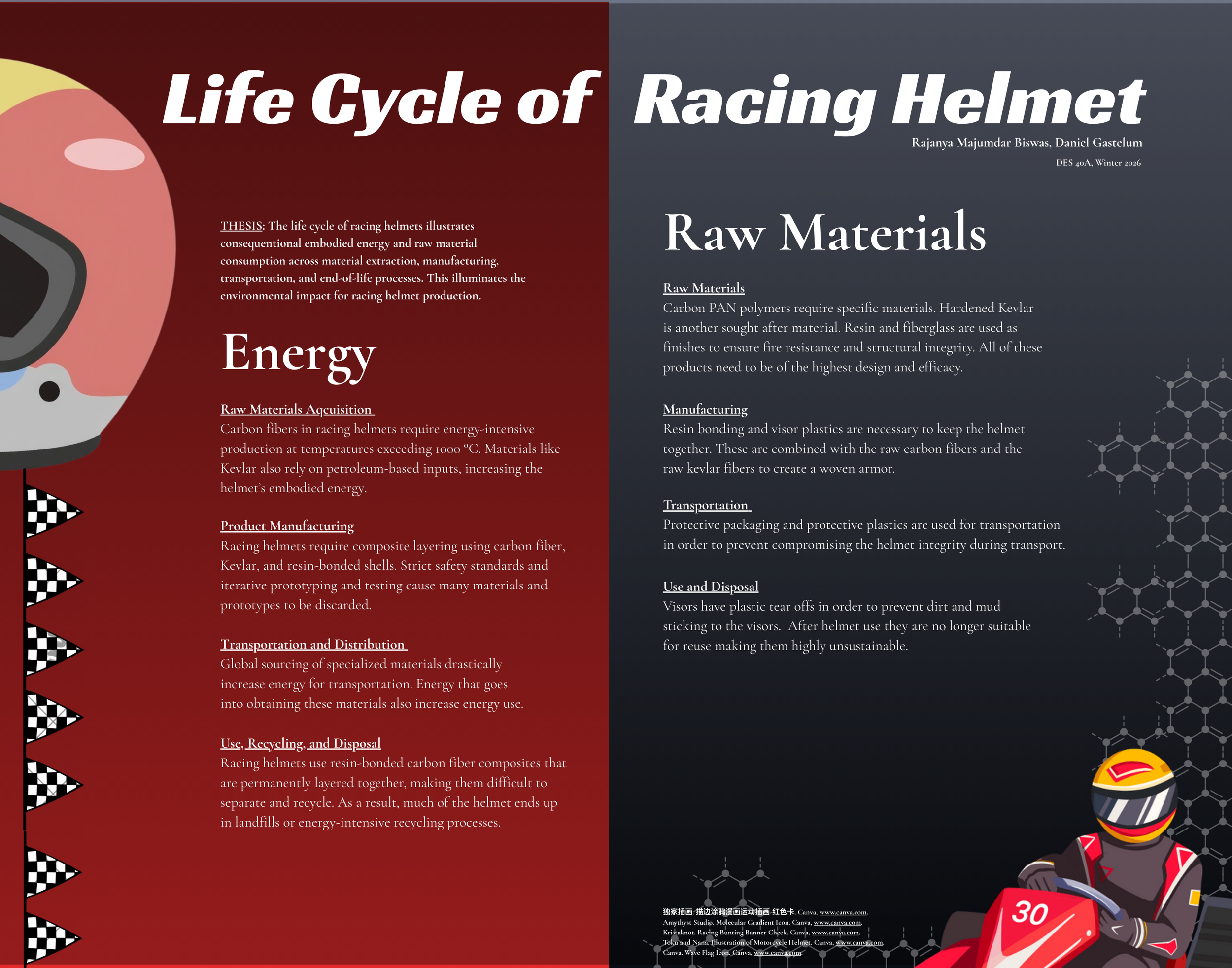
Daniel Gastelum
DES 040A
Cogdell
11 March 2026
Raw Materials of a Racing Helmet
300 kilometers an hour in a form fitting metal chassis is far from an ideal situation for most people. However, for some it is the very thing they live for. Racing cars of various shapes and sizes have been a staple of human nature ever since early cars. What started as a 15mph race on a horse track has evolved into multimillion dollar vehicles cleaving through the air at unfathomable speeds. Racing series like Formula One have become world wide sensations as audiences enjoy the racecraft and marvel at the engineering. Over the past 100 years, safety has become more of a concern as cars become faster and faster. There used to be no seatbelts, no helmets, barely any protection at all in early racing cars. Crash after crash, death after death, engineers and racing directors alike were able to increase the safety of their drivers. The final product, highly refined carbon fiber and fireproof outerwear as well as reinforced car structure to maximize safety at over 200 miles an hour. Racing Helmets are arguably one of the most broad and important aspects of safety in all motor and movement competitions. They are often the last line of defense when all else fails to protect one of the most important parts of the body. The higher the speed, the greater strength of the materials are required. High end racing implies high end materials and helmets are no exception. There are a plethora of refined raw materials in the lifecycle of a racing helmet such as carbon fiber, kevlar, reins, plastics, and a variety of fireproof materials. These items do their job wonderfully, but helmets are notoriously non-reusable due to losing integrity after one use. This begs the question, what are the raw materials and is the helmet as a whole a source of carbon waste?
The first raw material, carbon fiber. Famously ten times lighter and stronger than steel, carbon fiber is highly ideal for use in helmets. While many individuals are aware of carbon fiber as a material, it is not often described what makes it so much stronger than other products. Carbon fiber production hinges on the materials acrylonitrile, nitrogen, and oxygen.(pirancompos). Acrylonitrile is the main ingredient after it is polymerized to form polyacrylonitrile fibers which are heated and carbonized at extreme temperatures using nitrogen and oxygen resulting in raw fibers. These fibers are then treated and bonded with resins in order to create carbon fiber itself. What is often glazed over is the fact that acrylonitrile is derived from petroleum, a fossil fuel. Fossil fuel extraction and usage has always been a very large issue in the modern world. (Chen). It has a large impact on carbon emissions and is arguably the problem talked about most today. However, in the case of carbon fiber there is not a suitable alternative that provides the same degree of benefits. The first step of the carbon fiber process already results in carbon emissions. Production of acrylonitrile from petroleum uses toxic chemicals that often become emissions such as hydrogen cyanide and nitriles. These are all byproducts of the fibers themselves. The most dissatisfying part is the fact that in order to maintain integrity through the use of the carbon fiber itself, there is very little maintenance. The only option is to simply replace the entire frame. Thus when the carbon is cracked or broken, it loses its ability to be strong, making a useless piece of material that is barely recyclable. Carbon fiber gets its full potential when finished with epoxy resin, a complex raw material in and of itself with its own set of materials as well as environmental impacts.
Epoxy resin is a strong finish that hardens during chemical curing. Renowned for its strong adhesion and durability, it is often used as the “glue” that holds products together or raw materials such as carbon fiber. When used hand and hand with carbon fiber it is employed as the matrix material that binds the lattice carbon fiber layers together while the helmet is molded into shape. (Science Direct). Heat and pressure cure the resin similar to the concept of reinforced glass. Like carbon fiber, it is extremely lightweight but creates a very strong composite shell. The required materials to create such an incredible product are mainly chemicals such as Bisphenol A (BPA), epichlorohydrin, sodium hydroxide, anhydrides, and most importantly petroleum. Petroleum acts as the base for the chemical feedstocks. BPA reacts with epichlorohydrin to form epoxy resin molecules which are then purified with sodium hydroxide. This product is then cured using anhydrides which are then fused with other materials such as carbon fiber. (VALCO GROUP). The obvious material with high environmental and non-sustainable impact is petroleum. Its extraction disrupts habitats and emits greenhouse gasses. It isn’t the only raw material with downsides however. Bisphenol creates industrial chemical waste that can contaminate environments and this raw material is also dependent on fossil fuels to be made. Epochlorohydrin creates chlorinated chemical waste that can pollute water but also air as well. All of these processes are used in tandem with the carbon fiber manufacturing process to create one of the most efficient materials for high impact, high durability, and high heat resistance in racing helmets. It has the same non-maintainable frame as carbon fiber however, it is somewhat recyclable in contrast to the strict carbon frame. A carbon fiber, epoxy finished shell isn’t the only material needed to create the best racing helmet. The other key ingredient alongside carbon fiber, is an aramid fiber more commonly known as kevlar.
Kevlar is mostly known for its bulletproof quality in vests used by law enforcement and military branches. Its unique penetration resistance makes it a highly used material in safety. The process of making kevlar uses a polymerization of phenylenediamine with terephthaloyl chloride to create the aramid polymer chains. These polymers are dissolved in concentrated sulfuric acid and solidified in liquid solution while spinning. Afterwards it is dried to remove the acid and stabilize the compound to create kevlar. Similar to the other materials before, this process is highly dependent on chemical reactions and unfortunately, petroleum derived chemicals for the base feedstock. (Waghmare). The treatment of this material utilizes a large amount of water usage along with handling acid. This creates byproducts that possibly contaminate water supplies in nearby water sources. What makes kevlar so sought after is the fact that the fibers themselves can be layered and intertwined with carbon fiber sheets to create composite shells. This combined with the epoxy resin finish creates a material that is impact resistance due to the kevlar, durable with the carbon fiber, and absorbent to heat as well as impact with the epoxy resin finish. All three of these materials have been refined and researched to create the most efficient form of compound. This makes it especially hard to find replacements for each raw material due to the fact that their unique properties work hand and hand in a specific manner. This manner eliminates different substitutes like titanium or steel due to the fact that they lose a key part of the helmet's design. The fiber aspect of both carbon fiber and kevlar in their production also makes it incredibly efficient to maximize safety for the helmet itself. (Mercedes-AMG Petronas). Kevlar however, does increase greenhouse gas emissions as petroleum is extracted from the earth itself. Chemical use always implies possible chemical pollution and seeing as kevlar relies heavily on chemical reactions and finishes, it creates situations of acidic waste streams and hazardous chemical handling. Kevlar, like carbon fiber, loses its structural integrity after extreme use. Thus, the helmet is often just cast aside if small parts of it are reused. The recycling potential is extremely low once used. These chemically bonded materials aren’t the only necessities for the safety of drivers around the world and thus these aren’t the only raw materials that could possibly have an impact. While penetration and direct impact are reduced, reducing concussion risk requires materials that absorb more effectively than the rigid polymers of kevlar and carbon fiber, the material of choice is EPS Foam or Expanded Polystyrene Foam.
Expanded Polystyrene foam was designed specifically to absorb and dissipate impact energy. Multiple small air pockets compress during heavy impact allowing it to be a highly effective shock absorber despite being low density. In order to create a racing grade foam, the main ingredient is a styrene monomer and pentane in order to create such a material via multiple processes. Natural gas or petroleum is a key component in the base of production and the monomer itself is used to create polystyrene. Pentane is a blowing agent that allows the plastic itself to expand. These are finished with polymerization initiators to finish the formation. Styrene production depends on fossil fuels in order to be created. Air pollutants and toxic chemicals are heavily used in order to create such a particular material. The Pentane blowing agent that is so important for the plastic properties, uses volatile organic compounds to create emissions while also contributing to the ground level ozone formation. All of these environmental sacrifices and possible pollutants create a material that lines the inside of the drivers helmet. This material is made to break and lose integrity after an intense crash. By design, it is not meant to be replaceable or recyclable. The air pockets are made at construction and are very difficult to redo once already cured. This material is meant to be disposed of easily and clearly to maintain structure to the helmet itself. Thus the use and maintenance of said product is simply replacement with little recycling. (Sciencedirect). The compression of said foam reduces the acceleration of forces on the head of the driver. However, the danger of racing isn’t only the speed, it’s the heat.
Drivers operating in cars with intense engines implies high heat and high fuel usage. A crash doesn’t only offer the threat of impact, but also the threat of being burned alive, a fate all too common in early racing. The solution, Nomex, a fireproof synthetic fiber material mainly used in racing suits. This flame resistant material is also used in the helmet itself. M-Phenylenadiamine(MPD) and Isophthanoyl chloride(IPC) are used in unison with petroleum derived chemicals to create a fire-resistant fabric lining inside the helmet. (Sciencedirect). This material maintains its integrity under high temperatures and works with other safety materials to provide thermal protection. In order to manufacture the material, MPD and IPC react together to form meta-armaid polymer chains similar to the process of kevlar manufacturing. When combined with a strong acid in a spinning solution, the fibers solidify in coagulation. This process ensures structural integrity and efficiency. Similar to the other materials, there are downsides to such a materials production. Once again, petroleum based agents are key in providing the proper material properties. And acid handling risks are always apparent in fiber spinning practices. Thermal protection comes at an environmental cost to water ways and habitats via mining or oil drilling. Nomex, once burned, loses parts of its coating that prevent future burning. While minor heat can merit the reuse of the fibers, the suits are often replaced alongside the helmets if burned anywhere. Unlike the fibers of carbon and kevlar, sections of the cloth are reusable and thus are able to be recycled into other materials and other heat resistant products. Nomex is able to be recycled into its raw material just in smaller non-burned sections.
Chemicals, petroleum, polymers, and more are necessities to create such efficient materials. These all come at quite the cost both financially and environmentally. Greenhouse gas emissions are higher than ever as petroleum extraction refuses to slow down. All materials in a racing helmet employ the use of plastics or petroleum based chemicals in one way or another. This directly impacts habitats and the degradation of land. Half of the processes utilize water in order to purify surfaces, thus creating chemical wastewater that poses a threat to the environment around us. In order to use and maintain high end racing helmets, they need to be constantly checked and cleaned. Since helmets are such a key component of a driver's safety, there are very few shortcuts to preserve safety gear. The helmets are used, plastic visors are highly replaced, but other than that they are simply left alone. Sometimes the carbon composite fragments are recoverable. However, the main strength of these materials is the fact that they are all bonded together and made in unison. This eliminates most means by which a raw material can be reextracted from the helmet after use or crash. The recyclability of safety gear has always been lower than average, but in such a high end sport such as racing, the materials that are bonded together once broken are unusable for another helmet thus limiting what they can be used on. Something so unsustainable and so damaging to the environment must not be efficient, so why does this continue? Why does the world continue to waste on a product such as this?
Romain Grosjean, 2020 Bahrain Grand Prix, a day of death escaped. After crashing his Formula One car with another driver, the French-Swiss driver hurled into the metal barrier at 192 kph forcing 67G of force of impact on his entire body. The worst part, he was trapped, wedged underneath the metal barrier in a ball of fire engulfing his entire car. The world held its breath, as he emerged from the wreckage, alive. There were a plethora of technological advancements that saved Grosjean’s life, a number of products that worked just well enough even when half broken. The fireproof clothing, the heat resistant helmet, the impact absorption of the foam, and the kevlar reinforcement prevented his head from splitting open and fire to burn him alive. There is no question that safety is justified, while the environment is important and should always be kept in mind, being frugal by sacrificing safety is never the proper course of action. This realization begs another question, if the risk is so high and impact is so negative on the environment, why race? The age old question, “what’s the point”? Why were racers driving 200 miles an hour in 1976 practically praying that the brakes would work at the end of the straight? Why do Formula One drivers hit 300kph relying on reaction time to prevent the tires from slipping out? Is it even worth trying? While the answer seems like an obvious “No” in this context, there is a key factor being unaccounted for, human nature. These questions all revolve around the central inquiry, “Why aspire?”. The simple answer is that it is who we are as a human race to push limits of how fast, or how strong, or how far we can go. Whether that’s in running across the field at recess to launching to the moon, the human race is nothing without aspiration. Racing is about the theoretical limit, human existence revolves around a theoretical limit, and finding it. To ignore racing would be to ignore who we are, pioneers, inventors, and dreamers. The idea to stop racing would go against everything the world has worked so hard to stand for. Thus, as inefficient as helmets are, as toxic as they can potentially be, the solution is not preventing the product, it’s doing what we do best, and innovating solutions to protect what really matters, the environment as well as our asiprations.
Works Cited
9998pwpadmin. “The Logistics of Formula 1.” Formula 1 Crypto.Com Miami Grand Prix, 8 Feb. 2024, https://f1miamigp.com/news/press-release/the-logistics-of-formula-1/.
Bhambwani, Rupesh N. “The Nerve Center of an F1 Car — The Complex & Beautiful Steering Wheel.” Formula One Forever, 15 Feb. 2024, https://medium.com/formula-one-forever/the-nerve-center-of-an-f1-car-the-complex-beautiful-steering-wheel-4d11d0593bbc.
F1 Steering Wheels: How They Work, What the Buttons Do and More. 23 Jan. 2026, https://www.motorsport.com/f1/news/f1-steering-wheels-how-they-work-what-the-buttons-do-and-more/10561142/.
“How Does an F1 Steering Wheel Work?” Mercedes-AMG PETRONAS F1 Team, https://www.mercedesamgf1.com/news/how-does-an-f1-steering-wheel-work. Accessed 23 Jan. 2026.
Inside The Mercedes F1 Steering Wheel: An In-Depth Look. 12 May 2016, https://www.cati.ca/advanced-auto-mechanic-training-anatomy-of-a-mercedes-f1-steering-wheel/.
Klein, Jonathon. “Mercedes-AMG Petronas, Aston Martin F1, and McLaren Explain How an F1 Steering Wheel Is Designed and Torture-Tested.” The Drive, 17 June 2021, https://www.thedrive.com/accelerator/40957/f1-steering-wheel-faqs.
Scarborough, Craig. “Multi-Tasking Made Simple - Understanding the Modern Formula One Steering Wheel.” Motorsport Technology, 29 May 2019, https://motorsport.tech/formula-1/understanding-the-f1-steering-wheel.
Solve. F1 Composites: Revolutionising Formula 1 Racing Technology. 23 Feb. 2024, https://pirancompos
“What Happens to Old Formula 1 Cars? Fate, Museums, and More.” Wheel, https://vocal.media/wheel/what-happens-to-old-formula-1-cars-fate-museums-and-more. Accessed 23 Jan. 2026.
How Does F1 Transport Their Cars? | SGT Auto Transport. https://sgtautotransport.com/autoblog/transport-tips/how-does-f1-transport-their-cars. Accessed 30 Jan. 2026.
Chen, Hao, et al. “A Critical Review and Meta-Analysis of Energy Demand, Carbon Footprint, and Other Environmental Impacts from Carbon Fiber Manufacturing.” Resources, Conservation and Recycling, vol. 219, June 2025, p. 108302. ScienceDirect, https://doi.org/10.1016/j.resconrec.2025.108302.
“History of Auto Racing.” Wikipedia, 7 Feb. 2026. Wikipedia, https://en.wikipedia.org/w/index.php?title=History_of_auto_racing&oldid=1337019165
Oil and Petroleum Products Explained - U.S. Energy Information Administration (EIA). https://www.eia.gov/energyexplained/oil-and-petroleum-products/. Accessed 11 Mar. 2026.
“Epoxy Resins – Manufacturing Process of Epoxy Resins.” VALCO GROUP, https://www.valcogroup-valves.com/faq-2/epoxy-resins-manufacturing-process-of-epoxy-resins/. Accessed 11 Mar. 2026.
Waghmare, Subhash, et al. “A Mini Review on Fibre Reinforced Polymer Composites.” Materials Today: Proceedings, vol. 54, 2022, pp. 682–89. DOI.org (Crossref), https://doi.org/10.1016/j.matpr.2021.10.379.
Nomex - an Overview | ScienceDirect Topics. https://www.sciencedirect.com/topics/engineering/nomex. Accessed 11 Mar. 2026.
Rajanya Majumdar Biswas
Professor Cogdell
Design 40A
11 March 2026
Embodied Energy of a Life Cycle of Racing Helmet
When one visualizes Formula One racing, imagery of flashy cars, roaring crowds, and the energy of millions of fans and engines intertwining arises. However, beneath the surface is an insidious process of energy waste. Energy utilized in a racing helmet’s life cycle has a plethora of negative environmental effects due to intricately manufacturing specialized and advanced materials; racing helmets specifically have low energy consumption efficiency during their production cycle. In a society that thrives off of sports entertainment, including motor racing, car racing, one should consider how much energy is required in this globally popular sport to promote a more sustainable sport. Understanding the energy demands of racing equipment is imperative as these trends are connected to technology and manufacturing innovations. The current racing helmet life cycle has many drawbacks due to creating a product that relies on highly specialized materials with low energy efficiency in all life cycle stages: raw high energy consumption during raw materials processing and manufacturing, emissions generated during shipping, and challenges during use and disposal. By examining these phases, racing helmet manufacturers can better understand the energy sources, leading to possible design changes that create more energy efficient helmets.
Material efficiency is low due to using energy intensive materials, causing inefficient energy consumption. One specific racing helmet material is carbon composites, which require extremely high energy inputs, close to 183-286 MJ/kg (Li). Carbon composites are often extremely energy intensive as production temperatures surpass 1000 degrees Celsius, which is required for creating the lightweight materials for racing helmets (Li). Specifically, according to Andrew Mellor, “state-of-the-art structural and energy absorbing materials” are used for creating helmets, which further demonstrates the energy intensity of building helmets (Mellor). Another high energy consuming material used is Kevlar; similar to carbon composites, Kevlar requires extremely high temperatures and large amounts of energy during its production process (Modern Sciences). Furthermore, Kevlar relies strongly on petroleum-based raw materials and energy, which also require large amounts of energy to extract and process (Modern Sciences). Overall, composite materials used in helmets require drastic use of energy during both chemical processing and fiber formation (Li). Furthermore, composite, complex materials for racing helmets require permanently bonded carbon fibers, making it difficult to separate. Carbon fiber production and Kevlar only occur in specific industrial regions and must be transported globally for further processing, meaning that ships, air freight, and diesel powered trucking lead to the usage of diesel fuel and aviation fuel, which consume chemical energy. The specialized materials necessary for manufacturing racing helmets is just the start: safety procedures magnify the need of energy through all the various protocols involved in helmet design and testing.
Drastic safety procedures and lack of reusability lead to great energy waste during the production process in a helmet’s lifecycle. Due to strict racing helmet standards, any flaw leads to the disposal of the material. Additionally, iterative prototyping further wastes more energy and materials (Mellor). Composites utilized in Formula One racing use advanced shells for impact resistance, which require niche fibers, and the energy utilized to create these materials often goes to waste (Li). According to Advanced Protective Helmet for Formula One, the strict helmet safety protocols include multiple laboratory tests and multiple prototyping iterations, which requires significant energy input as labor and the equipment used for testing requires a vast amount of energy (Mellor). Prototyping helmet models requires natural gas and grid electricity to power furnaces used to create carbon composites for the prototypes. Additionally, prototyping the inner lining of the helmet requires steam and pressure to create the helmet’s energy absorbing liner, allowing effective handling of high and low speed collisions. The prototypes’ testing is often multistage, including impact testing, fire resistance testing, structural integrity testing, wind tunnel testing, and more (Paul). Each laboratory testing stage requires new equipment and a new input of energy, which further increases the total amount of energy required in the manufacturing stage. Specifically, fire resistance testing necessitates chemical energy in the form of propane and electrical energy. Additionally, structural integrity testing involves determining if helmets can withstand strong forces in high force environments; cultivating these environments uses significant energy, contributing additional energy use to the helmet’s life cycle (Paul). These tests tend to damage racing helmets, causing them to be discarded, wasting energy that goes into the testing process (Paul). For example, during impact testing, helmets are simulated to collide, and due to the energy absorbing materials being designed to degrade after one collision, the helmet must be discarded (Newman et al.). Oftentimes, the facilities that test the safety procedures do not occur in the same place, so helmets must be transported from facility to facility, and this transportation, often in the form of trucking, requires diesel fuel, consuming chemical energy. After passing safety protocols, the helmets enter another energy-intensive stage: shipping and transportation of the racing helmet in its use phase.
Transportation and distribution also contribute significantly to racing helmets’ embodied energy throughout both the distribution and use phases of the product lifecycle. The materials used and the mining required to obtain the specialized components are extremely energy intensive, with additional energy used for global production since the materials are not locally sourced (Li). Many of the testing facilities that racing helmets are shipped to are highly specialized and require specific conditions that can only be found in certain regions of the world (Paul). DHL, a logistical management company, states that Formula One mainly relies on ocean freight and air freight: ocean freight ships at a slower, more sustainable pace while air freight is for specialized materials needed immediately. Boat shipping typically requires fossil fuels or natural gas, while air transport requires kerosene-based aviation fuel. DHL is also considering sustainability measures in shipping to reach Formula One’s goal of becoming Net Zero by 2030. The labor and expensive tools required in the shipping process also increase the overall energy input (Mellor). Specifically, the World Economic Forum states in its article on supply chain decarbonization that “a significant amount of cost of energy is already tax take for many parts of the supply chain,” meaning that energy consumption in the forms of “dirty” energy such as fossil fuels, which produce many negative byproducts, is a major part of the international supply chain in transporting materials (World Economic Forum). Carbon composites are typically produced in China, South Korea, Japan, the United States, and in a limited amount in regions of Europe (BCC Research). Within these countries, only a select few regions have the factories, manufacturing abilities, infrastructure, and manpower necessary to produce these carbon composites, further limiting the locations at which the materials for helmets can be produced. Due to this limitation in production locations, many of these materials must be transported to various locations for racing. For example, Formula One is an international competition, so these carbon composites must be shipped globally, even though they are only a fraction of the materials required to manufacture racing helmets. According to DHL, between the Formula One races of Imola Grand Prix and the Monaco Grand Prix, there are 500 kilometers in which racing materials, which include racing helmets, must be shipped. Specialized trucks located in holding queues are used to travel this distance, using chemical energy in the form of diesel fuel. According to various estimates, around 4000 to 5000 megajoules are used to fuel this journey. In the helmet’s use phase, helmets are replaced after crashes or collisions to maintain safety standards, resulting in a short lifespan and an energy-inefficient use of the product (DHL). Typically, during the global races of Formula One, racers go through 10-15 helmets per season (Oracle RedBull Racing). This replacement frequency is quite high, as the total embodied energy of all these helmets for each racer eventually add up. However, there is not much energy required when actually utilizing the helmet in racing. After the transportation, distribution, and use phases helmet, additional energy related obstacles occur during disposal and recycling.
Next, the specialized composite materials in racing helmets cannot be easily recycled or reused, leading to the loss of energy used to produce the helmet. Specifically, complex synthetic materials are harder to break down, and the materials cannot be easily separated. Composite materials used in racing helmets created with strong resin permanently bond the carbon fibers together, which makes it difficult to separate the individual materials for reuse recycling (Li). Due to this, it is significantly energetically wasteful to reutilize these materials in the manufacturing of racing helmets. Racing helmets are typically maximized for structural strength and impact absorption for safety purposes, which requires the internal layers and the composite shell to be permanently bonded together (Mellor). Specifically, the carbon fiber that is utilized in the racing helmets are much more difficult to break down than common commercial materials such as plastic. Seraphim plastics claims carbon fiber is essentially a reinforced plastic, with heat and energy creating an extremely strong, almost unbreakable bonding of carbon fiber; due to this, it is almost energetically impossible to break it apart, as it will require significant amounts of money and energy to do so. For the various disposal methods, used helmets require transportation to the various disposal sites. This requires waste trucks powered by diesel fuel, which consumes chemical energy. To factor in the reusability and recyclability of carbon fiber in racing helmets, just the carbon fiber alone will require substantial energy, ranging anywhere from 25 to 75 megajoules of energy per kilogram of carbon fiber recycled (Seraphim Plastics). As for landfill waste, Carbon-fiber reinforced polymer (CFRP) composites, which is often utilized in racing helmets, has historically performed poorly due to the fibers being embedded with various materials that does not allow for the ability of remelting. Due to this, much of the helmet ends up in the landfill, significantly losing energy, as most of the energy going into making the helmet cannot be regained. Another option of disposal or reuse for racing helmets include incineration. In the incineration process of racing helmets, some of the energy can be recovered, however over half of the material (the fiber based polymer) may still remain as ash; moreover, the incineration process itself requires heat energy to break down the fiber-reinforced polymers in the racing helmets (Quereshi). Additionally, the incineration process can also produce a large amount of greenhouse gasses as a result of the process. These limitations in recycling illustrate the need for more energy efficient and sustainable alternatives for the manufacturing of racing helmets.
Further implications of moving towards a future that properly balances safety of the helmet and the sustainability of the helmet lies in bio-based innovation. Many of the current materials rely on nondisposable materials that are not able to be recycled, but strides have been made to create reusable materials. Specifically, according to MDPI Applied Sciences, work in agglomerated corks has the potential to replace the Expanded Polystyrene (EPS) liners that are essential for protecting the racer due its energy absorbing properties during a collision. Moreover, the agglomerated cork liners often recover fully after a crash in a way that the traditional EPS liner cannot, allowing it for reusability. Agglomerated corks, derived naturally from cork bark, only require heat to produce, making it a less energy-intensive option than EPS liners. Additionally, the agglomerated cork is 100% biodegradable, meaning that no extra energy(mechanical, chemical, heat, etc.) is necessary to break down the liner. However, the agglomerated cork liner is not as compact as lightweight, which is a possible potential drawback.
In conclusion, the life cycle assessment of racing helmets demonstrates significant environmental and energy-related tradeoffs. From manufacturing of complex materials, multistage testing, international transportation, and recycling hurdles, each stage contributes to a substantial energy footprint. Currently, sustainable, energy-efficient manufacturing is underdeveloped; however, boosting awareness and advocacy in the racing community for clean energy can drive industry change. Ongoing research in bio-based materials and reusable components is navigating a path to a more energy-efficient racing helmet. Formula One and other racing industries have the potential to set sustainability initiatives that can transform the energy related practices in other manufacturing and technology sectors.
Bibliography
BCC Research. Carbon Fiber Market: Global Industry Analysis and Forecast.
www.bccresearch.com/market-research/advanced-materials/carbon-fiber-market.html.
DHL. Inside the Fascinating World of F1 Logistics. Delivered: The Global Logistics Magazine, Oct. 2025.
www.dhl.com/global-en/delivered/global-trade/inside-f1-logistics.html.
Fernandes, Fábio A. O., Ricardo J. Alves de Sousa, Mariusz Ptak, and Gonçalo Migueis. “Helmet Design Based on the Optimization of Biocomposite Energy-Absorbing Liners under Multi-Impact Loading.” Applied Sciences, vol. 9, no. 4, 2019, article 735. https://doi.org/10.3390/app9040735.
Li, Yongqiang, Hualin Fan, and Xin-Lin Gao. Ballistic Helmets: Recent Advances in Materials, Protection Mechanisms, Performance, and Head Injury Mitigation. Composites Part B: Engineering, vol. 238, 2022, p. 109890. Elsevier, https://doi.org/10.1016/j.compositesb.2022.109890.
Mellor, Andrew. Advanced Protective Helmet for Formula One. SAE International, May 2005. sae.org/papers/advanced-protective-helmet-formula-one-2004-01-3514.
Ready, Jud. Modern Sciences. Bike Helmets: Materials, Evolution, History & Safety Innovations, Dec. 2024.
modernsciences.org/bike-helmets-materials-evolution-history-safety-innovations-decemb er-2024/.
Musenich, Ludovico, et al. D-HAT: A Diatom-Inspired Structure for a Helmet Concept Against Trauma. arXiv, 2 Jan. 2025. arxiv.org/abs/2501.01211.
Newman, James A., Christopher Withnall, and Michael Wonnacott. An Integrated Helmet and Neck Support (iHANS) for Racing Car Drivers: A Biomechanical Feasibility Study. Stapp Car Crash Journal, vol. 56, 2012, pp. 469–484.
biokinetics.com/wp-content/uploads/2024/04/Newman-et-al-2012-An-Integrated-Helmet-and-Neck-Support-iHANS-for-Racing-Car-Drivers-Stapp.pdf.
Oracle Red Bull Racing. Bulls’ Guide to Helmets. 30 Oct. 2020.
www.redbullracing.com/int-en/bulls-guide-to-helmets.
Paul, James C. Racing Helmet Design. Airflow Sciences Corporation, 1993.
www.airflowsciences.com/sites/default/files/casestudies/Racing_Helmet_Design.pdf.
Qureshi, J. A Review of Recycling Methods for Fibre Reinforced Polymer Composites. Sustainability, vol. 14, no. 24, 2022, p. 16855. DOI:10.3390/su142416855.
Qureshi, J. A State-of-the-Art Review on Recycling and Remanufacturing of Carbon Fiber from Carbon Fiber Polymer Composite. Elsevier, 2023. ScienceDirect. DOI:10.1016/S2666682023000683.
Ugle, Shubham R., Shweta D. Kate, and Dhananjay R. Dolas. Formula One Safety: A Review. International Research Journal of Engineering and Technology, vol. 2, no. 7, 2015.
www.irjet.net/archives/V2/i7/IRJET-V2I766.pdf.