Design Life-Cycle
assess.design.(don't)consume
Julissa Martinez A.
TA-Daniel
Section 4, Des 40A
March 11, 2026
THE RAW MATERIALS OF A SNOW GLOBE’S LIFE CYCLE
Ever wondered what snow globes are made out of ? During the holidays or during any time of the year, snow globes can be a small and a thoughtful gift for someone. However, its life cycle from raw material acquisition to disposal has the planet facing overconsumption waste that impacts our environment quality. What are the materials in the snow globe and how do they work in manufacturing processes?
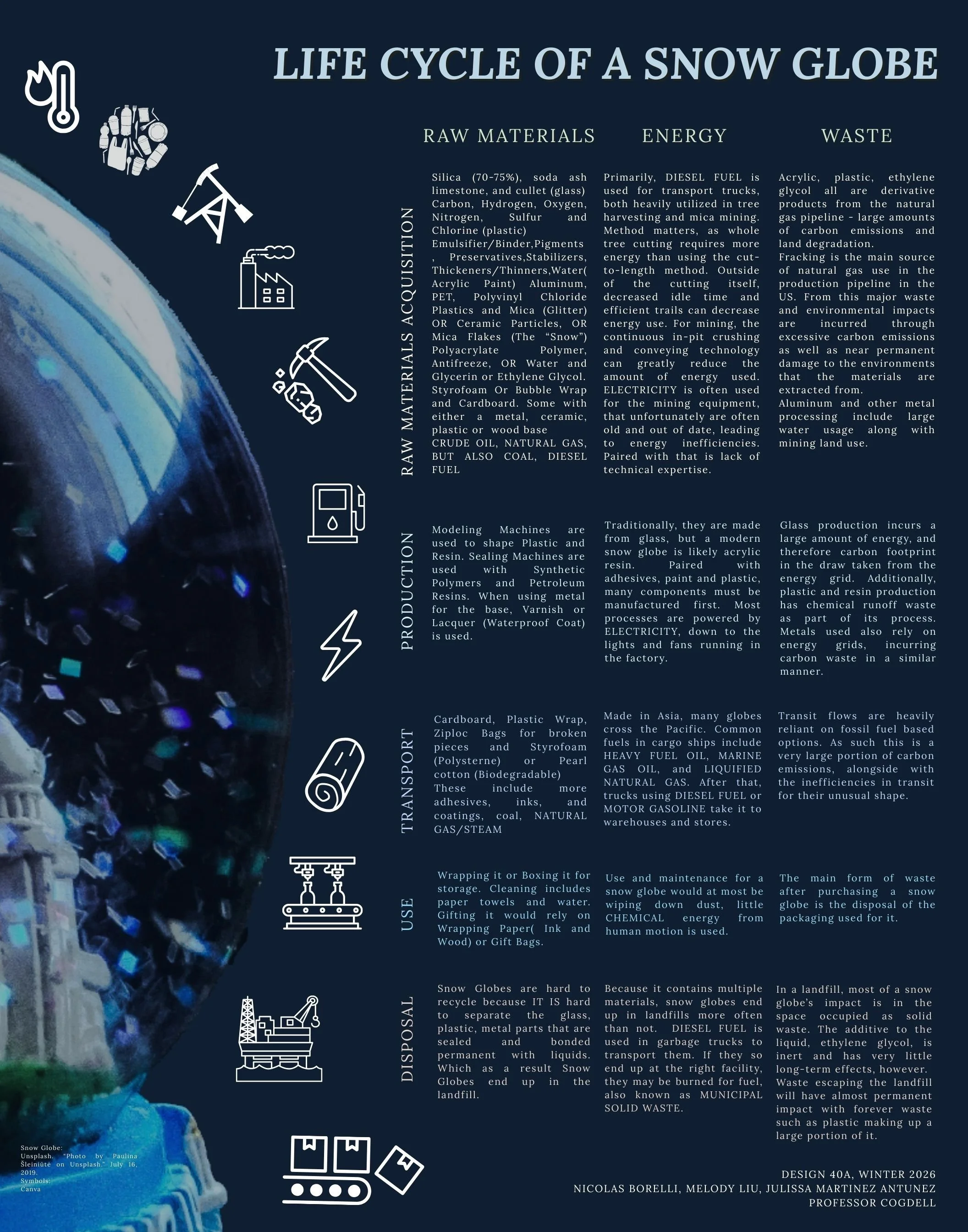
Before the actual production process of a snow globe we have the Raw Material Acquisition. To create the dome we need the Secondary Material Glass, which is 70-75% made out of Silica, and its other raw materials like soda ash, limestone, dolomite, and cullet. To make the base of the globe, we could either use metal, wood or the secondary material plastic. If a company uses plastic as its base, the raw materials include carbon, hydrogen, oxygen, nitrogen, sulphuric,and chlorine or silicon hydrogel. Snow globes with character figures are created by plastic and resin. If the company uses plastic, they most likely then would add a coat of acrylic paint and this secondary material includes, emulsifier/biner , pigments, preservatives, stabilizers, thickeners/thinners, and water. The “magical” snowflakes are made out of ceramic particles, benzoic acid +water +sugar, mica flakes, or glitter,which includes Aluminum, PET ,polyvinyl chloride plastics, and mica. The mysterious liquid inside of a snow globe is made out of polyacrylate polymer, antifreeze that includes corrosion inhibitors, water, propylene or glycol, and other potential additives, or it could be made out of water with glycerin or ethylene glycol. Lots of chemicals are used in order to make the “snowflakes” fall slowly. All these materials are protected with styrofoam or bubble wrap, and cardboard and to get it distributed to facilities safely via trucks/trailers,ships( international shipping) or rail transport.
The next stage is the product of manufacturing, after gathering all our material, factories use modeling machines to shape the plastic and resin, and sealing machines are used with synthetic polymers and petroleum resins. However, these sealing particles are ….When using a metal base, companies add coats of varnish or lacquer that are used to make the snow globe waterproof.
When transporting the snow globe to warehouses and stores, factories have to ship with lots of protective material to prevent the snow globe from breaking. Packaging materials like cardboard that comes from pine or fir, plastic wrap that is made out of polyethylene plastic with air bubbles , and styrofoam that “is made out of polystyrene resin …derived by petroleum and 98% of air because of blowing agents,flame retardants, and stabilizers [with] [s]mall amounts of pentane, [and] hydrocarbon gas are included” [15] or the use of pearl cotton (biodegradable). Styrofoams are said to be on top as the worst polluting objects because they are not degradable. [1] This connects as to why we are challenged with greenhouse gases and climate change.
During the use and maintenance stage, snow globes could be a gift for ourselves or to loved ones that are typically used for decor. People gift it with wrapping paper (ink and wood) or gift bags(dyes, additives, fabric, plastic and paper). There is little energy used, but if the snow globe is not stored well and it's hitting the sun's light, the liquid solution turns into cloudy yellow. Wrapping it or boxing it is promoted for a longer duration. Cleaning the snow globe may include paper towels and water.
At the end of the five stages , we have the possible choices of either recycling or disposing of the snow globes’ waste. Snow globes are hard to recycle because they have materials that are hard to separate. For instance, the glass, plastic, metal parts that are sealed and bonded permanently with liquids. Moreover, this results in the snow globe being thrown away into the trash, causing them to end up in landfills and release permanent long lasting impacts. Machinery is used to mine secondary raw material in the landfills. Additionally it's a hassle to separate waste and reusable materials in landfills, which is why strategic waste management is just as important as design. Recycled glass could’ve helped with saving energy.
Design is key to how materials manage waste and pollution. The life cycle of any object , as small as a globe, uses lots of energy, material , and waste. Before buying, it is important to notice if items are recyclable , easy to replicate with materials at home or if the items are degradable.
Bibliography
1. Andrews, Leah. “Let’s Banish Styrofoam - Queen of Snow Globes.” Queen of Snow
Globes,2020, www.queenofsnowglobes.com/lets-banish-styrofoam/.
2. Baheti, Payal. “How Is Plastic Made? A Simple Step-By-Step Explanation.” British
Plastics Federation, www.bpf.co.uk/plastipedia/how-is-plastic-made.aspx .
3. B, Sana. “What Is Resin? | What Is Resin Made Of? | What Is Resin Used For? -
Pourla EpoxyResin.” Pourla Epoxy Resin, 2025, pourlaepoxy.com/what-is-resin-what-is-resin-made-of-what-is-resin-used-for/
4. BestReviews. “The Best Snow Globe.” Chicago Tribune,
2020,www.chicagotribune.com/2020/02/07/the-best-snow-globe/.
5. Elchemy. “What Glycerin Is Made Of: Sourcing, Production & Applications for
Manufacturers.” Elchemy.com, Elchemy, 2025, elchemy.com/blogs/personal-care/what-glycerin-is-made-of-sourcing-production-applications-for-manufacturers.
6. Institute of Making. “Artificial Snow - Institute of Making.” Institute of Making,
2024,www.instituteofmaking.org.uk/materials-library/library/artificial-snow
7. Li, Caroline. “The Science behind Glitter: What Is It Made Of?” Eye Candy
Pigments, 2023, eyecandypigments.com/blogs/news/the-science-behind-glitter-what-is-it-made-of.
8. McKenna, Rachel. “How Are Snow Globes Made? Adventa Explains.”
Adventa.com, Adventa, 2025, www.adventa.com/gb/news/how-snow-globes-are-made.
9. V ora, Dhimen. “The Science behind Bubble Wrap: How It Works & Benefits.”
DIA Packaging -, 5 Mar. 2025, diapkg.com/blog/the-science-behind-bubble-wrap-how-it-protects-fragile-shipments/.
10. “How Are Snow Globes Made? A Behind-The-Scenes Look at the Magic.”
MusicBoxAttic.com, 2025, www.musicboxattic.com/blog/how-are-snow-globes-made-a-behind-the-scenes-look-at-the-magic/.
11. “Mica Flake: A Magical Slice Gifted by Nature.” Kehuimica.com,
2025,www.kehuimica.com/news/mica-flake-a-magical-slice-gifted-by-nature.html.
12. “Snow Globe Repair Center - Snow Globe Packing Instructions.”
Snowgloberepaircenter.com,2026, www.snowgloberepaircenter.com/Snow-Globe-Packing-Instructions.html.
13. “Soda-Lime Glass - Knowledge and References | Taylor & Francis.” Taylor &
Francis, 2021,taylorandfrancis.com/knowledge/Engineering_and_technology/Chemical_engineering/Soda-lime_glass/.
14. “What Is Antifreeze Made Of? Antifreeze Ingredients List Article |
JENNYCHEM.”Jennychem.com, 2024, www.jennychem.com/blogs/news/what-is-antifreeze-made-of.
15. “What Is Styrofoam Made Of? A Deep Dive into Styrofoam Composition.”
EPSOLE, 2024,epsole.com/what-is-styrofoam-made-of/.
16. “Www.ChemistryIsLife.com - the Chemistry of Snow Globes.”
Www.chemistryislife.com, www.chemistryislife.com/the-chemistry-of-snow-globes.
Melody Liu
Professor Cogdell
Design 40A, Winter 2026
March 13, 2026
Santa Claus is Killing the Planet: The Energy Life Cycle of a Snow Globe
During the winter season, countless snow globes of all designs hit the store shelves. Small painted figurines encased in a traditionally glass sphere, submerged in water with white sparkling particles imitating a snowy scene. As with all products, behind each globe lies a substantial investment of materials, labor, and energy to power the machines used to churn them out onto shelves. Mundane as it may seem, a considerable sum of energy is required to harvest raw materials, produce the secondary raw materials, construct the globe, transport it to shelves, and finally, to the landfill.
With snow globes ranging from highly decorated artisanal crafts to cheaply made mass-produced goods, the materials required vary as well. One such material is the snowy particles found inside the water, which often is the sparkly mineral: mica. Located relatively close to the surface, mica mining is often done through artisanal or open-pit mining (Child Labor in Mica Supply Chain). With the informal nature of artisanal mines, equipment is often outdated and workers have limited technical expertise, resulting in high energy consumption through inefficient work, as said by Moya et al., in their Ecuador-based study. The bulk of energy is put towards “primary mining activities, including exploration, extraction, haulage, and processing” (Purhamadani et al.) as well as grinding, which primarily utilizes electricity (Moya et al., 1). Furthermore, hauling the mineral out of the mines is no energy-conservative task, as said by Purhamadani et al., “a hauling truck consumes diesel at an average annual rate of 14.89 million liters.” Important to note, however, is that efforts have been made to reduce this number. The development of the continuous in-pit crushing and conveying (IPCC) greatly reduces energy consumption, according to Purhamadani et al., “It was estimated that a continuous system consumes, on average, 303.94 GJ and a traditional system consumes, on average, 471.48 GJ.” However, even with the most efficient technology, there is still a root issue with mica mining, being the labor supplied. As stated by the Bureau of International Labor Affairs, “Since mica mining became illegal in Jharkhand, the mica mining families in the state function outside the purview of national labor regulatory standards, which has increased the risk of labor exploitation, including the risk of child labor” (5). Mica as a material will not be sustainable so long as its method of harvest is through exploitive labor. Moving forward, another crucial material is wood, often used in the base of the snow globe and responsible for keeping it upright when propped on a flat surface. Similar to mining, the method and equipment matter in how much energy is consumed. As stated by Ghaffariyan et al., “The cut-to-length (CTL) method, with a harvester and forwarder, used 2.0 L/m³ which is lower than 2.7 L/m³ for the whole tree (WT) method, including a feller-buncher, skidder and processor” (603). However, it is, again, transport that consumes a heavy sum of energy, upwards of “0.77 L/km of diesel fuel or 2.09 L/m³ of wood” (Ghaffariyan et al., 603). The exact sum would depend on the trail taken as well, as rough terrain and long travel distances can greatly spike up the diesel usage. But there are many methods available to reduce the embodied energy, some listed are the reduction of work light usage, equipment maintenance, and efficient trail planning (Ghaffariyan et al., 604). These fixes are relatively small tasks, therefore their implementation should be easier than the development of an entirely new method of harvesting wood. While they may not stand as permanent solutions, the benefits reaped would still be substantial, both environmentally and economically. For both raw materials put towards the making of snow globes, similar patterns are found across both processes. New innovations can greatly reduce their energy usage, through new equipment (such as the IPCC), and behavioral changes, such as the reduction of idle time for workers and equipment.
Many of the required materials of a snow globe must first be manufactured before arriving at the factory to be put into one final product. Some include the previously harvested raw material, such as the wood that must be processed from log to refined plank. A common example is plywood, a manufactured material composed of varnished wood layers glued together. To arrive at its sturdy finished form, the raw wood must undergo a series of procedures, all requiring energy to execute. Detailed by Wilson and Sakimoto, approximately 1.69E L/m³ of diesel fuel powers the log haulers to transport the material. Afterwards, electricity is then used to remove the bark, cut it into blocks, undergo conditioning (heating the wood to improve the veneer quality), and peel the wood into long ribbons. Ultimately, this amounts to about 5.65E MJ/m³. These strips are then sorted by moisture before the veneer is dried using natural gas (5.22E m³/m³) or other wood (14.86 kg/m³) as fuel, which is the most energy-intensive step in the process. Once satisfied, it is coated in resin, cured, and cut into the appropriate sizes (60–61). The processing of raw materials aside, there are also secondary materials to consider—those that have to be entirely manufactured. Traditionally, glass is used to create the clear globe encasing the figurine. However, most modern snow globes instead turn to acrylic resin, also known as plexiglass or polymethyl methacrylate (PMMA), for its shatter resistance. While there were no concrete numbers found, the process can be laid out and the energy intensity assumed. PMMA contains acrylic acid, carbon, and oxygen, which are first polymerized, then melted together. Then, the resin undergoes thermal polymerization, requiring 140–150℃ heat (How Products Are Made). Afterwards, it is cooled and shaped by injection molding (McNeall Plastics). The melting and thermal polymerization is likely the most energy-intensive part of the process, though the exact fuel sources are unknown. A similar plastic, whose exact numbers also remain elusive, is polyethylene-terephthalate (PET), often used for the figurines inside the globe. With hydrogen and carbon as two key ingredients, this material requires hydrocarbon feedstock, which nowadays largely originates from fossil fuels (Hamman). However, the type of fuel is dependent on the region, as Hamman further writes, “For example, in North America and the Middle East, ethylene is typically produced from readily available natural gas resources while, in Europe and Asia, cracking of crude oil is more common.” Though snow globes can be produced in North America, many are shipped from Asia due to cheaper labor. Evident in the custom snow globe company Let It Snow Globe’s main page, “Your custom water globes are made factory direct, overseas in Asia.” Also noted by Hamman, “Calorimetry experiments have measured the net heat of combustion (LHV) for polyethylene to be about 4.5 x 10⁷ J/kg, which is higher than other major plastics.” With plastic itself already being energy intensive, the use of PET and other polyethylene plastics only furthers the high fossil fuel usage already so deeply ingrained in our, the US, and Asia’s manufacturing processes. But once the plastic is manufactured and molded into figurines, it then must be painted to complete the illusion of the snow globe scene, though important to note that most sources on energy use in paint production is more so focused on architecture and automobiles, with little information found on the acrylic paints that are more likely to be found in the globe. Even so, according to EonCoat, “The amount of electricity used for heat and power by the paint and coatings industry was reduced by 17.8 % between 2007 and 2012,” which was done through simplified painting processes and reducing the temperature used to cure coatings. Moving forward, superglue is a common cyanoacrylate adhesive that can be used to bind the plastic components together. However, very little information can be found on the energy usage of their production. The only found source is JinJiang’s article on its environmental impact, stating, “Production of cyanoacrylate adhesives mandates several processes, some of which may generate greenhouse gases and require large chunks of energy,” with any exact numbers or processes currently unknown. Similar can be said for antifreeze, or ethylene glycol, used in the water solution to create a slow-falling effect, making the illusion of snow possible. Even so, from the evidence seen, it can be conclusively stated that the secondary materials utilized in snow globe manufacturing share the common trend of requiring a non-negligible amount of energy to produce. The production of the snow globe itself also takes energy, likely electricity powering lights, fans, and equipment as workers hand-paint and construct each globe. Evident in Process Discovery’s video, some equipment used is a spray for varnish, a conveyor belt, a vacuum chamber to remove air bubbles, and a water purifier. Though the exact amounts of electricity are unknown, as snow globe factories are quite niche and do not publish these numbers. Even so, Solvis notes in his article on electricity demand in the manufacturing industry, “US manufacturers use an average of 95.1 kilowatt-hours (kWh) of electricity and 53,600 Btu of natural gas per square foot annually,” which can serve as a rough starting point for how much electricity is used to maintain mass production. Additionally, the energy used in the human labor required to construct the snow globes equates to about 3.5 MJ per worker-hour in China (Zhang and Dornfeld, 189). One such Chinese snow globe factory is Quanzhou Leader Industry Limited (China Snow Globe Manufacturers), which employs about 51–200 workers (ZoomInfo). Therefore, per hour, their workers supply 178.5–700 MJ of energy. This, however, only serves as a snapshot of the human energy provided, as the entire scope of the life cycle involves human labor. Still, it adds to the ever-increasing energy required to manufacture the secondary materials and the snow globes themselves. Even as innovations are made to reduce it, such as the simplified paint process, there is still a great cost to every material produced.
While transportation is required at every step of the process, the stretch of ocean between Asian factories and US warehouses amounts to the most significant use of fuel. As previously discussed, Let It Snow Globe is one such company that uses overseas labor to produce its custom globes, which then must be shipped all the way over to its warehouses on the opposite end of the world. Before they hit the sea though they must first be transported via truck to the port. Using Quanzhou Leader Industry as an example again, the nearby Quanzhou port is only 12 km or 23 minutes away in driving distance, as the city lies on the coast of the Pacific. One kilometer requires about 0.22–0.66 liters (Lamiro) of fuel, usually diesel or motor gasoline (EIA), therefore the trip would require about 2.64–7.92 liters. Once arrived at the port, the cargo must then begin its journey across the sea. Commonly, cargo ships are used to transport large amounts of goods over great distances, but at the cost of immense energy usage, given their impressive size. Typically, they are powered by one of three fuels: heavy fuel oil/residual oil, marine gas oil, or liquified natural gas (Fridell). Though the amount is dependent on journey length and boat size. According to Logiworld, a small ship can carry 100,000–500,000 gallons of fuel, Panamax ships can hold 750,000–1,500,000 gallons, and ultra-large container ships have the capacity for 3,000,000–5,000,000 gallons and beyond. The amount of fuel a cargo ship burns through during a voyage across the Pacific, or even the amount of fuel used per nautical mile remains unknown, with the only calculations found taken from Reddit or Quora. Regardless, once the cargo has reached American soil, a truck must again take over for the last stretch of the journey. Again, using Let It Snow Globe as an example, their home page states, “... merchandise is fast tracked to our warehouse near the Port of Long Beach, CA.” Since the company specializes in custom snow globes, each order must be delivered from Long Beach directly to the customer’s door rather than local stores, greatly extending this leg of the trip. Contributing to the heavy toll the trucking industry takes on energy usage in the transportation sector in the US, a whopping 52% (EIA). However, there have been steps taken to improve efficiency in light-duty vehicles, thanks to updated fuel economy standards (EIA). Still, transportation remains one of the heaviest uses of energy across the life cycle, with the snow globes traveling halfway around the world overseas.
Very little can be said about energy usage in use, reuse, and maintenance, as a snow globe is a decorative object. Once purchased, it spends most of its days sitting on a shelf or table. Occasionally, it may be picked up and shaken to enjoy the slow falling snow effect or wiped down once collecting dust, which both require human involvement. Therefore, it utilizes chemical energy, as said in Memorial Hermann’s article, “Like an automobile only runs on gasoline, the human body runs on only one kind of energy: chemical energy. More specifically, the body can use only one specific form of chemical energy, or fuel, to do biological work – adenosine triphosphate (ATP),” with the fuel stocked up in the human body through the act of eating food. But with the actions being relatively negligible, it is difficult to gauge just how much energy is used with each small motion.
Many snow globe owners would opt to send their globe to the landfill rather than break it down into individual parts to recycle when the time comes to dispose of it. However, in the hypothetical scenario where they do take the time, there is still difficulty in recycling the individual segments. For starters, plywood cannot be recycled (Recology) as it is too processed with varnish contaminants. The acrylic resin (PMMA) globe similarly has difficulty being recycled, as it is composed of linked monomer molecules with no apparent weak point to break them down. However, there is still the possibility of using pyrolysis, causing the PMMA to undergo thermal decomposition. But the downside is the temperature it must hit to cause said reaction, as the 400℃ minimum is a strong barrier to long-term PMMA recycling (Coxworth). Still, there is a new, developing process, as Coxworth details, “The process involves adding a chlorinated dichlorobenzene solvent to crushed [PMMA], heating the mixture to between 90 and 150ºC (194 and 302ºF), then exposing it to ultraviolet light.” While not fully implemented, it is a step in the right direction to recycle this increasingly common plastic. The PET plastic in the figurines also faces difficulties with being designated as waste, but with newly developed processes, it hopefully can postpone its trip to the landfill. Detailed by Muringayil Joseph et al., “Mechanical recycling involves shredding PET waste into smaller pieces, followed by cleaning, melting, and molding. Chemical recycling processes like glycolysis and methanolysis produce high-quality PET monomers. Biological recycling uses enzymes or microorganisms to degrade PET waste into simpler compounds.” But as it stands today, snow globes still find themselves in the trash. To arrive at their forever home in the landfill, they must first hitch a ride on a garbage truck. According to Zhao and Tatari, the US is home to 179,000 garbage trucks, 90% of which utilize diesel fuel, with the remaining 10% using compressed natural gas (180–181). Each of these vehicles travels, on average, 25,000 miles and collectively burns through 1.2 billion gallons of fuel per year. Higher than the typical vehicle, given the stop-and-go nature of the trucks and large payloads increases the necessary amount of fuel to function. Moves have been made to improve their energy efficiency, but the real impact of these changes still remains unknown (Zhao and Tatari, 181). Once the ride comes to an end, if the snow globe happens to find itself at a Municipal Solid Waste (MSW) combustion facility, its journey is not yet over. In these facilities, the snow globe, along with other waste, would be deposited in a combustion chamber, where the heat is used to generate steam in a steam turbine. Then, the turbine can generate electricity, which “reduces carbon emissions by offsetting the need for energy from fossil sources and reduces methane generation from landfills” (EPA). However, there are only 75 MSW combustion facilities in the US due to high costs and unpopularity among locals, as well as the toxic ash it may produce, which still gets dumped into a landfill once all is said and done. Even then, 550 kWh of energy can be produced per waste and 34 million tons of waste were combusted in 2017. At the end of the line, there is still hope for improvement in reducing our landfills and fossil fuel consumption through this process.
Following the flow of energy usage from raw material extraction to factory manufacturing to disposal, plus the transportation between each step, the humble snow globe carries a non-negligible energy footprint under its belt. While countless new methods and technologies are in development to more efficiently mine for materials, produce plastic, etcetera, the current state of the mass production of snow globes is still suffering from inefficiencies. Energy is not a limitless resource and further work must be done to strive for a longer future.
WORK CITED
“100% Recycled Acrylic | Closed-Loop Recycling Process & Eco-Friendly Manufacturing.” Accessed January 26, 2026. https://www.recrylic.com/recycling-process.
Challener, Mary. “Coatings Industry Innovations Enable Energy Conservation — American Coatings Association.” May 12, 2020. https://www.paint.org/coatingstech-magazine/articles/coatings-industry-innovations-enable-energy-conservation/.
Colin. Broken Snow Globe? There May Be More than Water inside | Northern New England Poison Center. December 18, 2013. https://www.nnepc.org/national-news/broken-snow-globe-there-may-be-more-than-water-inside.
Company, Valley Box. “Compare the Energy Needed to Manufacture with Wood.” Accessed February 3, 2026. https://www.valleybox.com/blog/bid/126872/compare-the-energy-needed-to-manufacture-with-wood.
Coxworth, Ben. “Simple Technique May Allow for Almost Complete Recycling of Plexiglass.” New Atlas, March 3, 2025. https://newatlas.com/materials/simple-technique-complete-recycling-plexiglass/.
EBSCO. “Energy Use in Manufacturing | Power and Energy | Research Starters | EBSCO Research.” Accessed February 12, 2026. https://www.ebsco.com/research-starters/power-and-energy/energy-use-manufacturing.
Elchemy. “Ethylene Glycol Antifreeze: Environmental Impact, Safety, and Disposal Practices.” Accessed February 12, 2026. https://elchemy.com/blogs/chemical-market/ethylene-glycol-antifreeze-environmental-impact-safety-and-disposal-practices.
Energy Consumption per Order. Ecommerce. April 7, 2025. https://www.alexanderjarvis.com/what-is-energy-consumption-per-order-in-ecommerce/.
eoncoat. Negative Environmental Effects of Paints & a Greener Future. n.d. Accessed January 31, 2026. https://eoncoat.com/paint-a-greener-future/.
“Frequently Asked Questions (FAQs) - U.S. Energy Information Administration (EIA).” Accessed January 31, 2026. https://www.eia.gov/tools/faqs/faq.php?id=34&t=6.
Fridell, Erik. “Emissions and Fuel Use in the Shipping Sector.” In Green Ports. Elsevier, 2019. https://doi.org/10.1016/B978-0-12-814054-3.00002-5.
Ghaffariyan, Mohammad, Robin Apolit, and Martin Kühmaier. “A Short Review of Fuel Consumption Rates of Whole Tree and Cut-To-Length Timber Harvesting Methods.” Current Investigations in Agriculture and Current Research 52 (November 2018): 603–6. https://doi.org/10.32474/CIACR.2018.05.000209.
Ghosh, Saibal, Sandip Mondal, Jajati Mandal, Abhishek Mukherjee, and Pradip Bhattacharyya. “Effect of Metal Fractions on Rice Grain Metal Uptake and Biological Parameters in Mica Mines Waste Contaminated Soils.” Journal of Environmental Sciences 136 (February 2024): 313–24. https://doi.org/10.1016/j.jes.2022.10.038.
Hamman, Curtis W. “Energy for Plastic.” Accessed January 24, 2026. http://171.67.100.116/courses/2010/ph240/hamman1/.
“How Acrylic Plastic Is Made - Material, Making, Used, Processing, Parts, Raw Materials.” Accessed January 24, 2026. https://www.madehow.com/Volume-2/Acrylic-Plastic.html.
“How Many Gallons of Fuel Does a Container Ship Carry? - LogiWorld.” October 2, 2024. https://www.logiworldllc.com/how-many-gallons-of-fuel-does-a-container-ship-carry/.
Lamiro. “How Much Fuel Does a Truck Consume?” Accessed March 1, 2026. https://lamiro24.com/en/blog/vehicle-operation-maintenance-tips/how-much-fuel-does-a-truck-consume.
Let It Snow Globe! “Custom Snowglobes, Wholesale | LetitSnowGlobe.Com - 1 (847) 564-3582.” Accessed January 28, 2026. https://www.letitsnowglobe.com/.
Marczak, Halina. “Energy Inputs on the Production of Plastic Products.” Journal of Ecological Engineering 23, no. 9 (2022): 146–56. https://doi.org/10.12911/22998993/151815.
McKenna, Rachel. “How Are Snow Globes Made? Adventa Explains.” Accessed January 26, 2026. https://www.adventa.com/us/news/how-snow-globes-are-made.
McNeall Plastics. “The Manufacturing Process of Acrylic Plastics: What You Need to Know.” February 8, 2023. https://www.mcneallplastics.com.au/news/the-manufacturing-process-of-acrylic-plastics-what-you-need-to-know.
Melchiorre, Zachary. “An Introduction to Acrylics and Acrylic Fabrication.” HP Manufacturing, July 1, 2022. https://www.hpmanufacturing.com/acrylic-and-acrylic-fabrication-guide/.
Memorial Hermann. “How the Body Uses Energy.” June 6, 2019. http://memorialhermann.org/services/specialties/rockets-sports-medicine-institute/sports-nutrition/how-the-body-uses-energy.
Moya, Marcelo, Javier Martínez-Gómez, Carla Carabajo, Angel Toapanta, and Carlos Cruz. “Energy Efficiency and Carbon Footprint Assessment in Artisanal and Small-Scale Mining Processing Plants in Ecuador.” Environmental Geochemistry and Health 47, no. 6 (2025): 192. https://doi.org/10.1007/s10653-025-02487-9.
Packham, D. E. “The Environmental Impact of Adhesives.” In Eco-Efficient Construction and Building Materials. Woodhead Publishing, 2014. https://doi.org/10.1533/9780857097729.2.338.
Popescu, Violeta, Cornelia Vasile, Mihai Brebu, et al. “The Characterization of Recycled PMMA.” Journal of Alloys and Compounds, 14th International Symposium on Metastable and Nano-Materials (ISMANAM-2007), vol. 483, no. 1 (2009): 432–36. https://doi.org/10.1016/j.jallcom.2008.08.148.
Process Discovery. Amazing Process of Making Snow Globes. A Crystal Snowball Factory. 2023. 13:15. https://www.youtube.com/watch?v=OIf9Qj9fyZk.
Purhamadani, Ehsan, Raheb Bagherpour, and Hossein Tudeshki. “Energy Consumption in Open-Pit Mining Operations Relying on Reduced Energy Consumption for Haulage Using in-Pit Crusher Systems.” Journal of Cleaner Production 291 (April 2021): 125228. https://doi.org/10.1016/j.jclepro.2020.125228.
Recology. “Davis and Yolo County - What Goes Where - Recology Davis.” Recology, n.d. Accessed March 2, 2026. https://www.recology.com/recology-davis/what-goes-where/.
“Snow Globe Manufacturers & Suppliers, China Snow Globe Manufacturers Price.” Accessed January 28, 2026. https://www.made-in-china.com/manufacturers/snow-globe.html.
Sophia. “Is Super Glue Biodegradable? The Environmental Impact of Superglue.” Fuji Technology, July 24, 2025. https://bearing-mechanicalparts.com/blog/is-super-glue-biodegradable/.
Sovis, Cody. “Decoding the Electricity Bill for a Manufacturing Company.” Keen Technical Solutions. Accessed February 27, 2026. https://www.keentechnicalsolutions.com/keen-technical-solutions/the-manufacturing-industrys-electricity-demand-explained.
Spence, Hugh Swaine. Mica: Its Occurrence, Exploitation, and Uses. Government Printing Bureau, 1912.
Stabbert, Don, and Sharry Stabbert. “Stretching the Fuel Range to Cross the Pacific.” MV Starr, March 9, 2011. https://mvstarr.com/stretching-the-fuel-range-to-cross-the-pacific/.
Stefl, Barbara A. and Kathleen F. George. “Antifreezes and Deicing Fluids.” In Kirk-Othmer Encyclopedia of Chemical Technology. John Wiley & Sons, Ltd, 2017. https://doi.org/10.1002/0471238961.0114200919200506.a01.pub2.
Study on Child Labor in the Scrap Mica Supply Chain in India Report. n.d.
Treyman, Marina, Anna Bezdudnaya, Vladimir Razumovsky, and Roman Smirnov. “Research, Control and Greening of Mica Mining Processes in the Regions.” E3S Web of Conferences 525 (2024): 02001. https://doi.org/10.1051/e3sconf/202452502001.
US EPA, OLEM. “Energy Recovery from the Combustion of Municipal Solid Waste (MSW).” Overviews and Factsheets. March 24, 2016. https://www.epa.gov/smm/energy-recovery-combustion-municipal-solid-waste-msw.
“Use of Energy for Transportation - U.S. Energy Information Administration (EIA).” Accessed February 1, 2026. https://www.eia.gov/energyexplained/use-of-energy/transportation.php.
“Use of Energy in Industry - U.S. Energy Information Administration (EIA).” Accessed February 12, 2026. https://www.eia.gov/energyexplained/use-of-energy/industry.php.
Vickey. “Five Tips to Care for Snow Globes - Aofute.” Aofute Christmas, November 26, 2022. https://aofute.com/five-tips-to-care-of-snow-globes/.
Vellini, Michela, and Michela Savioli. “Energy and Environmental Analysis of Glass Container Production and Recycling.” Energy, ECOS 2007, vol. 34, no. 12 (2009): 2137–43. https://doi.org/10.1016/j.energy.2008.09.017.
Warguła, Łukasz, Mateusz Kukla, Bartosz Wieczorek, and Piotr Krawiec. “Energy Consumption of the Wood Size Reduction Processes with Employment of a Low-Power Machines with Various Cutting Mechanisms.” Renewable Energy 181 (January 2022): 630–39. https://doi.org/10.1016/j.renene.2021.09.039.
“What Is The Difference Between Acrylic Polyurethane And Polyurethane? - YMS COATING.” Accessed February 12, 2026. https://ymscoatings.com/what-is-the-difference-between-acrylic-polyurethane-and-polyurethane.html.
Wilson, James B., and Eric T. Sakimoto. “Gate-to-Gate Life-Cycle Inventory of Softwood Plywood Production.” Wood and Fiber Science, 2005, 58–73.
Zhang, Teresa W., and David A. Dornfeld. “Energy Use per Worker-Hour: Evaluating the Contribution of Labor to Manufacturing Energy Use.” In Advances in Life Cycle Engineering for Sustainable Manufacturing Businesses, edited by Shozo Takata and Yasushi Umeda. Springer, 2007. https://doi.org/10.1007/978-1-84628-935-4_33.
Zhao, Yang, and Omer Tatari. “Carbon and Energy Footprints of Refuse Collection Trucks: A Hybrid Life Cycle Evaluation.” Sustainable Production and Consumption 12 (October 2017): 180–92. https://doi.org/10.1016/j.spc.2017.07.005.
ZoomInfo. “Quanzhou Leader Industry - Overview, News & Similar Companies | ZoomInfo.Com.” Accessed February 27, 2026. https://www.zoominfo.com/c/quanzhou-leader-industry-ltd/370121111.
Nicolas Borelli
Professor Christina Cogdell
DES 40A
3 March 2026
Cost of a Snow Globe
Often only remembered during the opening shots of holiday movies or as a cheap travel souvenir from a frigid local, such is how most people think of snow globes, if ever at all. However, the same cannot be said for the environments touched by the production of a single one of these novelty items, being a product rife with negative externalities. As a hallmark of the modern consumerist age, this novelty product casts a wide net for its fingerprint on the planet, being a global product. Perhaps even more embodied by our current era, the product is also heavily embedded in the natural gas industry, with the majority of the product being derived from petroleum. Though it may appear simple on the outset, the impacts made by an ordinary snow globe are anything but simple. Throughout the entire process from raw material acquisition to manufacturing to end of life, the making of a snow globe contains various waste products and externalities that all add up to its total environmental impact.
The environmental degradation caused by the snow globe begins far before the snow globe factory in the sites of raw material acquisition. As a product made from a variety of materials that is also not a major industry, it becomes clear that the best approach for totaling the environmental impacts is to examine each of the input materials separately. As such, the most important input source to examine is one the US is very familiar with, the natural gas industry. While it is often remembered by the public for its energy use, petroleum based plastics are also derived from this bonafide American pastime, these products making up various parts of the snow globe, from the resin globe itself, the plastic ‘snow’, and the water additive, ethylene glycol. As Jackson reports in his 2014 paper, this type of natural gas acquisition “require[s] considerable water.” The specific number cited being 500,000 gallons of water for a single well, though he does note that in a US state like Texas, this makes up “≤1% of total water use,” but is a very concerning amount in other regions where the immediate draw is high and the table being drawn from is not so bountiful, able to reach as high as 135% in the worst case examined. There are more impacts from this practice, also being seen in the fact that “23% of wells showed surface and soil gas leakage.” This provides demonstrable risks of various types of pollution, the most significant of which being large amounts of greenhouse gas emissions into the air and leaching into groundwater supplies. While petroleum is the main raw material for the majority of the average snow globe, a higher end product replaces the acrylic globe for a glass one, wherein the main ingredient is silica. The mining of this mineral is examined in Ashutosh’s paper, wherein they find “alteration of land structure,” “SPM (Suspended Particulate Matter) generated by silica mining,” and “large extraction of ground water” to be the main way this industry degrades the environment. As found by the paper, these forms of pollution are responsible for the destruction of the land surrounding the excavation site and the negative health risks from the SPM to nearby populations. With all this in mind, the coffee table novelty that is the snow globe begins to open a much more serious conversation when the effects of its raw material acquisition are brought into question.
The life of the snow globe continues as the raw materials are then synthesized into their respective forms, processes which are not without their waste and impact on the environment. Similar to the previous step, it is best to view the manufacturing of the snow globe by its requisite components, and much the same as raw materials, petro plastics are the main component to view. The paper by Adekanmbi begins the topic as airborne pollution generated by production facilities contains many harmful compounds released in smog, “such as benzene, toluene, and xylene.” While a non-insignificant portion of urban Americans recognize smog to be a regular facet of daily life, it cannot be understated how impactful these chemical contaminants are in their impact on the environment and the real health risks they impose. That is not even to discuss the “significant greenhouse gas emissions, primarily carbon dioxide (CO2) and methane (CH4).” As this paper finds, this part of the lifecycle is yet another point in which greenhouse gasses are bled into the environment, adding onto the large-scale issue that is climate change. Of course, there are even more externalities incurred by this major industry, being “wastewater discharge” that winds its way into the environment. These toxic byproducts of plastic making are, again, another very significant consideration when it comes to examining the waste and impact of the production process of a snow globe with its dire consequences for the surrounding wildlife and populations. Mirroring the previous step, all the previously discussed impacts are derived from the making of plastics, which, while still a major component of all snow globes, is not the only component in the process. The paper by Colangelo finds within its study that glass manufacturing is another industry with significant externalities, though with perhaps a bit more hopeful of tone. Similar to plastics, large amounts of carbon are released, though this time due to the huge energy needs of the process, having to reach extreme temperatures to melt and mold the glass. Another similarity being the volatile compounds released into the air from the inherent needs of the process. However, the paper highlights how carbon emissions are being contained and reduced by new technologies, adding a bit of hope that the plastics paper was rather low in. Ultimately, we find much like before, this rather insignificant consumer product has such large impacts in its manufacturing process that it calls into question an entire culture of needless consumption.
The phase of life that is transit and use, represents a smaller slice of the overall pie than the previously discussed steps, though it is still important to cover it. As Barbir finds in their paper, the obvious cost of fossil fuel use, the most ubiquitous source of energy in transportation, is the carbon emissions. As a rather stark figure, they provide an estimate of “250,000 deaths” being due to the pollution caused by fossil fuels, though it would be remiss not to mention that this paper is involving all types of fossil fuel use, not just transit. However, it also projects that the impacts on climate change are to be so significant as to raise global averages by 3-6 degrees Celsius by 2030. As outlined here, transportation becomes a very serious part of a snow globe’s journey, especially when viewing it as a global good with each material and component needing to be transported globally in many cases. As found by the Standord article, 16% of greenhouse gasses are emitted for transportation use, so this is a significant contributor to the effects discussed by the paper above. As for the byproducts of the use of snow globes, it may be surprising to find that they also are significant. One might not think that there are any real impacts as the imagination conjures using a snow globe to mean giving it a shake every now and again, however this is only due to the normalization of plastic packaging in our consumerist culture. With nearly every product being wrapped up in shiny plastic, a consumer does not even register tearing it off and throwing it into the bin as being a part of the use cycle, however the planet will not forget it so easily, unfortunately. Koelmans finds in their paper that microplastics are ubiquitous in our current day and age, though they still are an unrecognized risk. With how often packaging plastics wind up escaping into the environment, it is useful to consider them as microplastics. While technologies are beginning to take form to help close the loop on plastic packaging, it is undeniable that the current endstate of most packing plastic is either contained in a landfill or, more often, as microplastics. As found here, the transportation and use of these products are demonstrable risks to the environment and can have large scale impacts on the globe.
The waste and recycling of snow globes is the final part of their lifecycle, and in some ways is the most important to consider. As a composite product, snow globes are often going to find their life ending as another piece of trash, sitting in a landfill for the foreseeable future. It is extremely unlikely that the consumer is going to go through the arduous process that is breaking down the product and separating it to be recycled, outlined by the webpage made by Ethical Shift. As such, the most relevant endstate to consider for this product is in a landfill. That is, however, not such a dire topic as all the leadup has suggested, for the product itself is rather innocuous. The main focus of concern of the snow globe at the end of life is the plastic that makes up its entire composition. As found in the Koelmans paper, the impact of microplastics is largely unknown, as the study of their impacts is a burgeoning area of concern for scientific study. That is not to say that they are without harm, as the paper discusses that they should be considered a risk that is yet to be realized, not one that has the chance to be completely benign. One might then go to the additives found within the liquid of the snow globe as a contamination risk adding to the waste water let off by landfills, however the paper by Staples examines the risk of ethylene glycol, the main additive, finding it to be a surprisingly safe material. It was studied and the researchers find that it has little to no impact on the environment and safely degrades in a matter of days, also theorizing that it is safe in aquatic environments even in high concentrations. Overall, the end of life of this product is at the very least a peaceful end, though it still bears the weight of consumerist culture, being one of millions of products with no hopeful end except to waste away in a landfill.
Ultimately, the snow globe is to be seen as a novel trinket by the majority of consumers, the true environmental risks and pollution often forgotten. Finding extreme impacts at the very beginning of its life, the product embodies a large portion of the items on the isle of a supermarket, being a mainly petrol based product. This bleeds into its manufacturing and even has impact generated from these sources in its transit and use areas. The end of its life is to be relegated to landfill waste, where it finds a relatively peaceful end, at least in comparison to its more impactful stages. What this paper finds, is that the question supposed by consumerist culture is what a product is worth, however the compounding impacts drawn forth by the entire life of the product evokes a new question every consumer must face: What does a product cost?
Works Cited
Ashutosh, Mishra. “Impact of Silica Mining on Environment.” Journal of Geography and Regional Planning 8, no. 6 (2015): 150–56. https://doi.org/10.5897/JGRP2015.0495.
Adekanmbi, Alex Olanrewaju , Emmanuel Chigozie Ani, Ayodeji Abatan, Uchenna Izuka, Nwakamma Ninduwezuor-Ehiobu, and Alexander Obaigbena. “Assessing the Environmental and Health Impacts of Plastic Production and Recycling.” World Journal of Biology Pharmacy and Health Sciences 17, no. 2 (2024): 232–41. https://doi.org/10.30574/wjbphs.2024.17.2.0081.
Barbir, F., T. N. Veziroǧlu, and H. J. Plass. “Environmental Damage Due to Fossil Fuels Use.” International Journal of Hydrogen Energy 15, no. 10 (1990): 739–49. https://doi.org/10.1016/0360-3199(90)90005-J.
Colangelo, Scott. “Reducing the Environmental Footprint of Glass Manufacturing.” International Journal of Applied Glass Science 15, no. 4 (2024): 350–66. https://doi.org/10.1111/ijag.16674.
Jackson, Robert B., Avner Vengosh, J. William Carey, et al. “The Environmental Costs and Benefits of Fracking.” Annual Review of Environment and Resources 39, no. 1 (2014): 327–62. https://doi.org/10.1146/annurev-environ-031113-144051.
Koelmans, Albert A., Paula E. Redondo-Hasselerharm, Nur Hazimah Mohamed Nor, Vera N. De Ruijter, Svenja M. Mintenig, and Merel Kooi. “Risk Assessment of Microplastic Particles.” Nature Reviews Materials 7, no. 2 (2022): 138–52. https://doi.org/10.1038/s41578-021-00411-y.
“OEM Factory Customized Snow Globes Polyresin Snow Ball Souvenir Snowball.” Made-In-China.com, 2026, willken.en.made-in-china.com/product/wnbYdNPDMShW/China-OEM-Factory-Customized-Snow-Globes-Polyresin-Snow-Ball-Souvenir-Snowball.html. Accessed 13 Mar. 2026.
Staples, Charles A., et al. “Fate, Effects and Potential Environmental Risks of Ethylene Glycol: A Review.” Chemosphere, no. 3, Elsevier BV, Apr. 2001, pp. 377–83. Crossref, doi:10.1016/s0045-6535(00)00148-x.
Stanford University. “Energy for Transportation | Understand Energy Learning Hub.” Understand-Energy.stanford.edu, Oct. 2023, understand-energy.stanford.edu/energy-services/energy-transportation.
Team, Ethical Shift. “How to Dispose of a Snow Globe Safely & Responsibly.” Ethicalshift.com, 17 Jan. 2023, www.ethicalshift.com/recycle/how-to-dispose-of-a-snow-globe-safely-and-responsibly. Accessed 13 Mar. 2026.