Design Life-Cycle
assess.design.(don't)consume
Kayla Wong
Dr. Christina Cogdell
DES 40A
12 March 2026
Oil Pastel Raw Materials
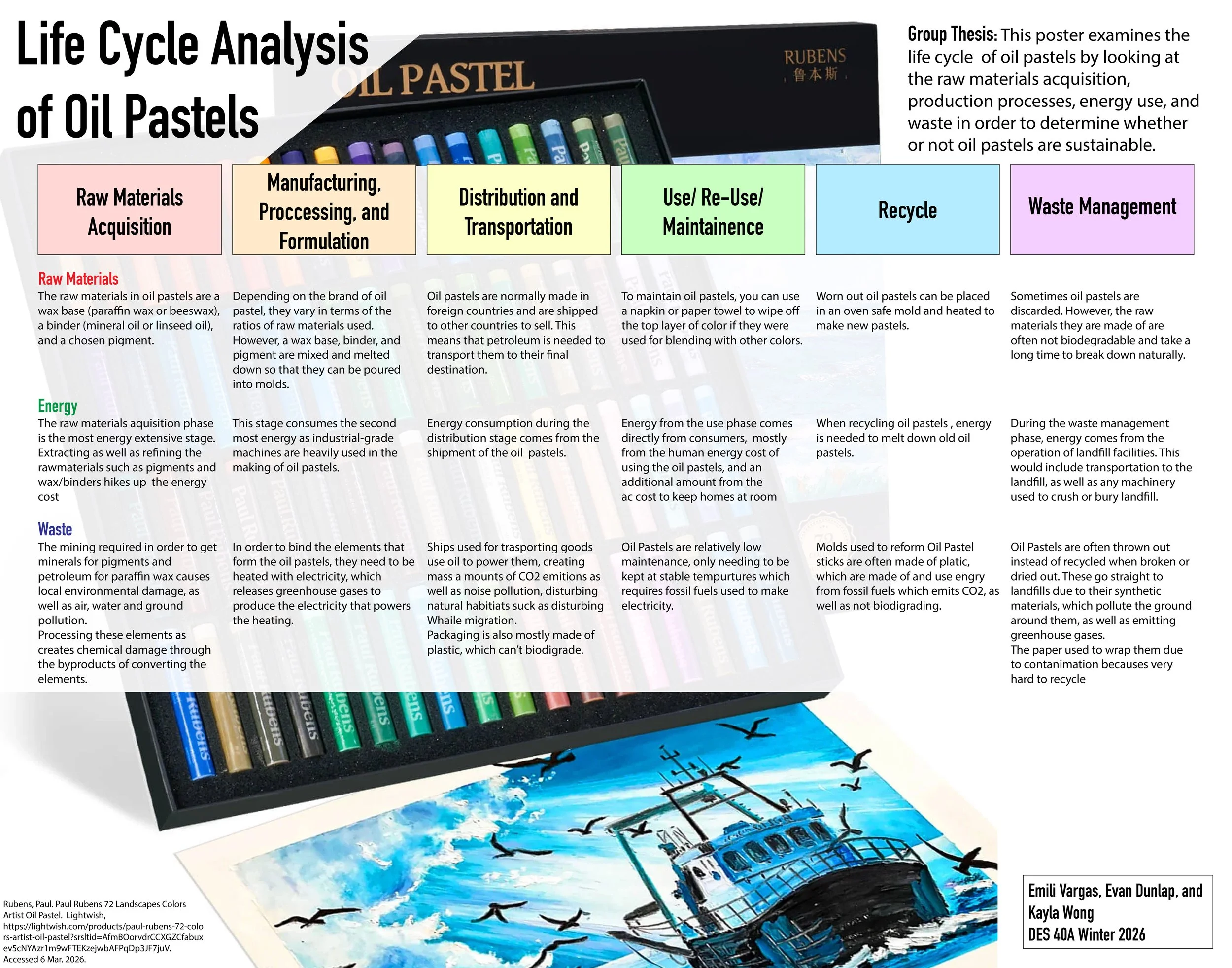
This paper will discuss the raw materials produced and used in the life cycle of oil pastels, most importantly the raw materials acquisition and product manufacturing stages because they highlight the roles of the raw materials in their respective life cycle stages. Additionally, it will also discuss if oil pastels are a sustainable product or not. The main raw materials used in the oil pastel manufacturing process are a wax base (paraffin or beeswax), binder (mineral oil or linseed oil), and pigment. Other secondary raw materials used in the packaging of oil pastels are cardboard, plastic, and paper. In the life cycle stage of production, oil pastels use both chemical and physical changes such as mixing and melting the materials together, pouring the melted mixture into molds, and demolding the finished products. Taking into account the main raw materials to make oil pastels, the remainder of the essay will discuss how to obtain the raw materials, assess if the raw materials are sustainable, and evaluate if oil pastels are a sustainable product.
One of the main raw materials in mass produced oil pastels is a binder, which is either mineral oil or linseed oil. Mineral oil is derived from the refinement of crude oil and does not biodegrade easily. Additionally, in order to obtain the mineral oil, there is a lengthy process of extracting the crude oil from the earth, refining it through multiple steps, and finally separating the refined crude oil from the mineral oil. This in turn demands a great amount of energy usage and results in high fossil fuel emissions. In oil pastels, mineral oil “keeps the pastel creamy, malleable and easy to blend” (Artchive). Linseed oil is derived from the seeds of the flax plant. It differs in the process of extraction compared to mineral oil because the seeds are ground and compressed to release the seeds’ oil. According to the source “TOWARDS AN ALTERNATIVE EXTRACTION PROCESS FOR LINSEED OIL”, researchers found a more efficient “new process of linseed oil extraction comprises the following stages: crushing, expression, demucilagination by electrical discharge, centrifugal separation of mucilage and solid residue, enzymatic treatment of the residue and final separation of oils, water and solid fractions” (Hossain et al.). In this extraction process, there is liquid waste and organic waste. Furthermore, cultivating the flax plant takes up land that could be used for other agricultural purposes. This begs the question, is linseed oil really sustainable? Looking at both of these types of oil pastel binders, mineral oil is commonly used in the production of mass produced oil pastels, which is not sustainable because it is derived from crude oil and it does not biodegrade easily. Alternatively, linseed oil is a more environmentally friendly option for a binder, but it takes a long time to grow the plant in order to obtain its seeds for the oil. This means that linseed oil is also not that sustainable in the long run. In addition to a binder, oil pastels also need a wax base.
A few common types of waxes that can be used to make mass produced oil pastels are beeswax and paraffin wax. Beeswax is a natural wax that is made from honeybees and it provides a more sticky and smooth texture in an oil pastel. It is also used in higher quality oil pastels and it “gives them their smooth, blendable texture” (Artchive). Obtaining beeswax requires a rendering process from the bees’ honeycomb, which requires energy to melt the raw wax for refinement. Depending on how much beeswax is harvested at a time, it can either be a sustainable or unsustainable raw material. Paraffin wax is a synthetic lubricant or wax that is derived from petroleum refinement. Quite a bit of energy goes into obtaining paraffin wax because you have to extract the petroleum, process it, separate it, and further refine it. Paraffin wax also does not easily biodegrade which raises concerns on sustainability. It also provides a stable texture that is also smooth in an oil pastel, which makes it easy to blend colors. Paraffin wax is also added to oil pastels “to harden the pastel without making it too brittle” (Artchive). Even though both materials have similar results in the final product, paraffin wax is not the most sustainable option because of its origins and lack of biodegradability. Furthermore, the source “COMPARATIVE PATHWAY ANALYSIS of PARAFFIN WAX and BEESWAX for INDUSTRIAL APPLICATIONS” states that “Paraffin wax contains up to 11 carcinogenic compounds (Website 1) (Hossain et al.). However, it is noted that paraffin wax is commonly used in the production of mass produced oil pastels. Moreover, pigments are another essential raw material in the production process of oil pastels.
The most important raw material that is necessary to give oil pastels their colors is pigments. In mass produced oil pastels, generally synthetic pigments are used in order to cut costs. In addition, the book, Paint and Surface Coatings, states that the “demand for consistency mean that even these natural pigments, such as iron oxides, are now being made synthetically” (Lambourne and Strivens). The process to create synthetic pigments is quite lengthy and takes a lot of energy to make them consistent. Additionally, the synthetic pigment refining process also produces a great deal of waste such as hazardous solid waste and contaminated wastewater. After discussing the raw materials in the oil pastels themselves, there is still a bit to unpack about the raw materials that go into the packing process of oil pastels.
In addition to the raw materials that compose the oil pastels themselves, cardboard and plastic play a major role in the packaging of the product. When researching the production of the cardboard boxes for the oil pastels, there was little to no information provided. In a more general scope, cardboard is made from either virgin fibers or recycled fibers. There are a lot of physical and chemical changes that the fibers must undergo in order to become workable cardboard. According to the book, Handbook of Paper and Paperboard Packaging Technology, a major step in the manufacturing of cardboard is “The fibres are prepared by mixing them with water to form a very dilute suspension, which is poured onto a porous mesh” (Kirwan). Cultivating the vegetation for cardboard can also have a positive effect on the environment since it reduces carbon emissions in the atmosphere. Plastic is used to wrap the oil pastel boxes in order to prevent them from opening in transport. It is also used as a tray in some brands of oil pastels to prevent the pastels from getting damaged in transport. Plastic is made from a polymer called polyethylene and it has an extensive production process that requires a significant amount of energy. According to the source, “How Shrink Wrap Is Made”, polyethylene is made by the process of polymerization, which is “Ethylene gas is polymerized using high heat and pressure, or catalysts, to create polyethylene. This process forms long chains of repeating ethylene units” (Eastaugh et al.). When looking at these packaging materials from a sustainability viewpoint, cardboard and some of the plastic can be recycled into new products. After taking a look at the various raw materials used in the production process of oil pastels, it can be concluded that they are not a sustainable product.
In short, oil pastels are not a sustainable product because many of its raw materials are not biodegradable and the rate at which the materials are being used is greater than the rate at which they are being replenished. One example being that synthetic pigments are commonly used to color the pastels even though they take a long time to break down. Another example is paraffin wax since it is derived from petroleum and also does not biodegrade easily. A final example is mineral oil because it is also made from refined petroleum and also takes a long time to break down. Since oil pastels are an unsustainable product through the analysis of its raw materials and are a common art medium across age groups and experience levels, companies should rely more on natural raw materials or find other natural substitutes to produce them. Consumers of oil pastels should also do their best to preserve the lifespan of their pastels to reduce the likelihood of having them end up in landfills.
Bibliography
Artchive. “Oil Pastels: History, Techniques, How They Are Made – Artchive.” Artchive.com, 19 Apr. 2024, www.artchive.com/art-mediums/oil-pastels/?utm_source=chatgpt.com. Accessed 29 Jan. 2026.
Gros, C., et al. “Towards an Alternative Extraction Process for Linseed Oil.” Chemical Engineering Research and Design, vol. 81, no. 9, Oct. 2003, pp. 1059–1065. Chemical Engineering Research and Design, doi:10.1205/026387603770866182. Accessed 5 Feb. 2026.
Hossain, M. Enamul, et al. “Comparative Pathway Analysis of Paraffin Wax and Beeswax for Industrial Applications.” Journal of Characterization and Development of Novel Materials, vol. 1, no. 4, 2010, pp. 1–13.
“How Shrink Wrap Is Made.” Pro-Tect, 2024, shrinkwrapcontainments.com/blog/how-shrink-wrap-is-made/.
Kirwan, Mark J., editor. Handbook of Paper and Paperboard Packaging Technology. 2nd ed., John Wiley & Sons, 2013. ISBN 9781118575070.
Leslie, Ken. Oil Pastel. Echo Point+ORM, 1 Aug. 2022.
Lambourne, Robert, and Thomas A. Strivens. Paint and Surface Coatings: Theory and Practice. 2nd ed., Woodhead Publishing, 2011. ISBN 9781855733480.
Twin Specialties Corp. “How Mineral Base Oils Are Made.” Twin Specialties Corp., 5 May 2020, www.twinoils.com/news/how-mineral-base-oils-are-made/. Accessed 6 Feb. 2026.
Ungvarsky, Janine. “Paraffin Wax.” Research Starters, EBSCO, 2023, www.ebsco.com/research-starters/chemistry/paraffin-wax.
“Why Non-Toxic Oil Pastels Are Essential for Safe Art Projects-Dehuang Stationery Co.,Ltd.” Dhawj.com, 2025, www.dhawj.com/news_details/1973601334653296640.html. Accessed 6 Feb. 2026.
Emili Vargas
Professor Christina Cogdell
DES 40A
March 10, 2026
Where the Majority of Energy comes from in the Life Cycle of Oil Pastels
Oil pastels are an art medium consisting of pigments, wax, and non-drying oils. These three materials are combined to form solid objects, known as oil pastels, which are then used for drawing or painting. Though oil pastels resemble oil paint in their composition, they differ in that oil paints dry permanently over the course of weeks, whereas oil pastels do not dry and can indefinitely be reworked. This is due to the combination of pigments and non-drying oils, which are held together by wax, enabling them to move smoothly over drawing paper or canvas. Industrial oil pastels are made by heating wax, oil, and pigments, then mixing them until the pigments are evenly distributed. The mixture is then molded into sticks and packaged for distribution (Artchive). Research into historical art materials has also shown that oil pastels consist of pigment particles combined with waxes, oils, and fillers that help maintain the structure of the stick (La Nasa et al.; Singer et al.). In studies examining historical pastel materials, researchers describe oil-based crayons as containing mixtures of “pigments, waxes, and lipidic binding media,” confirming the general composition of modern oil pastels (La Nasa et al.). Although oil pastels are manufactured using industrial processes, they require relatively low overall energy compared with many other industrial products. Their energy consumption is driven primarily by the raw materials stage of their life cycle, particularly during raw material extraction and pigment production which involve mining and refining. To understand where most of the energy consumption occurs, it is necessary to examine the raw material stage at full.
[Raw Materials Phase]
The raw materials stage is the most energy intensive part of the oil pastel life cycle. This stage includes the extraction and processing of pigments, as well as the production of the wax and oil binders which hold the pigments together. These processes involve mining activities, chemical reactions, and high temperatures, which are energy-intensive. The production of pigments involves activities such as the extraction of mineral resources and compounds. Mining operations rely on heavy machinery such as excavators, drilling rigs, crushers, and grinding mills, which consume large quantities of fuel and electricity (Buxbaum). As explained in industrial pigment manufacturing research, inorganic pigments are often produced through “complex high-temperature processes and mineral treatments” that require significant industrial infrastructure (Buxbaum).
After extraction, mineral ores undergo several refining steps before they can be used as pigments. These processes may include crushing, washing, chemical treatment, and high-temperature processing to isolate the desired pigment compounds and remove impurities (Buxbaum). For example, iron oxide pigments commonly used to produce red and brown colors are created by heating iron compounds to temperatures between approximately 800 and 1000 degrees Celsius, which requires significant thermal energy (Gitnux). Titanium dioxide, one of the most widely used white pigments in art materials and coatings, can require between 17 and 41 gigajoules of energy per ton during industrial production depending on the manufacturing method used (European Commission), which is roughly equivalent to several months to a year of household electricity use.
Pigment production also involves grinding and dispersion processes to create extremely fine particles that can mix evenly with binders in art materials. Milling equipment used to achieve these fine particle sizes requires additional electricity, and grinding processes can consume roughly 10–15 kilowatt-hours of energy per kilogram of pigment produced (ZipDo). Synthetic organic pigments, which are “man-made” pigments which are produced through chemical synthesis of organic (carbon-based) compounds, often require more complex chemical processing, including controlled reactions and purification steps designed to produce stable color properties. According to Lomax and Learner, synthetic pigments involve “complex molecular structures and manufacturing pathways” that contribute to the technical and energy demands of pigment production (Lomax and Learner). Considering each step of creating a synthetic pigment; the chemical synthesis, heating and reaction process, purification, and drying + milling, the pigment production takes roughly 3-5 MWh of energy per metric ton of pigment produced (24 Chemical Research). In addition to pigments, oil pastels require binders such as waxes and oils. Wax provides structural stability while oils help disperse pigment particles throughout the material. Studies of wax-based drawing media explain that wax functions as a binding material that “holds pigment particles together while allowing smooth application onto a surface” (Ellis and Yeh). The binders may come from petroleum refining or plant wax extraction. Paraffin wax, for instance, derived from petroleum, is separated and purified from crude oil in oil refineries using the process of oil distillation and chemical treatment. High temperatures are necessary to maintain these refining activities which consume the most energy out of around 5-15 gigajoules of energy per ton of refined wax (Medwin). Researchers have started exploring alternative methods for producing pigments in more sustainable ways. For example, recent studies examine producing natural pigments through microorganisms using biosynthesis techniques (Qin et al.). This research notes that microbial pigment production may provide “more sustainable and controllable alternatives” to conventional industrial pigment synthesis (Qin et al.). Although these approaches are still developing, they demonstrate how pigment production may evolve as industries seek to reduce environmental impacts.
[Manufacturing Phase]
Once these materials are processed, they are then delivered to manufacturing plants for further processing to form the final product. Although this stage of processing requires less energy compared to the processing of materials, there is still some energy required for the operation of machines. Industrial oil pastel manufacturing typically involves pigment mixing, binder heating, molding, cooling, and packaging (Artchive; Leslie). During manufacturing, pigments are mixed with waxes and oils using industrial mixers or high shear blending machines to ensure that pigments are well distributed throughout the binder mixture, these mixers typically consume between 1 and 15 kW depending on batch size. To effectively mix waxes and oils with pigments, it is essential to first heat the mixture of waxes and oils to enable it to melt and be effectively mixed with pigments. Such heating is usually done through electricity or natural gas. After effectively mixing all the materials, the mixture of pigments is molded into sticks using various molds or machines. Finally, the pastels are cooled to enable the binder to set and stabilize the sticks.
Manufacturing facilities also consume energy through supporting operations such as lighting, ventilation, climate control systems, and conveyor belts used to move products through the production line. Research on manufacturing systems shows that industrial machine tools consume energy through mechanical motion, electrical motors, and auxiliary equipment used throughout factory operations. As Zhou and colleagues note, “machine tools are among the primary energy-consuming equipment in manufacturing systems” (Zhou et al.). Although these processes require electricity and mechanical energy, their energy demand remains lower than that of raw material and pigment production.
[Distribution and Usage Phases]
Transportation and distribution contribute additional energy consumption to the life cycle of oil pastels. Art supplies are often produced in centralized manufacturing facilities and shipped globally to retailers and consumers. There are various brands of oil pastels that originate in Asia and Europe and must be transported to other countries.
The energy consumption in transportation is dependent on the mode of transport. Ocean transport is known to consume less energy per unit of cargo compared to other modes of transport. On the other hand, air transport is known to consume more energy compared to ocean transport. Trucks are used for transporting goods between ports, warehouses, and stores. They use diesel fuel or petroleum as a source of energy. This process of transportation consumes less energy compared to raw material and pigment production. Once oil pastels reach consumers, the energy demand associated with the product decreases significantly. The use phase of oil pastels requires very little energy compared with most manufactured products. Unlike other electronic devices or machines that use fuel to operate, oil pastels do not require any fuel to operate. Instead, it is only the human body that provides energy during this stage. When an artist is using an oil pastel to create art work, it is the movement of his or her hands that creates pressure on the oil pastel to create an image on a given surface. It is muscles that convert food to energy. Although this energy is very small compared to other machines used to create pigments, it is still notable. Wax-based drawing materials function effectively without any external power source beyond human interaction (Ellis and Yeh).
Some indirect energy may be associated with storage conditions. The oil pastels are usually stored at room temperature, which is around 70 degrees fahrenheit, to avoid melting or hardening. This process might involve the use of heating or cooling systems, which are usually used in buildings. This process, therefore, involves the use of energy, but the energy consumption is not related to the oil pastel product.
[End-of-Life phase]
The last process in the oil pastel life cycle involves the oil pastel product having reached the end of its life cycle. Most oil pastel products are disposed of as solid waste and then landfilled because the products cannot be recycled. Waste disposal processes usually involve the use of energy for the process. Garbage trucks, which use diesel fuel, are used to collect the oil pastel products and then dispose of them in landfills. Landfills usually use heavy machinery such as compactors and bulldozers to spread the oil pastel products in the landfills to ensure efficient use of space. The products might also be burned, and the heat energy generated might be used to produce electrical energy. Although the process involves the use of energy, the energy consumption is not significant compared to the energy consumption during the oil pastel life cycle.
Conclusion
Overall, it can be concluded that in the life cycle of oil pastels, the highest amount of energy is consumed during the raw material stage, specifically during pigment extraction and chemical processing. The mining activities, chemical reactions, and high-temperature processes require considerable amounts of energy to produce materials used in oil pastels (Buxbaum; Lomax and Learner). On the other hand, during the manufacturing, transport, usage, and disposal of oil pastels, less energy is consumed.
As mentioned, as oil pastels do not require very much energy during their usage and disposal stage, it can be concluded that oil pastels have lower energy consumption compared to other products and materials. However, it is still important to understand the life cycle of oil pastels and analyze where exactly energy is being consumed during this life cycle, so that future improvements to sustainability can be made.
Bibliography
Artchive. “Oil Pastels.” Artchive, 30 June 2024, www.artchive.com/art-mediums/oil-pastels/.
Buxbaum, Gunter, editor. Industrial Inorganic Pigments. 2nd completely rev. ed., Wiley-VCH, 1998.
Ellis, Margaret Holben, and M. Brigitte Yeh. “The History, Use and Characteristics of Wax-Based Drawing Media.” 1998.
La Nasa, Jacopo, et al. “An Integrated Analytical Study of Crayons from the Original Art Materials Collection of the MUNCH Museum in Oslo.” Scientific Reports, vol. 11, no. 1, 2021, article 7152. https://doi.org/10.1038/s41598-021-86031-6.
Leslie, Ken. Oil Pastel Materials & Techniques for Today’s Artist. Echo Point Books & Media, 2025.
Lomax, Suzanne Quillen, and Tom Learner. “A Review of the Classes, Structures, and Methods of Analysis of Synthetic Organic Pigments.” Journal of the American Institute for Conservation, vol. 45, no. 2, June 2006, pp. 107–125. https://doi.org/10.1179/019713606806112540.
Qin, Zhijie, et al. “Production of Natural Pigments Using Microorganisms.” Journal of Agricultural and Food Chemistry, vol. 71, no. 24, 2023, pp. 9243–9254. American Chemical Society, https://doi.org/10.1021/acs.jafc.3c02222.
Singer, Brian, et al. “Investigation of Materials Used by Edvard Munch.” Studies in Conservation, vol. 55, no. 4, 2010, pp. 274–292. JSTOR, http://www.jstor.org/stable/42751727.
Yusuf, Lukman A., Kayode Popoola, and Haruna Musa. “A Review of Energy Consumption and Minimisation Strategies of Machine Tools in Manufacturing Process.” International Journal of Sustainable Engineering, vol. 14, no. 4, 2021, pp. 1–17. https://doi.org/10.1080/19397038.2021.1964633.
Zhou, Lirong, et al. “Energy Consumption Model and Energy Efficiency of Machine Tools: A Comprehensive Literature Review.” Journal of Cleaner Production, vol. 112, 2016, pp. 3721–3734.
Gitnux. “Pigments Industry Statistics.” Gitnux Market Data Report, 2026.ZipDo. “Pigments Industry Statistics.” ZipDo Education Reports, 2026.
Winchem Industrial. “What Are the Environmental Impacts of Pigment Red 179 Production?” Pigment-Dye.com, 2024.
PMC. “Actinomycete-Derived Pigments: A Path Toward Sustainable Industrial Colorants.” National Center for Biotechnology Information, 2024.
Environmental Protection Agency. (n.d.). EPA. https://www.epa.gov/green-power-markets/green-power-equivalency-calculator-calculations-and-references
24 Chemical Research. Pigments Market 2025: Global Forecast to 2032. 24 Chemical Research, 2025,
https://www.24chemicalresearch.com/reports/298118/global-pigments-forecast-market-2025-2032-381
Medwin Publishers. A Review of Industrial Paraffin Production Technologies Based on Recent Developments. Petroleum & Petrochemical Engineering Journal.
Wutai Chemical Equipment. What Is the Energy Consumption Level of a Powder Coating Mixer? 2025.
Evan Dunlap
Professor Christina Cogdell
DES 40
11 Mar. 2026
The Waste of Oil Pastels
This paper will focus on the waste created during the production, distribution, and aftermath of oil pastels. The majority of waste is created from the raw materials phase, transportation phase, and disposal phase. Oil pastels are an art material made of wax, pigments, and a variety of binding agents that are often synthetically produced. These products are considered a difficult but relatively beginner-friendly tool for low difficulty projects and are used by both professionals and children at different levels of quality. However, the processes necessary in order to make these pastels produce a lot more waste than people would initially expect. Oil pastels, despite their non-toxic nature, also create heavy metals and other toxic substances in the process of their creation. These materials used within oil pastels are secondary materials that have to be processed from raw materials, each with their own harvesting and chemical processing.
The acquisition of raw materials and secondary materials for oil pastels causes environmental damage through mining, chemical waste, and water and air pollution. Mining causes immense environmental damage in order to collect the raw metals for the pigments. Mining itself is also a massive producer of waste. Mining of any kind using multiple methods of extraction, which create waste types including tailings: “tailings are the major wastes produced from gold extraction and they contain high amounts of heavy metals (HM). These metals leach out in an uncontrolled manner into surrounding environments on exposure to water or through dispersal by wind.” This contamination can cause massive damage to human and animal populations. However, the environmental damage goes even beyond larger organisms, and to the soil itself: “Heavy metals affect the natural population of bacteria in the soils” (Fashola). This destruction of populations in the soil is detrimental to plants, bugs, microclimates, and the animals that rely on those populations. Heavy metal and acid mine drainage also affect groundwater quality, including aquifers. The increase of heavy metals in water, local ecosystems, and air pollution has led to higher amounts in rural and urban areas (Fashola). Beyond pigments, oil pastels are also made out of wax, which is naturally expensive to produce. The most common substitute for wax in oil pastels is paraffin wax, which is made from petroleum. Petroleum is a crude oil classified as a fossil fuel. In order to get the fossil fuel, the petroleum has to be mined and processed before use. This requires water both for cooling and filtration. This creates produced water or processed water:
The ratio of produced water to oil in a conventional well was approximately 10 barrels of produced water per barrel of oil. According to the American Petroleum Institute (API)1, more than 18 billion barrels of waste fluids from oil and gas production are generated annually in the United States… Produced waters contain levels of radium and its decay products that are concentrated, but the concentrations vary from site to site (EPA).
This requires methods of disposal, ones that often can have effects on the surrounding area. Mining and processing also produce other substances: “Oil production processes used in conventional drilling generate an estimated 230,000 metric tons or five million cubic feet (141 cubic meters) of TENORM sludge each year” (EPA). This sludge contains dissolved solids produced from the temperature and pressure change, and has silica and barium. However, this sludge can also contain radiation depending on the area, which can be spread through contamination, and is also often contaminated equipment. The sludge is disposed of in Burn pits or Brine pits, depending on its hazard level. Burn pits are used as storage for non-hazardous oil wastes with periodic burning, while Brine pits are lined or earthen pits are used for more hazardous wastes. In these pools, the sludges. will concentrate at the bottom, making the pond sediments pose a potential health risk (EPA).
While the mining of pigments and resources is damaging, it doesn’t stop there. One of the pigments that was used in many products, including nickel-cadmium batteries, pigments, coatings, and plating. This yellow pigment, while vibrant, caused many issues, not only from its collection but also the health effects it would cause. Cadimium can be spread through many different avenues, including rivers, soil, plants, and animals, mainly shell fish who eat and absorb it. This is important because “Cadmium exerts toxic effects on the kidney, the skeletal system, and the respiratory system and is classified as a human carcinogen” (World Health Organization). While for the purpose of pigments, it has been discontinued in the US, other metals and byproducts still pollute the landscape in the same way. This is not to mention synthetic pigments, which are made through chemical processes. These processes not only have a significant greenhouse gas impact but also create chemical byproducts that are often toxic and harmful to ecosystems (Zlaugotne, Beate, et al.). Pigments are secondary resources that need to be processed before being used in manufacturing. Near the factories, it is the easiest to see the damage that is caused by the production of these dyes and their application: “the water in the rivers has the color of the dye the factories produce that day. The soil in which people grow their food becomes toxic as they use the water for farming. The rivers are dead, as fish and plants can't survive the chemicals that the factories dump into the rivers” (Bachinger). While this issue is beginning to become better in recent years, the damage these pigments do to these ecosystems will last for decades. The toxification of the ground and water will need to be treated for both the safety of the people and for the plants and animals to be able to survive in that environment again, which will take years of treatment and reintroduction. While the processing is a huge source of pollution, so is the distribution after the process of forming them is finished.
Distribution of oil pastels across long distances through ships, trucks, and the usage of packaging creates air and water pollution, as well as builds up in landfills. Shipping across long distances causes large amounts of CO2 as well as disturbing ocean habitats. One of the ways that animal life is harmed by shipping is through “The 80,000 tonnes of antifouling paint used each year (projected to double by 2030) contain a range of toxic compounds to stop biological growth on ship’s hulls.” (Lee, Hu, and Chen 6) These compounds can contaminate the water, further damaging the ocean wildlife. The energy, as well as resources needed to produce this amount of pain, also adds to the carbon footprint of the ships, along with the creation of steel needed for the construction. The ships themselves also emit large amounts of greenhouse gas from burning oil to keep the ships going on their long journeys: “Maritime shipping is a significant contributor to anthropogenic climate change. It emits over one billion tonnes of carbon dioxide equivalent (CO2e) each year in the form of CO2, methane, black carbon, and other climate pollutants. Shipping’s 3% share of global GHG emissions is comparable to a medium-sized industrialised country” (Seas at Risk 5). Methane is a particularly strong greenhouse gas, being even more damaging than carbon dioxide. This release of methane increases their damage, especially considering how often these trips are taken at each stage. Pentel, a popular Oil Pastel brand, has factories and locations all over the world, which is common for most manufacturing industries. This means that not only are they taking long voyages, but these trips are also happening more often to transport materials to each location (Pentel Co 3). Oil spills are also a huge source of harm. While less common, they are far more immediately damaging to the environment, causing mass death in areas near the spill and contaminating water. Oil spills can also spread out further towards land, causing animals to get covered in it. Ports are particularly vulnerable to damage as “Port developments are hotspots for impacts of all kinds: poor air quality, high concentrations of heavy metals from biofouling paints, marine pollution including underwater noise, coastal degradation and habitat loss, extensive damage to the seafloor from ship anchors, as well as the uprooting of local communities and the triggering of cross-cultural conflict” (Seas at Risk 7). The damage done in these areas is linked not only to coastal marine life damage but also to effects on whale migration. While this has become a stronger point of regulation, it is still a massive problem, and is not helped by the removal of natural habitats within these areas. Packaging for water pastels, particularly plastics contribute to landfills and ground contamination. Paper packaging also often needs to be thrown out due to the synthetic materials within the pastels contaminating them and making them extremely difficult to recycle. The Washington State Department of Health even urges that when working with paints and pastels, all contaminated products be disposed of in the trash. This is due to possible pigments within the oil pastels as well as the wax. This makes them inseparable from the paper, preventing them from being broken down by the water within the recycling process (Wood). The final step of the packaging is similar to the final step of the oil pastels themselves, as the most common destination of both is the landfill due to their synthetic nature.
The end of the life cycle of oil pastels, the disposal phase, is where oil pastels are put in landfills, polluting the ground and water supplies. Oil pastels are quite easy to recycle. The materials that are needed to recycle oil pastels are only a binding agent, heat, and a mold (Loh). These are quite easy to find, though they are also often made of synthetic molds. It is also very rare that oil pastels are recycled. Oil pastels are most often thrown out when they have dried up or broken. This creates a lot of unnecessary waste that ends up in landfills. Landfills are especially toxic because they release millions of tons of greenhouse gases into the air and contaminate the water and ground around them. Landfills are associated with a wide range of enviormental concerns and pollution issues, including “(a) underground water pollution due to the leaching of organic, inorganic, and various other substances of concern (SoC) contained in the waste, (b) air pollution due to suspension of particles, (c) odor pollution from the deposition of municipal solid waste (MSW), and (d) even marine pollution from any potential run-offs” (Siddiqua). These all contribute to harm being done to both communities and local ecosystems. The wide variety of pollution types that practically radiate from landfills requires the local environment to be erased and destroyed, removing habitats and scaring off animals. The runoff also affects further environments, both in rivers and as said in the ocean. Landfills also contain most of the PTEs (Potentially Toxic Elements): “There are various adverse environmental effects related to the PTEs. The majority of the PTEs are non-biodegradable and thus cannot go through degradation either chemically or microbially. Hence, their long-term influence is released via the ground and through the soil” (Siddiqua). Cadmium, as well as other metals used in pigments are included in this category. These chemicals, as mentioned before, will affect plant life, animal life, and get into water reserves in the area. These are just a few of the consequences that make landfills horribly toxic to the environment and people. Often it is common for people to think of landfills as separate from society, however meny groups live in these dangerous environments: “Over 15 Million people are confirmed to live and work in communities that rely on garbage dumps worldwide, though this is expected to be a gross underestimate. This number is on the rise” (International Samaritan). These people are exposed to the worst effects of landfills. This environment is not just mildly harmful; it is literally deadly. Some of the life threatening effects that people who are forced by circumstance to live in are “methane gas buildup causing spontaneous combustion, getting swallowed into garbage landslides and suffocating, illness from contaminated food and water, toxic air, and lack of sanitation, serious and/or gangrenous injury from glass or shrapnel, being run over by garbage trucks/crushed by contents, disease and disability caused by medical waste dumping, Gang violence and blackmail based on region, trauma and mental illness related to severity of the conditions” (International Samaritan). This is not even a complete list of complications, as the severity and types of dangers vary widely depending on what is being dumped there. These conditions are inhumane and exist because of the toxic materials and damage they cause, along with a lack of awareness of the consequences of these landfills. These ways of contaminating are shared through most of the steps of the cycle, creating a chain of pollution.
The methods in gathering, producing, and disposing of oil pastels often use synthetic materials, produce heavy metals, and create waste that is harmful to environments and communities. Not only do the byproducts create chemical pollution, which is harmful to ocean life, microbiomes, and to people through water and ground pollution, but the CO2 and greenhouse gases released during all phases are extremely harmful. These issues are even worse at the end of their life cycle, where they contribute to the growing landfills that put families and children in danger. While oil pastels may seem unassuming, the synthetic pigments, as well as the petroleum-based wax they are made of, make large amounts of waste. These methods are often chosen because they are cheaper to produce; this is often prioritized over the health of people and the environment. The consequences of creating oil pastels and other similar products contribute to the pollution currently devastating ecosystems, animal populations, and entire communities.
Bibliography
Bachinger, Leo Matteo. “Synthetic Dyes and Environmental Impacts.” CSDT, csdt.org/culture/sustainabledyes/environmentimpact.html.
“Chemicals of Public Concerns I Cadmium.” World Health Organization, World Health Organization, 2019, www.who.int/teams/environment-climate-change-and-health/chemical-safety-and-health/health-impacts/chemicals/cadmium.
Fashola, Muibat Omotola, et al. “Heavy Metal Pollution from Gold Mines: Environmental Effects and Bacterial Strategies for Resistance.” International Journal of Environmental Research and Public Health, U.S. National Library of Medicine, 26 Oct. 2016, pmc.ncbi.nlm.nih.gov/articles/PMC5129257/.
“Learn: Communities in Garbage Dumps.” International Samaritan, 3 Nov. 2025, intsam.org/about-garbage-dump-communities/.
Lee, Paul T.‐W., Kai‐Chieh Hu, and Tao Chen. 2010. “External Costs of Domestic Container Transportation: Short‐Sea Shipping versus Trucking in Taiwan.” Transport Reviews, 20 Apr. 2010, 30 (3): 315–35. doi:10.1080/01441640903010120.
Loh, Joanne. “Recycle Oil Pastels & Crayons.” Craft Passion, 25 Oct. 2024, www.craftpassion.com/how-to-recycle-crayons-oil-pastels/.
“Painting and Pastels | Washington State Department of Health.” Washington State Department of Health, doh.wa.gov/community-and-environment/contaminants/art-hazards/painting-and-pastels. Accessed 11 Mar. 2026.
Pentel Corporate Report, Pentel Co., Ltd., 2016, pentel.ca/docs/pentel_CR2016_en.pdf.
Siddiqua, Ayesha, et al. “An Overview of the Environmental Pollution and Health Effects Associated with Waste Landfilling and Open Dumping.” Environmental Science and Pollution Research International, U.S. National Library of Medicine, Aug. 2022, pmc.ncbi.nlm.nih.gov/articles/PMC9399006/.
“The State of Shipping & Oceans Report”, Seas at Risk VZW, 2023, seas-at-risk.org/wp-content/uploads/2023/07/The-State-of-Shipping-and-Oceans-Report-Final.pdf.
“TENORM: Oil and Gas Production Wastes.” EPA, Environmental Protection Agency, 19 Feb. 2026, www.epa.gov/radiation/tenorm-oil-and-gas-production-wastes#:~:text=According%20to%20the%20American%20Petroleum,vary%20from%20site%20to%20site.
Wood, Robin. “Discover What Paper Can and Can’t Be Recycled with Our Paper Recycling FAQs.” Russell Richardson, www.russellrichardson.co.uk/advice/3/paper-recycling-faqs. Accessed 10 Mar. 2026.
Zlaugotne, Beate, et al. “Life Cycle Impact Assessment of Microalgae and Synthetic...” Paradigm, Paradigm, 11 June 2023, reference-global.com/article/10.2478/rtuect-2023-0018.