Design Life-Cycle
assess.design.(don't)consume
3/9/2026
DES 40A
Professor Christina Cogdell
Raw Materials for the Life Cycle of UV Resin
UV or Ultra Violet resin consists of many materials, some hard to come by. UV resin is a fast curing liquid polymer that hardens under UV light very quickly. It is like magic and is a very useful and speedy alternative for many people. Especially since it does not require mixing like other forms of resin do. Other forms of resin are not fast curing, and take more effort and time to provide results. So what is used to make the magic of UV resin happen? Well there are many, and the materials are the first step to making the magic come true. I will elaborate on the raw materials that are used to create UV resin, where they can be acquired even if it is difficult to do so, and what needs to be considered while acquiring them.
To start off, we should start with the primary raw materials of UV resin. The primary materials of UV resin are very important as they make up the main properties of UV resin. The primary materials serve as the base materials used to make UV resin, which make them extremely important. The primary raw materials of UV resin consist of “synthetic polymers…, polystyrene, polyurethane and polyvinyl chloride.” (Montazeri, Mahdokht, and Matthew J. Eckelman, 2018). There are also oligomers, monomers, and photoinitiators. Oligomers “are pre-polymers that provide the fundamental properties of the cured film, such as flexibility, hardness, and chemical resistance.” ( Lencolo37.com, 2025). Monomers are “reactive diluents to adjust viscosity and influence the final cured properties. They help in reducing the resin's viscosity and improving adhesion.” ( Lencolo37.com, 2025). Photoinitiators are components that “absorb UV light and trigger polymerization, converting the liquid resin into a solid form. Different photoinitiators are used based on the wavelength of UV light and curing requirements.” ( Lencolo37.com, 2025). All of these materials work in tandem and are equally important to the creation of UV resin. Despite being used for different functions, all the materials serve their purpose during production, and are needed to make UV resin. UV resin materials are all chemically based, so the materials can only be sourced from chemical means. The main way to acquire UV resin materials for manufacturing is through chemical suppliers and labs. These are the most reliable sources because UV resin is very chemically advanced.
Primary materials are important but what solidifies them, just like UV resin solidifies, are the secondary raw materials. The secondary raw materials of UV resin consist of various additives that enforce the chemicals and the oligomers, monomers and photoinitiators mentioned before. These secondary additives are important for helping solidify the UV resin. The additives are extensive and “include stabilizers, colorants, and fillers used to enhance specific traits like flame retardancy, thermal conductivity, or UV stability.” (INCURE INC., 15 Jan. 2026). The secondary raw materials of UV resin are just like the primary raw materials. All the secondary raw materials are all chemically based. So, the same way you acquire the primary raw materials for UV resin is the same way you acquire the secondary materials for it. It is acquired through chemical suppliers and labs which is the most reliable source.
Primary and secondary materials are important because without them there would be no manufacturing process at all. However, it is still important to consider how these materials get manufactured. Manufacturing is very important because depending on the manufacturing process, the quality of the UV resin created can be drastically, significantly different in a good or bad way. An example of this drastic quality difference would be the adhesion which is one of the most important things about UV resin to consider when picking materials. “You must ensure the resin is chemically compatible with the substrates (e.g., polycarbonate, stainless steel, glass). Some plastics may require surface treatments like corona or plasma discharge to improve wetting and bond strength.” (INCURE INC., 15 Jan. 2026). Depending on the materials used, the UV resin may not be able to be used on certain surfaces at all, which is not good in the slightest.
Manufacturing for quality goes hand in hand when it comes to environment and safety. Environment and safety considerations are some of the most important things to consider with any product. Something as chemically advanced as UV resin especially has to consider this. An example of the consideration of environmental quality is something like “Cationic epoxies are generally better for high-heat environments, while certain acrylics are formulated specifically for outdoor UV resistance.” (INCURE INC., 15 Jan. 2026). These things are especially important during transfer.
Transfer of UV resin materials is handled with great care, because it is chemical. If those chemicals were to spill or break or anything else, it would cause terrible damage and harm. So safety especially needs to be considered not only for transfer but overall.
Environmental effects of the raw materials can include “reduction in durability and service life” and “release of microplastics and microparticles” (Andrady, A.L., Heikkilä, A.M., Pandey, K.K, 2023). There is also the problem of greenhouse gasses. All of this is harmful not only to the environment but also to humans.
As stated earlier, UV resin is very chemically advanced, a lot of chemical related issues due to the materials is a given. A safer approach to the acquiring and using the materials would be “VOC exposure for workers and building inhabitants, reducing potential deleterious health effects, while the inclusion of bio-renewable ingredients reduces the need for non-renewable petrochemical inputs. While these direct benefits are obvious, there are other types of hazards and potential environmental impacts to consider, such as total energy use for production and application, or greenhouse gas (GHG) emissions.”. (Montazeri, Mahdokht, and Matthew J. Eckelman, 2018) This is a very interesting solution, because nothing of quality is lost. Sustainability for UV resin is still a primary concern and topic despite the suggestion of use of other materials.
Sustainability needs to be considered. If the UV resin is not sustainable it just causes even more problems in the future. Another example of a solution would be “the use of bio-based alternatives to fossil-based building blocks in many applications” (Montazeri, Mahdokht, and Matthew J. Eckelman, 2018). Just because UV resin is chemical, does not mean it has to be extremely damaging and destructive. UV resin is useful but extremely hazardous, and to make it more accessible these impacts the materials make need to be considered. Especially if it wants to be used for a long time.
There is so much to consider when creating UV resin, it feels like such a task. UV resin is hard to make, there are many materials that are not easily accessible, and that need to be handled with care. There are a lot of things to consider when creating UV resin when it comes to materials, but everything about them is important. Materials are the foundation of UV resin, and by taking into consideration the many factors that are involved with them, like the type of polymers used, or if something is fossil or bio based, it creates a landscape for improvement and sustainability for such a valuable resource. UV resin is a very useful and valuable man made resource, and to continue producing it materials need to be factored in.
Bibliography
Chard, Jonathon M., et al. “Shades of Green: Life Cycle Assessment of a Urethane Methacrylate/Unsaturated Polyester Resin System for Composite Materials.” Sustainability, vol. 11, no. 4, Feb. 2019, p. 1001. https://doi.org/10.3390/su11041001.
The Athena Sustainable Materials Institute, et al. “A Cradle-to-Gate Life Cycle Assessment of North American Wood Product Resin Systems.” Athena Sustainable Materials Institute, by U.S. Endowment for Forestry and Communities and USDA Forest Service Forest Products Laboratory, directed by Jamie Meil, Feb. 2022, www.compositepanel.org/wp-content/uploads/Wood-Resins-LCA-Report_Final_Athena-With-CRS_Feb-2022-1.pdf.
Hu, Yun, et al. “A Green and Sustainable Strategy for Recyclable Ultraviolet (UV)-curable Resin From Tartaric Acid via Three Dimensional (3D) Printing to Reduce Plastic Pollution.” Journal of Cleaner Production, vol. 436, Jan. 2024, p. 140772. https://doi.org/10.1016/j.jclepro.2024.140772.
Andrady, A. L., et al. “Effects of UV Radiation on Natural and Synthetic Materials.” Photochemical & Photobiological Sciences, vol. 22, no. 5, Apr. 2023, pp. 1177–202. https://doi.org/10.1007/s43630-023-00377-6.
Ahsan, Qumrul, et al. “Life Cycle Analysis of Phenolic Resins.” Elsevier eBooks, 2025, pp. 569–85. https://doi.org/10.1016/b978-0-323-95660-4.00027-1.
Montazeri, Mahdokht, and Matthew J. Eckelman. “Life Cycle Assessment of UV-Curable Bio-based Wood Flooring Coatings.” Journal of Cleaner Production, vol. 192, Apr. 2018, pp. 932–39. https://doi.org/10.1016/j.jclepro.2018.04.209.
Sofer, Gail. “Establishing Resin Lifetime: Key Issues and Regulatory Positions.” BioProcess International, vol. JANUARY 2003, 2003, pp. 64–65. eu-assets.contentstack.com/v3/assets/blt0a48a1f3edca9eb0/bltc8da807ec06de81c/658c44708ffcd1040a0e7e94/0101ar09_76810a.pdf.
Shen, Yan, et al. “Green Manufacturing Process Design for Infusible Acrylic Resin Composites: A Data-guided Life Cycle Management Model Incorporating Material-process-property-energy-emission Relationships.” Composites Part a Applied Science and Manufacturing, vol. 181, Mar. 2024, p. 108146. https://doi.org/10.1016/j.compositesa.2024.108146.
Song, Jin Han et al. “Synthesis and Characterization of UV-Curable Resin with High Refractive Index for a Luminance-Enhancing Prism Film.” Polymers vol. 17,1 76. 30 Dec. 2024, doi:10.3390/polym17010076
Kočí, Vladimír, et al. “LCA OF LIQUID EPOXY RESIN PRODUCED BASED ON PROPYLENE AND ON GLYCERINE.” ACTA ENVIRONMENTALICA UNIVERSITATIS COMENIANAE (BRATISLAVA), vol. 20–20, no. Suppl. 1, journal-article, 2012, pp. 62–67. fns.uniba.sk/fileadmin/prif/actaenvi/ActaEnvi_2012_Suppl.1/10_S_Koci_Loubal_Acta2012_Suppl_1.pdf.
seo0769. “Understanding UV Resin: Composition and Applications - Guangdong Lencolo New Material Co., LTD.” Lencolo37.com, 2025, www.lencolo37.com/article/185.
Tech. “UV Resin Adhesive: An Industrial Guide - INCURE INC.” INCURE INC., 15 Jan. 2026, incurelab.com/wp/uv-resin-adhesive-an-industrial-guide?srsltid=AfmBOoqz9x6v3EqpcJ5fd_fOWbpXBoseO2E0ap8yS7lzQWZDG0ZcUjq-. Accessed 13 Mar. 2026.
Eurus Yang
DES40A | WQ 26 | A05
13 March 2026
Embedded Energy in the Life Cycle of UV Resin
Introduction
UV resin is widely used in coatings, printing inks, adhesives, and additive manufacturing, such as stereolithography (SLA) 3D printing. The material cures quickly when exposed to ultraviolet light, which allows fast production and low solvent emissions. Because UV curing uses electrical equipment, it is often assumed that the curing stage consumes the most energy.
However, life cycle assessment research shows a different pattern. Many studies suggest that the largest energy cost occurs earlier in the supply chain, especially during raw material production and chemical synthesis (Montazeri and Eckelman 933). These upstream stages require the extraction of fossil fuel and multiple chemical reactions; similar conclusions are reported in studies of composite resin systems and photopolymer materials used in advanced manufacturing (Das et al. 4).
This paper argues that most of the embedded energy in UV resin is consumed during the raw material and manufacturing, rather than during UV curing itself. Other phases contribute comparatively smaller energy consumption, except the recycling phase faces challenges because of the difficulty of recycling (Ulkir 6).
Raw Materials
The raw materials stage is the most important source of embedded energy in the life cycle of UV resin. Before resin production begins, chemical feedstocks must be extracted from sources such as crude oil, natural gas, or agricultural biomass. The extraction and refining of these materials require large amounts of mechanical and thermal energy.
For fossil-based resin systems, the life cycle begins with crude oil extraction. Oil extraction typically uses heavy drilling equipment powered by diesel engines or electricity. Pumps, drilling rigs, and compressors act as the primary movers that bring crude oil from underground reservoirs to the surface. These machines consume large amounts of fuel and electricity during operation. After extraction, the crude oil must be transported to refineries and processed into petrochemical feedstocks such as ethylene, propylene, and other hydrocarbons used to produce acrylates and epoxy resins (Montazeri and Eckelman 933).
Once the raw petroleum materials are refined, additional energy is required for chemical synthesis. Many UV resin ingredients are produced through multi-step industrial reactions. For example, methanol is an important feedstock used in producing formaldehyde, which is a key precursor for several industrial resin systems. Industrial production of formaldehyde typically requires oxidation of methanol using catalysts and controlled heat conditions. This process involves industrial equipments like temperatures controller, pressurized systems, and chemical reactors which requires huge amounts of energy (Bushi et al. 26).
Even when renewable materials are used, energy consumption during raw material production can still be high. Bio-based resin components may require agricultural machinery such as tractors and harvesting equipment powered by diesel fuel. Fertilizer production, irrigation, and biomass processing also require additional energy inputs before the material can be converted into polymer precursors (Hu et al. 2). After harvesting, the biomass must still go through chemical modification and polymer synthesis to become usable resin components.
These extraction and synthesis processes embed large amounts of energy in UV resin before manufacturing even begins. The combination of fuel-powered extraction equipment, electricity-driven industrial processing, and heat required for chemical reactions makes the raw material stage the largest contributor to energy consumption in the life cycle of UV resin.
Product Manufacturing and Use Phase
These two phases are put together because sometimes factory manufacturing and household handicrafts have similarity of curing the resin. In addition, the household use process usually won’t cost an excessive amount of energy.
After the raw chemical ingredients are produced, the next stage is product manufacturing. In this stage, different chemical components are combined to form the final UV resin formulation. Typical UV-curable resin systems contain oligomers, reactive monomers, photoinitiators, and various additives that control viscosity, curing speed, and mechanical properties (Montazeri and Eckelman 933).
The manufacturing process usually begins with blending and mixing these ingredients in controlled industrial equipment. Chemical mixers and stirred tank reactors are commonly used to combine the resin components into a uniform liquid formulation by rotating mixing blades to keep the materials evenly distributed. Pumps and transfer systems are also used to move liquid chemicals between storage tanks and mixing equipment (Shen et al. 3). These operations mainly consume electricity, which provides the mechanical energy required for mixing and fluid movement.
In some cases, additional heat energy is required during manufacturing. Industrial heating systems or jacketed reactors may be used to maintain stable processing temperatures during formulation to reduce viscosity and ensure chemical reactions occur properly (Chard et al. 6).
Once the liquid resin formulation is prepared, the material is ready for curing. During curing, ultraviolet light activates photoinitiators that trigger polymerization and form a crosslinked polymer network. (Duraccio et al. 3). UV curing systems use specialized UV lamps or LED UV sources, which consume electrical energy to generate the radiation required for polymerization. Additive manufacturing systems using UV resin follow a similar pattern. In stereolithography printing, the resin is exposed to light layer by layer while the printer platform moves vertically to form the final object. The printer uses electric motors, optical systems, and UV light sources to control the curing process (Ulkir 7).
Although UV curing equipment uses electricity, life cycle assessment studies show that the energy consumption of the curing stage is relatively small compared with the energy required to produce the resin’s chemical ingredients. For example, in the life cycle assessment of UV-curable wood coatings, electricity used during UV curing contributed less than one percent of the total energy cost of the coating system (Montazeri and Eckelman 936). This result suggests that most of the embedded energy in UV resin has already been consumed during earlier chemical production stages.
Overall, the product manufacturing stage involves several types of energy use, including electricity for mixing equipment, pumps, and UV lamps, as well as process heat for temperature control during formulation. Compared with the raw materials stage, manufacturing also contributes a huge portion of the total energy embedded in UV resin products. But using UV resin requires relatively less energy.
Transportation
Transportation contributes to the embedded energy of UV resin because the material and its precursor chemicals move through global supply chains before reaching final users. Chemical intermediates move through global supply chains before reaching final users.
Life cycle data for industrial resin systems show that transportation often involves trucks and rail systems for moving chemicals and materials between production sites (Bushi et al. 17). These transportation activities require fuel and, therefore, add energy consumption to the life cycle.
At the global scale, the UV-curable resin market is concentrated in several major industrial regions. Market analyses identify Asia-Pacific, North America, and Europe as the primary regions for production and consumption of UV-curable resins (Ultraviolet Curable Resin Market Size & Share Report). This global distribution means that resins and chemical intermediates may travel long distances, often by ship and then by truck to manufacturing facilities.
Although transportation contributes to the embedded energy of UV resin, it is still usually smaller than the energy required to produce chemical feedstocks. Transportation adds additional energy to the life cycle but does not typically exceed the impact of raw material synthesis.
Recycling and End-of-Life
Recycling and end-of-life management present significant challenges for UV resin materials. Most UV-curable resins form thermoset polymer networks when they cure. Thermosets contain cross-linked structures that cannot be easily melted and reshaped like thermoplastic plastics.
Research on additive manufacturing materials explains that photopolymer resins used in stereolithography behave as thermosets and therefore cannot be easily recycled using conventional plastic recycling methods (Ulkir 8). Instead, these materials are often disposed of through landfill or incineration.
Although landfilling and incineration may appear not to consume excessive energy, these non-recyclable disposal methods constitute, in themselves, a severe blow to the environment. This means that much of the embedded energy invested in producing UV resin cannot be recovered after the product reaches the end of its life cycle. Energy used during raw material extraction, chemical synthesis, transportation, and manufacturing remains locked within the cured polymer structure.
Some research is attempting to improve the recyclability of UV resins. New recyclable photopolymers based on dynamic covalent chemistry can allow reshaping or repair under specific conditions (Hu et al. 2). Other research also explores bio-based epoxy and vitrimer materials that can improve recyclability and material recovery (Xin et al. 2754). Although these materials are promising, they are still in early stages of development and are not widely used in commercial UV resin products.
Therefore, recycling remains a major limitation in the sustainability of current UV resin systems because the energy embedded in the material cannot be recovered.
Conclusion and Judgement
Examining the full life cycle of UV resin shows that most of the embedded energy occurs during raw material extraction and chemical manufacturing. The production of monomers and other chemical intermediates requires large amounts of fossil fuel energy and industrial processing. In comparison, UV curing, transportation, and recycling contribute much smaller amounts of energy.
Although UV resin is an efficient and widely used material in modern manufacturing, its production still depends heavily on fossil fuel-based chemicals. Continuous large-scale use of these materials may contribute to resource depletion and environmental impacts over time. In addition, most UV-cured resins form thermoset polymers that are difficult to recycle, which means that much of the embedded energy cannot be recovered at the end of the product’s life.
For these reasons, future research should focus on developing alternative resin systems that use renewable feedstocks or recyclable polymer structures. Improving material design and chemical synthesis could reduce the dependence on fossil fuels and improve the long-term sustainability of UV resin technologies.
Bibliography
Bushi, Lindita, et al. “A Cradle-to-Gate Life Cycle Assessment of North American Wood Product Resin Systems.” Athena Report, 2022, pp. 1–93.
Chard, Jonathon M., et al. “Shades of Green: Life Cycle Assessment of a Urethane Methacrylate/Unsaturated Polyester Resin System for Composite Materials.” Sustainability, vol. 11, no. 4, Jan. 2019, p. 1001. www.mdpi.com, https://doi.org/10.3390/su11041001.
Das, Sujit. “Life Cycle Assessment of Carbon Fiber-Reinforced Polymer Composites.” The International Journal of Life Cycle Assessment, vol. 16, no. 3, Mar. 2011, pp. 268–82. Springer Link, https://doi.org/10.1007/s11367-011-0264-z.
Duraccio, Donatella, et al. “UV-Curable Coatings for Energy Harvesting Applications: Current State-of-the-Art and Future Perspectives.” Micro and Nano Engineering, vol. 23, June 2024, p. 100266. ScienceDirect, https://doi.org/10.1016/j.mne.2024.100266.
Hu, Yun, et al. “A Green and Sustainable Strategy for Recyclable Ultraviolet (UV)-Curable Resin from Tartaric Acid via Three Dimensional (3D) Printing to Reduce Plastic Pollution.” Journal of Cleaner Production, vol. 436, Jan. 2024, p. 140772. ScienceDirect, https://doi.org/10.1016/j.jclepro.2024.140772.
Montazeri, Mahdokht, and Matthew J. Eckelman. “Life Cycle Assessment of UV-Curable Bio-Based Wood Flooring Coatings.” Journal of Cleaner Production, vol. 192, Aug. 2018, pp. 932–39. ScienceDirect, https://doi.org/10.1016/j.jclepro.2018.04.209.
Shen, Yan, et al. “Green Manufacturing Process Design for Infusible Acrylic Resin Composites: A Data-Guided Life Cycle Management Model Incorporating Material-Process-Property-Energy-Emission Relationships.” Composites Part A: Applied Science and Manufacturing, vol. 181, June 2024, p. 108146. ScienceDirect, https://doi.org/10.1016/j.compositesa.2024.108146.
Ulkir, Osman. “Energy-Consumption-Based Life Cycle Assessment of Additive-Manufactured Product with Different Types of Materials.” Polymers, vol. 15, no. 6, Jan. 2023, p. 1466. www.mdpi.com, https://doi.org/10.3390/polym15061466.
Ultraviolet Curable Resin Market Size & Share Report, 2030. https://www.grandviewresearch.com/industry-analysis/uv-curable-resins-market. Accessed 13 Mar. 2026.
Xin, Junna, et al. “Green Epoxy Resin System Based on Lignin and Tung Oil and Its Application in Epoxy Asphalt.” ACS Sustainable Chemistry & Engineering, vol. 4, no. 5, May 2016, pp. 2754–61. ACS Publications, https://doi.org/10.1021/acssuschemeng.6b00256.
Zoe Cordett
Professor Cogdell
DES40A A05
13 March 2026
Assessing the Waste Implications of the Life Cycle of UV Resin
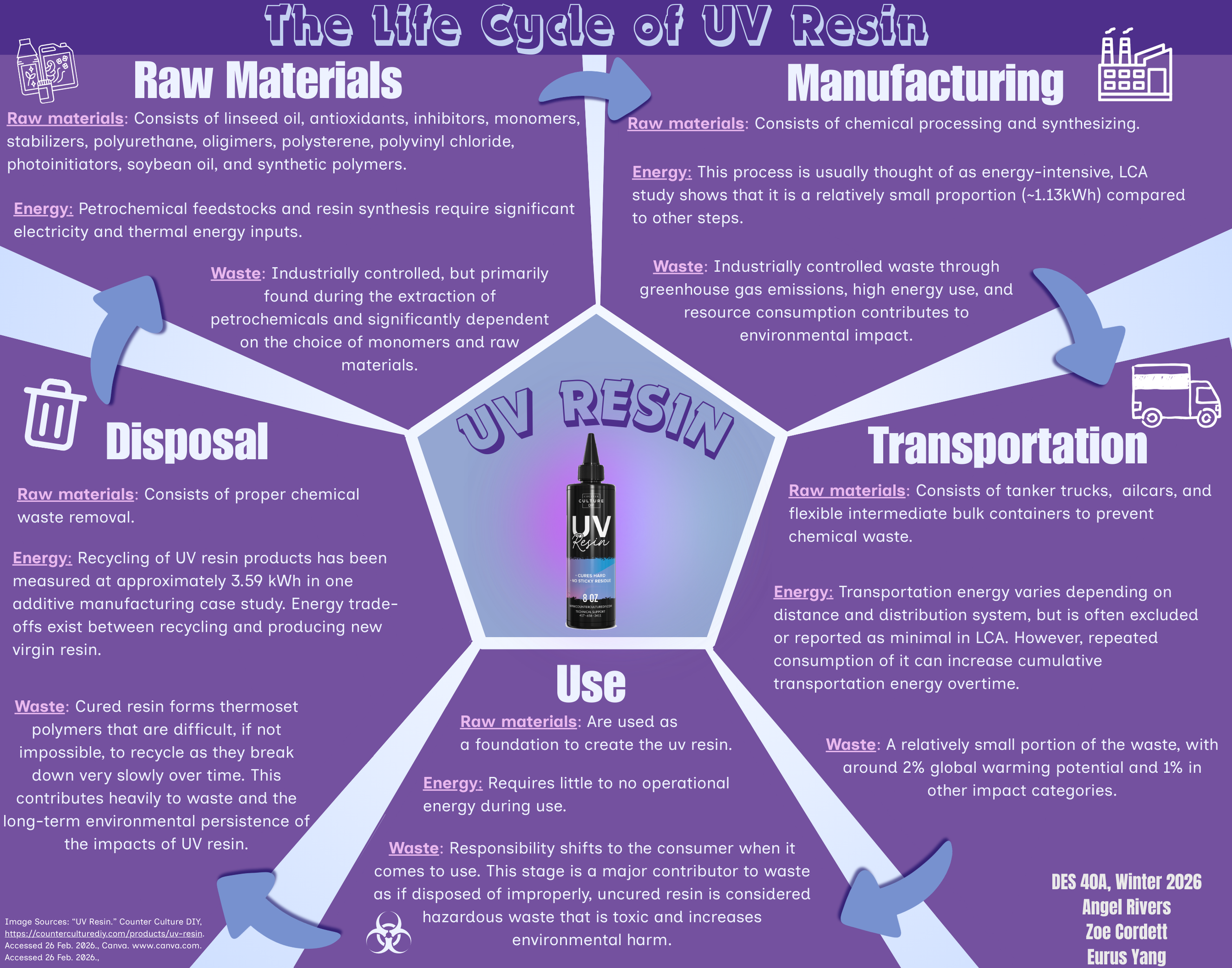
UV resin is a durable and glossy material often used for crafting, hobbies, 3D printing, coating, and repairing, which makes it perfect for casual uses as well as industrial applications. It is especially appealing compared to traditional two-part resins as it is a one-part resin and quick-curing when exposed to UV light. While these characteristics may make it appealing for a variety of applications, the life cycle of such a product is an extensive process, consisting of numerous steps that ultimately result in waste implications often disregarded. Thus, with an increasing number of people looking to use such a versatile tool, there comes an increasing risk of users not fully aware of the environmental consequences that come with its production and potentially improper disposal. This waste is an important environmental consideration that plays a role in deciding on what type of resin to use for a project. The Life Cycle Assessment is a comprehensive process that evaluates all of the raw materials, energy, and waste that is included in every stage of an object from the beginning to the end. Considering the entire life cycle of UV resin, each stage results in waste being produced with the most significant amounts of waste occurring during the use and disposal stages, as uncured resin leads to hazardous waste and cured resin forms thermoset polymers that result in long-term environmental persistence.
As the beginning stage, the raw materials acquisition for UV resin begins impacting the environment through the extraction of petrochemicals even before the resin manufacturing itself takes place. Studies show that the impacts of taking constituents and processing them to produce resin are insignificant in comparison to the impacts of producing the feedstocks themselves in the first place (Chard et al. 1). Thus, the first step of waste in the life cycle begins with the extraction of petrochemical feedstocks, not manufacturing. As an industrial process, petrochemical extraction begins with raw materials that are then converted through drilling and chemical processing that releases pollutants into the atmosphere, implying that the environmental consequences of UV resin begin much before the product itself is created. This step is also significantly influenced by the type of constituents chosen as improvements have been made to the environmental impacts of resin systems through the choice of particular monomers (Chard et al. 1). This suggests that each brand and factory's method of raw materials chosen and utilized for the creation of UV resin will change the long-term impact of it, making overall waste dependent on industrially controlled decisions. Furthermore, extraction and upstream material input production have been found to account for between 55% (smog) and 97% (GWP-100) of the potential environmental burdens (Bushi et al. 57). This numerical data and evidence explains how extraction and feedstock production majorly contribute to environmental impacts from pollution and emissions produced during this phase. However, it must be noted that this step is moderate in waste and industrially controlled which both differ from later steps in the life cycle. Once raw materials are acquired, manufacturing may begin which continues to generate controlled, industrial waste as the ingredients are processed and synthesized.
The next stage is the manufacturing and synthesis of components for the production of UV resin, resulting in additional industrial waste but still in a controlled manner. During production, significant amounts of waste are created through non-renewable sources, high energy consumption, and greenhouse gas emissions to the point of sustainability gaining attention (Shen et al. 1). Despite the lack of specific numerical data, this highlights the greater and broader environmental impacts of specifically the production of UV resin through numerous streams of waste. This refers to the industrial byproducts that are created during the production of resin components as well as the emissions generated. Additionally, UV resin chemical components also include oligomers and monomers that allow the resin to become resistant and sealed when exposed to UV rays. The chemical processing of these additives contributes to the environmental waste as monomers are primary contributors to ozone depletion and oligomers are generally petroleum-based (unless proposed bio-renewable substitutes are used) (Montazeri and Eckelman 934, 938). Although these are industrial byproducts, implying they are controlled to an extent, the actual process of manufacturing that harms the environment is a clear form of waste even if not direct. Not just the emissions during product application are critical to environmental impacts, but the manufacturing of coating components is a factor too (Montazeri and Eckelman 933). Thus, even if industrially controlled, manufacturing plays a significant role in the waste produced from manufacturing UV resin. While the production of UV resin results in more measurable energy and emissions waste, transportation and distribution contribute to the environment in a more indirect manner.
In comparison to material acquisition and production, the transportation stage produces a smaller but still measurable amount of waste. In a study, it was concluded that transportation represented about 2% of the total global warming potential of the UV resin, as well as less than 1% in most of the other environmental impact categories (Chard et al. 10) This indicates through numeric data that transportation is truly a small part of the overall waste of UV resin, yet still present. It was even proven that choosing a better raw material could reduce the environmental impact more than the location of its sourcing would increase the impact (Chard et al. 12). This indicates that focusing on sustainability in ways such as choosing less environmentally harmful materials may have a more significant impact on the environment than simply reducing the distance of transportation and distribution. Thus, transportation proves to be such a small factor of waste that it is less impactful than the choice of the material itself. Having now considered the minor impacts of transportation on waste, the use and handling of UV resin contributes substantially more to the overall waste of the life cycle.
During the use and handling of UV resin, hazardous waste is created through improper disposal and leftover resin which makes it a major contributor to the overall environmental impact. In the use phase, waste becomes much more serious as uncured resin must be treated as hazardous waste that can be toxic as it may never be poured down the drain or into regular trash (“Guideline for 3D Printer Safety”). These required procedures demonstrate the full extent to which leftover waste is considered hazardous waste, making it a significant contributor to the overall waste of the life cycle. Partially cured or uncured resin can be so hazardous that one must consider clean-up materials that contain UV curable resins as well as proper state disposal methods for chemical waste (“Proper Handling of UV Curable 3D Printing Resins”). In this way, proper disposal is left up to the consumer and user, which differs from earlier stages that were controlled industrially. Therefore, the environmental impact of how UV resin is used heavily depends on the user’s awareness and ability to follow correct procedures for disposal. For example, those using UV resin recreationally or casually may be less familiar with hazardous waste procedures and increase the probability that it is discarded incorrectly, therefore unintentionally contributing to the environmental implications of it. A safety guide for UV curable 3D printing emphasized that it is imperative consumers understand the hazards and toxicity of UV resin to the point of taking precautions such as wearing gloves and using adequate ventilation (Idacavage 13). Overall this shift from industrially controlled waste to consequences dependent on each individual consumer and their respective actions increases the risk and plausibility of harm to the environment. Understanding that the use phase generates a significant amount of waste, the recycling stage may now be considered as the longest-lasting and most persistent form of the environmental impact of UV resin.
The final stage of the life cycle is the disposal of UV resin, containing uncured resin and thermoset polymers, which act as long-term environmental impacts, despite some studies that suggest end-of-life impacts creating less waste. It’s been found that thermosetting plastics account for about 18% of global plastic production as the vast majority are buried, burned, or discharged into the ocean creating an annual global production of 65 million tons. This is due to the molecular structure of thermosetting polymers that are densely cross-linked, making it difficult to melt and break them down. (Hu et al. 1). The structure then prevents them from being traditionally recycled and therefore a setback in the complete disposal of UV resin. This consequently highlights that thermosets such as UV resin are extremely difficult to recycle and oftentimes end up in landfills which contributes even more to the overall environmental impact through serious pollution to nature. This is especially concerning as it becomes a long-term waste management issue. The degrading effects of UV radiation on construction materials and their impacts on their lifetimes have been well documented (Andrady et al. 1177). This explains how UV resins and polymer waste break down extremely slowly which demonstrates their persistence in the long run especially when it comes to environmental impact. Materials that break down slowly and degrade over long periods of time such as these imply that waste from UV resin endures in landfills or the environment as a whole depending on their method of disposal. When rigid materials like thermoset polymers begin to accumulate, long-term issues regarding pollution begin to arise. Therefore, even if it appears as though the impacts of earlier phases in the life cycle have greater immediate waste implications, the overall effects of the disposal phase may accumulate over time. This suggests that the disposal phase is, in fact, a highly consequential portion of the life cycle to the environment. Studies found that the production phases have the most detrimental effects on human health and the materials stage contributed 47.2% and 52.5% to the total harm to the ecosystem's biodiversity and resource availability (“Life Cycle Analysis of Phenolic Resins” 575). This information implies that other phases of the life cycle have greater impacts than the disposal phase. However, it is important to acknowledge that there are various viewpoints in scientific studies. Although this specific study indicates that end-of-life impacts may be less than other stages, the fact that thermoset polymers are non-recyclable remains a valid concern that only accumulates further over time. Therefore, due to the material structure and composition of UV resin it cannot be traditionally recycled which implies that it has a significant impact on the environment long-term. Thus, proper end-of-life handling is extremely important and must be a considered factor. Concluding with this stage emphasizes that every stage in the life cycle contributes to waste, but use and end-of-life disposal are the most substantial impacts.
Following the life cycle of UV resin demonstrates that every stage generates waste, with the use and disposal stages being the most significant. In sum, raw materials and manufacturing produce moderate amounts of waste that are often industrially controlled, and transportation has minimal impact. On the other hand, use has substantial impact in the form of hazardous waste and disposal has thermoset persistence that results in long-term environmental impact. Understanding the impacts of this life cycle underscores the importance of considering material selection, proper handling techniques, and environmental awareness in an attempt to minimize waste that comes from the life cycle of UV resin. As the popularity of resin increases in a broad range of settings from casual users to industries, the consideration and education on what materials are most environmentally friendly, more sustainable production processes, as well as proper methods of disposal become exponentially important.
Works Cited
Andrady, A. L., et al. “Effects of UV Radiation on Natural and Synthetic Materials.” Photochemical & Photobiological Sciences, vol. 22, no. 5, May 2023, pp. 1177–202. Springer Link, https://doi.org/10.1007/s43630-023-00377-6.
Bushi, Lindita, et al. “A Cradle-to-Gate Life Cycle Assessment of North American Wood Product Resin Systems.” Athena Report, 2022, pp. 1–93.
Chard, Jonathon M., et al. “Shades of Green: Life Cycle Assessment of a Urethane Methacrylate/Unsaturated Polyester Resin System for Composite Materials.” Sustainability, vol. 11, no. 4, Jan. 2019, p. 1001. www.mdpi.com, https://doi.org/10.3390/su11041001.
Guideline for 3D Printer Safety, UBC Safety & Risk Services, May 2025, riskmanagement.sites.olt.ubc.ca/files/2025/05/CHEM-GDL-004-Guideline-for-3D-Printer-Safety.pdf.
Hu, Yun, et al. “A Green and Sustainable Strategy for Recyclable Ultraviolet (UV)-Curable Resin from Tartaric Acid via Three Dimensional (3D) Printing to Reduce Plastic Pollution.” Journal of Cleaner Production, vol. 436, Jan. 2024, p. 140772. ScienceDirect, https://doi.org/10.1016/j.jclepro.2024.140772.
Idacavage, Mike. Working with UV Curable 3D Printing, Colorado Photopolymer Solutions, 17 May 2016, radtech.org/proceedings/2016-toc.htm.
“Life Cycle Analysis of Phenolic Resins.” Phenolic Resins, Elsevier, 2026, pp. 569–85. www.sciencedirect.com, https://doi.org/10.1016/B978-0-323-95660-4.00027-1.
Montazeri, Mahdokht, and Matthew J. Eckelman. “Life Cycle Assessment of UV-Curable Bio-Based Wood Flooring Coatings.” Journal of Cleaner Production, vol. 192, Aug. 2018, pp. 932–39. ScienceDirect, https://doi.org/10.1016/j.jclepro.2018.04.209.
Proper Handling of UV Curable 3D Printing Resins | PAMA. https://pama3d.org/proper-handling-of-uv-curable-3d-printing-resins/. Accessed 5 Feb. 2026.
Shen, Yan, et al. “Green Manufacturing Process Design for Infusible Acrylic Resin Composites: A Data-Guided Life Cycle Management Model Incorporating Material-Process-Property-Energy-Emission Relationships.” Composites Part A: Applied Science and Manufacturing, vol. 181, June 2024, p. 108146. ScienceDirect, https://doi.org/10.1016/j.compositesa.2024.108146.