Design Life-Cycle
assess.design.(don't)consume
Catarina Kenat
Professor Cogdell
DES 40A
13 March, 2026
Fire Extinguisher Life Cycle: Raw Material
Fire extinguishers are located in every building people step foot in due to regulations. Over time, fire extinguishers have evolved because of their importance. Every fire extinguisher has the same purpose: to quickly put out a fire in its early stage. To ensure this, there are five types of fire extinguishers: types A, B, C, D, and K. The difference between the types is the description of the situations in which the fire extinguisher would be used. All five types go through the same life cycle. The only difference would be the agent inside the fire extinguisher, but the most common agent is monoammonium phosphate. Fire extinguishers are not made to influence the consumer; there is no best brand. Instead, regulations ensure that all companies have similar instructions and diagrams so that no one is persuaded by branding. The goal is not to increase prices or compete between brands; it is to save people's lives. Fire extinguishers are everywhere, but they are often overlooked and rarely thought about despite their importance. This paper will discuss the chemical and physical processes of materials being produced in the life cycle of fire extinguishers. Most importantly, it will focus on the materials stage due to how it is produced, creating multiple sustainable outcomes in the end.
Raw materials for a fire extinguisher are secondary raw materials that go through a chemical process. Secondary materials are “formed when something extracted from the earth is processed in order to be converted into a new compound, substance, or form” (Cogdell, lecture 10). The raw materials in a fire extinguisher are all secondary raw materials such as rubber, PVC, aluminum alloy, steel, plastic, monoammonium phosphate, and ammonium sulfate. There are no primary raw materials used directly in the making of fire extinguishers; instead, they contain synthetic or processed materials. Primary raw materials come directly from the earth, while fire extinguishers rely on materials that have already been processed. These secondary raw materials undergo a chemical process in order to be made. The chemical process is defined as something that “changes the nature (properties) of a material through separation or extraction” (Cogdell, lecture 10). For instance, a chemical process may involve firing materials with oxygen to purify ore into metals. An example of a secondary material used in fire extinguishers is aluminum alloy. “Aluminum alloy comes from bauxite ore, which is commonly sourced from Australia, China, Brazil, and India” (Britannica Editors). The next step is melting the ore using a combination of heat and oxygen to purify it into metal. During this process, another metal such as copper may be melted with it to create an alloy. Another example of a secondary raw material is steel, which also goes through a chemical process. Steel is created from iron ore that is melted in a blast furnace with carbon to purify the material. The last example is rubber, as there are many types of synthetic rubber. The synthetic rubber used in fire extinguishers is silicone rubber because of its high heat resistance. Silicone rubber has this heat resistance “due to the Si–O bond of silicone rubber and its inorganic properties, [making it] superior to ordinary organic rubbers in terms of heat resistance” (Shah and Shit). Natural rubber is flammable but can be extracted easily, unlike silicone rubber, which requires a large amount of energy to be produced. Extracting and processing all of these materials requires significant energy and time because secondary raw materials are used.
The raw materials are manufactured and assembled into a fire extinguisher through nine main components. Each component goes through either a physical process or a chemical process. The physical process is defined as something that “changes the form (shape) of a material, usually through the application of thermal or kinetic energy” (Cogdell, lecture 10). The first component is the hose and nozzle, which are made of rubber and PVC. The hose and nozzle are a physical process due to a specific mold that they are melted into. Next are the siphon tubes, which are made of PVC and aluminum alloy. To make siphon tubes are made through the physical process since they need to be folded and shaped. The handle is made of steel. “Steel, for example, can be drawn into thin walled tubes or formed (by rolling, folding, or welding)” (Ashby, 196). Steel can therefore be formed into many shapes due to the physical process. The body, also known as the cylindrical tank, is made of aluminum alloy. The pressure gauge is made of plastic. “The pressure gauge is a small, circular gauge attached to the outside of the valve assembly to show whether or not the fire extinguisher has proper pressure to expel the agent” (Security, Koorsen Fire). The pressure gauge is made through the physical process due to a specific formation that is required creating kinetic energy. The agent inside the majority of fire extinguishers is monoammonium phosphate, a dry chemical. In the past, ammonium sulfate was commonly used as well, which is another dry chemical. The agent goes through the chemical process in order to be made. There is mostly a physical process for materials when the product is getting assembled, using secondary raw materials that have been made through the chemical process.
Safety inspections are necessary before transporting fire extinguishers to the public. The inspection is not done by a robot or machine; instead, it is completed by people. Before fire extinguishers are sent out, a person inspects them and performs tests to ensure they meet all safety requirements. “The requirements are broken down into three different sections on inspection, maintenance and testing” (O’Connor) After inspection, there is a check to ensure that there are mechanical parts of all fire extinguishers, extinguishing agent, expelling means, and physical condition. The testing is completed after and then, fire extinguishers are packaged in cardboard boxes and wrapped in plastic bags. They are shipped by ground because they can be combustible if transported by air. Fire extinguishers are important products shipped to “clients: hotel groups, chain stores and warehouses, ports and airports, fuel supply and storage networks, major industries, telecommunications data centers, banking system and government” (Urquiaga). Due to the large demand for safety from fire extinguishers they are shipped out to many different companies. “NFPA recognized a common fire problem in the early 1940s” (Gallup). The author continues by describing how this led to regulations requiring buildings, particularly restaurants, to have at least one fire extinguisher in the facility. Fire extinguishers are required to be transported to many types of locations, causing new materials to be used for the packaging and mode of transportation.
The goal in the modern era is to make mass produced products more sustainable, and companies are working toward this with fire extinguishers. When recycling fire extinguishers, they must be taken to a specific location and cannot be placed in a regular recycling bin. They also cannot simply be thrown away because they may contain chemicals that are unsafe for waste management plants. There are two options of fire extinguishers, one is a rechargeable fire extinguisher and the other is a disposable fire extinguisher. The rechargeable fire extinguisher may be refilled with the same agent as before. Eventually, the extinguisher may become rusty or develop cracks, and this is when it should be recycled. When recycling the fire extinguisher it should be taken to a fire department. “Some fire extinguishers that are still mostly sound can be recycled by any steel processing facility. Your local fire department has a way to safely release any leftover extinguisher materials that are inside before you release it for recycling and processing” (Patterson). When taken to the fire department, the extinguisher is often shipped to a fire extinguisher company. For example, the CheckFire Group has a department where extinguishers are taken apart. They remove the hose, nozzle, handle, and dry chemical agent. The remaining piece is the body, which is made of aluminum alloy and can be recycled. The hose, nozzle, and handle can either be recycled or reused in another fire extinguisher. The fire extinguisher agent monoammonium phosphate can be reused as well, but in a different situation. The agent is used as a fertilizer for agriculture purposes “The results of the present preliminary study showed that when fire extinguisher filler powder is added to acidic and alkaline soils, a significant quantity of nutrients capable of being absorbed by plants is released” (Tsigka). This study supports the idea of monoammonium phosphate in a fire extinguisher to be reused as a fertilizer instead of throwing it in the waste plant and creating a toxic environment. It is possible to reuse and recycle the materials that are a part of the fire extinguisher.
Fire extinguishers are an essential safety tool that people encounter every day, yet they are often overlooked. Despite their simple appearance, they are created through a complex life cycle that involves both chemical and physical processes. From the use of secondary raw materials such as aluminum alloy, steel, rubber, and dry chemical agents, to the manufacturing of multiple components, each step plays an important role in ensuring that fire extinguishers function properly during emergencies. Strict inspections and regulations also guarantee that the product is reliable and safe before it reaches homes, businesses, and public spaces. Additionally, the life cycle of fire extinguishers shows that sustainability is becoming an important focus in modern manufacturing. Many components can be recycled or reused, such as the aluminum body and metal parts, while the chemical agent can even be repurposed for agricultural fertilizer. These practices reduce waste and allow materials to continue being useful after the extinguisher’s original purpose has ended. Overall, fire extinguishers demonstrate how a widely used safety product can be produced, maintained, and recycled in ways that both protect human life and support more sustainable material use.
Bibliography
Ashby, M.F., Cebon, D., Materials Selection in Mechanical Design, Euromat, 1993, https://www.utc.fr/~hagegebe/UV/MQ12/CORRECTIONS_TD/%5BASHBY99%5D%20-%20Materials%20Selection%20In%20Mechanical%20Design%202Ed.pdf
Britannica Editors. "bauxite". Encyclopedia Britannica, 16 Jan. 2026, https://www.britannica.com/science/bauxite. Accessed 12 March 2026.
Christiania, Cogdell. “Lecture 10.” 12 Mar. 2026.
Gallup, James G. “Commercial Kitchen Fires: Greater Awareness and Wider Attention Needed.” Professional Safety, vol. 49, no. 8, 2004, pp. 28–31. JSTOR, http://www.jstor.org/stable/45453783. Accessed 4 Feb. 2026.
O’Connor, Brian. “Guide to Fire Extinguisher ITM: NFPA.” Nfpa.Org, 30 Oct. 2020, www.nfpa.org/news-blogs-and-articles/blogs/2020/10/30/guide-to-fire-extinguisher-itm
Patterson, Brian. “Do You Know How to Dispose of a Used Fire Extinguisher?” AAA Fire Protection Service, 30 Nov. 2018, https://www.aaafireprotection.com/index.php/2018/11/30/do-you-know-how-to-dispose-of-a-used-fire-extinguisher/. Accessed 4 Feb. 2026.
Security, Koorsen Fire &. “Get to Know Your Fire Extinguishers: Fire Extinguisher Parts & Usage.” Blog, Koorsen Fire & Security - - -, 26 Aug. 2025, blog.koorsen.com/get-to-know-your-fire-extinguishersfire-extinguisher-parts-usage
Shit, Subhas C., and Pathik Shah. “A Review on Silicone Rubber - National Academy Science Letters.” SpringerLink, Springer India, 30 July 2013, link.springer.com/article/10.1007/s40009-013-0150-2#citeas.
Tsigka, Ioanna, et al. “Investigating the Potential Use of End-of-Life Fire Extinguisher Powder as a Soil Amendment in Different Soil Types: A New Approach Following a Circular Economy Model.” MDPI, Multidisciplinary Digital Publishing Institute, 15 Oct. 2024, www.mdpi.com/2071-1050/16/20/8913.
Urquiaga, Ana Julia Acevedo, et al. “(PDF) the Recycling of Fire Extinguisher; First Step toward a Circular Economy.” IEOM Society Journals, 28 Nov. 2019, www.researchgate.net/publication/342452215_The_Recycling_of_Fire_Extinguisher_First_Step_Toward_a_Circular_Economy.
Audrey Agniel
Professor Cogdell/ Mr. Rothberg
DES 40A
13 March 2026
Where the Remnants of a Fire Extinguisher Lay
A Research Report of the Life Cycle (Waste) of a Fire Extinguisher
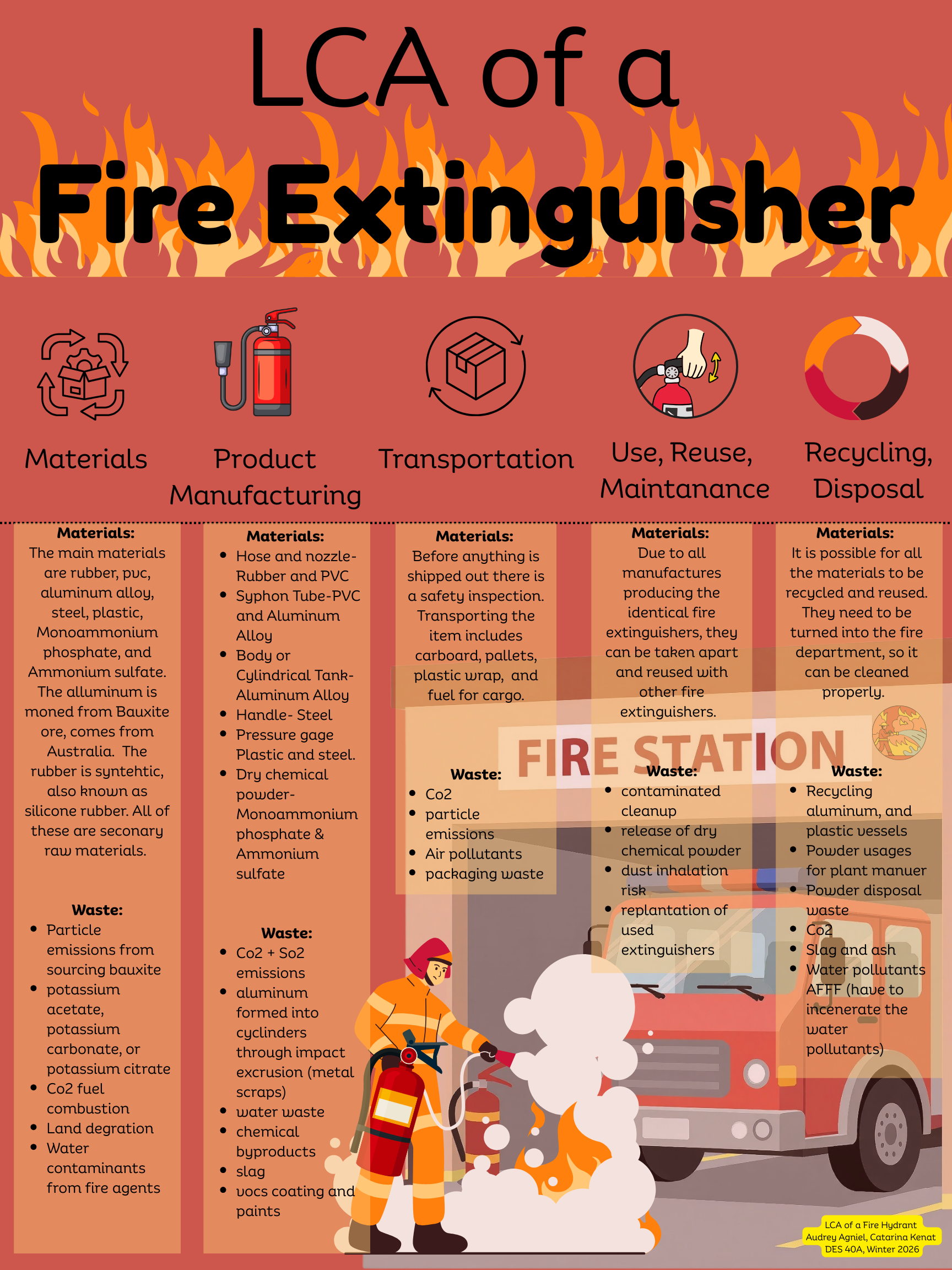
All objects natural or man made have a full lifecycle they must undergo. From the beginning of its raw materials being sourced to its end being its final disposal. Fire extinguishers were first patented in 1723 by Ambros Godfrey, a German born chemist (Ravindra, ch 31). Later in 1819 the first portable fire extinguishers were developed by Captain William Manby. This vessel was made with three gallons of pearl ash (potassium carbonate) compressed with air (Fire Safety Advice Centre, 2011). Then near the late 19th century, where the soda-acid extinguisher emerged. Followed by the 20th century fire extinguishers that incorporated different fire agents, for example, carbon tetrachloride, liquid chlorobromomethane, and methyl bromide. Though these substances proved to be highly toxic, and often lead to fatal accidents (Fire Ranger, 2019). Now in modern fire extinguishers the primary extinguishing agent is monoammonium phosphate, which is safe for humans and highly effective (Fire Safety Advice Centre, 2011). The development of fire extinguishers is evident in combating hazards and never-ending in its search for the most efficient and effective vessel. Through each new rendition that emerges, the full life cycle is enacted. From its beginning of life, to where and how it will be disposed of. The waste phase of a fire hydrant's life cycle can inflict significant environmental harm, through the leak of residual chemical agents that poison the land, though recycling alternatives have risen as a way to dispose of a fire hydrant with less damage, there is still abundant amounts of waste, from their pressurized canisters, to their plastic components, and toxic chemicals. This shows that improper disposal can contribute to hazardous waste accumulation and loss of resources unless efficacious recycling systems are implemented. Each step of a lifecycle analysis has its own set of waste, both positive and negative. Looking at a fire extinguisher, raw materials come first.
The beginning of a lifecycle for an object starts with the acquisition of its raw materials. Fire extinguishers consist of two components, its exterior shell, and the fire regents within. The shell is derived from high strength aluminum alloy sheets. Aluminum starts as bauxite ore, which is smelted and formed into cylinders using cold impact extrusion (Hehl, pg 49-112). These alloys are typically sourced from industrial aluminum suppliers in North America or China, as high-grade corrosion resistant alloys, 6061, 6351, or 7060. Next are the extinguishing agents that are carried, dry chemicals such as monoammonium phosphate, or sodium bicarbonate. As well as water for freezing resistance, foam such as aqueous film forming foam or AFFF, and lastly wet chemicals such as potassium acetate, potassium carbonate, or potassium citrate. Through the process of sourcing materials, there is still lots of waste from the beginning. To be able to source such materials, large movers are needed, which create particle emissions, and Co2 fuel combustion for larger scale source depletion. Further if materials are not made by recycled materials such as plastics, that in turn adds to the wastefield, where land degradation and sludge waste are emitted into the air (Sapargaliyeva, vol3). The two sides of fire hydrants are made and disposed of as a two body system. Their outer casing can properly be disposed of through recycling the aluminum properties and plastic parts, but the inner extinguishing components often are dumped. Phosphogypsum specifically in the Republic or Kazakhstan is stored in dumps which negatively impacts the environment and humans (Sapargaliyeva, vol3). The waste of raw material acquisition is abundant. Where scrap alloys and plastic often are dumped, and extinguishing agents are depleted, and discarded. What comes next is how the product is made through the materials that are sourced. The second step of the cycle comes forth.
Product manufacturing is one of the most taxing phases; this is where the raw materials become the final product. Usually done in large scale manufacturing plants, aluminum alloys are formed into cylindrical vessels and extinguishing components are stored inside. The bodies of the extinguishers are made from aluminum in a full seamless unit for CO2 extinguishers. This is done to ensure its capacity to hold fifty five bars of pressure on average. The process itself of molding, is called cold impact extrusion, this is where a hydraulic ram is used to press and form the aluminum slug into a hollow sheet. Then it goes through a heat treatment process to increase its strength (City Fire Protection). For water and powder based extinguishers, they are made of mild steel in a process called deep drawing. “This is where the cylinder body is deep drawn and and the base and the dome of the extinguisher are formed separately, then welded to the cylinder body” as said by the City Fire Protection Org. For the valves they are typically made from brass. Through forging which is when a hot metal forms using brass bar stock. After the forging process the valve bodies are machined to create openings and threads. Then come the dip tube and nozzles that are usually made from aluminum or plastic. The process of making a fire extinguisher is very resource heavy. Through large amounts of aluminum being used, to the creation of the minor components, very little is recycled. The production of metal is an energy intensive process where large amounts of scrap metal are produced. Further the chemical agents can have environmental consequences. Further with its large scale or demand, the production of the cylinders and charging them with gases, is an energy intensive process. Which finally ends with the painting and finishing of the cylinders in ovens, which can produce volatile organic compounds emissions. The production sequence of this phase attributes to global warming parameters (Johnson, E.P). Through CO2 emissions, water waste, airborne particles, slag, metal waste, and vocs coating and paints, many environmental and health harms arise in the making of a fire extinguisher.
Each object that is factory made must be transported and distributed for user access. When an item is finished being produced, the transportation phase is seen. For fire extinguisher distribution it is labor excessive to to the heavy, pressurized canisters, and risk of hazardous materials require special care. Fire extinguishers are classified under hazardous materials (hazmat) due to being pressurized vessels during transportation. For this reason they are required to comply with the Department of Toxic Substances control which are regulations and EPA ID tricking numbers. For transport specific requirements they are secured vertically and need to be in a vibration resistance bracket to prevent movement or accidental discharge. Further they must be kept in a dry condition away from direct sunlight and heat. Like any other form of transportation fuel and co2 emissions are seen as well as packaging waste. Both energy and waste go hand in hand for this stage. Seeing that the energy being output from vehicles, are the most waste the fire extinguishers give off in this stage. Kozhevin researches the human involvement of delivery fire extinguishers to facilities specifically through water, “ It follows that the greater the mass of the fire extinguisher the higher the intensity of physical activity on the participant is” which in turn slows transportation rates. The transportation and distribution phase is equated by its distance and emissions. Further if the extinguishers are improperly transported or disposed units risk releasing agents that can pollute air or soil. From being transported to the hands of a user, the fire extinguisher finishes another phase and is ready to be used.
The use phase of an object, focuses on how an individual uses this item, be that through reuse, or its maintenance. Studies show that in use, “boron-based fire extinguishers offer 22 percent faster suppression and cooling than the conventional approach which uses water”(Sani). This shows that during the use, a fire extinguisher has a high effective rate of water. Through stored pressure extinguishers are units that are pressurized with ninety percent nitrogen and ten percent helium through a compressor. When an extinguisher is in use the pressure discharges, along with the pressure gas. It is also noted that every time an extinguisher is used, it is noted to be immediately sent to be refiled. Even when only used once the City Fire Protection Org states it is needed to send it to get replenished no matter the scale of its use. The waste that is seen during the use process is the waste of the fire agents being used. Hazardous waste cannot be thrown in a regular trashcan, so the only way to replenish it is at a local fire department or sending it back to the initial distributor. The contaminated cleanup and release of any chemical powder can result in dust inhalation, so be advised. Though this step should always be handled with care due to its hazardous waste, and pressurized canisters.
The recycling and disposal phase is one of the most important when it comes to the end of a fire extinguisher. The way of disposing of a fire extinguisher is by taking it to a local fire department or fire protection company due to this hazardous waste. Though these companies are trying to fire alternative recycling processes. The regular outcome of disposing of fire agents is dumping which causes heavy amounts of water pollutants which deregulate soil and damage our environment. For this reason many recycling alternatives are being tested. Matthew Benfer and Emily Williams tested the effects of portable fire extinguisher agents on cultural heritage materials. This study studies how its materials will affect cultural heritage materials and ways to clean. The tests conducted evaluated variables of exposure to fire, extinguisher and materials type, and direct vs indirect sample exposure. The conclusion was none of the cleaning methods worked for all of the materials, and that damage to the samples was immediate (Benfer). This article shows how strenuous fire agents can be in our environment. Further water runoff caused by “discharges of fire extinguisher waters that contain PFAS such as aqueous film-forming foams (AFFF)” stated by Daniel Maga. Maga discusses the factors of runoffs on water pollutants. Where these substances and their metabolites show a high degree of mobility with a low degradability. For this reason they are bioaccumulative and often migrate among their environmental compartments, while being toxic. As of March 2021, when this article was released there is no suitable end of life treatment for extinguishers that are both technologically and cost efficient for handling PFAS. At this time the collective method was to temperature above 1100 C for the disposal of PFAS to degrade materials compounds. Though this method consumes large amounts of energy since it requires incineration of large quantities of water to dilute a smaller fraction of PFAS. Some studies have tried to combat this notion. Ionna Tsigka conducted an experiment on plant soil in 2024, since fire agent waste is high in nitrogen and phosphorus, it is possible to be used as a fertilizer or soil amendment. This experiment was carried out with two leafy vegetables as bio markers, one being acidic and one alkaline. Then filler powder from used extinguishers were added to the soil samples. The results found that the addition caused no toxicity in either plant. The early signs of testing seem to appear encouraging due to the high, root length, and chlorophyll content increased and total antioxidant capacity enhanced. There have been ways made to recycle fire agents in a positive way though experiments are still new. Though there is progress, most agents are still detrimental to our environment and need proper care. For the outer vessel most of the metals and plastics are highly recyclable due to them being made out of steel, aluminum and plastic. The end of a fire extinguishes life, and has many outcomes. Studies have brought forth the recycling proposal of many of its agents, while some see their disposal as only harmful to our environment.
The lifecycle assessment of a fire extinguisher is a dual vessel/ agent item that is extremely hazardous but helpful. The evolution of the fire hydrant has gone through many forms, where its effectiveness also increases, though its end of life disposal is always difficult. Like many other products, their raw materials, and processing phases are the same. Where bauxite ore is sourced then melted into aluminum alloys to be able to create the vessel. Then where production comes in is the assembly through cold impact extrusion, and the additives of paint, copper nozzles, and labels. Then the fire agents are pressurized inside the canisters and are ready to be shipped. The transportation phase is like many others in the sense of energy and carbon emissions, where extinguishers differ in the packaging of them. Lastly, ending with its disposal many studies have tried to come up with positive ways to recycle its properties, but with water pollutants and its extremely hazardous agents/ waste, it is difficult to do. As of now all fire extinguishers must be given to a nearby fire department where they will properly be disposed of. Showing that improper disposal can contribute to hazardous waste accumulation and loss of resources. In my role as the waste position in the LCA, I was able to research possible recycling outcomes, and detriments. By doing so I would say they are not completely sustainable. The outer casing of aluminum can definitely be recycled but the interior fire agents pose to be environmentally harmful, and contribute to water pollutants. All together fire extinguishers were interesting to research since they are in our daily lives, but progress does need to be made in their end of life disposal.
Bibliography
Amaker, Tyler, et al. “Evolution of Fire Extinguishers.” Science Technology and
Society a Student Led Exploration, 29 July 2020, opentextbooks.clemson.edu/sciencetechnologyandsociety/chapter/evolution-of-fire-extinguishers/.
Amos, Mary. “User-Centered Design of a Portable Fire Extinguisher.” Sage Journals, 30 May 2017, journals.sagepub.com/doi/abs/10.1177/02614294231170265.
Benfer, Matthew, and Emily Williams. “Assessing the Impact of Fire Extinguisher Agents on Cultural Resource Materials - Fire Technology.” SpringerLink, Springer US, 17 Nov. 2017, link.springer.com/article/10.1007/s10694-017-0684-9.
Johnson, E. P., et al. “Fire Extinguishers: A Case Study of CFC Replacements - The International Journal of Life Cycle Assessment.” SpringerLink, Ecomed, Sept. 1992, link.springer.com/article/10.1007/BF02978805.
Kozhevin, Dmitry F., et al. “Determination of Human Movement Parameters When Delivering Fire Extinguishers to the Fire Centre at Water Transport Facilities.” Fire Safety, journals.rcsi.science/2411-3778/article/view/308620. Accessed 13 Mar. 2026.
Kyle. “How Is a Fire Extinguisher Made? (Manufacturing Process): City Fire Protection.” City Fire, 20 Nov. 2024, www.cityfire.co.uk/news/how-is-a-fire-extinguisher-made/.
Maga, Daniel, et al. Environmental Assessment of Various End‐of‐life Pathways for Treating Per‐ and Polyfluoroalkyl Substances in Spent Fire‐extinguishing Waters | Environmental Toxicology and Chemistry | Oxford Academic, 15 June 2020, academic.oup.com/etc/article/40/3/947/7734426.
Sani, Sadiku Aminu. “Fire Extinguisher Types and Applications.” TMP Universal Journal of Research and Review Archives, 28 Nov. 2023, tmp.twistingmemoirs.com/index.php/ujrra/article/view/56.
Sapargaliyeva, B, et al. “ENVIRONMENTAL DISPOSAL OF LARGE-TONNAGE INDUSTRIAL WASTE FOR THE PRODUCTION OF FIRE EXTINGUISHING POWDERS.” REPORTS OF THE NATIONAL ACADEMY OF SCIENCES OF THE REPUBLIC OF KAZAKHSTAN, vol. 3, no. 2224–5227, Mar. 2019, pp. 325–230, https://doi.org/10.32014/2020.2518-1483.000.
Tsigka, Ioanna, et al. “Investigating the Potential Use of End-of-Life Fire Extinguisher Powder as a Soil Amendment in Different Soil Types: A New Approach Following a Circular Economy Model.” MDPI, Multidisciplinary Digital Publishing Institute, 15 Oct. 2024, www.mdpi.com/2071-1050/16/20/8913.