Design Life-Cycle
assess.design.(don't)consume
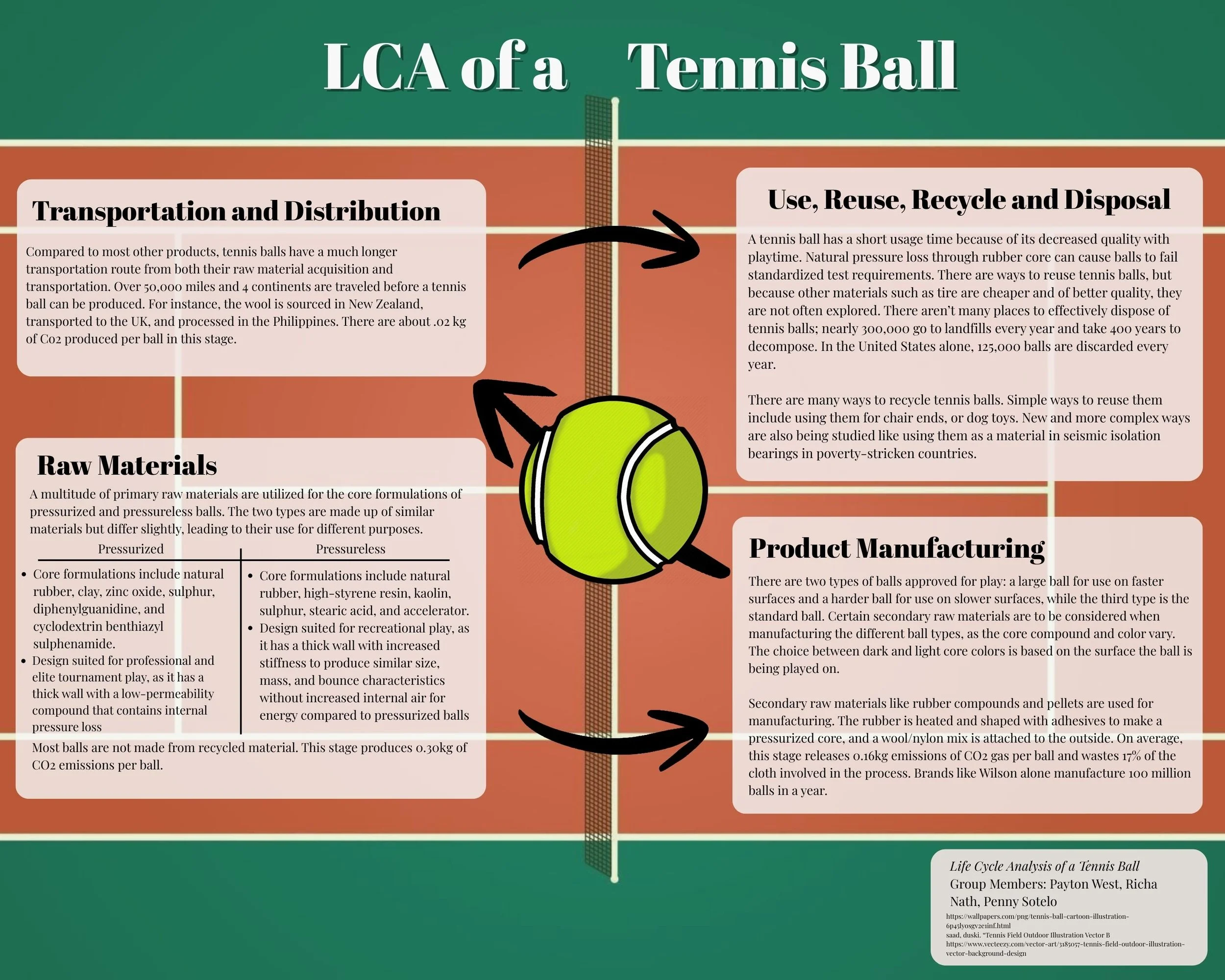
Penny Sotelo
DES 040A
Professor Cogdell
13 March 2026
Tennis Ball Lifecycle: Materials
Tennis balls originated in the fourteenth century and evolved through several developments, including the discovery of vulcanized rubber, the addition of felt covering, and a color shift. Although tennis balls rely on chemical components and physical properties, most of these materials are non-biodegradable and contribute negatively to the environment. Within the life cycle of a tennis ball, specific primary and secondary raw materials, such as natural rubber and cloth pieces, are utilized at different stages of production, ultimately forming the final product. While the types and amounts of materials used can be wasteful, more sustainable alternatives exist.
A multitude of primary raw materials are in the “raw materials acquisition” stage of the life cycle, which can be switched to more sustainable options. Tennis balls can be classified as pressurized or pressureless. Tennis balls were originally only “pressurized”, but later “pressureless balls” were introduced to increase the life of tennis balls. Each type has its own characteristics, and players have their own preferences for its use. Both types have a ball core composed of “natural rubber and other ingredients to form a specific mixed compound capable of withstanding the stresses of the game” (Steele, Degradation 4). Natural rubber is a core foundation, allowing for consistent bounce and elasticity. The two types of balls are made of similar materials but differ slightly, leading to different purposes. To distinguish between the two, the core formulation for pressurized balls is “100 parts by weight natural rubber, 30 pbw ‘general purpose furnace (GPF) black (a reinforcing filler), 30 pbw clay, 32 zinc oxide, 3.5 pbw sulphur, 2 pbw diphenylguanidine (DPG) (an accelerator for the curative system), and 1 pbw cyclodextrin benthiazyl sulphenamide (HBS) (also an accelerator)” (Sissler, Viscoelastic 7). GPF black is used as a reinforcing filler in the rubber core to increase the ball’s durability and tear strength. Clay functions as a filler in the rubber, helping control density and stiffness. Zinc oxide acts as a curing activator in the vulcanization process of the ball’s core to increase durability and resilience. Sulphur forms a bond between rubber polymer chains that improves durability and resistance. The DPG and HBS accelerator is for the vulcanization process of the rubber compound, ensuring the rubber cures properly and consistently. Pressureless balls' core formulation consists of “100 pbw natural rubber, 30 pbw high-styrene resin, 20 pbw kaolin, 2.5 pbw sulphur, 2 pbw stearic acid, and 1 pbw accelerator” (Sissler, Viscoelastic 7). Most materials for pressureless balls are used for the rubber internal core. High-styrene resin within the core increases hardness and stiffness. Kaolin creates a barrier to maintain the internal ball core, while stearic acid is a curing agent that enhances the tear resistance of the core. The materials mentioned are transferred to the second stage for processing into secondary raw materials.
The primary raw materials from stage one are turned into secondary raw materials for product manufacturing. In the first step, individual pellets are weighed and measured before being “placed into an automatic mould, and half-shells are formed under controlled pressure and temperature” (Sissler, Advanced 8). Controlling pressure and temperature is important because the rubber must undergo vulcanization, which transforms natural rubber into a more durable material. After the excess rubber has been removed, an “adhesive solution of natural rubber is applied to the edges of the half-shells” (Sissler, Advanced 8), and they are then placed into an automated press. The process allows the half-shells to create a uniform structure, preventing the ball from splitting under impact. Once the cores are pressurized, they are “buffed and coated with a uniform layer of rubber solution in preparation for application of the cloth” (Sissler, Advanced 8). Buffing and coating are essential to allow a strong bond between the rubber and cloth, extending the ball’s lifespan. In terms of a primary to secondary raw material process, the woven cloth is made of wool fibers combined with nylon fibers in a sateen weave. Other balls made from needle felt are composed of entangled synthetic fibers punched through a woven layer, which is not ideal for performance and sustainability. Then, dumbbell pieces of cloth are cut out from the cloth on the bias to “ensure minimum distortion of the cloth once applied to the cores” (Sissler, Advanced 8). Ensuring minimum distortion is essential to maintain the structural integrity and quality of the ball. Finally, through a steaming process, the cloth is raised to make it fluffy and then stamped with logos before being sealed in pressurized cans (Sissler, Advanced 8). The raised fibers are an important element for air resistance and control during play. To further build on the manufacturing process, specific guidelines should be followed.
Standardized testing ranges are enforced, including size, mass, bounce height, core color, and wall thickness. There is one of the three types of balls that is considered a standard ball, which is classified as “Type II”. The other two types are approved for play: a harder ball, classified as “Type I”, for use on slower surfaces and a large ball, Type III, for use on faster surfaces (Steele, Degradation 5). This suggests that there are specified factors to be considered when manufacturing a ball, especially for the surface on which the ball is being played. To compare differences, the ball diameter ranges are 65.41 mm to 68.58 mm for Type I, 65.41 mm to 68.58 mm for Type II, and 69.85 mm to 73.02 mm for Type III (Steele, Degradation 5). The amount of raw materials differs depending on the ball type. All ball types must have a “mass between 56.0 and 59.4g and a rebound height between 134.62 and 147.32cm when dropped from a height of 254cm” (Steele, Degradation 5). The purpose of manufacturing the pressurized core compound varies, resulting in different core colors. Black cores have “higher carbon contents than the lighter ones, and are used on clay courts” (Sissler, Advanced 6). Certain secondary raw materials, specifically color, are to be considered when manufacturing different ball types. Moreover, a pressurized ball has a “wall thickness of approximately 3mm, formed with a high-density, low-permeability compound to contain internal pressure” (Steele, Degradation 4). The design suggests a natural pressure loss suited for better playing performance in professional play, such as elite tournaments. By contrast, a longer life span is possible through the manufacture of a “thicker wall with increased stiffness to produce similar size, mass, and bounce characteristics without the aid of increased internal air for energy storage” (Steele, Degradation 5). The pressureless ball lessens the need to make more balls, as this type lasts longer for players. This suggests that the ball is well-suited for recreational play. Once the balls are manufactured, they are packaged and transported.
The transportation and distribution of tennis balls can be unsustainable, but there are alternatives to consider. Wimbledon, an annual tennis tournament, uses many balls that travel thousands of miles. Within the Wimbledon tennis ball production “mile journey”, raw materials are transported from multiple countries before arriving at the final destination. For example, clay from the United States travels 8,710 miles, wool from New Zealand travels 11,815 miles, and chemical components such as sulphur and silica are transported from several Asian countries (“The 50,000 Mile Journey). After these materials are transported, Bataan in the Philippines handles the production. Tins for packaging material are transported from Indonesia (1,710), and finally, the fully produced tennis balls travel 6,660 miles to Wimbledon (“The 50,000 Mile Journey”). The total journey is approximately 50,570 miles. The amount of mileage that the materials and balls cover through transportation is very unusual for a product. High mileage has a detrimental impact on the environment, contributing to greenhouse gas emissions and the carbon footprint of the product. Not to mention, the number of countries involved in this transportation creates a complex supply chain that faces quality control issues, as different countries may have varying standards. Long-distance transportation is prone to high shipping costs, increased lead times, and delays. After experiencing this long journey, the company “managed to keep the supply chain relatively short, and centered around the Philippines” (“The 50,000 Mile Journey). The solution presented is especially helpful because it lowers the environmental impact and logistical complications. I researched for more general information that is not only dedicated to Wimbledon, but I was unsuccessful in finding those sources. I also tried to find more sustainable ways to transport tennis balls, but there was not much information. After transportation, the usage and maintenance of tennis balls determine their life span.
Within the “use, reuse, maintenance” stage, fewer amounts of materials are utilized, but there are many factors that play into the tennis ball’s life span. Material and structural characteristics are key components that influence the ball's performance. Rubber is influential as “rubbers with lower permeability to air tend to be less resilient” (Steele, Degradation 19). This is important because this type of rubber would affect the quality of the ball’s bounce and durability. Therefore, using a different type of rubber is more sustainable and creates less wasteful tennis balls. Moreover, the two materials of wool and nylon fibre mix found in tennis ball cloth are desirable for the cloth’s performance. Wool creates a desired extensive surface texture under strain, while nylon adds increased strength and durability. The impact of the ball onto the surface can create damage, so having these appropriate material properties prevents a shorter ball life span. When the fabric begins to wear, “small fibers begin to protrude from the surface” (Steele, Improved 20) and continue to break into smaller fibers, which create a “fuzzy” appearance on the fabric. The amount of fuzziness affects the ball aerodynamics. While some fuzz is essential for the ball’s drag and spin control, excessive fuzz causes the ball to travel more slowly and reduces consistency during play. A process with specific measurements can further show the ball maintenance.
The natural ageing process of a ball can be shown through control characteristics, such as bounce (cm), forward compression (mm), return compression (mm), and pressure (kPa). The bounce for a new ball is 138.54 cm, for a one-week ball is 135.93 cm, for a one-month ball is 133.27 cm, and for a three-month ball is 132.61 cm (Steele, Degradation 119). The results show a slight decrease in centimeters. Ideally, a tennis ball should not rebound less than 135 cm, so after the one-month range, the ball is not desirable. Forward compression measures the stiffness and resistance of the rubber core after being subjected to force. The forward compression for a new ball is 0.240 mm, for a one-week ball is 0.237 mm, for a one-month ball is 0.253 mm, and for a three-month ball is 0.254 mm (Steele, Degradation 119). A low value indicates a stiffer ball, while a high value indicates a softer ball. Return compression measures the ball’s elasticity and how well it recovers its original shape after being compressed. The return compression for a new ball is 0.323 mm, for a one-week ball is 0.322 mm, for a one-month ball is 0.345 mm, and for a three-month ball is 0.360 mm (Steele, Degradation 119). A low value indicates a slower and softer performance, requiring less force. A high value indicates a faster and firmer performance, requiring a more powerful force. The results show a steady increase in the measurements, and the ball becomes less firm over time. In other words, the ball’s ability to recover its original shape lessens. The internal pressure for a new ball is 137.10 kPa, for a one-week ball is 136.56 kPa, for a one-month ball is 122.25 kPa, and for a three-month ball is 118.34 kPa (Steele, Degradation 119). The results show that pressure decreases slightly over one week, then decreases significantly after one month, and then after three months. This reduction in internal pressure leads to a decrease in the ball’s ability to rebound. An internal pressure close to 137 kPa is important for preserving the ball’s life span. I was not able to find out whether the balls in this natural ageing study were classified as “pressurized” or “pressureless”, which would be important because these two types present different control characteristics. Once the ball encounters the inadequate measurements, it reaches the stage of “recycling and disposal”.
Tennis balls produce large amounts of waste, but there are sustainable practices in the “recycling and disposal” stage of the life cycle. Each year, around 320 million new tennis balls are used worldwide. This amount of balls is “estimated to produce approximately 21,000 metric tons of waste from the balls” (Aybar 1). The indicated waste is severely detrimental to the environment, especially annually. Not to mention, when manufacturing the tennis balls, “the amount of cloth that is wasted is around 17%” (Sissler, Advanced 8). However, there are opportunities to use this waste to create new products. For instance, companies “recover [the waste] to produce flip-flops; for energy valorization to make new sustainable sports products, as filaments for use in 3D printing or as recycled material in the construction of new tennis courts or horse footing” (Aybar 2). This shows that it is possible to reuse tennis balls for other purposes instead of contributing to environmental waste. Finding ways to reuse materials reduces the environmental impact of tennis balls while extending the life of materials for other products.
The life cycle of a tennis involves several raw materials that are processed into secondary materials to produce the final product. Processing and manufacturing these materials negatively contribute to the environment, but there are alternatives to lessen the impact. It is important to find more ways to increase the life span and use more sustainable materials.
Bibliography
Aybar, Marta Rodríguez, et al. "Physical-mechanical properties of new recycled materials with additions of padel-tennis ball waste." Journal of Cleaner Production 413 (2023): 137392.
Ball Manufacture, www.itftennis.com/media/2167/balls-ball-manufacture.pdf. Accessed 5 Feb. 2026.
“How Are Tennis Balls Made? Step-by-Step.” Elite Tennis Coaching, elitetenniscoaching.com/how-are-tennis-balls-made-step-by-step/#:~:text=Each%20tennis%20ball%20comprises%20two%20rubber%20hemispheres%2C,joined%20later%20to%20form%20one%20sealed%20ball. Accessed 5 Feb. 2026.
Marconcini Bittar, Helena and de Aguiar Hugo, Andreza and de Nadae, Jeniffer and da Silva Lima, Renato, The Circular Economy of Tennis Balls: A Multi-Methods Analysis. Available at SSRN: https://ssrn.com/abstract=4415013 or http://dx.doi.org/10.2139/ssrn.4415013
Shull, Madison. What Is a Tennis Ball Made of? The Materials behind Every Bounce | Tennis Express, tennisexpress.com/blogs/news/what-is-a-tennis-ball-made-of-the-materials-behind-every-bounce. Accessed 5 Feb. 2026.
Sissler, Lise (2012). Advanced modelling and design of a tennis ball. Loughborough University. Thesis. https://hdl.handle.net/2134/10073
Sissler, Lise, et al. "Viscoelastic modelling of tennis ball properties." IOP conference series: materials science and engineering. Vol. 10. No. 1. IOP Publishing, 2010.
Steele, Carolyn (2006). Tennis ball degradation. Loughborough University. Thesis. https://hdl.handle.net/2134/10763
Steele, C., Jones, R., & Leaney, P. (2008). Improved tennis ball design: incorporating mechanical and psychological influences. Journal of Engineering Design, 19(3), 269–284. https://doi.org/10.1080/09544820701328127
Rolling, Tracy. The Ultimate Guide to Tennis Balls, www.midwestracquetsports.com/blog-ultimate-guide-to-tennis-balls/a/tennisballguide/. Accessed 5 Feb. 2026.
The 50,000 mile journey of Wimbledon's tennis balls. “The 50,000 Mile Journey of Wimbledon’s
Tennis Balls.” Warwick Business School, 2018,
www.wbs.ac.uk/news/the-50-000-mile-journey-of-wimbledon-s-tennis-balls/. Accessed 10 Mar. 2026.
Richa Nath
DES 040A
Christina Cogdell
13 March 2026
Tennis Ball Life Cycle: Embodied Energy
Tennis is an extremely popular sport internationally, but little thought goes into it by the general population about the production, energy usage, and waste of the materials put into it, even as the world tries to shift towards sustainable thinking. This paper will examine the energy used to create, use, and dispose of a tennis ball during its lifespan by determining which factors are the biggest contributors and where improvements towards sustainability can be made, such as in reduction of raw materials acquisition, reduced waste packaging, and in more sustainable reuse methods. In the life cycle of a tennis ball, the most energy intensive stages are raw materials acquisition and product manufacturing, and to a lesser extent the disposal stage, all of which can be made less intensive with alternative production and waste practices.
The materials acquisition stage of the ball’s life cycle requires the most energy out of any. The main raw materials acquired for the production of a ball are synthetic rubber, wool, and clay, as well as various metals and chemicals for performance. The wool is primarily sourced in New Zealand, the clay from the United States, and the rubber from Thailand and Southeast Asia, where the balls are also often produced (Mustard). Most materials used are not biodegradable, and some are especially harmful to the environment such as nylon (“All About No Waste”). Materials are often not sourced where they are used for production (like the wool), and not near where the products are shipped for use. Additionally, most material acquisition is not of reusable material but of raw material. These factors all add up to intense energy use only to extract materials out of the globe, adding up to around 0.25 kilograms of CO₂ emissions per ball for this stage (“Renewaballs”). All of these points can be less impactful with reused materials, such as recycled wool or alternatives to rubber (“Renewaballs”). This stage precedes production and transportation of the good, which additionally uses lots of energy that can similarly be reduced by different acquisition practices.
Alternative methods of raw material acquisition exist, though some do not directly reduce emissions in this stage, but ensure that overall waste and environmental impact is reduced so that less energy is used in other stages. The brand Renewaball creates tennis balls from previously recycled tennis balls, creating a 29% reduction in carbon footprint over a lifespan (“Renewaballs”). They take the felt and rubber components separately out of used balls and use those to form around 30% of a ‘Renewaball’. Although the raw materials stage of a Renewaball also is energy-intensive, it greatly reduces the energy used in the end-of-life stage which leads to less material extraction once the cycle is restarted (“Renewaballs”). However, although this is an effective solution, due to stringent quality requirements during production of the ball, most manufacturers have been resistant to adopting alternative materials, and balls can be difficult to recycle due to the kind of adhesive used (“All About No Waste”).
The production of a ball employs many transformations which use mechanical, electrical, and chemical energy from humans and automated machines (Mustard). By heating, the rubber is turned into a “slug” which will become half-domes to shape the core; this uses a significant amount of power per shell, though standard exact numbers are not available. Then, some balls are pressurized and others are not, depending on level of play. They are then buffed and given adhesive. Onto the adhesive goes two pieces of dog bone-shaped felt, which can only be dyed a few specific colors. The balls are then “fluffed” in a giant vat, where they are collectively steamed to ensure a certain felt thickness. The felt texture is crucial for the performance of the ball and the main component noticed in ball degradation (Steele iii). Finally, a label is heat-applied, and the balls are put in a pressurized can. Many of these steps involve intense heating or cooling for several minutes at a time for “curing” which use significant amounts of energy per ball, though exact figures are not available (“Ball Manufacture”). Additionally, balls which are not satisfactory to the manufacturer get discarded. This can be because of incorrect feel or failure of randomized performance tests (Steele 49). Because there must be a specific feel to the “fuzziness” of the felt and high expectations for individual ball performance (Steele iii), this can lead to many balls being discarded, adding to waste and increasing the amount of energy used per ball sold. On average, there are approximately 0.15 kilograms of CO₂ emissions per ball during this stage (“Renewaballs”), and over 300 million balls get produced every year, adding up to a significant amount of energy use and waste (Lane et al 185). Human labor and energy is also a big factor in determining how balls get produced; companies like Slazenger have shifted location of production as recently as 25 years ago so that labor costs are cheaper for them, owing to its importance (“The 50,000 mile journey of Wimbledon’s tennis balls”).
The next stage of the life cycle is transportation and distribution, involving an extremely long and wide supply chain. This begins before manufacturing, with transportation of raw materials. Some materials such as wool (from New Zealand) have to travel long distances to their manufacturing location (usually in Southeast Asia). Other materials like rubber are sourced more locally to the factory. For the company Slazenger, which produces balls in the Philippines, clay is shipped over 8,000 miles from the US, wool over 11,000 miles from New Zealand (which is then shipped to the UK to be made into felt weaving), and silica from Greece (“50,000 mile journey”). Other raw materials are sourced closer, in Southeast Asia. Because ball production is mostly centralized in Southeast Asia but balls are used all over the world, transportation is extensive to help the product reach customers. For instance, the Slazenger process precedes packaging in Indonesia, and possibly an additional 6,000 miles of travel to London for Wimbledon and other customers in the other hemisphere (“50,000”). Additionally, Slazenger’s production, although internationally sourced, is considered one of the more localized productions in the industry as many of their materials still come from countries near the Philippines or the Philippines itself, which is unusual (“50,000”). Of course, the main reason why such supply chain practices are still done is for cost-effectiveness (“50,000”), though some companies are experimenting with more sustainable practices even at the expense of cost (“Renewaballs”). Though the environmental impact of this stage is comparatively low per ball (“Renewaballs”), the fact that production is not local for most consumers contributes to additional energy used for transportation that could be reduced.
During the use stage, not much additional energy is required besides human energy to play with the ball, but the short length of this stage leads to the biggest reason for excessive energy usage in production: high consumption and the resulting waste, and additional production to supplement that consumption and waste. This stage is often extremely short, especially in professional play - during the 2015 US Open, 98,000 balls were produced by Wilson for a total of 508 matches, averaging 192 balls per match (Clemmons). The Grand Slam advises balls to be changed after only seven games (although this number in practice is much higher for recreational play) (Steele 2). Tennis balls are easily discarded due to player perception of feel or due to degradation which can be superficially minor but might greatly affect performance; often player perception of degradation exceeds the real degradation, especially due to differences in ball texture and fuzziness, and not aided by the fact that each player has individual specific preferences, shortening the use life span even more (Steele iii). This adds to waste and therefore requires more energy for additional production. Some solutions have been created, such as Wilson’s non-pressurized tennis balls invented in 2019 that last up to four times longer than a ball with a pressurized core (“All About No Waste”). However, these are yet to become industry standard.
Currently the standard practice for tennis ball end-of-life is simple disposal into a landfill, or incineration, the latter of which especially uses energy and creates excessive emissions. A ball on average contributes 0.10 kilograms of CO₂ emissions in this stage (“Renewaballs”). Approximately 21,000 tons of metric waste are created by tennis ball disposal each year (Aybar et al 1). Because so many balls go to waste so quickly, production adds up, and the cycle repeats and compounds. Some alternative uses for recycling have been proposed: the aforementioned Renewaballs reuse tennis balls into tennis balls themselves (“Renewaballs”). The American company RecycleBalls collects tennis ball waste and partners with events like the US Open to repurpose the rubber and felt into other products, like toys or court surfaces (“All About No Waste”). Research conducted for the Journal of Cleaner Production in 2025 looked at the feasibility of using tennis ball waste in recycled material as an alternative to plaster (which could reduce both material waste and emissions), finding that it was indeed a workable alternative, especially for specific products like plaster panels (Aybar et al 1). Other research for the Journal of Environmental Management found that tennis balls could be used as inert bulking agents in soil to aid in the aeration of composting piles, greatly reducing energy consumption and greenhouse gas emissions, though there were concerns with contamination of the soil by the ball material (Aviñó-Calero et al 8). Most alternatives are young or flawed (for instance, the Renewaball cannot use more than 30% recycled material due to performance failures past that number), and have not been widely adopted.
Due to their popularity, tennis balls use excessive amounts of energy owing to the fact that the margins for performance and quality accepted by consumers are thin, and the status quo for production is perceived as difficult to budge from. Especially in the raw materials acquisition, production, and end-of-life stages, efforts can be made to reduce energy usage in service of a greener and more sustainable future. Though adoption of such efforts is currently slow, increasing demand and research is being given to making this industry more sustainable, and the industry may follow what will hopefully be a greater trend in the world of moving away from energy overconsumption.
Bibliography
Aviñó-Calero, Juan, et al. "Addition discarded tennis balls as an inert bulking agent to olive mill waste and pig slurry during composting reduces the energy consumption related to ventilation and the generation of anaerobic gases." Journal of Environmental Management 395 (2025): 127905. https://www.sciencedirect.com/science/article/pii/S0301479725038812
Aybar, Marta Rodríguez, et al. "Physical-mechanical properties of new recycled materials with additions of padel-tennis ball waste." Journal of Cleaner Production 413 (2023): 137392. https://www.sciencedirect.com/science/article/pii/S0959652623015500.
Ball Manufacture. International Tennis Federation, 2019. International Tennis Federation, www.itftennis.com/media/2167/balls-ball-manufacture.pdf.
Clemmons, Anna. "Inside Wilson's Tennis Ball Factory." ESPN. Originally published in ESPN The Magazine, 26 Aug. 2015. https://www.espn.com/tennis/story/_/id/13518288/the-making-us-open-tennis-balls-wilson.
Lane, Ben, et al. Characterisation of ball degradation in professional tennis. International Sports Engineering Association, 14 Feb. 2017. https://link.springer.com/article/10.1007/s12283-017-0228-z .
Mustard, Amanda. "New Balls, Please." New York Times, 2 Sept. 2016. https://www.nytimes.com/2016/09/04/sports/tennis/wilson-tennis-balls-made.html.
"Renewaballs have a 29% lower environmental footprint than regular tennis balls: this is how it." Ecochain, 12 Jan. 2026, ecochain.com/customers/renewaball-the-first-circular-tennis-ball/. Accessed 5 Feb. 2026.
Sissler, Lise. Advanced modelling and design of a tennis ball. Diss. Loughborough University, 2012.
Steele, Carolyn. Tennis ball degradation. Diss. Loughborough University, 2006. https://repository.lboro.ac.uk/articles/thesis/Tennis_ball_degradation/9527618
"Tennis Ball Recycling." All About No Waste at Stanford, Stanford, waste.stanford.edu/impact-projects/tennis-ball-recycling. Accessed 5 Feb. 2026.
Wang, DongPo, et al. "Experimental study on physical model of waste tennis ball-sand composite shed cushion under rockfall impact." Bulletin of Engineering Geology and the Environment 81.5 (2022): 193.
"What's the carbon footprint of a tennis ball?" Arbor, www.arbor.eco/carbon-footprint/tennis-ball. Accessed 5 Feb. 2026.
Payton West
Christina Cogdell
DES 40
Mar 13, 2026
LCA of a Tennis Ball: Waste
A tennis ball is something used often in everyday life. It is used for PE in schools, playing fetch with your dogs, and of course for the sport itself. However, we seldom think about what happens after we use them. After taking this class and researching more about the life cycle of a tennis ball, I’ve gained startleing knowledge about where exactly a tennis ball goes and the amount of waste they produce. The life cycle of a tennis ball produces a significant amount of waste in the form of excess materials in production, pollution from extensive manufacturing and transportation, and improper disposal methods. However, there are viable ways to reuse and recycle that offer practical solutions to reduce these impacts.
Due to concerns involving a tennis ball's performance quality, many of the materials used to make them are freshly extracted which is extremely wasteful. To make a tennis ball, there are many raw materials involved, such as rubber, clay, sulphur, resin, and zinc oxide (Sizzler 2012). To extract raw materials from the earth, machines powered by fossil fuels are necessary. This means that to extract all of these materials there is a constant output of CO2. While I couldn’t find an exact figure for the carbon footprint surrounding the extraction of the raw materials, I found a source that confirms it is less than .10kg out of an average of about .3 kg of CO2 per ball (Arbor). In order to make balls that are “up to a standard”, most tennis balls are made of natural rubber. This is because newly extracted rubber is the best way to ensure that it has the right bounce and firm structure (Steele, 2006) . However, extracting this rubber is leading to deforestation in the Amazon (CBS News 2023). Extracting rubber for every new tennis ball is an extremely wasteful process and isn’t a sustainable method for the environment or production.
The production process of a tennis ball outputs the most CO2 out of any stage, as well as wastes extra materials not utilized in the making of the balls. After transporting all of the materials to the production facility it is time to assemble the balls. The main emissions from a tennis ball come from manufacturing and material production, particularly the rubber and felt components. Its carbon footprint averages around 0.30 kg CO2e per ball (Arbor). To add to this point, every year 360 million tennis balls are manufactured (Lane et al 2017) which means that roughly 108 million kgs of CO2 are emitted annually from tennis ball production alone. In the big picture it might not be a lot, but the number is in no way small. Another factor to consider in the production process is the physical waste. During the manufacturing process about 17% of the felt used to wrap the tennis balls is wasted along with the rubber used to make the outer shell of the ball (Aybar 2023). So, not only does the production and manufacturing process cause the most gaseous waste, it also contributes physical waste in the form of unused materials. The second highest contributing factor in CO2 is transportation.
The transportation of raw materials and the completed tennis ball is one of the longest journeys taken by any product. This is because the raw materials are all being transported from different parts of the world so that a “quality” product can be made. The transportation stage emits CO2 from the fossil fuels used to power the shipping methods, however compared to the output from production and manufacturing stages, it contributes a smaller, but still meaningful percentage (I couldn't find an exact percentage, but it's inferred from the above statistics). To complete the whole tennis ball, materials must travel 50,000 miles and go through 4 different continents before being manufactured in the Philippines (WBS, 2018). The scale of the transportation of the elements that compose the tennis ball is quite frankly Mark Johnson, Professor of Operations Management said, “One of the longest journeys I have seen for a product” (WBS, 2018). To accurately demonstrate this statement, they provide a graph of the transportation route of all the different raw and secondary materials used to make a tennis ball. According to the below image (Table 1), wool has the longest transportation distance. The wool must be transported from New Zealand to the UK, where it is made into the felt that composes the outer layer of the tennis ball. It will then be sent all the way to the Philippines for the rest of the manufacturing process and shipped off to another part of the world. Overall this cycle seems redundant in nature and is the reason why the transportation of a tennis ball is so extensive. Unfortunately, once a tennis ball reaches its destination and gets put into play, its use time doesn’t make up for these losses.
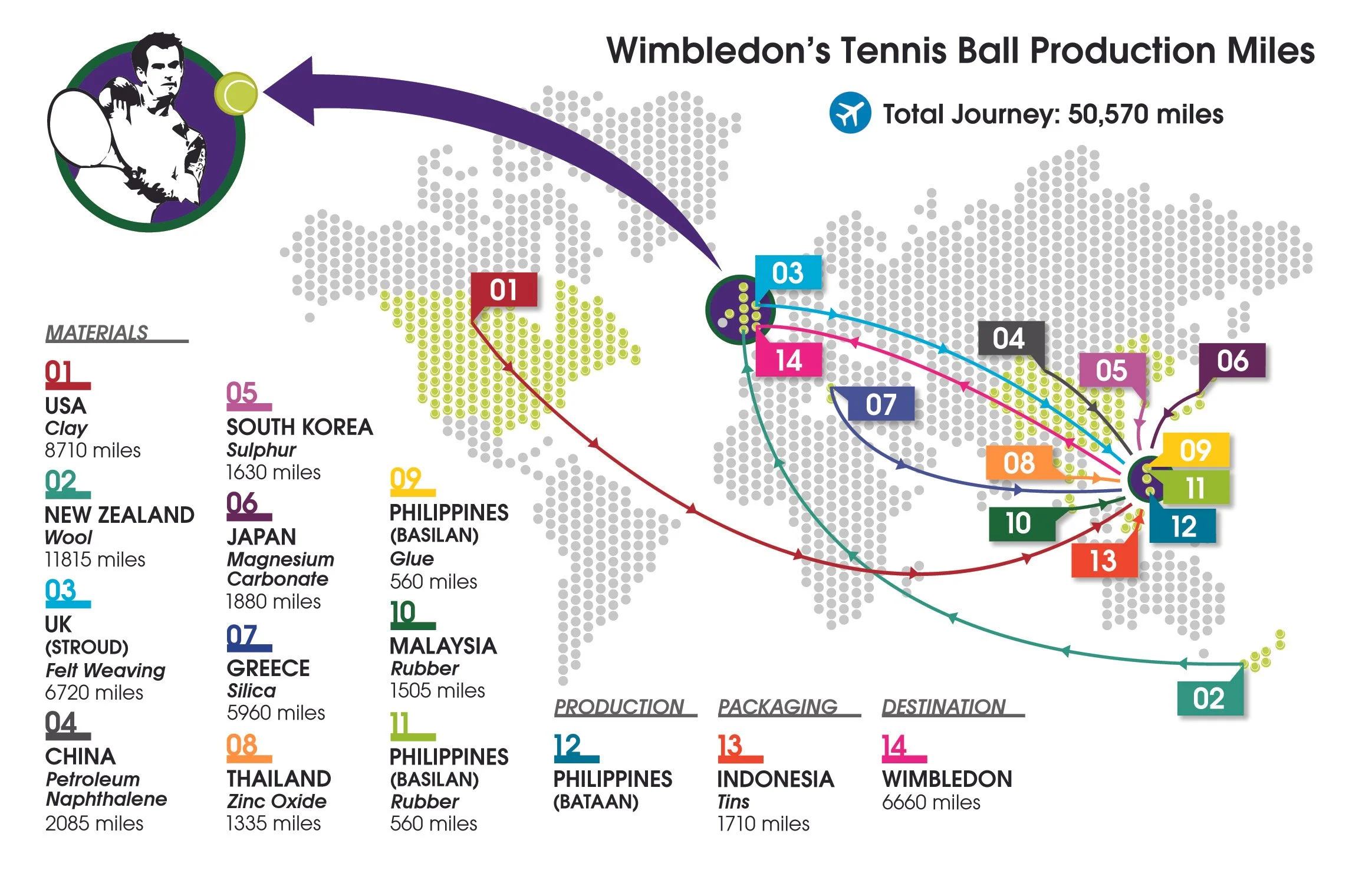
Table 1
A tennis ball's use period is very short and not many proper disposal systems exist that allow them to be recycled, it is this aspect of the life cycle that contributes the most physical waste. A tennis ball can only be used for a finite amount of time and unfortunately there is no form of maintenance you can take to ensure that they last longer. The only guide for how long a tennis ball can be used for is when there are noticeable drops in its physical quality. Things like increased fuzziness from the felt and decreased durability of the core (less bounce) are usually the common signs that a tennis ball is no longer fit for play (Steele, 2006). This time can vary depending on the purpose of play, but a singular Grand Slam event like Flushing Meadows, goes through nearly 100,000 balls (CBS news). Assuming this statistic is true, nearly ⅓ of all the disposed tennis balls come from this singular tournament. When considering how to dispose of a tennis ball, many issues arise. For starters, there aren’t many viable means of disposal. Because tennis balls have an adhesive that keeps the felt firmly on the surface, they require a separate disposal system if they are to be recycled. There is also a cost factor in establishing and running a separate system for the felt removal. Due to these reasons about 99% of tennis balls are thrown away every year. This produces 21000 metric tons of waste (Aybar 2023), the equivalent of filling the Empire State building up to the 62nd floor (Marconcini 2023).The major problem with that, is the fact that a singular tennis ball will take 400 years to decompose on its own (Recycle Balls 2022). This not only means that tennis balls accumulate at a startling rate with no quick means of decomposition, but it also means they will stay in landfills for a long period of time. This would damage the environment and potentially injure animals. Thankfully however, there are many ways to recycle tennis balls.
There are many ways to recycle a tennis ball, but cost and better alternative options make it difficult to incentivise their use. As previously mentioned, it takes money and effort to prepare tennis balls for recycling. Because of this extra cost and effort, it is difficult to incentivize the recycling of tennis balls, especially when tires are an easier alternative. Tires provide a better material because of their tougher makeup, quantity and cheapness. Most of the projects that involve recycling used rubber are dominated by tires because of its cheap repurposing cost and built in metal support fibers (Wang, DongPo, et al. 2022). However, there are some simple ways being used to repurpose them. Some companies are taking used tennis balls and actually recycling them into tennis balls again. The process involves removing the outer layering and shredding the rubber to repurpose it into a new ball. However, projects like this are few and far between. Another popular use for tennis balls is simply using them as chair, table, or walker endings. This is a fast and simple method that requires no bigger system. It is something people can do at home or in classrooms. Even though it requires extra effort, it is important that we find ways to recycle and reuse these materials so that most of them don't end up in landfills. There are also new and experimental uses for these excess materials that are being researched.
New experimental studies are being conducted as to the possible large-scale reuse methods of tennis balls. One way being studied to reuse tennis balls is to use them as seismic isolation bearings. A study conducted by Katamakas et al. (2021) showed that tennis balls can make a cheaper and effective alternative to isolation bearings in poverty-stricken countries. They would use recycled tennis balls and fill them with mortar and put them between layers of houses. The balls proved they could take a significant amount of stress comparable to those of typical isolation bearings. Unfortunately, because of weight issues, they have not been proven effective for structures of larger sizes, but for small houses they are an effective alternative. This project in particular was momentous in a couple of ways. For one, the cost per ball is only $0.05 compared to the typical 10,000 dollar cost of normal bearings. There is only one way that the ball isolation bearings would cost more than that, and that would be to use 200,000 balls on a single house. The study doesn't say how many balls are used per house, but from the planning images shown there basically a 0% chance of that happening. This is a huge innovation because one of the main problems with recycling tennis balls is the cost. This counters that notion. It uses the tennis balls effectively while also making them the preferred and more cost effective alternative. The project itself also has the potential to have global impacts. “No viable solution towards the mass-scale re-use and sustainable management of this large number of tennis balls has been proposed so far.” (Katsamakas et al. 2021). So not only is it a viable method cost-wise, but it also has the potential to reduce tennis ball waste by a significant amount.
Another method of reuse/upcycling is from the Recycle Balls website. Recycle Balls (2022) highlights their project in Vermont that takes used tennis balls and turns them into other materials. Unlike the previous example, the “Green Gold” operation removes the felt from the ball and uses the “processed natural crumb rubber obtained through the grinding and separation of recycled tennis balls”. This material is used to make a variety of products. These include, but are not limited to, tennis courts, turf, sidewalk material, and one coat stucco replacement. Tennis courts made from recycled tennis balls aren't just better for waste management, but they also use up to 10,000 balls per court and have been proven to absorb shock better than normal courts (Recycle balls 2022). When taking into consideration that tennis is the world's 4th most played sport with nearly 87 million players around the world (Marconcini 2023), the potential these courts hold as a possible recycle method is vast. The one-coat stucco is an alternative form of recycling presented by Recycle Balls. It is half the price of normal stucco, lasts a long time, and doesn't crack. This is important because it also shows a better alternative to a commonly used product that uses recycled materials, and at a lower cost. The main sentiment of the article is that there are many cost-effective ways to upcycle and reuse tennis balls that provide better alternatives to existing products. If we want to reduce the waste produced by tennis balls, then we need projects like this to reuse the waste produced by disposed tennis balls.
There is a large amount of waste produced by tennis balls every year both physically and in the form of gas and environmental impact. The unsustainable methods of raw material acquisition contribute to deforestation. The gaseous emissions from fossil fuel use in production and transportation stage create a significant amount of CO2. And the physical waste produced due to improper methods of disposal reaches into the hundreds of thousands every year. Fortunately, there are proven and experimental methods being implemented that use the materials from discarded tennis balls and make them into things like courts, turf and structural supports. It is these projects that must be supported if the waste produced by tennis balls is to be reduced.
References
Arbor. What’s the Carbon Footprint of a Tennis Ball? Accessed March 12, 2026. https://www.arbor.eco/carbon-footprint/tennis-ball
Aybar, Marta Rodríguez, et al. "Physical-mechanical properties of new recycled materials with additions of padel-tennis ball waste." Journal of Cleaner Production 413 (2023): 137392.
CBS News. “Ecological Impact of Tennis Balls Is out of Bounds, Environmentalists Say - CBS News.” Www.cbsnews.com, 6 Sept. 2023, www.cbsnews.com/news/tennis-balls-ecological-impact-sustainability-problem/.
Katsamakas, Antonios A., et al. "Feasibility study on re-using tennis balls as seismic isolation
bearings." Frontiers in Built Environment 7 (2021): 768303.
Lane, Ben, et al. "Characterisation of ball degradation events in professional tennis." Sports Engineering 20.3 (2017): 185-197.
Marconcini Bittar, Helena and de Aguiar Hugo, Andreza and de Nadae, Jeniffer and da Silva Lima, Renato, The Circular Economy of Tennis Balls: A Multi-Methods Analysis. (2023) Available at SSRN: https://ssrn.com/abstract=4415013 or http://dx.doi.org/10.2139/ssrn.4415013
Miller S. (2016). Yellow, Fuzzy and Flat: Where Do Recycled Tennis Balls Go?The New York
Times. Available at:
https://www.nytimes.com/2016/09/11/sports/tennis/yellow-fuzzy-and-flat-where-do-recycled-tennis-balls-go.html (Accessed March 11, 2026).
Sissler, Lise (2012). Advanced modelling and design of a tennis ball. Loughborough University. Thesis. https://hdl.handle.net/2134/10073
Steele, Carolyn (2006). Tennis ball degradation. Loughborough University. Thesis. https://hdl.handle.net/2134/10763
The 50,000 mile journey of Wimbledon's tennis balls. “The 50,000 Mile Journey of
Wimbledon’s Tennis Balls.” Warwick Business School, 2018,
www.wbs.ac.uk/news/the-50-000-mile-journey-of-wimbledon-s-tennis-balls/.
“TO RECYCLE and REUSE ALL TENNIS BALLS.” Recycleballs.org, 2022, www.recycleballs.org/solution/.
Wang, DongPo, et al. "Experimental study on physical model of waste tennis ball-sand composite shed cushion under rockfall impact." Bulletin of Engineering Geology and the Environment 81.5 (2022): 193.