Design Life-Cycle
assess.design.(don't)consume
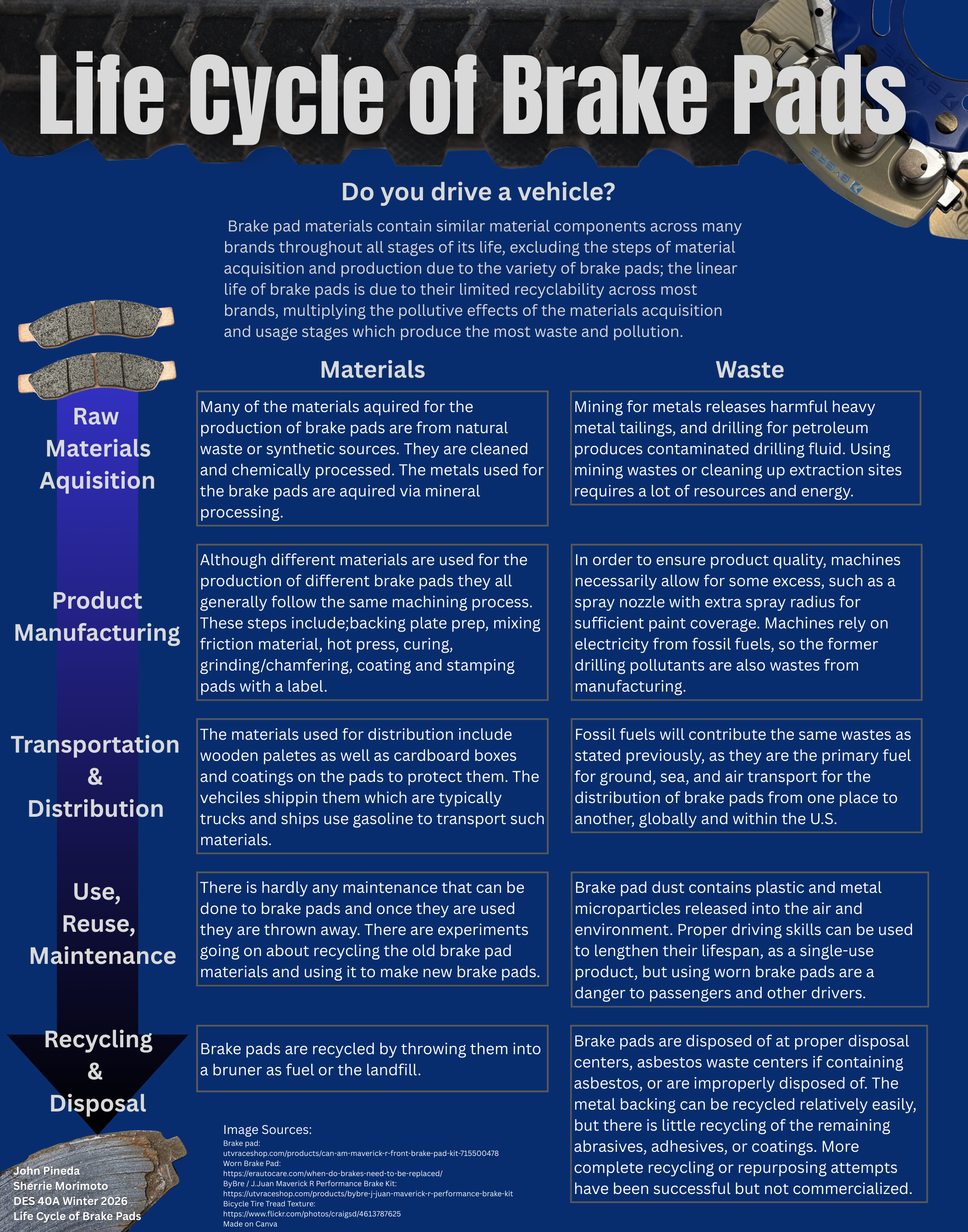
Poster for LCA of Brake Pads
John A. Pineda
Professor Cogdell
DES 040A
27 February 2026
Materials
Brake pads are a common maintenance practice for all vehicle owners and their importance lies in giving the vehicle the ability to stop safely. The brake pads achieve this by turning kinetic energy into thermal energy through friction between the pad and rotor. They have been around for over a century and become a billion dollar market and yet they are constantly being researched in ways to improve them. That is because there is not just one way to make them and their life cycle shows that. The life of brake pads is a long process that starts with obtaining the materials to produce the brake pads and ends when they are disposed of as waste. Throughout their life cycle the materials used for brake pads tend to be similar with the exception of their production process.
The composition of brake pads are unique to every manufacturer although they share some common materials. With over 2,000 materials being used by manufacturers a brake pad consists of about 10-20 of them. (Borawski, 2020) This means that there exists a plentitude of brake pad formulas each containing different materials and having different properties. All these materials are categorized in 4 sections based on their functions; abrasives, filler, binder, and reinforcement. The Binder is a resin that keeps all of the brake pad materials together and their characteristics unchanged. It is characterized by a high coefficient of friction and resistance to high temperature changes. Reinforcement materials serve to increase strength and durability and are usually fibers like aramid or ceramic particles. Fillers like their name suggests fill the empty spaces between the other materials while improving brake pad friction and durability. Agyowu (2020) , a engineering faculty at ATBU University, Nigeria explains that the most common filler used in the automotive industry was asbestos. Its high heat resistance and low manufacturing cost made it the ideal choice but due to its carcinogenic nature it is being replaced with many natural fibers. Common fillers now used in brake pads are vermiculite, calcium carbonate, and barium sulfate. Abrasives are used to improve the coefficient of friction between the brake pad and disc as well as to give the brake pad longevity. Lubricants are also used to aid in the removal of heat from the brake pad and disc interacting so that the pad material does not lose its structure. Common abrasives are silicates, steel, and quartz. Common lubricants are metallic sulphates and graphite. (Borawski, 2020) Although brake pads may differ in the types of materials used, they all serve common purposes and some materials are widely used. According to Borawski brake pad materials can also be categorized as natural and artificial. He explains that natural materials are metals or materials derived from plants and animals. As described by Borawski artificial materials include ceramics, organic synthesized materials, and synthetic materials. To add to all these categories of brake pad materials there also exist different types of brake pads for specific purposes.
There are four types of brake pads each with its advantages and purposes. Borawski (2020) states that the abrasive is the main component of brake pads and determines the type of brake pad it is. Bridgestone (2026) a tire manufacturing company explains the advantages of all four types of brake pads. They say organic brake pads are the most common and affordable but have the shortest longevity and are not ideal for high temperature braking. They explain that organic brake pads are asbestos free and are made of fibers and resins. In contrast they state that semi-metallic and metallic brakes are made of mostly or entirely metals and are associated with great braking performance, medium cost, and loud noise. They describe ceramic brake pads as being made from ceramics and having high costs, good breaking power, and low noise. Each of these brake pads are made of different materials to serve different purposes. Despite their different purposes brake pad manufacturers look for the same qualities when testing out different material formulations. These qualities include a high coefficient of friction, hydrophobic properties, environmental friendliness, wear, stopping strength, and noise. (Egeonu, 2015) Since there are thousands of materials available for producing brake pads it can be assumed that testing of different combinations of materials will continue for the future. It can also be acknowledged that with the abundant resources available for brake pads it is impossible to write about all of them in less than 7 pages.
Since there is an abundance of material combinations for brake pads the process of acquiring these materials differs greatly for each brake pad manufacturer. Most materials in brake pads are either mined or produced in factories. The mined materials are metals like copper and iron which undergo a mineral processing where they are crushed into fine powders. Other materials like resins and fibers are either synthetically processed or chemically treated from natural waste. All these materials are combined because they each provide characteristics that make the pad work properly. (Sensitive Brake, 2024) Since there are thousands of brake pad materials the process of how each one is acquired cannot be described.
Despite the endless information on brake pad materials the machining of brake pads, packing and shipping them is very similar across manufacturers. Remsa (2023) a national brake manufacturer describes the machining process in 7 steps. The first step is the mixing process where all the materials are mixed together to form a homogenous mixture. Following is the hot press where the materials are pressed together melting the resins and allowing them to bind with other materials.This takes multiple cycles and allows for a decrease in volume. The curing process hardens the pads by placing them in the oven. The scorching process gives the brake pads its friction properties. Then the machining process gives the brake pads the right thickness. Following it is the installation of accessories and packaging. This packaging process is further explained by Frontech (2024) a manufacturer of brake pads. They state that the brake pads produced are packed in cardboard boxes into pallets and shipped via trucks or ships. (Frontech 2024) Although the production process of brake pads may be similar, Browaski (2020) says that the production technology of each manufacturer is “the best kept trade secret.” (para. 9) This means that each manufacturer has their own technology to produce brake pads and does not release this information to the public. This explains the lack of information available about the production of brake pads.
The information available is also limited and minimal for the maintenance and disposal of brake pads. As of now there is little maintenance that can be done to brake pads and ways are being researched to recycle them. The only maintenance to brake pads that can be done is cleaning them, braking softer, and constantly checking their wear. (Kalinichenko, 2025) After the brake pad is replaced it is sent as waste to be burned releasing CO2into the atmosphere. A group of engineers in Sweden recently tested the recyclability of brake pads and found interesting results. They processed the friction material from used brake pads and used it to create new brake pads resulting in similar tribological properties and reduced CO2 emissions. (Lyu et. al, 2020) Apart from these experiments the recycling of brake pads is still a work in process.
In conclusion the life cycle of brake pads is very complex because of the many materials that can be used. These materials are either mined or produced in factories and combined in different ways to try and improve their tribological properties. While the process for making brake pads may be similar across manufacturers the technology used to produce them is kept secret. When the pads reach the end of their life span they are burned as waste although research shows the recycling of them may be possible in the future. Overall, the life cycle of brake pads is a long process that has a lot of potential to be studied and improved.
Works Cited
Ayogwu, Danladi Ozokwere, Ibrahim Saidu Sintali, and Mohammed Ahmed Bawa. “A Review on Brake Pad Materials and Methods of Production.”
Composite Materials, vol. 4, no. 1, 2020, pp. 8–14. https://www.researchgate.net/profile/Ibrahim-Saidu-Sintali/publication/370130329_A_Review_o n_Brake_Pad_Materials_and_Methods_of_Production_A_Review_on_Brake_Pad_Materials_an d_Methods_of_Production/links/6441060d39aa471a524eb920/A-Review-on-Brake-Pad-Material s-and-Methods-of-Production-A-Review-on-Brake-Pad-Materials-and-Methods-of-Production.pdf.
Borawski, Andrzej. “Conventional and Unconventional Materials Used in the Production of Brake Pads – Review.” Science and Engineering of
Composite Materials, vol. 27, no. 1, 2020, pp. 374–396. https://doi.org/10.1515/secm-2020-0041.
Bridgestone. “Ceramic vs. Metallic Brake Pads: What’s the Difference?” Bridgestone Tires, 2026, https://tires.bridgestone.com/en-us/learn/tire-
maintenance/ceramic-vs-metallic-brake-pads.
Egeonu, Darlington, C. Oluah, and P. Okolo. “Production of Eco-Friendly Brake Pad Using Raw Materials Sourced Locally in Nsukka.” Journal of
Energy Technologies and Policy, vol. 5, no. 11, 2015, pp. 47–54. https://www.researchgate.net/profile/Darlington-Egeonu/publication/286927474_Producton_of_ Eco-Friendly_Brake_Pad_Using_Raw_Materials_Sourced_Locally_In_Nsukka/links/56703b8f08ae5252e6f1d701/Production-of-Eco-Friendly-Brake-Pad-Using-Raw-Materials-Sourced-Locall y-In-Nsukka.pdf.
Frontech. “The Supply Chain of Brake Pads Manufacturers Explained.” Frontech, 14 Oct. 2024, www.frontech.com/a-the-supply-chain-of-brake-
pads-manufacturers-explained.html.
Kalinichenko, Oly. “The Ultimate Guide to Brake Pads: Types, Maintenance, and Replacement.” Tate Boys, 14 July 2025,
www.tateboys.com/blog/the-ultimate-guide-to-brake-pads-types-maintenance-and-replacement.
Lyu, Yezhe, et al. “Recycling of Worn Out Brake Pads—Impact on Tribology and Environment.” Scientific Reports, vol. 10, no. 1, 2020.
Rajaei, Hosein, et al. “Investigation on the Recyclability Potential of Vehicular Brake Pads.” Results in Materials, vol. 8, 2020, article 100161.
https://www.sciencedirect.com/science/article/pii/S2590048X20301035.
Remsa. “Fundamental Steps in the Manufacture of Brake Pads.” FMG Brakes, 23 Feb. 2023, www.fmgbrakes.com/remsa/how-are-brake-pads-
produced/.
Sensitive Brake. “What Is the Raw Material for Brake Pads?” Sensitive Brake, 6 Dec. 2024, sensitivebrake.com/what-is-the-raw-material-for-brake-
pads/.
Silva, Andre. “How Is the Brake Pad Manufacturing Process Done Step by Step?” Alibaba, 26 Jan. 2026, carinterior.alibaba.com/question/brake-
pad-manufacturing-process-explained.
Spring Works Auto. “Different Types of Brake Pads.” Spring Works Auto, https://springworksauto.com/blogs/auto-truck-trailer-repair/different-
types-of-brake-pads-santa-r osa-ca.
Suspension Setups. “Brake Pad Compounds Explained.” Suspension Setups, https://suspensionsetups.com/garage/brake-pad-compounds-
explained/.
Sherrie Morimoto
Prof. Codgell, Elieza Delaney-Lewis
DES 40A A03
13 March 2026
Wastes and Pollutants from the Life Cycle Analysis of Brake Pads
From the automobile boom of the twentieth century to the development of alternative fuel cars, it is evident that the United States has grown reliant on cars as an accessible mode of transportation, with 91.7% of households owning cars in 2022 (Valentine 2026). Regardless of whether the vehicle is a sedan, SUV, or truck, one of the many parts that are always present and necessary are the brake systems. Braking systems are a crucial part of safe transportation, with antilock braking systems from the 1960’s and brake disc innovations contributing to the improved efficiency and control of the vehicle. In particular, the brake pad has seen lots of development through the variety of brake pads, which grow with increasing research and development into new materials or to accommodate new car models and strengths. The basic function of the brake pad is to provide a replaceable yet durable source of friction which converts the kinetic energy of the rotating wheel into thermal energy, or heat (Borawski 2020). As a crucial part of all vehicles, and consequently the lives of those who are influenced by their vehicles, it is imperative to analyze the sustainability of brake pad production by conducting a Life-Cycle Analysis (LCA) of the brake pad. An LCA covers the five stages of raw material acquisition, product manufacturing, product distribution, product use and maintenance, and product recycling and disposal in order to dissect the individual components of materials used, energy consumed and waste produced in each stage. The main topic to be discussed will be research into the types of waste produced within the life cycle of brake pads, followed by their anthropocentric and environmental effects. Brake pads produce pollution in both stages of acquiring raw materials and their use in vehicles, producing mining tailings and toxic microparticles respectively; the net environmental impact, however, should also be evaluated by accounting for the lack of an established recycling stage which necessarily perpetuates the former stages of manufacturing, thus multiplying the negative environmental impact.
A Life-Cycle Analysis can be used to evaluate the sustainability of brake pad wastes by first knowing about the materials and energy inputs and their positive and negative effects. Brake pads have a relatively linear life cycle starting with the extraction of metals, minerals, and oil via mining and drilling, for the binders like plastic resin, abrasives of metals and other composites, fillers, and reinforcements like aramids (Ayogwu 2020, Borawski 2020, Cieślak 2025). This stage uses heavy machinery which often requires fossil fuels to power the extraction and distribution of resources from the ground to the factory. The manufacturing process uses electricity, derived from fossil fuels, or fossil fuels themselves to power factories. After the factory process uses excess materials used to ensure quality during the production process, the brake pads are shipped in trucks or other fossil-fuel dependent modes of transportation. When used, there are no inputs but there is the production of brake dust, and when worn down enough, they are thrown away or partially recycled.
Though the process produces wastes at each step, the raw materials stage in particular has high pollutive effects throughout the entire process of extraction, mainly as wastes which result from mining for metals and drilling for oil. Mining is necessary to extract new sources of minerals like iron for cast iron and steel, brass, titanium, barite, graphite, and aluminosilicates (Borawski 2020). Metals are crucial to the performance of metallic and semi-metallic brake pads, as they are not only used to create the back plate on which the friction material is glued to, but also in the binder as a metal matrix composite and as an abrasive factor (Ayogwu 2020). However, the direct wastes from mining include tailings from milling and processing, as well as water used in water-based extraction processes. Acid mine drainage, which is contaminated water that can result naturally or from mining, can seep into surface bodies of water as well as groundwater at higher rates than natural if mining occurs (Lottermoser, 2014). The issue with tailings, which is essentially sludge-water laden with high traces of heavy metals, is that it needs to be stored for a long period of time, taking up large volumes of space and requiring secure construction, even freezing the water to avoid leaching. Tailings don’t always end up in a storage area, though, and can be found pouring into streams, killing most wildlife which depends on it. If leakage from a tailing dam or storage unit occurs, more acid mine drainage will leach toxic metals into water (Lottermoser, 2014). If the concentration of metals like lead, arsenic, and cadmium are high in the water, it not only forces communities to intensively purify their groundwater before drinking, but entire fields of agricultural crops or fishing grounds may have to be cut off due to the metals making their way into the consumed products.
Similarly, drilling is necessary to acquire fossil fuels, which are not only components of plastics like resins and aramids, but also the energy source for machinery operating the extraction and processing of ores. Of the different drilling fluids used to extract petroleum from the drill site, oil-based drilling fluids are most toxic but highly efficient, containing carcinogenic barium, chromium, and mercury, as well as other polycyclic aromatic hydrocarbons containing toxic fluorine and naphthalene, the latter of which is a fumigant. Chemically, many of the toxins in oil-based drilling fluids are still dangerous in solid forms, challenging the industry to find safe sequestration methods of spent fluids (Njuguna 2022). Any worker in both mining and drilling face the danger of health problems simply by being exposed to the work environment. Synthetic drilling fluids, which have been found to be less dangerous than oil-based drilling fluids, would still require over three years to finally begin recovery after stopping leakage into a benthic environment, implying the result of an oil-based leak could wreak much more harm on ocean life (Neff 2000). Though the levels of toxic chemicals may be of relatively low concentration within one animal, consuming several of these animals can result in the bioaccumulation of toxins that have the potential to directly damage the nervous system in addition to being carcinogenic.
The waste which results from the usage stage is different from that of the raw material acquisition stage due to the fact that the product, the brake pad itself, becomes the waste in the form of brake pad dust. Brake pad dust is composed of microparticles of the friction material, which is a blend of metals, ceramics, plastics, or organic materials (Borawski 2020). The brake pad dust which results is inherently unavoidable due to the fact the mechanism requires the brake pad, rather than the tire, to be damaged in order to stop the vehicle. It is possible that with proper driving and braking technique that the brake pad may last longer, but it is not possible to extend the use of the product beyond what is specified as this may result in danger or accidents. Though the brake pads must produce dust to function properly, it should be noted that the dust is not in any way negligible in terms of environmental and human health. The individuals most prone to danger are the users of the brake pads themselves: drivers and passengers. Copper, a metal which can be found in brake pads, was found to have caused the most lung inflammation out of the tested brake pad types (Parkin 2025). Despite being both asbestos-free and copper-free, another study using iron-based semi-metallic brake pads also had results showing lung inflammation, cardiac changes, even fibrosis, after four weeks of exposure (Zhou 2025). Aside from the microparticles being airborne, they can also wash down streets into waterways and persist for long periods of time due to the strong structure of plastic resin, once again causing harm to aquatic systems and polluting groundwater (Geylin 2019).
While considering the relative amounts of waste which are produced in each stage of the LCA of brake pads, it is important to take a step back and account for the effects of having a linear life cycle due to the lack of recycling on the total wastes which are produced in the industry of brake pad production. LCAs should be able to identify product linearity if a product lacks the ability to be reused, repaired, or recycled, resulting in a life starting as materials and ending in the landfill; the converse of linearity being circularity in which the used product can be reused, repaired, or recycled. Circularity mimics the natural cyclical nature of matter, such as water, nitrogen, and carbon cycles, resulting in high sustainability for production of the product. Two major hindrances to the full recyclability of brake pads can be found in the chemical composition of the friction material. The first is the fact that the waste which results from brake pad dust is lost as airborne particles, and can’t be reintroduced into the life cycle; the second is that the chemical structure of the friction material isn’t easily recycled. While the metal backing of the brake pads is easy to recycle as a solid piece of metal, the paint which sticks to its surface is rarely converted back into liquid paint, the adhesives which bind the friction material to the plate can’t be separated from the friction material to become pure adhesives, and the friction material contains binders like phenol or epoxy resins which are thermoset plastics that do not melt back into their original form (Borawski 2020). It is also important to note that banned materials such as asbestos or copper must be identified and sorted out of any recycling attempts, since they are not allowed to be in brake pads above a miniscule amount (Department of Toxic Substances Control, 2014). As a result of these two major hurdles, recycling brake pads is relatively small-scale, with popular auto shops not advertising services to take in used brake pads (AutoZone). The ultimate result of this linearity is the continuation of the need to find external sources for materials, like other scrap metals and further drilling of oil, in order to continue brake pad production. Acknowledging this, the overall pollutive effect of the wastes produced throughout one life cycle are repeated with each brake pad produced, making the recycling stage of life highly impactful on total waste in the context of global production.
This analysis into the life cycle of brake pads lightly covers the relatively important aspects of the waste and pollution which results from the stages of raw material acquisition, product usage, and recyclability, but can help progress the discussion around the innovation of brake pads for increased circularity and sustainability. There have been recent innovations in brake pad experiments, with others acknowledging the importance of reducing environmental impact of single-use brake pads. Approaches to this include improving the longevity of brake pad materials, recreating the brake pad friction materials, capturing brake dust, and finding ways to recycle the friction material into new brake pads or entirely different materials. Another study which conducted a comparative LCA on different brake pad types represents the necessity of improving upon existing materials in order to make them more efficient, increasing the life span of brake pads and reducing the production necessary to supply vehicles (Gradin 2024). An approach from the other end of ideas was to redesign the brake pad by prioritizing natural fiber alternatives to some of the heavy metals, minerals, and plastics that are found in brake pads so as to reduce the reliance of brake pad production on these material sources (Dirisu 2024). The capture of brake dust is relatively new, with several types of vacuum systems on the market, each attempting to capture the dust produced by brakes and tires before they are dispersed into the air (Eliseev 2022). This has the potential to be used alongside other experimental attempts at recycling friction material by mixing more binders and rubbers with crushed brake pad waste to make partially recycled friction material, or incorporated into asphalt as an additional material (Lyu 2020, Li 2022, Nunes 2024). The abundance of available routes lends a positive outlook to the reduction of wastes and pollutants which result from the brake pad life cycle, and can model a way of thinking about the life cycles of other vehicular and transportation-related inputs for future advancement.
Works Cited
“AutoZone Store Services: AutoZone.” AutoZone.Com, www.autozone.com/lp/store-services. Accessed 20 Feb. 2026.
Borawski, Andrzej. “Conventional and Unconventional Materials Used in the Production of Brake Pads – Review.” Science and Engineering of
Composite Materials, vol. 27, no. 1, 17 Nov. 2020, pp. 374–396, https://doi.org/10.1515/secm-2020-0041.
Cieślak, Małgorzata, et al. “Study on the Use of Aramid Waste for the Production of Boards.” Scientific Reports, vol. 15, no. 1, 5 June 2025,
www.nature.com/articles/s41598-025-05184-w?utm, https://doi.org/10.1038/s41598-025-05184-w.
Danladi Ozokwere Ayogwu, et al. “A Review on Brake Pad Materials and Methods of Production.” Composite Materials, vol. 4, no. 1, 20 June
2020, p. 8, https://doi.org/10.11648/j.cm.20200401.12. Accessed 19 May 2024.
Dirisu, Joseph O, et al. “Development of Eco-Friendly Brake Pads Using Industrial and Agro-Waste Materials.” Journal of Engineering and Applied
Science (Cairo), vol. 71, no. 1, 1 Mar. 2024, https://doi.org/10.1186/s44147-023-00345-y.
Eliseev, Akex. “FEATURE: The Engineers Fighting Deadly Air Pollution with an Ingenious Car Add-On.” Institution of Mechanical Engineers, 24
Nov. 2022, www.imeche.org/news/news-article/feature-the-engineers-fighting-deadly-air-pollution-with-an-ingenious-car-add-on.
Geylin, Mike. “Brake Pad Waste Collection Systems: Innovating Greener Brakes.” The BRAKE Report, 17 May 2019, thebrakereport.com/waste-
collection/. Accessed 6 Feb. 2026.
Gradin, Katja Tasala, and Anna Hedlund Åström. “Comparative Life Cycle Assessment of Car Disc Brake Systems—Case Study Results and
Method Discussion about Comparative LCAs.” The International Journal of Life Cycle Assessment, vol. 25, 4 Nov. 2019, pp. 350–362, https://doi.org/10.1007/s11367-019-01704-9.
Grigoratos, Theodoros, and Giorgio Martini. “Brake Wear Particle Emissions: A Review.” Environmental Science and Pollution Research, vol. 22,
no. 4, 17 Oct. 2014, pp. 2491–2504, www.ncbi.nlm.nih.gov/pmc/articles/PMC4315878/, https://doi.org/10.1007/s11356-014-3696-8. Accessed 19 Sept. 2019.
“How Long Do Brake Pads Last? - Autozone.” AutoZone.Com, AutoZone, 14 July 2025, www.autozone.com/diy/qa/how-long-do-brake-pads-last.
Li, Yuanhao, et al. “Performance Evaluation of Asphalt Mixture Using Brake Pad Waste as Aggregate.” Case Studies in Construction Materials, vol.
17, Dec. 2022, p. e01639, https://doi.org/10.1016/j.cscm.2022.e01639. Accessed 6 Feb. 2026.
“Limiting Copper in Brake Pads | Department of Toxic Substances Control.” Department of Toxic Substances Control, State of California,
dtsc.ca.gov/scp/limiting-copper-in-brake-pads/. Accessed 20 Feb. 2026.
Lottermoser, Bernd. Mine Wastes Characterization, Treatment and Environmental Impacts Bernd Lottermoser. Springer Berlin, 2014.
Lyu, Yezhe, et al. “Recycling of Worn out Brake Pads ‒ Impact on Tribology and Environment.” Scientific Reports, vol. 10, no. 1, 20 May 2020,
www.nature.com/articles/s41598-020-65265-w.pdf?origin=ppub, https://doi.org/10.1038/s41598-020-65265-w.
Neff, J.M., et al. “Environmental Impacts of Synthetic Drilling Fluids.” US Department of Interior, August 2000,
https://espis.boem.gov/final%20reports/3175.pdf.
Njuguna, James, et al. “The Fate of Waste Drilling Fluids from Oil & Gas Industry Activities in the Exploration and Production Operations.” Waste
Management, vol. 139, Feb. 2022, pp. 362–380, https://doi.org/10.1016/j.wasman.2021.12.025. Accessed 20 Mar. 2022.
Nunes, Felipe Marerro. “Environmental Impacts Associated with the Life Cycle of Natural Rubbers: A Review and Scientometric Analysis -
Sciencedirect.” Science Direct, 25 Dec. 2024, www.sciencedirect.com/science/article/pii/S0926669024023276.
Parkin, James G. H., et al. “Copper-Enriched Automotive Brake Wear Particles Perturb Human Alveolar Cellular Homeostasis | Particle and Fibre
Toxicology | Full Text.” Springer Nature Link, 13 Feb. 2025, particleandfibretoxicology.biomedcentral.com/articles/10.1186/s12989-024-00617-2.
Rajaei, Hosein, et al. “Investigation on the Recyclability Potential of Vehicular Brake Pads.” Results in Materials, vol. 8, Dec. 2020, p. 100161,
https://doi.org/10.1016/j.rinma.2020.100161. Accessed 25 Feb. 2021.
Valentine, Ashlee. “Car Ownership Statistics – Forbes Advisor.” Forbes, 2 Mar. 2026, www.forbes.com/advisor/car-insurance/car-ownership-
statistics/.
Zhou L. et al. “Health Impacts of PM2.5 Emissions from Brake Pad Wear: A Comprehensive Study on Pulmonary, Metabolic, and Microbiota
Alterations.” Toxicology, U.S. National Library of Medicine, 12 Jan. 2025, pubmed.ncbi.nlm.nih.gov/39809340/.