Design Life-Cycle
assess.design.(don't)consume
Gianna A. Ramirez
Dr. Christina Cogdell
DES010 Section 4
3 February 2026
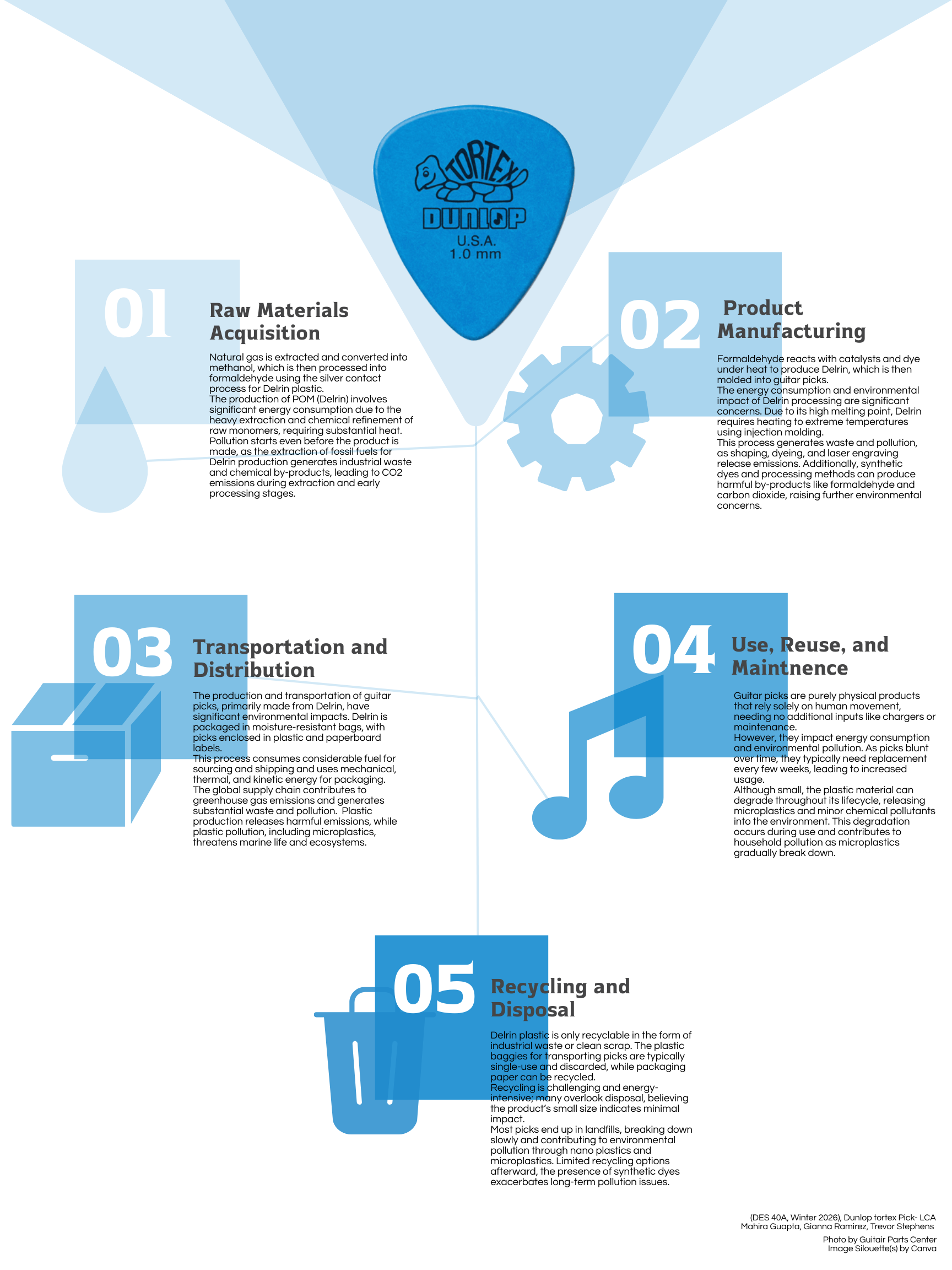
This Life Cycle Analysis examines the Dunlop Tortex® guitar pick, focusing on the waste and pollution generated at each stage of its life, from extraction to end of life, and calculating the final total. Dunlop's official website mentions that Tortex® picks are made of a Delrin base and are durable due to special processes; details about other materials and their environmental impact remain vague. These uncertainties regarding the product's overall sustainability, unfortunately, remain. However, this research article aims to clarify these points by analyzing the components of the Dunlop Tortex® guitar pick, focusing specifically on the waste and pollution aspects of a complete analysis.
The extraction of raw materials and early creation of Dunlop's Tortex® Pick begins this product's environmental impact, significant waste and pollution finding its way long before the product is finalized. The Su, Lei, et al. paper “Global Transportation of Plastics and Microplastics argues, “ …fossil fuel will continue to dominate the raw material for plastic industries…The so-called “plastic age” is generally accepted by our industrialized society, following the Stone Age, the Bronze Age, and the Iron Age (Fig. 3).” Delrin (polyoxymethylene, or POM), the primary material in Tortex® picks, is a petroleum-derived plastic. Because most plastics originate from fossil fuels, their production contributes to debris and emissions. Even if minimal compared to other stages, through the processes, the by-product continues to grow and still places a toll on the environment. Processing (early) POM can release formaldehyde if degraded. Archodoulaki, V. -M., et al. in “Property Changes in Polyoxymethylene (POM) Resulting from Processing, Ageing and Recycling.” It says, “investigations performed in parallel…identified formaldehyde and carbon dioxide as the main degradation products.” Two polluting and dangerous substances, CO2 and formaldehyde, are posing ozone and air quality risks, and there is excess and waste that is released by Delrin, the main piece of this product. In “Polymer Degradation,” on Wikipedia, it further emphasizes by-product production, “Polymers and particularly plastics are subject to degradation at all stages of their product life cycle, including during their initial processing, use, disposal into the environment, and recycling…The rate of this degradation varies significantly; biodegradation can take decades...”These findings show that environmental impacts begin during extraction and continue throughout the product’s lifecycle.
Manufacturing represents another stage where environmental impacts occur. During production, plastic scraps and defective picks can contribute to additional material waste. Processes used to engrave and color the picks also require energy and chemicals that add to the product’s environmental footprint. Laser engraving is commonly used to label plastic products such as Dunlop’s Tortex® picks. Although efficient, laser systems still consume energy and contribute to industrial emissions. In Khan, Mohammad Muhshin Aziz, et al. “Optimization of Laser Engraving of Acrylic Plastics from the Perspective of Energy Consumption, CO2 Emission and Removal Rate.” It states that, “The manufacturing industry consumes one-third of global energy and is responsible for 36% of CO2 emissions.” ” Additionally, the report also addresses,“ CO2 is mainly used for manufacturing and stuffing the lasers…As the machine tool is an essential tool for product manufacturing, energy consumption in manufacturing is substantial and should be analyzed and reduced to lessen the carbon footprint,” demonstrating the need to optimize and change this, along with the effects and releases. This shows its common use in manufacturing and the impacts that are affecting the environment, along with others that contribute to a carbon footprint, waste left, and the detrimental environmental impact of these CO2 contributions. The bright coloring of Tortex® picks is produced using synthetic dyes commonly used in plastic products. The paper notes, “Synthetic Dyes: A Threat to the Environment and Water Ecosystem.“ Dye manufacturing generates chemical residues that contaminate aquatic and aerial ecosystems if not properly treated…they are found to have several adverse effects on working people in the industry…ETAD…had published the directives on the list of reactive dyes that have caused respiratory or skin sensitization”. In addition to wastewater pollution, these dyes may introduce persistent chemical residues into ecosystems, contributing to long-term environmental contamination. Showing the emissions and chemical wastes exposed and the harm of them being enough not only impacting our planet, but also the dye pollutants and their composition, causing reactions.
Plastic can be transported over long distances for extended periods, leading to increased fuel consumption, emissions, and cumulative environmental impacts. The ocean is most notably affected, as it enters and harms marine life and the waters. The pathways and movement of plastic products, including those from Dunlop, contribute significantly to global percentages, movement, and the dispersion of microplastics. For instance, Su, Lei, et al. “Global Transportation of Plastics and Microplastics: A Critical Review of Pathways and Influences.” multiple quotes or statements in this like, “...the major part of plastic pollution in the sea has been attributed to the plastic waste from land-based sources……Despite the efforts in waste management, plastics in any form are continuously being emitted from various sources and are acting as a material flow throughout the whole ecosystem.”...Shipping itself generally develops chemical wastes and heavy emissions however there is a (2030 sustainability is working on emissions and such, and mitigating emissions across the supply chain “delrin”), but for now, the chemical byproduct and greenhouse gas, and the impact of plastic goods shipping. According to Delrin in “Delrin Announces New Sustainability Goals,” the company states, “Delrin’s sustainability commitments…reduce the cradle-to-gate product carbon footprint for standard grades by an additional 40% between 2024 and 2030.“ Perhaps ultimately in due time it will lead to a more sustainable, less CO2-emitting and emission-wasteful product, but the information shown so far gives a clearer picture of the materials concerns. The Tortex® pick is part of a bigger plastic pollution problem, with chemical emissions, microplastics, environmental harm, etc expanding. Even before reaching the consumer's hands, by this point, transportation has contributed immensely through its extraction, processing, and transportation.
Although small, its use includes a typically short life span, with losing, snapping, and buying guitar picks in bulk being a nearly universal experience for guitarists. This product's components still raise concerns and questions about its period of use, particularly the releases, microplastics, and chemical byproducts emitted, which will be addressed. Within the study, Khan, Mohammad Muhshin Aziz, et al. “Optimization of Laser Engraving of Acrylic Plastics from the Perspective of Energy Consumption, CO2 Emission and Removal Rate.” It states, “This study alone raises serious questions not only about the chemical stability of POM but also about the appropriateness of sliding materials…” Despite most of the chemicals being present during the actual extraction process, Pom itself as a substance is of concern and some worries, which would directly be concerns for guitarists or users of these picks, especially with the concerns being relative to sliding, there may be chemical issues and emissions with the friction created. The critical review in “ Su, Lei, et al. “Global Transportation of Plastics and Microplastics: A Critical Review of Pathways and Influences states,” Particularly, the smaller particles, such as micro- and nanoplastics, were believed to pose more threat…Inhalation, ingestion, and skin contact were three primary routes for small microplastics and nanoplastics entering human bodies.” As showing concerns with friction and chemical emissions along with the source showing microplastics and the issues regarding its ingestion and overall presence, it shows the wastes produced and concerning chemicals, the issues, and wastes developed during this period of playing and use.
After the product’s use phase, the final stage of its life cycle involves disposal or recycling, which presents some of the most significant waste and environmental challenges for plastic products thus far. Recycling and disposal prove to be one of the biggest concerns as they are composed of a few but very resistant materials, plastic itself being a persistent issue of environmental consequences. The source Su, Lei, et al. “Global Transportation of Plastics and Microplastics: A Critical Review of Pathways and Influences.” When addressing microplastics and nanoplastics, states “their threats to ecosystems and humans need to be further addressed, plastics have been regarded as global environmental issues following global warming, ocean acidification, and ozone depletion…It is estimated that 6300 million tons of plastic waste have been generated, and 79% of them are associated with landfills or accumulated in natural environments (Geyer et al., 2017).” With the actual microplastics and their impact on acidification being addressed, the chemical byproducts and their effects on the earth and oceans. Within the source, Su, Lei, et al. “Global Transportation of Plastics and Microplastics: A Critical Review of Pathways and Influences.” going on to show even more information keeping in mind that plastic is also present to contain the product and that the plastic bags made during the actual packaging to contain the product, typically in bulk, will likely be thrown away into the environment on arrival. “Most of the plastic waste is generated and disposed of on land before reaching aquatic environments…most discarded plastics simply end up in landfills or the natural environment, degradation taking place over long periods of time as a particularly durable variety of plastic as well. Recycling, if possible, is unlikely to play a role in the world and its environmental consequences…a non-single-use polymer product refers to the maximum service time before any significant failures occur. Being discarded in the environment, the plastic waste will experience a considerable period of natural aging (Corcoran et al., 2009). The degradation in terms of geochemical, biological and physical mechanisms would largely alter the fate of plastics in their full “life span”. This shows the plastic, waste, and emissions that occur, and even if not placed in a landfill, addresses that Delrin is reusable but only under specific uses/conditions of reuse and proper recycling. Even if properly done, the quality of plastic naturally gets poorer. Within the “Polymer Degradation.” Wikipedia “Plastic which is recycled by simple re‑melting (mechanical recycling) will usually display more degradation than fresh material and may have poorer properties as a result. [3” showing that this product ultimately has a lot of trouble and is likely to waste and decay in a landfill, emitting its byproducts. The information in “HDPE vs. Delrin®: Material Differences and Comparisons” shows, “However…petroleum products — making them non-renewable and ultimately unsustainable,” further reinforcing the unsustainability and its properties lead it to a wasteful afterlife, most afterward as addressed earlier would just end up in landfill or natural environments as waste. Regarding the coloring, Yusuf, Mohd. “Synthetic Dyes: A Threat to the Environment and Water Ecosystem” talks about this issue, which, as previously mentioned, shows and explains the toxic and unsustainable wasteful properties of the dyes, and it makes it that much harder in this recycling end-of-life phase. The disposal of plastic, particularly the plastic utilized by Dunlop's Tortex® products, negatively impacts the environment, as it is well liked even by the producer, Jim Dunlop, of these picks, because it is found to be durable and long-lasting in nature. The durability, emissions released, and low recycling value, due to the properties of synthetic dyes, ultimately show that this product can only be reused a few times, and contributes significant impacts throughout its life cycle, especially in disposal.
The life cycle of the Tortex® pick, from raw material extraction to disposal, showcases detrimental environmental impacts behind its limited company transparency. From the base, made primarily from Delrin plastic, derived from fossil fuels, the pick contributes to harmful emissions. Concerns arise from the synthetic dyes, packaging, shipment, and adverse effects of emissions that persist in the environment, oceans, and people, and they resist degradation. While the product can be reused up to five times if recycled properly, this merely postpones its eventual disposal in a landfill or its release into nature, highlighting the broader environmental challenges posed by plastic products like the Tortex® pick.
Archodoulaki, V. -M., et al. “Property Changes in Polyoxymethylene (POM) Resulting from Processing, Ageing and Recycling.” Polymer Degradation and Stability, MoDeSt 2006 Special Issue, vol. 92, no. 12, Dec. 2007, pp. 2181–89. ScienceDirect, https://doi.org/10.1016/j.polymdegradstab.2007.02.024.
Delrin. “Delrin Announces New Sustainability Goals.” Delrin, 21 Apr. 2025, https://www.delrin.com/delrin-announces-new-sustainability-goals/.
HDPE vs. Delrin®: Material Differences and Comparisons. https://www.xometry.com/resources/materials/hdpe-vs-delrin/. Accessed 27 Jan. 2026.
Khan, Mohammad Muhshin Aziz, et al. “Optimization of Laser Engraving of Acrylic Plastics from the Perspective of Energy Consumption, CO2 Emission and Removal Rate.” Journal of Manufacturing and Materials Processing, vol. 5, no. 3, July 2021. www.mdpi.com, https://doi.org/10.3390/jmmp5030078.
Kusy, Robert P., and John Q. Whitley. “Degradation of Plastic Polyoxymethylene Brackets and the Subsequent Release of Toxic Formaldehyde.” American Journal of Orthodontics and Dentofacial Orthopedics, vol. 127, no. 4, Apr. 2005, pp. 420–27. ScienceDirect, https://doi.org/10.1016/j.ajodo.2004.01.023.
“A New Generation of Shipping Fuels Is Accelerating the Sector’s Decarbonization Goals.” World Economic Forum, 22 Nov. 2024, https://www.weforum.org/stories/2024/11/shipping-zero-emission-fuels/.
“Polymer Degradation.” Wikipedia, 17 Jan. 2026. Wikipedia, https://en.wikipedia.org/w/index.php?title=Polymer_degradation&oldid=1333413133.
(PDF) Plastic Packaging Waste Impact on Climate Change and Its Mitigation. https://www.researchgate.net/publication/284726839_Plastic_Packaging_Waste_Impact_on_Climate_Change_and_its_Mitigation. Accessed 3 Feb. 2026.
Su, Lei, et al. “Global Transportation of Plastics and Microplastics: A Critical Review of Pathways and Influences.” Science of the Total Environment, vol. 831, July 2022, p. 154884. ScienceDirect, https://doi.org/10.1016/j.scitotenv.2022.154884.
“TORTEX® TRIANGLE PICK 1.0MM.” Dunlop, 19 Sept. 2025, https://www.jimdunlop.com/tortex-triangle-pick-1-0mm/
Yusuf, Mohd. “Synthetic Dyes: A Threat to the Environment and Water Ecosystem.” Textiles and Clothing, John Wiley & Sons, Ltd, 2019, pp. 11–26. Wiley Online Library, https://doi.org/10.1002/9781119526599.ch2.
The Material Lifecycle of Dunlop Tortex Guitar Picks
Guitar picks are a common item used by those with an interest in instruments. This paper will establish the materials used at each stage of the lifecycle of a guitar pick in a material lifecycle analysis. This will begin with the extraction of natural gas and end with the disposal of the guitar pick and secondary material.
The material lifecycle of a Dunlop Tortex guitar pick begins with raw material acquisition, and the first step in this section of the lifecycle is natural gas extraction. Natural gas is used as the primary raw material for the plastic that the guitar will be made of after a lengthy processing and refinement process. To start, natural gas is heated and injected into a prereformer that breaks it down or forms it into mostly carbon monoxide (CO) and hydrogen gas (H2) (Barzegar Aval et al.). This is then catalyzed by a nickel-based catalyst to form a synthesis gas that needs to be catalyzed by a copper, zinc oxide, or alumina catalyst to form a methanol solution (Barzegar Aval et al.; Millar and Collins). This methanol solution is then highly purified by a multistage distillation process to remove impurities that are typically other hydrocarbons. Once a high-purity methanol feedstock is created, it is combined with water, exposed to a silver catalyst, and heated to produce formaldehyde solution. However, just like the methanol, this solution contains impurities that need to be removed. The formaldehyde is typically purified via extraction or vacuum distillation, which causes the formaldehyde molecules to polymerize (Barzegar Aval et al.; Hagen-Keith 2). This polymerization is broken via pyrolysis, heating the polymers in the absence of oxygen, to break them down into molecular form before being solidified via cold traps. This purified formaldehyde can then be sent to a polymerization chamber to finally form Delrin. One important addition to this final step is acetic anhydride, as this stabilizes the hemiacetal ends of the Delrin polymers (Wikipedia). During this process, where virgin base Delrin is formed, industrial byproduct is produced, and it is typically only this fresh and clean Delrin that can be recycled into more Delrin (Delrin, Delrin ® Acetal Homopolymer Thermoplastic Resin Molding Guide Delrin ® | Technical Guide 36). If the Delrin is not to the desired colors available in the base material, a third-party dye can be added, but it needs to be tested so that it does not interfere with the plastic crystallization. The dyes used for Delrin are regularly derived from fossil fuels. Finally, the Delrin can be molded into the desired form, a guitar pick, after being heated and pushed through molding or extruding machines (Delrin, Delrin ® Acetal Homopolymer Thermoplastic Resin Molding Guide Delrin ® | Technical Guide 9-28). There are several important things to note when it comes to the manufacturing process outlined here. Several different sources were used in conjunction to establish a process from start to finish, beginning with natural gas and ending with Delrin. This resulted in some differences in how chemical species like methanol and formaldehyde were produced and purified. With this outline, some of the steps might not typically be used together, but were combined to help establish a broader understanding of how Delrin plastic is formed. A combination of research papers and manufacturing guidelines was used to create the material flow discussed earlier. As explained before, this might result in a combination of steps that might be done for more lab-based production of certain chemical species that don’t match up with their industrial counterparts. Several materials that should be considered as ‘ingredients’ but were not explicitly listed in the manufacturing process include metal catalysts for species conversion and acetic anhydride for stabilizing the final polymer. The heating steps involved for purifying or converting chemical species often involve state changes and temperatures regularly above 150 oC. Additionally, these steps are highly controlled with the flow rates and concentrations of reactants perfectly balanced to achieve maximum reactivation of desired products and mitigation of undesired products, especially for methanol. The process outlined above, unfortunately, does not touch the delicate nature of many of the processes, as slight changes could result in significantly different reactions. Now that an overview of the raw material acquisition stage for the material life cycle of a Dunlop Tortex guitar pick has been established, the product manufacturing stage, along with the transportation and distribution stage, will be examined.
After a base form of Delrin is obtained, it is heated and molded into the desired shapes of guitar picks. This is part of both the raw material acquisition stage and the product manufacturing stage, as dye could be added before the Delrin is molded, or it could not in the cases where it is already dyed. Once the guitar picks are formed, they are typically engraved with a laser, as Delrin is resistant to chemical marking and would make inks or dyes on its surface ineffective (Hagen-Keith 1,3, 8). A common type of laser that is used for plastic engraving is a CO2 laser (Waldron). This works by passing an electric current through a sealed tube of the gas, typically a mixture of CO2, N2, He, as well as a few others, depending on the laser. After this is done, a plasma-like state is induced into the gas, which allows it to emit electromagnetic radiation at specific wavelengths that are captured and focused into the laser. This laser is then used to heat specific portions of the surface of the Delrin to create the desired engraving patterns, in this case, the logo and name of the company manufacturing Dunlop Tortex guitar picks in a process known as raster, which is commonly done for engraving or even shaping Delrin-based items(Waldron; Hagen-Keith 8). There are a few things to note with the description of laser engraving laid out above. Delrin does not have to be shaped using laser cutting techniques. It can be molded as discussed in the first section of this analysis. However, if high-precision parts are desired, then laser cutting is used to produce them, but since guitar picks are the main focus of this analysis, this is not a significant area to explain thoroughly. Once the guitar picks have been engraved, they are ready to be shipped to customers and vendors.
Guitar picks are regularly sold in small plastic bags that use paperboard to display their labeling (Dunlop). When shipped in bulk, cardboard boxes are likely used as this product is relatively small, light, and comes in preportioned packaging, but this is not confirmed and simply assumed. The bags are plastic and therefore derived from fossil fuels, so their base material is also likely some type of liquid fossil fuel or fossil fuel derivative. The paperboard and cardboard packaging are paper-based and use wood as a base material, with glues added in for the corrugated paper (cardboard). The paperboard labeling likely uses synthetic dyes and adhesives to mark the paperboard, which is another area where fossil fuels are used as a base material. One important thing to note is that what was left out of the manufacturing process is that the base, non-molded Delrin, is typically shipped in moisture-resistant polyethylene bags, which adds another source of plastic production into the lifecycle of guitar picks (Delrin, Delrin ® Acetal Homopolymer Thermoplastic Resin Molding Guide Delrin ® | Technical Guide 37). Once the guitar pick is sold to the customer and the packaging is removed and mostly discarded into the trash, the guitar pick is ready to be used. Since the guitar pick is a hand-powered item that requires no additional materials to operate over its lifetime, it requires no maintenance materials or materials to make use of it, apart from the guitar. At the end of their consumer usage life, guitar picks are regularly thrown into the trash, as recycling them is difficult and requires strict cleaning and separation of materials (Eco Recycling Today). However, this does not mean that all of the materials involved in the production of guitar picks end up in the landfill because some of them can be recycled quite easily.
The only Delrin reasonably viable for recycling is the scrap Delrin that is produced during the initial forming of Delrin (Delrin, Delrin ® Acetal Homopolymer Thermoplastic Resin Molding Guide Delrin ® | Technical Guide 36). This Delrin is clean, has a very low moisture content, and does not significantly impact the quality of the Delrin that it is recycled into. Apart from this, there are efforts into recycling the consumer end Delrin products. One such organization is Eco Recycling Today. This organization sorts the polyoxymethylene (POM; Delrin) and cleans it to remove any lubricants or contaminants (Eco Recycling Today). After this, similar to the industrial waste Delrin, it is reground and melted back together in a carefully controlled process as polyoxymethylene breaks down easily at the wrong temperature. After forming the recycled and newly melted Delrin into pellets, it can be reused in the formation of Delrin-based products. There is another approach to recycling consumer-end Delrin products, heterogeneous electromediated depolymerization (Zhou et al.). This is a chemically focused process that breaks down the polymers in the Delrin into more basic components, like formaldehyde. This is a much more encompassing approach than the previous recycling methods discussed because this process can be used on the majority of the Delrin products, as the process is less intense in terms of energy and necessary conditions. One thing to note is that this process was new as of 2023 in terms of application to Delrin, but it has seen a lot of attention since then, and is likely to continue growing as this process also applies to many plastics that are discarded at the end of their lifecycle. The article used for this depolymerization information has been cited nearly forty times, implying some level of traction in the recycling community.
There are a few key things to consider when reading this analysis of the material lifecycle of guitar picks. As explained before, the explanation for the chemical production of Delrin in the first section used a combination of research and manufacturing information. This may have resulted in a description of the production process that is different from the one used to produce actual Delrin. The production of secondary materials: catalysts, dyes, and packaging, was not thoroughly explained, as the main focus was on the guitar picks, and some of the processes for these materials, specifically the plastics, are similar to the production process of Delrin. The materials used in the transportation of guitar picks are incomplete because much of the information could not be found. Some information was found and is what is discussed in the analysis, but a thorough list or description of the packaging could not be found. This was further shown during the research process, as two additional sources that only discussed plastic transportation yielded no further information than the sources above. The recycling and disposal stage of the material lifecycle was touched upon several times throughout the analysis, as the waste from one stage, i.e., the packaging or production, was the material used in the recycling and disposal stage. Typically, Delrin is not recycled at all, apart from the pure industrial waste that is produced at the same time as the initial Delrin. This results in the vast majority of Delrin-based products, including guitar picks, being discarded as the recycling process is incredibly tedious despite efforts to improve their recyclability with new methods. Throughout this analysis, Delrin has been a major focus as it is the base material for the guitar picks. Because of this, the process for making Delrin should be considered as part of the production process of these guitar picks, as it is a major source of energy consumption, raw material use, and waste production.
To summarize this analysis of the material lifecycle of Dunlop Tortex guitar picks, the first step is to extract natural gas and convert it into a methanol feedstock via a catalyst reaction. This methanol is then converted into formaldehyde, which is then polymerized with catalysts used at each step. Once this is done, the base Delrin can be formed into the guitar picks using molding machines, after which they are inscribed with designs by a laser. Then they can be packaged in plastic and paper-based materials before being used. At the end of their life, guitar picks are regularly thrown away, but the packaging and industrial plastic waste created during the production process of Delrin can be recycled back into the process. Overall, just like many plastic-based products, guitar picks do not have a circular-based lifecycle, as it is either impractical or significantly tedious to recycle or reprocess the materials used in their production and lifetime.
Works Cited
Aasberg-Petersen, Kim. Large Scale Production of Synthesis Gas for Methanol and GTL Plants. Topsoe, 2005.
Barzegar Aval, Bahare, et al. “Optimal Process Design for Coproduction of Methanol and Fischer–Tropsch Liquid Fuels.” Industrial & Engineering Chemistry Research, vol. 63, no. 23, 1 June 2024, pp. 10309–10324, https://doi.org/10.1021/acs.iecr.4c00250. Accessed 13 Mar. 2026.
Delrin. Delrin ® Acetal Homopolymer Thermoplastic Resin Molding Guide Delrin ® | Technical Guide. 2024.
---. Transportation & Industrial DuPont TM Delrin ® Acetal Homopolymer Thermoplastic Resin Molding Guide. 2019.
Dunlop. “Products - Dunlop.” Jimdunlop.com, 2026, www.jimdunlop.com/products/. Accessed 27 Feb. 2026.
Eco Recycling Today. “Polyacetals (POM) Recycling Guide.” Eco Recycling Today, 11 May 2025, www.recyclingtoday.org/blogs/news/polyacetals-pom-recycling-guide?utm_source=chatgpt.com. Accessed 6 Feb. 2026.
Hagen-Keith, Ingrid. Delrin Material Profile. 2013.
Millar, Graeme J., and Mary Collins. “Industrial Production of Formaldehyde Using Polycrystalline Silver Catalyst.” Industrial & Engineering Chemistry Research, vol. 56, no. 33, 10 Aug. 2017, pp. 9247–9265, https://doi.org/10.1021/acs.iecr.7b02388.
Track Record. “Transportation: Delivering the Plastic Products You Can’t Live Without.” Up.com, 2018, www.up.com/customers/track-record/tr020420-transportation-and-plastics.htm?utm_source=chatgpt.com. Accessed 6 Feb. 2026.
Waldron, Jacob. “Laser Marking Technologies, LLC.” Laser Marking System, 20 Sept. 2024, lasermarktech.com/what-are-co2-lasers/.
Wikipedia. “Polyoxymethylene.” Wikipedia, 3 July 2020, en.wikipedia.org/wiki/Polyoxymethylene.
WTC Group. “Welcome to Zscaler Directory Authentication.” Wtcgroup.com, 2026, admin.wtcgroup.com/plastics-logistics-in-a-changing-environment/?utm_source=chatgpt.com. Accessed 6 Feb. 2026.
Zhou, Yuting, et al. “Heterogenous Electromediated Depolymerization of Highly Crystalline Polyoxymethylene.” Nature Communications, vol. 14, no. 1, 10 Aug. 2023, https://doi.org/10.1038/s41467-023-39362-z. Accessed 7 Dec. 2024.
Energy Emissions in the Production of Delrin Guitar Picks
The energy emissions from the production of Delrin, a plastic used in the making of most guitar
picks, comes from various activities including chemical processes, transportation packaging and
recycling itself. While often overlooked due to their size, the production of Delrin guitar picks
represents a carbon-intensive lifecycle that spans from high-heat fossil fuel synthesis to global
logistics. This illustrates how even minor musical accessories contribute significantly to
industrial energy emissions.
The carbon footprint of a Delrin plectrum begins long before the material reaches a
manufacturing plant. The process starts with the extraction of fossil fuel resources such as crude
oil or natural gas, which serve as the primary raw materials used to create polyoxymethylene
(POM), the polymer commonly referred to as Delrin. Fossil fuel extraction itself requires
extensive infrastructure and energy input, including drilling operations, pumping systems,
transportation pipelines, and refining facilities. These early stages already contribute to
greenhouse gas emissions through the burning of fuel for machinery and the release of methane
during natural gas extraction. After these fossil fuel resources are obtained, they must be
transported to petrochemical refineries where they are converted into basic chemical feedstocks.
These feedstocks are then processed through several chemical reactions that gradually transform
them into usable industrial materials. According to Plastic Europe, the leading pan-European
trade association representing plastics manufacturers, the production of one kilogram of POM
resin requires an estimated 100 to 110 Megajoules (MJ) of energy. To put this into perspective,
this is equal to the amount of energy composed in approximately 100 cans of Monster Energy
Drink.
2
Transforming POM into the guitar pick in factories undergoes a lot of high pressure
machinery. The secondary processing stage involves turning monomers into the rigid plastic
pellets used in factories. This stage is characterized by chemical energy rather than just
mechanical energy. “A small amount of a commonomer, such as ethylene oxide, is introduced
during polymerization,” (partZpro® 2). Next, due the high melting point of Delrin, it undergoes
a thermal heating process which averages a temperature requirement of 200°C so that it can be
used in injection molding. “Injection molding is a well established manufacturing process used to
mass produce parts. The process consists of melting thermoplastic pellets and injecting the
melted material into a mold,” (Welover). Although this process is efficient, it still consumes
significant energy because the machines must run continuously at high temperatures and
pressures. Moreover, the excess plastic that escapes the mold, can be looked at as wasted energy
unless it’s immediately put back into the machine.
Many companies choose to engrave their brand’s name, logo, or product information
directly onto the guitar picks they manufacture. This engraving is most commonly done using
laser engraving machines because they provide high precision, speed, and consistency during
mass production. Laser engraving works by directing a highly focused beam of light onto the
surface of the plastic, which heats and vaporizes a thin layer of the material in order to carve the
desired text or design into the pick. While this process allows manufacturers to create clear and
durable markings that will not easily fade or rub off during use, it also introduces additional
environmental concerns that are often overlooked when discussing the production of small
plastic items. During the laser engraving process, the intense heat generated by the laser interacts
with the surface of the plastic material. When Delrin or other plastic polymers are exposed to this
concentrated heat, very small particles of plastic can be released into the air. These particles are
3
commonly referred to as microplastics. Microplastics are extremely small fragments of plastic
that can remain suspended in the air before eventually settling into surrounding environments. In
industrial settings, these airborne particles can pose health risks to workers if proper ventilation
and filtration systems are not in place. Over time, these particles may also contribute to broader
environmental pollution if they escape factory environments and enter surrounding ecosystems.
Some newer laser engraving machines also aim to improve energy efficiency by
optimizing the power usage of the laser beam. An example is a brand named OmTech which
advocates for an advanced control software that allows the machine to use only the minimum
amount of laser power necessary to engrave the design, which helps reduce both electricity
consumption and the amount of material vaporized during the process. Additionally, some of
them include filters and are compressor systems that can help reduce the total energy required to
keep the machines operating at safe temperatures. These technological improvements
demonstrate how manufacturers are beginning to address the environmental impacts associated
with even the smaller stages of plastic product manufacturing.
The carbon footprint of a guitar pick is amplified by the energy required for global
shipping, including the input products such as pigments as well as of the final product itself, and
individual retail packaging. Many picks are produced in bright colors or specialized finishes that
require the addition of pigments during the manufacturing process. These pigments are often
manufactured separately in chemical plants and then shipped to plastic manufacturing facilities.
As a result, the environmental footprint of a guitar pick includes not only the production of the
base polymer but also the energy required to produce and transport these additional materials.
Transportation and global logistics represent another important component of the carbon
emissions associated with guitar pick production. Raw materials used to manufacture Delrin are
4
often sourced from multiple countries, and the manufacturing process itself may occur in
different regions from where the final product is sold. For example, raw petrochemical
feedstocks may be extracted in one country, processed into polymer materials in another, and
finally molded into guitar picks in manufacturing facilities located in major industrial hubs such
as the United States or China. After production, the finished picks must then be shipped to
distributors, music stores, and online retailers around the world. Each stage of this global supply
chain requires transportation by cargo ships, trucks, trains, or airplanes, all of which burn fossil
fuels and generate greenhouse gas emissions. These transportation-related emissions are often
categorized under “Scope 3” emissions according to the GHG Protocol. Scope 3 emissions refer
to indirect emissions that occur throughout a company’s value chain rather than directly from its
own facilities. In many industries, these emissions account for the majority of a product’s total
carbon footprint, sometimes reaching 80-90 percent of the overall emissions associated with the
product. Air transportation, in particular, significantly increases the environmental impact
because airplanes require far more fuel per unit of cargo compared to sea shipping or rail
transport. Even though guitar picks themselves are extremely lightweight, the cumulative effect
of shipping millions of them across global markets adds to their overall environmental footprint.
Packaging further contributes to the energy consumption associated with guitar picks.
Most picks are sold in small plastic bags or blister packages that allow customers to easily see
the product in retail stores. In many cases, the packaging materials weigh more than the picks
themselves. This means that additional energy is required not only to produce the packaging
materials but also to transport them alongside the picks. Some manufacturers also use cardboard
backing or decorative containers to make the product appear more attractive to consumers. While
these packaging choices improve marketing appeal, they also increase the material and energy
5
costs associated with each unit sold. In some premium product lines, picks may even be
packaged in reusable containers made from metal, wood, or glass, which further increases the
manufacturing energy required for packaging.
Consumer behavior also plays a role in increasing the environmental impact of guitar
picks. Because picks are inexpensive and easily lost, many musicians purchase them in bulk and
replace them frequently. Professional musicians and frequent performers often go through picks
quickly because the edges gradually wear down with continuous use. As a result, players may
replace their picks every few weeks or months in order to maintain the desired tone and playing
feel. Casual players may keep picks for longer periods of time, but they also tend to lose them
easily during practice sessions or performances. This cycle of loss and replacement leads to
continuous demand for new picks and repeated manufacturing and transportation processes.
Recycling is usually hard and the process requires high heating technology but most
players don’t even consider disposing them off under recycling assuming their small size doesn’t
make an impact but it does when there’s so many. Research by Archodoulaki et al. suggests that
POM can maintain its mechanical properties through up to five recycling cycles but they are
rarely recycled. Estimates suggest the average professional guitarist might lose over 40,000 picks
in their lifetime which is astounding. When multiplied across millions of musicians worldwide,
the number of discarded picks becomes extremely large. Once in a landfill, Delrin does not easily
break down because it is designed to be durable and resistant to chemical degradation. Although
the material may remain largely inert, it can gradually fragment into microplastics over long
periods of time. These microplastics can enter soil and water systems, contributing to broader
environmental pollution.
6
For a standard production cycle of one ton of Delrin picks (which is about 1.2 million
picks), the approximate carbon footprint is 5.5 to 6.5 tons of CO2 emissions. This number
highlights the hidden environmental cost behind a product that appears insignificant due to its
small size. While a guitar pick is light in hand, its carbon shadow is surprisingly heavy. From
fossil fuel extraction and chemical synthesis to manufacturing, transportation, and disposal, each
stage of the lifecycle contributes to energy consumption and greenhouse gas emissions.
Reducing the environmental impact of guitar picks may require several different
strategies. Manufacturers could explore alternative materials that produce fewer emissions
during production, such as biodegradable polymers or recycled plastics. Localizing production
and distribution systems could also reduce transportation-related emissions by shortening supply
chains. Additionally, encouraging musicians to reuse picks for longer periods of time or
participate in recycling programs could help decrease the number of discarded picks entering
landfills. While these changes may seem small on an individual level, collective action across the
music industry could significantly reduce the environmental footprint associated with these
common accessories.
*The following table uses information from AI (gemini 3) as I could not find out these exact
values for each step specifically for Delrin.
7
Lifecycle Stage Approx. CO2
emissions
(Metric Tons)
1. Raw Material
Synthesis
3.24
2. Manufacturing 0.20 – 0.50
3. Packaging 0.40 – 0.80
4. Shipment &
Logistics
0.15 – 1.20
5. End-of-Life
(Disposal)
1.46
TOTAL ESTIMATE ~5.5 – 6.5 Tons
Left: guitar picks in molten form in a mold
(source: One Army)
Right: cute customized laser
engraved guitar picks
(source: Caitlyn Minimalist)
8
Bibliography
1. “Acetal (Delrin): A Complete Guide.” Jiga,
https://jiga.io/3d-printing/acetal-delrin-complete-guide/#:~:text=Also%2C%20as%20a%2
0thermoplastic%2C%20the,re%2Dmolded%20into%20other%20parts.
2. Archodoulaki, V. M., et al. "Property Changes in POM During Multiple Recycling Cycles."
Journal of Applied Polymer Science, 2001. [Academic Journal]
3. Delrin Material Overview: Composition, Properties, and Applications | partZpro®.
partzpro.com/blog/delrin-material-overview-composition-properties-and-applications.
4. GHG Protocol. "Category 4: Upstream Transportation and Distribution." 2022.
ghgprotocol.org/sites/default/files/2022-12/Chapter4.pdf
5. “Highlight: DURACON® bPOM: The First POM Produced from Carbon Recycling
Technology.” Polyplastics Group, Jan. 2022,
www.polycsr.com/en/highlight/2022_01.html.
6. “Material Handling.” Delrin, 21 Apr. 2025,
https://www.delrin.com/industrial/material-handling/.
7. Olscher, Christoph, et al. “Evaluation of Marker Materials and Spectroscopic Methods for
Tracer-Based Sorting of Plastic Wastes.” Polymers, vol. 14, no. 15, July 2022, p. 3074.
PubMed Central,doi.org/10.3390/polym14153074.
8. PlasticsEurope. "Eco-profiles and Environmental Product Declarations for POM." 2023.
plasticseurope.org/sustainability/circularity/life-cycle-thinking/eco-profiles-set/
9. Su, Lei, et al. “Global Transportation of Plastics and Microplastics: A Critical Review of
Pathways and Influences.” Science of The Total Environment, vol. 831, July 2022, p.
154884. ScienceDirect, https://doi.org/10.1016/j.scitotenv.2022.154884.
10. “Top Sustainable Laser Engraver Practices for Earth Day.” OMTech Laser, 19 Apr. 2023,
omtech.com/blogs/knowledge/top-sustainable-laser-engraver-practices-for-earth-day.