Design Life-Cycle
assess.design.(don't)consume
Haley Tran
Professor Cogdell
DES 40A
6 March 2026
Liquid Cooling Charging Cable : Materials
The electric cooling charging cable is an electric vehicle’s way of getting power to itself. From where the energy flows within the cable and the structure of it all relies on the materials used within itself that puts together the cable. As this is an electrical piece of technology, the material components used have to be sturdy and durable to withstand the power that flows within it to provide energy to one's vehicle to operate correctly. Since this provides a way for high powered energy to travel though itself, it tends to heat up a great amount that requires the cooling to maintain its lifelong use. The main materials that bring this whole piece of technology together consists of copper, rubber, gallium providing structure, safety, and sustainability.
Copper, the main component where the energy flows through, comes from a naturally formed material found underground. It is usually found in ores, but before it is processed it is called native copper. Native copper is the raw and organic material form of copper before anything is done to it to be turned into the copper we see every day (Superfund Research Center). After native copper is collected, it goes through a process called smelting where the metal is extracted from the ore and separates the impurities, giving themselves the pure copper materials. Copper itself is very malleable, so it is not very difficult to manipulate it.
Overtime, objects made with copper are under the risk of being oxidized. Oxidization of copper causes it to turn from its original orange color, to dark red, then to a green, which is what we have seen in the Statue of Liberty which is made out of copper. Materials like copper oxidize
from oxygen, moisture, and carbon dioxide when it interacts with the metal, which oxidizes the material forming that protective layer (Superfund Research Center). There are ways of preventing copper from oxidizing, but that is from regular maintenance which involves cleaning and wiping it down, polishing it, or applying a protective outer coating. In certain environments, a full oxidization process of copper can take anywhere from five to thirty years (MEL Science). In a liquid charging cable, copper wires are where the material takes place. Though copper is used, it also oxidizes but not usually as it is usually encased with a rubber outer casing which blocks out oxygen to prevent it from oxidizing (MEL Science). As copper wires hold the electric current current in a liquid cooling charging cable, oxidation decreases its electrical properties lowering the strength and conductivity. Copper being so small, plays a very big role in powering the liquid cooling charging cable.
A big rule when engaging with electrical components is making sure of having some type of protection to not only protect the product, but also yourself. Rubber is used in a liquid cooling charging cable to wrap itself around copper to not only protect itself from oxidization, but to also counteract any electrical currents that try to escape and become loose (Cho et al., 2006). Rubber
is a natural insulator for electrical wirings. Due to its safety characteristics, it is commonly used in safety gear when interacting with electrical workings. Rubber comes from a material called latex, which comes from a tree called hevea brasiliensis or rubber trees, which are commonly found in the Amazon or Brazil.
It is collected from a process called tapping, which is when a spout is inserted in a tree, and you cut along a curve that goes upwards away from the tap. The cuts made into the tree releases latex and follows the track that was created down to the tap which is where the latex is collected in a bucket. This is very similar to how maple syrup is collected, but this time with
latex and rubber. As latex is a natural substance coming from the rubber tree, it is prone to spoiling, so ammonia or other preservatives are added to prevent that (Buranov & Elmuradov 2010). As the latex is collected, it consists of rubber particles and water, but what is needed is the rubber only. To obtain the rubber itself only, some type of acidity is added to slowly separate it as the rubber comes together and separates from the water becoming a soft and solidified substance which is similar to how milk curdles to create a cheese when an acidic component is added (Buranov & Elmuradov 2010). The rubber is then put through a rolling machine to squeeze out any water that is stuck within it, then it is left to dry. Now a soft rubber material is left, but it is not durable yet. To make the rubber more durable, it goes through a process called vulcanization which is where the rubber is heated up with sulfur (Buranov & Elmuradov 2010). This makes the rubber more elastic and durable than it was before. This rubber is what makes it safe for copper wires within the liquid cooling cable to be touched.
The other main component that makes this charging cable safe is the cooling aspect. Without any cooling to something that is electrical and heats up a great amount is dangerous and not safe to operate. Within a liquid cooling charging cable, liquid gallium is used to cool the cable itself due to the large amount of electricity flowing throughout it to power an electric vehicle. Gallium is not only a great heat absorbing material, but can be liquid at room temperature so it will not require more energy to have it become a liquid to flow through the charging cable.
Gallium comes from a mix of materials, such as aluminum or zinc. It goes through a process called electrolysis which is where electric currents are traveling through the ore which helps separate its components, which is where gallium comes into place and gets separated (Yuxin et al., 2025). The liquid cooling charging cable pumps gallium through its system,
cooling it throughout the process (Yuxin et al., 2025). Though there is not a lot of research regarding gallium in liquid cooling charging cables, the basics of how it is obtained and operated gives a good understanding on how it plays its part in a liquid cooling charging system.
As these three materials play a big significant part in how a liquid cooling charging cable operates to power electric vehicles, the sustainability is also important as the increase of electric vehicles are out there everyday, thus the production of more charging cables being released. Copper is a very common material that is recycled or reused over and over again because it does not lose its durability or its conductivity (CUSP). Copper is reused by melting it back down and in the process of that, impurities are removed and taken away to bring back the pure copper to be used to its full potential.
The rubber that wraps itself around the copper can also be reused or recycled. A way that it can be reused is by grinding it down and repurposing it for things like rubber mats or the surfaces for playground equipment, and so much more (GMT). Though reusing or recycling it help keeps it out of landfills and dumps, it loses its quality over time unlike copper which keeps its durability the same (GMT). As rubber gets reused, it does not go back into being big structural objects like tires due to the strength needed to make it safe.
Similar to copper, gallium can be reused indefinitely. It keeps its properties and stays the same. It can be reused as many times as it could the same as copper which makes it a good material for the liquid cooling charging cable to help support sustainability in materials (Guan et al., 2025). If needed, gallium can be taken from one product and put to another and keep its same characteristics as it had before with the original place. It gets purified again and then removed of any purities like copper, and put out to be reused once again.
The materials that go into the liquid cooling charging cable all play an important part when it comes to powering it, the safeness, and the sustainability of it all. The copper that helps create a track to guide the electricity on where to go to charge electric vehicles everywhere, to the rubber that provides the safety of how it operates and it being handled, and then the gallium that provides the cooling technology to make this product long lasting and safe for all. They all could be reused and recycled, as the copper and gallium keep their initial properties and durability, and the rubber being repurposed for other low safety usage make them all great sustainable materials. Characteristics of the materials like these help make the liquid cooling charging cable a durable product for all.
Works Cited
Https://www.sciencedirect.com/science/article/abs/pii/s1051200421000968 | request PDF. Accessed March 10, 2026.
https://www.researchgate.net/publication/351163114_httpswwwsciencedirectcomscienceart icleabspiiS1051200421000968.
Melville, Steve. “A Brief Guide on the Rubber Recycling Process.” GMT Rubber, May 12, 2025. https://www.gmtrubber.com/a-brief-guide-on-the-rubber-recycling-process/.
“Copper Recycling: An Infinitely Recyclable Material.” CuSP, October 24, 2025. https://www.cuspuk.com/sustainability/copper-recycling/.
Https://www.sciencedirect.com/science/article/abs/pii/s1051200421000968 | request PDF. Accessed March 10, 2026.
https://www.researchgate.net/publication/351163114_httpswwwsciencedirectcomscienceart icleabspiiS1051200421000968.
BJ;, Buranov AU;Elmuradov. “Extraction and Characterization of Latex and Natural Rubber from Rubber-Bearing Plants.” Journal of agricultural and food chemistry. Accessed March 10, 2026. https://pubmed.ncbi.nlm.nih.gov/20000314/.
Cho, P. L., Seo, G., Jeon, G. S., & Ryu, S. K. (2000). Adhesion Between Rubber Compounds and Copper-film-coated Steel Plates. The Journal of Adhesion, 73(1), 43–63. https://doi.org/10.1080/00218460008029296
“Methods of Copper Oxidation.” MEL Science. Accessed March 11, 2026. https://melscience.com/US-en/articles/methods-copper-oxidation/?srsltid=AfmBOoqor419 AUL_REx-oTHRyH5YTRGGqSI0Ud671yhmrcEQtwJo6Drg.
“Copper Mining and Processing: Processing Copper Ores.” Superfund Research Center. Accessed March 11, 2026.
https://superfund.arizona.edu/resources/learning-modules-english/copper-mining-and-pro cessing/processing-copper-ores.
Houxi Ye
Professor Christina Cogdell
DES 40A A05
March 9, 2026
Liquid-Cooling Charging Cables: Energy
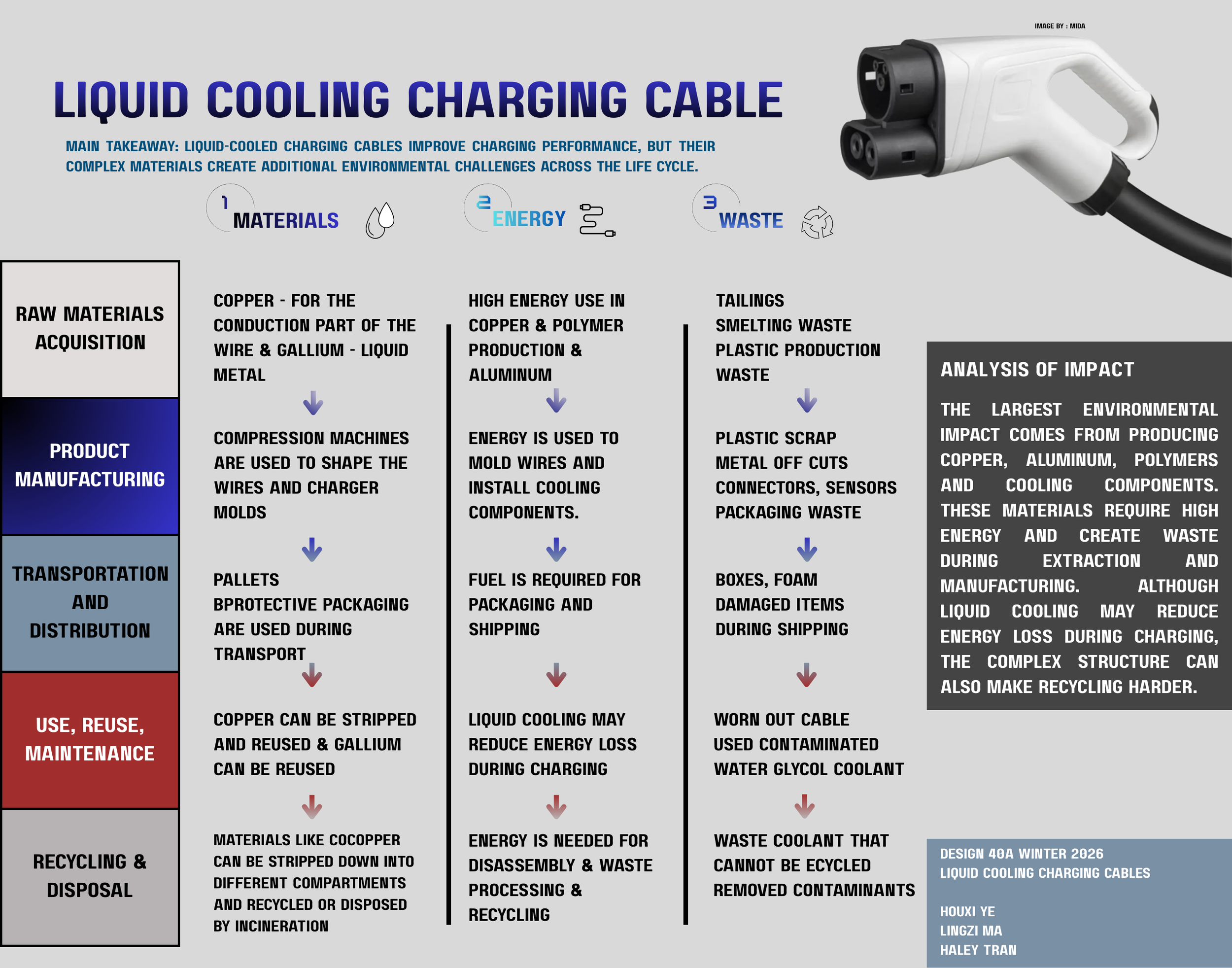
Life-cycle analysis is useful because it demonstrates to manufacturers and consumers where the environmental burden of a product truly resides. The analysis of the full life-cycle of a product requires consideration of the entire process from raw material extraction, through manufacturing and transportation, to usage and disposal, not just the usage of the product. Liquid-cooling charging cables may seem more sustainable at first. They can improve charging speed and allow higher current transfer. However, those use-phase benefits do not outweigh the total life-cycle burden.
The materials of a liquid-cooling charging cable consist of copper conductors, polymer insulation and jacketing, as well as other additives. Although liquid-cooling charging cables improve charging performance, most of their embedded energy comes from raw material extraction and manufacturing.
The embedded energy of a liquid-cooling charging cable starts with the extraction and processing of its predominant raw materials: the copper conductor used to carry electrical energy. Copper is one of the fundamental materials in any type of charging cable; however, the production of copper is also one of the least energy-efficient processes available. Prior to the time that a copper conductor is produced in either wire rod or finished form, the copper must have undergone mining, concentration, smelting, refining, and semi-fabrication. Each of these processes requires large quantities of fuel and electricity, and therefore, a significant amount of embedded energy is present in the copper conductor prior to the assembly of the finished product.
Copper production is a major source of environmental impact because mining, smelting, and refining all require large amounts of electricity and fuel before the conductor is even assembled into the cable. This is especially true when the electricity sources utilized heavily rely on fossil fuels, or, as is the case with more recent production techniques, the supply of usable ore is of lower quality requiring increased processing.
In addition to the copper conductors used in creating a liquid-cooling charging cable, the cable utilizes a number of polymeric materials for insulation, sheathing, and final outer protective casing. In the case of these materials, the polymers will most likely not have the same environmental impact as copper, since they cannot transmit electrical energy; however, their manufacturing processes are also extremely energy intensive.
The production processes of polymeric materials consist of the extraction of the feedstock materials, refinement of the feedstock materials, polymerization of the feedstock materials, and manufacturing from the polymerized materials into a usable product; all of which require very high amounts of energy, although the use of plasticizers or additives will increase the amount of energy required to produce the final polymer. This factor becomes increasingly important considering the design of liquid-cooling charging cables as opposed to "regular" charging cables. The patent cited in the bibliography states that the use of liquid-cooling systems involves greater complexity in the cable design rather than merely having a "bigger" standard cable. Consequently, Because the cable must include cooling-related features in addition to standard charging components, its design requires more material and more production steps, which increases embedded energy in the early life-cycle stages.
Since these materials already contain substantial embedded energy, there will be additional embedded energy added to the total embedded energy of the cable once the manufacturing portion of the life-cycle process begins. Manufacturing adds a large amount of embedded energy because the cable’s copper and polymer parts still have to be drawn, coated, extruded, and assembled before the final product is completed.
After a cable system's primary components (i.e., the copper conductor and polymers) have been produced, each of those components must still undergo a number of industrial processes (i.e., cold drawing, coating, extruding, assembling, and finishing) before they can be used as components in a finished cable system. Similarly, however, as energy is required to produce and shape all wire conductors, energy is required to produce each of the polymer components used for insulation and jacketing of the cable system so that they are suitable for charging with a liquid-cooled system. The manufacturing processes for a liquid-cooling cable are also complicated by the need to integrate the cooling channels and other liquid-related components into the cable system's overall design, resulting in a greater demand for energy compared to "regular" cable systems.
The technical report that is specific to this type of cable system provides strong evidence to the argument that the process by which cable systems are manufactured also possess their own level of embedded energy. Although the generic data that relates to the individual materials contained within the finished product can demonstrate some of the issue, the manufacturing of cable systems must be viewed separately. In addition to each of the materials' embedded energy, there is also embedded energy present due to the use of industrial machinery utilized to convert raw materials into finished products. Therefore, as long as copper and PVC can be produced in a more energy-efficient manner, there are still substantial quantities of energy that are required to convert the copper conductors and polymer components into finished products. As a result, the manufacturing of liquid-cooling charging cables should not be viewed as a minor step in the process of assessing the total building energy of a completed cable system. It is one of the key reasons why embedded energy is concentrated so heavily before the use phase begins.
Energy costs are incurred all along the supply chain: the movement of materials between locations, even if efforts are put into the mining and manufacturing stages, uses fuel and releases emissions. For example, copper concentrate produced at a mine will be shipped to a smelter to make metal in order to ship it to a refiner to make other conductors, then packaged and shipped to a warehouse, electric vehicle charging station, or consumer. The distance of these transportations becomes another significant piece of the total embedded energy in global supply chains.
While transportation may appear smaller in scope than mining or manufacturing, it is essential to include transportation when doing a full Life Cycle Assessment. This is because all forms of transportation are repeated. Between the extraction of raw materials, refinement of semi-finished parts, and shipping of finished goods to their destination, every instance of transportation adds to the total embedded energy of that product. Current research into electric power and warehouse systems supports this systems-wide approach to evaluating the energy efficiency of products. Energy consumed while in use does not end once a product leaves a production site; energy used during storage, handling, transportation, and distribution creates additional environmental impacts on the product. For this reason, it is inappropriate to evaluate a liquid-cooling charging cable solely based on charging efficiency. The embedded energy of the cable is created over a sequence of transportation and industrial transitions that begin long before it is manufactured and continue until it is used.
A liquid-cooling charging cable may improve charging efficiency during use by reducing thermal stress and operational losses. These gains may offset a small part of the product’s earlier energy burden. However, they do not remove the large amount of embedded energy created during extraction and manufacturing. End-of-life recycling may reduce future energy demand, especially through copper recovery. However, recycling does not remove the energy already consumed in the earliest life-cycle stages.
Overall, the embedded energy of a liquid-cooled charging cable is primarily due to the energy consumed to extract the raw material and assemble the finished product. The energy expended in producing the cables accounts for the largest share of transmitted energy at the time of the cable's delivery. Transportation adds more energy before the cable is ever used because raw materials, semi-finished parts, and finished products all move through different locations in the supply chain, while better charging efficiency can only offset a small part of those earlier costs. End-of-life recycling may reduce future energy demand, especially through copper recovery, but it does not remove the heavy burden already built into the cable’s first stages. Liquid-cooling charging cables may improve charging performance, but they can only be considered more sustainable if the energy intensity of materials and production is reduced. In that sense, the true environmental challenge is not only how the cable works, but also how it is made.
Works Cited
Ashby, Michael F. Materials and the Environment: Eco-informed Material Choice. 2nd ed., Butterworth-Heinemann, 2012. Materials and the Environment: Eco-informed material choice - ScienceDirect
Aurubis AG. Life Cycle Assessment of Copper Wire Rod (Aurubis ROD / RheinROD). 2024. Aurubis_LCA Report Copper Wire Rod 2023.pdf
Franklin Associates. Cradle-to-Gate Life Cycle Analysis of Polyvinyl Chloride (PVC) Resin. American Chemistry Council, 2021. Cradle-to-Resin Life Cycle Inventory of Polyvinyl Chloride (PVC) Resin - American Chemistry Council
International Copper Association. Copper Cathode Life Cycle Inventory (LCI): Global Summary. 2025. ICA-LCI-GlobalSummary-202503-R6-With-updates.pdf
Liu, Lingchen, Dong Xiang, Huiju Cao, and Peng Li. “Life Cycle Energy Consumption and GHG Emissions of the Copper Production in China and the Influence of Main Factors on the above Performance.” Processes, vol. 10, no. 12, 2022, article 2715, https://doi.org/10.3390/pr10122715.
“Liquid Cooled Charging Cable and Connector.” United States Patent Application Publication US20200282851A1, 2020. Google Patents. US20200282851A1 - Liquid cooled charging cable and connector - Google Patents
Luo, Yongjun, Xinyi Tang, Lei Geng, Xiang Yao, Feihong Li, Xudong Li, and Qingrui Wang.
“A Comprehensive Life Cycle Carbon Footprint Assessment Model for Electric Power Material Warehouses.” Energies, vol. 17, no. 24, 2024, article 6352. energies-17-06352.pdf
Miljögiraff. Life Cycle Assessment of PVC Cable Insulation with MCCP and Alternatives. Report 924, commissioned by Intertek Denmark, 2021. 2021-LCA-ROHS-PVC-with-MCCP.pdf
Recio, J. M. B. Energy Consumption and CO₂ Emission; Production, Use and Final Disposal of PVC, XLPE and PE Cables with Mineral Charge. Technical Report, 2000s. UPC - Cables final report.pdf
Shahraki, H., et al. “Assessing the Environmental Impacts of Copper Cathode Production Using Life Cycle Assessment.” Integrated Environmental Assessment and Management, 2024. https://onlinelibrary.wiley.com/doi/abs/10.1002/ieam.4857?utm_source
Ye, L., et al. “Life Cycle Assessment of Polyvinyl Chloride Production and Its Recyclability in China.” Journal of Cleaner Production, 2017. https://www.sciencedirect.com/science/article/abs/pii/S0959652616318029?utm_source
Lingzi Ma
Professor Christina Cogdell
DES 040A A05
Mar 8th, 2026
Liquid Cooling Charging Cable: Waste
This paper examines the waste impacts of liquid cooled charging cables across their life cycle, with a focus on the kinds of waste produced at different stages. The purpose of this paper is to study how these cables create waste from the beginning of production to the end of their use. Liquid cooled charging cables help support fast electronic vehicle charging, they also have more complex materials and systems than normal cables. Which can produce much more waste, harming the environment when we are unaware. These cables use metal, plastic, and liquid cooling components, which can make their waste impacts more difficult to manage. From study it shows that a large part of the waste problem appears in the maintenance and disposal stages. Coolant handling adds extra steps, and the mixed metal and plastic construction makes recycling and reuse more complicated than with usual cables. However, waste does not begin only at the end of the product’s life. It can also appear during the earlier stage through raw material, manufacturing, use, maintenance, and recycling. To understand where these waste impacts begin, the first section to examine is the raw materials used in these cables.
The first waste pressure comes from the materials needed to build the cable. “The cables in WHs mainly contain copper (Cu) and poly(vinyl chloride) (PVC), which is commonly used to insulate and sheath cables.” (Kumar et al.). This shows that key materials for cable production are copper and PVC. They carry waste pressure because copper requires mining and processing, which inherently consumes resources, and PVC will accumulate a lot of material waste. These materials inherently make recycling difficult from the outset.These materials inherently make recycling difficult from the start. Because the cable combines metal and polymer layers, it also sets up later waste challenges that the materials are hard to separate. Another example from the raw material stage is “The most common type of extruded power cable insulation is based on cross-linked polyethylene (XLPE), which cannot be recycled as a thermoplastic material” (Ouyang et al.). Cable insulation material creates waste problems from the material design stage. There are materials like XLPE that can not be recycled as thermoplastic material, the end of life waste pressure actually begins with material choice. The next stage is manufacturing, where the materials are combined into more complex cable systems.
During manufacturing, the multiple parts increase the complication of the cooling cable, and makes later separation harder. “The RADOX® HPC500 system consists of a connector, cooled cable, cooling unit and coolant ” (HUBER+SUHNER). This quotation highlights that liquid cooling cable is a multi part system. Which means there are more manufacturing steps, and more waste would be produced compared with standard charging cables. When all of the material needs to be produced and assembled together. The manufacturing process is more complicated than standard charging cables. Another example that shows waste risk is “The cable industry is identified as a major PVC producers which needs to be more environmental cognizant” (Janajreh et al.). Janajreh explained that to manufacture the cable needs more PVC material. This means there will be waste concern because PVC is widely used in cables, but PVC waste is not always easy to separate which makes the recycling, or disposal even more difficult. This is important because even normal production can create so much left over harming the environment. After producing the cable moved into everyday use, which is also how it could be damaged.
During the use phase, the heat that is produced can affect wear and replacement. “As charging speeds become faster, heat increases, and the accompanying cables and cable connectors become bulkier, heavier, and more cumbersome, making them hard to manage” (CPC). When products become bulkier and harder to handle, they are more likely to experience more wear and connector damage that can lead to more replacement and additional waste. They are more likely to produce waste because cables are heavier, they wear out more easily from daily plugging and unplugging. For Connectors, if subjected to greater stress it may require repair or replacement sooner. In the use stage, another waste concern needed to be aware is “Cooling medium: water-glycol mix” (Phoenix Contact). It points out the usage of liquid cooling charging cables rely on coolant. This means it increases environmental concerns when maintenance, has higher leakage risks, and more difficult coolant handling. If coolant leaks during use, it can enter the soil posing an environmental pollution risk. Maintenance becomes important because of how hard the cooling cable needs to be handled, and liquid cooling adds extra waste than normal cables.
Compared with normal cables, liquid cooled cables may require extra maintenance steps. “Waste antifreeze should be recycled either 1) in an on-site unit, 2) by a mobile service, or 3) off-site.” (United States Environmental Protection Agency). This example showed that handling used coolant is complicated. This makes maintenance extra difficult, because a normal cable is usually fixed by replacing the cable or the connector, but liquid cooling charging cables need to consider where liquid waste should go and be handled properly. This supported my thesis that maintenance parts produce more waste. Another example showing liquid cooling charge cable is different and different to maintenance is “Electrical cable waste requires a separation between the metal and the insulating material. The objective of this work was to separate the copper from the plastic in electrical cable waste previously ground below 2 mm, using jigging, shaking table and froth flotation techniques” (Pita and Castilho). Cable maintenance is not a simple disposal process, as Pita and Castilho explain it needs detailed techniques. Recovering these materials demands extra labor, money, and processing. Because separation depends on specialized methods that are more complex than normal cable, liquid cooling charge cable can produce waste more costly and complicated to manage. The next state is recycling and disposal where it becomes a waste challenge.
Recycling is difficult because cables mix metals with plastics that are harder to recover. “Recycling of electric cables focuses on the recovery of metals, mainly copper and aluminum, while polymer insulation is often considered waste and ends up in landfills. ” (Wędrychowicz et al.).When recycling focuses on metals, and mainly copper, aluminum, it means that for liquid cooled charging cables, the design is even more complex so material separation can be harder. As a result, more non-metal parts may end up as disposal waste causing even more waste. In addition, the more recycling challenge that liquid cooling charge cables need to face is “Electrical cords and cables are e-waste” (San José Recycles). This directly explains that the cable is not usual waste, it is e-waste, which requires special handling. E-waste is waste of used electronics, cords and cables are considered as part of it. The e-waste cables should be collected separately from normal trash so that recyclable metals and the waste can be managed more safely. This recycling and disposal challenge shows why there were so many waste impacts, leading to the overall conclusion.
Overall, looking at the full life cycle of liquid cooled charging cables the waste is created through the whole life stages, not only at the end. In the raw materials stage, materials like copper, and PVC create environmental concerns at the very beginning of the creation stage because they require labor, money, and process. In the manufacturing stage, the complex cable production can also create plastic waste. During the use stage, liquid cooled charge cables need coolant systems which adds more material to use and handling. In the maintenance stage, coolant replacement, and handling separate the wire can create additional waste compared with normal cables. Finally, in the disposal and recycling stage, these cables are harder to process because metal and insulation materials must be separated before recovery. Overall, these stages show that design choices strongly affect waste outcomes. For this reason, improving repairability, reducing unnecessary material complexity, and designing cables for easier recycling are important ways to reduce waste in the future.
Works Cited
“Electric Vehicle (EV) Liquid Cooled Charging Cables.” CPC, www.cpcworldwide.com/Liquid-Cooling/Electric-Vehicle-Charging/EV-Charging-Cables. Accessed 5 Feb. 2026.
HUBER+SUHNER. “High Power Charging (HPC).” HUBER+SUHNER, https://www.hubersuhner.com/en/markets/industry/ev-charging-infrastructure/ev-fast-charging/high-power-charging-hpc. Accessed 5 Feb. 2026.
Phoenix Contact. “High Power Charging: Megawatt Charging with CCS.” Phoenix Contact, https://www.phoenixcontact.com/en-us/technologies/high-power-charging. Accessed 5 Feb. 2026.
United States Environmental Protection Agency. “Antifreeze Recycling.” U.S. Environmental Protection Agency, Feb. 2016, https://www.epa.gov/sites/default/files/2016-02/documents/antifreeze.pdf. Accessed 5 Feb. 2026.
San José Recycles. “Electrical Cords and Cables.” San José Recycles, https://sanjoserecycles.org/guide/electrical-cords-cables/. Accessed 5 Feb. 2026
Wędrychowicz, Maciej, et al. “Recycling of Electrical Cables-Current Challenges and Future Prospects.” MDPI, publisher, 10 Oct. 2023, www.mdpi.com/1996-1944/16/20/6632.
Kumar, Harendra, et al. “Latest Trends and Challenges in PVC and Copper Recovery Technologies for End-of-Life Thin Cables - Sciencedirect.” Science Direct , 15 Feb. 2024, www.sciencedirect.com/science/article/pii/S0956053X23007493.
Janajreh, I., et al. “Mechanical Recycling of PVC Plastic Waste Streams from Cable Industry: A Case Study - Sciencedirect.” Science Direct, Nov. 2015, www.sciencedirect.com/science/article/abs/pii/S2210670715000530.
Ouyang, Y., et al.“Recyclable Polyethylene Insulation via Reactive Compounding with a Maleic Anhydride-Grafted Polypropylene | ACS Applied Polymer Materials.” ACS Applied Polymer Materials, 21 May 2020, pubs.acs.org/doi/10.1021/acsapm.0c00320.
Pita, Fernando, and Ana Castilho. “Separation of Copper from Electric Cable Waste Based on Mineral Processing Methods: A Case Study.” MDPI, Multidisciplinary Digital Publishing Institute, 8 Nov. 2018, www.mdpi.com/2075-163X/8/11/517.