Design Life-Cycle
assess.design.(don't)consume
Carlos A Obando Jr
Professor Christina Cogdell
DES 40A Energy, Materials & Design Across Time
March 11, 2026
Orthopedic Shoes: A Raw Materials Perspective
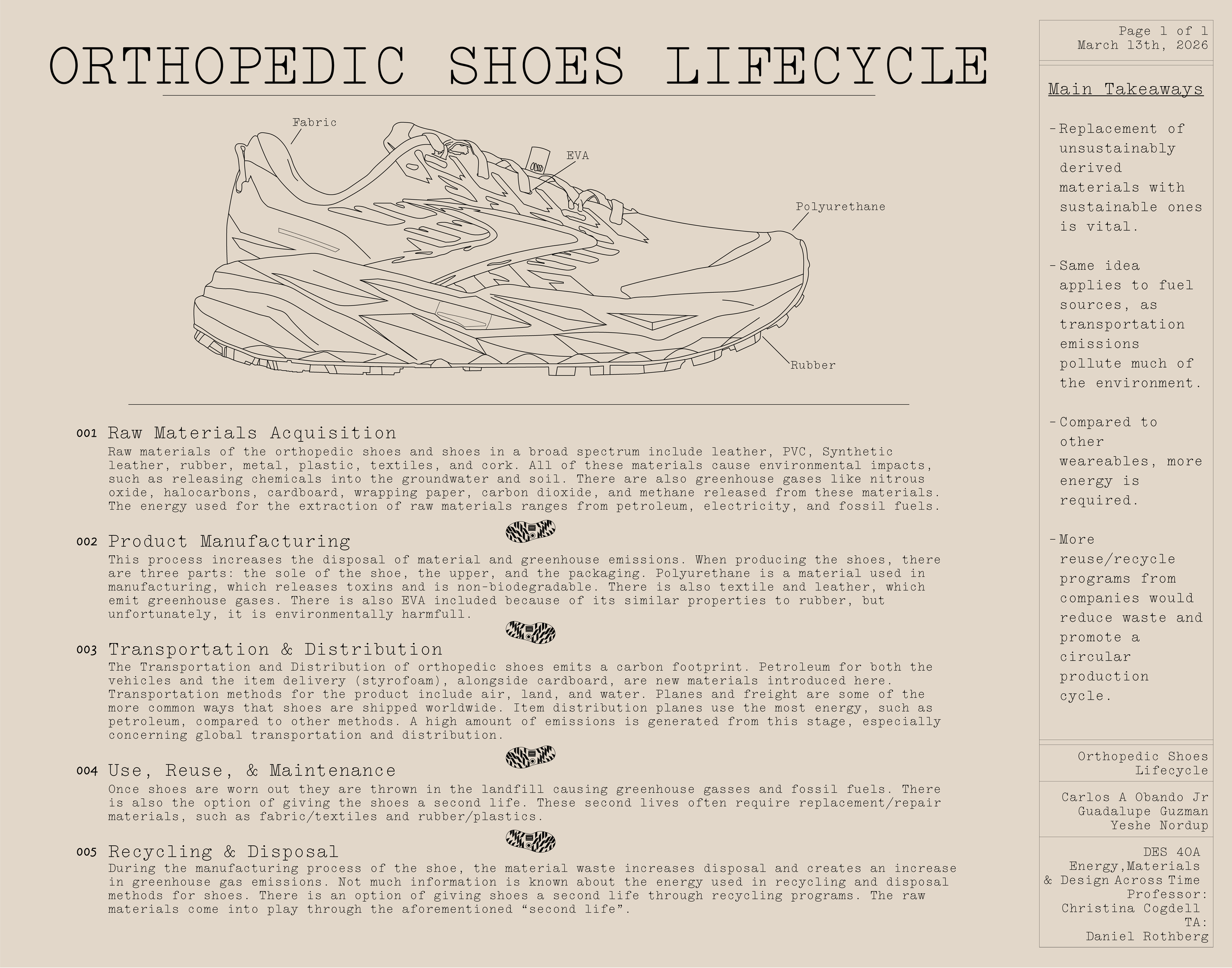
Orthopedic shoes are an underrated part of fashion. They provide valuable footwear support to those who need it, such as elderly folk. They can also look very snazzy at the same time, doing a perfect double duty of looking and feeling good. However, have you ever thought about what goes into them? Probably not, which is why my group and I are presenting the story behind them. I’m specifically tackling the raw materials aspect of the life cycle analysis of orthopedic shoes. Life cycle analysis (LCA) is the process of analyzing the entire life of something, from resource extraction to product disposal, and identifying the environmental effects. The raw materials present in Orthopedic shoes are numerous and present through all 6 stages of their life-cycle. However, raw materials are most prevalent in the stages of raw materials acquisition and manufacturing, and as such, have a significant need for sustainable innovation.
Due to the abundance of materials introduced into these two stages, RM acquisition and manufacturing, I’ll discuss two in depth to get a good sense of what goes on in this stage of shoe production. A prominent material is rubber, which can come from a variety of places, but the one I’m discussing comes from Hevea Brasiliensis, the rubber tree. Attaining the rubber is a time-intensive process, as planting and cultivation of seedlings, which need about 7 years of care, only to be harvested 13-18 years later (Marrero Nunes et al.). Harmful effects on the soil and use of pesticides and herbicides are some of the main environmental effects present at this stage (Marrero Nunes et al.). Latex is then extracted and must undergo procedures to become either fresh latex or coagulated rubber, cup lump (Marrero Nunes et al.). After all that, it must undergo at least one more process before it can finally be turned into a known product, such as shoe soles (Marrero Nunes et al.). Concentrated latex would be one of the penultimate materials made before a known product; its primary environmental impact is water pollution because of the industrial waste generated (Marrero Nunes et al.). This part of the manufacturing process has a huge effect on the end properties of the rubber. For example, the curing time the rubber requires can vary from rubber to rubber; it all depends on what the manufacturer requires (Chen). How well the rubber is made can influence its resistance to different parts of the process, as poorly made rubber won’t withstand exposure to PU or EVA casting resins or solvents (Chen). EVA itself is also used in shoes due to its similar properties to rubber. EVA (ethylene vinyl-acetate) is a type of plastic made from monomers ethylene and vinyl-acetate (Lopes et al.). The main way of making it is by high temperatures and high pressure or emulsion (“Developments in Plastic Materials”). Unfortunately, due to the nature of plastics, EVA is incredibly difficult to recycle, which leads to a lot of waste (Lopes et al.). However, there is a sustainable version of EVA that came about around 8 years ago, EVA from sugarcane (Bio-Based Ethylene). This version is recyclable and similar in properties to its synthetic version (Bio-Based Ethylene). These stages have the most room for improvement when it comes to utilizing less environmentally harmful materials due to the many materials that can be used here.
Transportation and distribution, on the other hand, don’t have a lot of new materials introduced. There’s cardboard for the shoe boxes, which just comes from wood/plants. Some companies, though, utilize the recyclability of cardboard, such as Brooks. They claim to use “100% recycled and recyclable materials” (Sustainable Consumption), and as the owner of Brooks shoes, most of that material is cardboard. On the fuel side of transportation, there’s an interesting alternative fuel called green methanol, which is basically fuel from sustainable biomass. The creation process itself has green all over it, with renewable energy electrolyzing water, attaining green H2 and O2, then a reaction with biomass or waste-sourced carbon generates green methanol synthesis (Li et al.). Due to this process, this green methanol has practically zero carbon emissions, making it perfect for a sustainability effort (Li et al.). In 2023, Nike, in partnership with other companies, launched H2 Barge 1, the world’s first hydrogen-powered inland container barge; its only “waste” being humid air and clean water (Nike – Reducing). Most of the improvement here can be from the vehicle fuel used, so it’s great that efforts are being made to make it more “green”.
As with the previous stage, the use, reuse, recycling & disposal stages don’t introduce many new raw materials. Most of the raw materials appear in the re-use/repair section, where they just use more of the initial raw materials to repair the shoe. For example, Nike Grind, which is Nike’s upcycling program, uses leather scraps from manufacturer waste for a variety of purposes, such as shoemaking (Leather — Nike). In their Raw Materials Standards, Nike goes into detail about what animal hides are permitted for their products, and leather from sheep and cows is permitted (Nike - Manufacturing). However, they specify that the hides, specifically for cow, can’t be from the Amazon biome, must have certification, clear traceability, and the animals must be treated humanely (Nike - Manufacturing). Recycling shoes often involves a lot of physical destruction, such as a grinder for Nike’s recycling process (“Recycling + Donation”). Disposal often means tossing them into a landfill and nothing else, so the raw materials there would be the fuel used to power the transportation, in which case fuels like the aforementioned green methanol would be used once again. The need for innovation is prevalent here, too, but in terms of waste management rather than raw materials, and that is outside the scope of this paper.
The flaws in my research lie in how niche the topic of orthopedic shoes is. There isn’t a de facto orthopedic brand, and since they’re shoes, there isn’t much raw-materials-wise that doesn’t also apply to standard shoes. As such, I used information I could gather on standard shoes to supplement the lack of orthopedic-specific sources. Due to the fact that they’re both shoes, one could reasonably apply the information gathered for shoes to orthopedic shoes. There was also an almost overwhelming favoritism toward the raw material acquisition and manufacturing stages when it comes to raw materials. Those stages are by far the biggest users of raw materials, so I focused on two materials to be more in-depth compared to briefly mentioning a lot. Despite these setbacks, the sources I found for this paper fit my topic very well.
The raw materials of orthopedic shoes are the most significant and common in the first two stages, raw materials acquisition and manufacturing, compared to the other three stages, where raw materials take a relative backseat. Rubber and EVA are just two possible materials in these stages, and the processing that goes into turning them into something usable for production is extensive and environmentally harmful. Transportation & distribution uses more general raw materials, in this case, cardboard for storage and green methanol for vehicle fuel, which is comparatively more sustainable than the previous stage. Use, re-use & recycle, and disposal contain likely the least amount of new introduced raw materials, with repairing re-using the same materials from the initial stages, recycling only changing the physical form of the initial materials, and disposing being the tossing of shoes into landfills, which clearly isn’t sustainable. I chose my sources due to the lack of specific sources regarding orthopedic shoes, but I made sure that they had relevant information that could be applicable to orthopedic shoes. It’s easy to forget about orthopedic shoes, since only some of us require them, but the mere fact that they’re shoes means they have the same raw materials, and thus, the same effects on our environment. Which means that if we want to reduce that impact, which is something that’s only just beginning with the big companies, we need to dedicate more resources to improving the materials we use, so when we inevitably purchase new shoes, our old ones won’t be around to pollute.
Bibliography
Bio-Based Ethylene Vinyl Acetate (EVA) - FKuR (EN). https://fkur.com/en/bioplastics/im-green-eva/. Accessed 11 Mar. 2026.
Chen, Miles. Understanding Silicone Rubber For Shoe Sole Mold Making: Composition, Standards, and Applications. 30 Jan. 2026, https://www.alibaba.com/product-insights/silicone-rubber-for-shoe-sole-mold-making.html.
“Developments in Plastic Materials and Recycling Systems for Packaging Food, Beverages and Other Fast-Moving Consumer Goods.” Trends in Packaging of Food, Beverages and Other Fast-Moving Consumer Goods (FMCG), Woodhead Publishing, 2013, pp. 58–107. www.sciencedirect.com, https://doi.org/10.1533/9780857098979.58.
Leather — Nike Grind Materials. https://www.nikegrind.com/leather/. Accessed 12 Mar. 2026.
Li, Junguo, et al. “Green Methanol—An Important Pathway to Realize Carbon Neutrality.” Engineering, vol. 29, Oct. 2023, pp. 27–31. ScienceDirect, https://doi.org/10.1016/j.eng.2023.08.005.
Lopes, Diana, et al. “Natural and Synthetic Rubber/Waste – Ethylene-Vinyl Acetate Composites for Sustainable Application in the Footwear Industry.” Journal of Cleaner Production, vol. 92, Apr. 2015, pp. 230–36. ScienceDirect, https://doi.org/10.1016/j.jclepro.2014.12.063.
Marrero Nunes, Felipe, et al. “Environmental Impacts Associated with the Life Cycle of Natural Rubbers: A Review and Scientometric Analysis.” Industrial Crops and Products, vol. 224, 2025, pp. 120350-. search.library.ucdavis.edu, https://doi.org/10.1016/j.indcrop.2024.120350.
Nike - Manufacturing, Chemistry, Product and Business — NIKE, Inc. https://about.nike.com/en/resources/sustainability-policies. Accessed 12 Mar. 2026.
Nike - Reducing Our Carbon Footprint — NIKE, Inc. https://about.nike.com/en/mission/initiatives/reducing-carbon-footprint. Accessed 11 Mar. 2026.
“Recycling + Donation: Where Does It All Go?” Nike.Com, https://www.nike.com/sustainability/recycling-donation/recycling-donation-where-does-it-go. Accessed 11 Mar. 2026.
Sustainable Consumption | Brooks Running. https://www.brooksrunning.com/en_us/meet-brooks/running-responsibly/sustainable-consumption/. Accessed 11 Mar. 2026.
Yeshe Nordup
Professor Christina Cogdell
DES 040
3/2/2026
Energy consumption during a shoe’s life cycle
Shoe products are one of the most energy consuming products on the market. The byproduct of this outcome are large amounts of greenhouse gases, carbon emissions and an extremely high leftover carbon footprint. Many components and parts go into a singular shoe thus making a shoe’s manufacturing process, a complex one. This paper will focus on the energy consumption of 4 main steps to a shoe’s life cycle. Those being energy used in raw material extraction, its manufacturing process, the transportation methods, and its final days in the waste/reuse process. Compared to other wearable products, the shoe-making industry in particular, along with its many types of materials and complicated processes required, becomes a significant consumer in energy.
When creating any sort of product we must first understand the types of materials that are consumed for its manufacturing. A lifecycle assessment of a footwear published on MDPI, states that some of the most common materials used in a shoe’s manufacturing process are rubber, thermoplastic and PVC. Apart from rubber, which is a raw material, thermoplastic, PVC and polyester are considered secondary materials and require a combination of chemicals and steps to create. The raw materials that are needed to create these secondary materials require crude oil, coal and natural gasses.
Because there are many types of raw materials, to keep things short, this section of the paper will be focusing primarily on rubber and crude oil. Rubber can be extracted naturally from plants and trees alike or created synthetically. Natural rubber is extracted through a simple process called tree tapping. Synthetic rubber, however, requires multiple types of chemicals that need to be combined as well as a key step called vulcanization. This process heats the chemicals and bonds them together to create a more heat resistant version of rubber. Compared to natural rubber, synthetic is often seen as a better material due to its higher heat resistance. (Green Gubre Group). To produce 1 tonne of synthetic rubber, 120-200 Gigajoules of energy is required (Synthetic Rubber, R.E.P). Crude oil on the other hand requires drilling as the oils and gasses build up in one rock, thus making drilling vertically down possible (The Essential Chemical industry). A good estimate of energy consumed when extracting oil is for every 1.5% of the energy that is produced is used. Overall the types of energy used in material such as rubber and oil are heat, electrical, mechanical and chemical.
Moving onto perhaps the most complicated step of a shoe’s lifecycle, the manufacturing process. The manufacturing step is often the step that sets the shoe’s energy consumption far from other wearable products.Spencer's industries, a company specializing in custom thermoforming, states that thermoplastic, in particular, uses both natural and synthetic materials. These natural resources include cellulose and its fibers whereas the synthetic counterpart includes polyester and nylon. Thermoplastics are created by heating up granules that are made up from different types of components and are then able to be remolded multiple times. Some other types of energy also include electricity for machines and kinetic energy for pressing molds. The amount of energy used when making thermoplastics varies depending on the method. Injection molding, the most common method used to manufacture thermoplastics, according to Science Direct, is also a very energy consuming process. Requiring around 1.2-1.5 Kilowatts per kilogram (kWh/kg) for output and the heat input requiring 4.4 megajoules, it is a significant amount of energy consumed for thermoplastic.
Unlike thermoplastic, PVC is better known for being created from a wide variety of raw materials. Apple Rubber, a manufacturer in rubber production, states that PVC is created most regularly from salt and oil. Putting salt through the process of electrolysis, creates pure chlorine gas which is then later used for chemical reactions (“How is PVC resin made”, Bastone). Carbon is extracted from petroleum or natural gas. Refineries then extract ethylene, a hydrocarbon, through the process of thermal cracking. These two materials are required specifically in a 57-43% ratio making PVC a much more unique plastic. PVC relies primarily on thermal and electrical energy as electrolysis uses electricity to produce chlorine gas and thermal cracking is used to convert petroleum into carbon.
The transportation process of shoes is rather simple as not much information is needed to fully grasp the methods and energy used for this process. Cross referencing transportation information from a life cycle analysis on Adidas shoes and the U.S Energy administration (EIA), the most commonly used methods of transportation include freights and ships for sea and planes for air. It is also safe to assume that transportation methods for land include trucks and trains.
Reading the EIA’s report, we see that the types of energy used include electricity, fossil fuels and petroleum.
The final step of a shoe’s life cycle is its end of life and recycling process. Being frank, not much is known about the recycling process. “Got sneakers”, a shoe recycling organization states that due to its material, a shoe’s life expectancy is about 40 years before it begins its decomposing process. The time that those shoes are slowly waiting to decompose, there will have been many more shoes that will have piled up waiting for the same thing to repeat itself. Additionally, a recycling process for shoes hasn't actually been widely known yet. Instead, there are many more hypothetical solutions to get rid of this problem. One example provided by Soles 4 souls, gives options to either donate depending on its condition, or to simply remove the non recyclable parts, clean the shoes and find a recycling center that accepts shoes.
Moving on from the individual energy consumption of each step, this segment of the paper will begin to dive into the overall waste that is produced. Although this information doesn’t directly correlate with the energy used for each step of the shoe’s life cycle, looking at how much waste and carbon emissions are released, we can also imagine the amount of energy that is used to be able to create this much waste. A report done by Run Repeat, the average carbon emission from a shoe’s life cycle is around 14 kilograms worth. The highest amount of emissions coming from the manufacturing process at around 9.5 and the second highest from raw materials at 4 kilograms of emissions. Logistics and end of life take around 0.3 kilograms.
Although not directly correlated with energy, the higher carbon emissions there are, the more and different types of energy that are used. Additionally, the report breaks the shoe into 4 different parts. The upper sole, midsole, insole and outsole. The report tells us which soles take what material and how much carbon emissions each step of the manufacturing process takes. For example, the upper sole uses fabric like nylon and polyester and produces 41% of the step’s carbon emissions. Likewise thermoplastic is used on the outsole of the shoe and emits 13% of its emissions.
In conclusion, a shoe’s lifespan is a rough and heavy one. Heavy in consumption of both materials and energy. Rough with its end of life usage and not having too many options once it cannot be worn anymore. There are many problems that revolve around shoe manufacturing. High energy usage, material usage and waste. These leave very negative impacts on our environment and it is imperative that new effective, efficient and sustainable methods are found. But not all hope is lost, humans are constantly finding new ways to produce these materials much more sustainably and effectively. It may seem to be a lot but constant experimentation have brought outstanding results, results that may shift the way that shoe production is headed in the near future.
Works Cited
EIA. “Use of Energy for Transportation - U.S. Energy Information Administration (EIA).” Eia.gov, 16 Aug. 2023, www.eia.gov/energyexplained/use-of-energy/transportation.php.
“GotSneakers.” GotSneakers, Accessed March 12. 2026
Group, Green Gubre. “How Synthetic Rubber Is Made – Step-By-Step | Green Gubre Group.” Greengubregroup.com, 14 Oct. 2024, www.greengubregroup.com/blogs/how-synthetic-rubber-is-made-a-step-by-step-guide.
Lichtarowicz, Marek. “Extracting Crude Oil and Natural Gas.”
Www.essentialchemicalindustry.org, 7 Sept. 2018, www.essentialchemicalindustry.org/processes/extracting-oil-and-natural-gas-fracking.htm
l .
MARECHAL, Sylvie. “Synthetic Rubber.” Rubber Injection Molding Machines - REP
International, 2024, www.repinjection.com/rubber-devulcanization/synthetic-rubber.
Markel, Eden. “What to Do with Old Shoes? | Soles4Souls.” Soles4Souls, 28 Mar. 2025,
soles4souls.org/what-to-do-with-old-shoes.
McLoughlin, Danny. “All Eco Sneakers Do Is Kill the Planet a Little Bit Slower
[Study].” Athletic Shoe Reviews, 6 Aug. 2021, runrepeat.com/eco-sneakers-research .
theVR. “The Basics of Thermoplastic Production.” Spencer Industries, 28 Jan. 2020,
www.spencerindustries.com/the-basics-of-thermoplastic-production/
“Transportation.” Adidas Shoes Commodity Chain, 29 Apr. 2015, adidasshoescommoditychain.wordpress.com/transportation/
Stoneexpert. “How Is PVC Resin Made - BASTONE.” BASTONE Plactics, 24 Dec. 2025, bastone-plastics.com/blogs/how-is-pvc-resin-made /. Accessed 13 Mar. 2026.
Van Emburg, Cole, et al. “Quantifying Energy Consumption Variability in Injection Molding: A
Meta-Regression Analysis.” Resources, Conservation and Recycling, vol. 227, 9 Dec.
2025, p. 108730, www.sciencedirect.com/science/article/pii/S092134492500607X ,
Guadalupe Guzman
Professor Christina Cogdell
Assistant Teacher Daniel Rothberg
Design 40A
13 March 2026
Waste lifecycle of Orthopedic Shoes
While walking all day in uncomfortable shoes, or just having foot issues, customers seek orthopedic shoes. Orthopedic shoes help to solve many foot and support issues like bunions, plantar fasciitis, heel pain and arch support. There are many orthopedic shoe companies that customers can buy from which include Hoka, Brooks, and New Balance. Although many of these orthopedic shoes are great they are all seen as the saving grace for relief of any foot problems but in the big picture these shoes cause environmental problems. For this paper, I will focus on the environmental waste lifecycle of orthopedic shoes, which include toxic chemical release, pollution, and greenhouse gas emissions. This overview of issues will help to become more mindful of what we buy and have a better understanding of the lifecycle of orthopedic shoes. It should be mentioned that there were no sources specifically talking about orthopedic shoes lifecycle. The sources that will be used are from footwear as a whole due to the fact that many materials used in orthopedic are the same. Though our main focus will be orthopedic shoes.
Materials for orthopedic shoes contain materials that are emitters of greenhouse gasses and some that are sustainable. Some of the materials that are most commonly used in orthopedic shoes include thermoplastics including polypropylene, polyethylene foams, polyamide, cork, carbon composites, and polyethylene (FAAOP(A)). These thermoplastics are derived from oils specifically Polyamide, polyethylene and polypropylene (Environmental Impact of Three). Some thermoplastics could also be made of natural materials like plant cellulose from cotton and wood. The raw material that makes thermoplastics amounts to 95 % of the environmental impact (Environmental Impact of Three). Cork is used to make the thermocork. The Cork is “harvested for its bark every nine years…This allows the trees to live full, healthy lives, while also giving the bark enough time to regrow”, this makes cork environmentally friendly (Why Cork Footbeds Are). Other materials used are leather, silicone, rubber and textiles. Natural Rubber can be made from trees but this can lead to destruction of habitat and deforestation. Synthetic rubber is made using petroleum which leads to fossil fuel dependency. In order to obtain leather, it is harvested from an animal then processed for tanning. In an article called Reusing finished leather waste, they mention leather in a global spectrum produces “600,000 tons of solid waste (such as shaving, finished leather waste, and sludge)” (Giehl). Leather contains many hazardous chemicals one of which is called chromium III (Giehl). One type leather called Bovine causes the highest environmental impact (Norwegian Research). For textiles, there was mainly mention of cotton which was seen as a major environmental hotspot (Bodoga). Finally, we can’t forget the packaging like cardboard and wrapping paper. Cardboard and wrapping are made of the pulps of tree chips then cooked in a chemical. These chemicals lead to water pollution and chemical pollution, and deforestation. As we can see all these materials contribute to greenhouse gasses and some are environmentally friendly materials.
Although the manufacturing process seems to not cause any issue it could cause serious environmental harm. In an article called Environmental Impact of Footwear Using Life Cycle Assessment mentions that the manufacturing process contributes 79.81% of carbon footprint (Bodoga). The process of making the upper sole and sole are the main contributors to this carbon footprint. The upper sole contributes about 39.94 % while the sole contributes about 30.10% of emission (Bodega). The sole and upper sole materials that contributed to this were made of bovine leather, polyurethane and textile. These were materials that were mentioned to be common materials in orthopedic shoes. The manufacturing of the packaging also played a contribution in the carbon footprint this was mainly due to the cardboard. This packaging manufacturing percentage was 2.37 % of carbon dioxide, the paper was 0.26 % and the cardboard was 2.1%of carbon input (Bodega). Brooks, a global orthopedic shoe company, mentions in their responsibility report of 2023 called Running responsibly mention that most of the environmental impact of their shoes comes from the manufacturing stage as well. A case study done by Nike called Nike’s Sustainable Rubber Lifecycle mentions that Rubber is one of the central to the shoe manufacturing process and mentions how at times it is overlooked. They continue by mentioning that synthetic rubber during the shoe manufacturing releases large amounts of greenhouses gases, CO2 and is energy intensive (Hussain). Also, in this case study it mentions that the manufacturing process also contributes to a labor and resource intensive stage (Hussain). It is also notable to mention that Nikes manufacturing factories are located in many parts of Asia creating the soles and midsoles of shoes. Brooks also mentions that they also have factories in Asia. They continue by mentioning a 4-tier system for their shoe lifecycle and 8 parts of components which include the lace, lining, midsole as well as other parts (Brooks Running). There is also mention that Brooks manufacturing facilities contributes about 1,171 metric tons of greenhouse gas emissions (Brooks Running). With all this mentioned we can assume that the orthopedic footwear industry could also pose an environmental impact at the manufacturing stage. Also, with all mentioned the manufacturing process is labor-intensive and has the highest greenhouse gas emissions in the manufacturing stage.
Footwear industry can emit a carbon footprint during the transportation and distribution stage. In the same case study of professional shoes, it mentions that for these shoes the distribution to the consumer is 2.78% of carbon dioxide. It continued mentioning that the transportation and distribution stages needed further investigation. It mentions that these stages could have contributed the greater part of the carbon footprint especially from the global chains (Bodoga). The Nike case study mentions that the distribution for their products is on a global scale. They distribute through road transportation, sea, and air. They do mention that at this stage it contributes a large part of the carbon emission but it’s not comparable to the manufacturing process emissions (Hussain). From the Brooks case study, it mentions that the emission for transportation and distribution is 17% of carbon dioxide. This percentage accounts for the upstream and downstream of the product. Brooks intensity of the greenhouse emission for transportation and distribution came out to 1.78 kg of carbon dioxide. It also mentions that the upstream is transported by rail, air, ocean and track. For the downstream products, they were transported by air, truck and ocean. The upstream itself released 11,192 metric tons of CO2 while the downstream was 17.839 metric tons (Brooks Running). It continues by mentioning that for the downstream emissions the energy of distribution to the centers and retail stores are also included. With all this mentioned it is clear that distribution and transportation does play a good portion of the carbon emission compared to the manufacturing process stage. Although there isn’t data specifically for orthopedic shoes in distribution and transportation we can assume that the percentage of carbon emission would be quite large especially on a global scale.
Maintaining footwear is one thing but reusing could release greenhouse gasses. In order for an orthopedic shoe to continue to help with the relief of pressure or condition the shoes must be maintained. One of the simplest ways to maintain it is cleaning with mild soap, damp cloth, leather conditioning, and air dry naturally. Rotating shoes, wearing breathable socks, taking out the insoles of the shoes overnight is good for the shoes longevity (How to Extend the Life). Also, proper storing of shoes, replacing insoles and always maintain shoes dry can help main shoes longevity. In order to reuse shoes, they either have to be repaired, donated or redistributed to other countries. There were drawbacks due to the redistribution of second hand materials, there was loss of jobs and environmental waste (Van Rensburg 607). Shoe repair efforts in other countries was unsuccessful due to people preferring brand new shoes. In the Nike case study extending the life of shoes could reduce the overall footprint. It continues by mentioning that one of the challenges is trying to expand the life of shoes is the responsibility of the consumer and there needs to be a mindset of sustainably (Hussain). Though there was no mention on how orthopedic shoes cause environmental harm through the reuse of shoes with what was mentioned, we can assume there could also be the same rising issues. With this the reuse practices are limited and there needs to be other ways of waste management.
Although there are efforts to reuse shoes they are either recycled or mainly disposed of in landfills. For the end of life of professional shoes the carbon dioxide emitted amounted to 8.02 %. In the Brooks case study, they report that for the transportation and end of life treatment amounts to 5,466 metric tons of carbon in 2023 (Brooks Running). They continue mentioning that 88 % of them are is recycled. They also mention that 26 % of raw materials they use are bio based or recycled. They continue by saying that they help to recycle shoes by accepting worn shoes at their stores. One of the organizations they mention specializes in recycling shoes they are called Soles4souls (Recycle Your Old Shoes). Nike also has a program named Recuse-a-Shoe initiative and they collect worn shoes worldwide (Hussain). Nike case study mentions that the stage that is most challenging is the end of life. Brooks mentions that in order to reduce their greenhouse emission they plan to develop other solutions for unavoidable waste and reduce material waste. Both Nike and Brooks are trying to move to a more zero waste emission and both companies are trying to be transparent about their goals to acquire this. The case study for professional shoes mentions that the end of life is one of the stages that emits a large amount of emissions similar to the manufacturing stage. Their research found that the end of life phase needs urgent improvement. They continue by saying that there needs to be more of a circular economy and improvement in recycling programs (Bodoga). It goes even further by saying the footwear industry needs to take action on this matter. Nike mentions that in order to solve this issue globally consumer participation is needed to reuse the waste. In 2023, 23.4 billion shoes were made while 22 Billon pairs of shoes were discarded (Alves). In 2016 a transparency pledge was launched this made the footwear industry be transparent about their products and about the labor conditions (Welcome | Transparency Pledge). Both Nike and Brooks seem to be transplanted about their progression on being more mindful about their emission footprint. For this is the reason we were able to collect all the data about their footwear. With this transparency pledge we will be better able to tackle any issues in the footwear lifecycle. This will help companies of these footwear industries to be more mindful of the waste being caused. With all this said we can assume that orthopedic shoes pose a large amount of waste in landfills and there is a clear challenge on recycling shoes.
Orthopedic shoes may be comfortable, solve foot issues like bunions, plantar fasciitis, heel pain and arch support. There are also many great orthopedic shoe companies to solve these issues. Although many of these orthopedic shoes are great to save foot problems they clearly cause environmental problems. My focus for this paper was the environmental waste lifecycle that orthopedic shoes cause, which includes toxic chemical release, pollution, and greenhouse gas emissions. As mentioned before there was no data specifically for orthopedic shoes to calculate exactly how much waste is emitted. As an alternative option data of footwear as a whole was collected. Although I did at least incorporate one global orthopedic shoe brand Brooks and compare their data with other footwear as a whole. From the data collected we confirmed that all the stages of the footwear lifecycle emitted waste either greenhouse gases like carbon dioxide, very harsh chemicals and many other pollutions. As stated the major contributor of emission is the manufacturing process of shoes and next was the end of life of the shoe that also posed a large amount of emissions. There was a clear concern from the footwear industry about their environmental impact and it’s good that they are slowly progressing on their footprint. Though there is much improvement to be resolved one thing is clear we as the consumers have to be mindful of what we buy and how we dispose of our shoes.
References
“A Comparative Life Cycle Assessment of Cork versus Traditional Shoe In” by Alexandra Lum. https://digitalcollections.sit.edu/isp_collection/3588/. Accessed 5 Mar. 2026.
Alves, Diana I., et al. “An Innovative Solution for Post-Consumer Footwear Waste: Nonwoven Fibrous Structures with Thermal and Acoustic Insulation Properties.” Materials [Basel, Switzerland], vol. 18, no. 20, Oct. 2025, p. 4765. PubMed, https://doi.org/10.3390/ma18204765.
Bodoga, Alexandra, et al. “Environmental Impact of Footwear Using Life Cycle Assessment— Case Study of Professional Footwear.” Sustainability, vol. 16, no. 14, July 2024. www.mdpi.com, https://doi.org/10.3390/su16146094.
Bhavsar, Parth, et al. “Solving the Plastic Dilemma: The Fungal and Bacterial Biodegradability of Polyurethanes.” World Journal of Microbiology & Biotechnology, vol. 39, no. 5, 2023, p. 122. PubMed Central, https://doi.org/10.1007/s11274-023-03558-8.
Brooks Running. (2024). Running responsibly: 2024 Corporate Responsibility Report. Brooks Running, 2024, https://www.brooksrunning.com/on/demandware.static/- /Sites/default/dw991e94c3/cmscontent/Project/ADT/Brooks%20Running/Landing/2023/ Spring-2023/running-transparency/S24-CR-Report-v2.pdf.
“Environmental Impact of Three Different Engineering Thermoplastics: How Much Does It Change When Using Recycled Polyamide?” Journal of Cleaner Production, vol. 514, July 2025, p. 145769. www.sciencedirect.com, https://doi.org/10.1016/j.jclepro.2025.145769.
FAAOP(A), Séamus Kennedy, BEng (Mech), CPed. “Material Choices in Foot Orthotic Design.” Hersco Edu Center, 1 Aug. 2024, https://hersco.com/education-center/foot- orthotic-materials/.
Giehl, Diego, et al. “Reusing Finished Leather Waste to Produce Pigmented Thermoplastic Polyurethane Composite.” Collagen and Leather, vol. 6, no. 1, Feb. 2024, p. 5. Springer Link, https://doi.org/10.1186/s42825-024-00149-7.
How Is Cardboard Made: Manufacture of Corrugated Board | GWP Group. 14 Jan. 2016, https://www.gwp.co.uk/guides/how-is-cardboard-made/. Guides and Advice.
“How to Extend the Life of Your Orthopedic Shoes | TDO Therapy.” TDO Therapy | Therapeutic - Diabetic - Orthopaedic Footwear, 7 Nov. 2025, https://www.tdotherapy.co.uk/blogs/news/extend-the-life-of-orthopedic-shoes.
Hussain, Ayan. “Nike’s Sustainable Rubber Lifecycle: Balancing Innovation, Circular Economy, and Global Supply Chains.” Zenodo, 2025, https://doi.org/10.5281/zenodo.16901933.
Lum, Alexandra. “A Comparative Life Cycle Assessment of Cork versus Traditional Shoe Insole Material.” Independent Study Project (ISP) Collection, Apr. 2023. COinS, https://digitalcollections.sit.edu/isp_collection/3588.
Natural vs. Synthetic Rubber vs Plastics: Top Differences and Why You Should Go Natural | YULEX®. https://www.yulex.com/post/natural-vs-synthetic-rubber-top-differences-and- why-you-should-go-natural. Accessed 5 Mar. 2026.
Norwegian Research Information Repository. https://nva.sikt.no/registration/0198e6e9aa85- 2540377c-c45e-4d7e-9c40-566fb17707eb. Accessed 5 Mar. 2026.
“Recycle Your Old Shoes.” Brooks Running, https://support.brooksrunning.com/hc/en- us/articles/360037955572-Recycle-your-old-shoes. Accessed 8 Mar. 2026.
“6 Ways Cardboard Does More Harm than Good.” LimeLoop, https://www.thelimeloop.com/guide/blog/6-ways-cardboard-does-more-harm-than-good. Accessed 5 Mar. 2026.
Supply Chain Transparency | Brooks Running. https://www.brooksrunning.com/en_us/supply- chaintransparency/?srsltid=AfmBOoq0gpfV3RbwVOU8ZtUCjA5AB_4ajrLPNVOt4oIot olf00_xDgIs. Accessed 6 Mar. 2026.
theVR. “The Basics Of Thermoplastic Production.” Spencer Industries, 28 Jan. 2020, https://www.spencerindustries.com/the-basics-of-thermoplastic-production/.
Van Rensburg, Melissa L., et al. “Life Cycle and End-of-Life Management Options in the Footwear Industry: A Review.” Waste Management & Research: The Journal for a Sustainable Circular Economy, vol. 38, no. 6, June 2020, pp. 599–613. DOI.org (Crossref), https://doi.org/10.1177/0734242X20908938.
“What Are Orthopedic Shoes, and Do You Need Them?” Dr. Comfort Blog, 1 Nov. 2024, https://www.drcomfort.com/blog/what-are-orthopedic-shoes/.
What Are Orthopedic Shoes? | Dr. Comfort. https://www.drcomfort.com/blog/what-are- orthopedic-shoes/?srsltid=AfmBOopqX4kTiFbke1Rw15zybQHjcT9- prByzzDnrmhuaMio-P1rU3r5. Accessed 10 Mar. 2026.
Welcome | Transparency Pledge. https://transparencypledge.org/. Accessed 8 Mar. 2026.
“Why Cork Footbeds Are the Most Sustainable Solutions for Shoes.” Taos Footwear, https://taosfootwear.com/pages/why-cork-footbeds-are-the-most-sustainable-solutions- for-shoes. Accessed 4 Mar. 2026.