Design Life-Cycle
assess.design.(don't)consume
Epigmenia Saavedra
Des 40
Professor Cogdell
03-13-26
Raw Materials
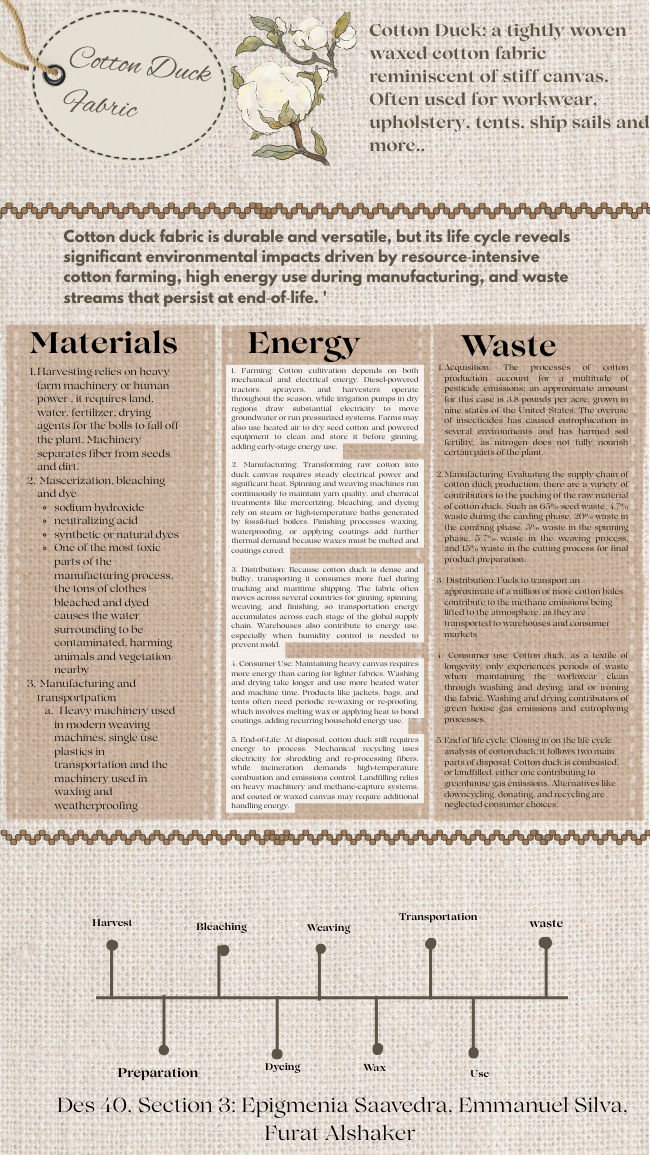
This lifecycle analysis will discuss the raw materials used in the lifecycle of Cotton Duck, a tightly woven waxed cotton fabric reminiscent of stiff canvas. Often used for workwear, children’s seats, upholstery, tents, ship sails, and more (Coated Fabrics and Film Association, 2025). This essay will emphasize the raw materials used throughout the processing, production and transportation of cotton duck. It’s important to note that although there’s a focus on the fabric itself, each process uses other products, materials, or energy sources that all interact to make the finished product. When thinking about the environmental impacts of Cotton Duck, it’s just as important to think about dyeing plants and the people that are affected by the pollution and contamination of water sources. The fabric industry is one of the highest sources of contamination in our oceans and atmosphere, landfills are full of unused non-degradable textiles, and oftentimes cotton duck ends in landfills. The processing of cotton fibers produces the most environmental impact through the bleaching and dyeing process as the petroleum based dye and that seeps into the water and surrounding environments, however the waxing process and the single use plastics used in storing and transporting the fabric are other major factors.
I’ll walk through the different stages of the production process, the raw materials used in each phase, and how these materials affect the environment, without going into too much detail on the production processes of different industries. The stages of production are 1. harvesting and preparing the raw materials, 2. mercerizing, bleaching and coloring the threads, 3. preparing and waxing the cotton duck, 4. Transportation and finally, waste.
The first process of production is the gathering of raw materials, growing cotton requires land and a large amount of water, the method of picking often depends on the area. In the United States, cotton is now separated from the plant by using stripper harvesters or spindle pickers, while some other parts of the world, like China or India, pick cotton by hand. The first stripper harvesters were carriages made of wood, pulled by horse. Farm machinery today favors the brush roll stripper with nylon bristles, it rolls over evenly spaced fields, picking the cotton with boll attached and other debris like leaves and twigs. The conditions of the crop have to be right in order to maximize the efficiency of the stripper, the plants need to be dry/frozen so they can snap out of the plant and into the machine. This is done through cold weather or desiccant(drying) harvest aid chemicals, which rely on certain conditions to properly dry the plants and allow them to be picked up by the harvester. Some harvest aid chemicals are incredibly toxic, and can harm other vegetation or animals nearby.
After the cotton is picked by the harvester, the machine separates the heavy objects, and twigs from the cotton fibres, up to 60% can be removed by the harvester. It then goes to multiple cleaning steps, further separating the cotton fibers from anything else. The cleaning process determines the quality of the fibers, too much processing can harm them in order to maintain high quality fabric, the foreign objects in the fibers need to be removed without excessive processing. The fibers are then . Along this process I’ll also name the materials used in the machines, such as iron, steel, oil, etc.
Then comes the mercerization of the cotton yarn in order to make the absorption of dye deeper. This is when the fabric or fibers is submerged in caustic soda(sodium hydroxide) for around 4 minutes, it’s then treated with water or acid to neutralize the soda(Brittanica, This process is usually done on thicker, higher quality cotton fabrics. Mercerization allows the fabric to absorb dye better, using less dye. The process uses 21-23 percent caustic soda(Sodium Hydroxide), which is incredibly corrosive to animals and vegetation. It’s the same solution used in petroleum refining and soapmaking. After this it’s singed with gas or electric powered heat. An alternative to this common mercerization process is electrochemical cell treatment that doesn’t require bleach, caustic soda or neutralizing acids(O eco-textiles). The article also analyzes the environmental impact of Sodium Hydroxide and notes that it’s toxic to animals but relatively safe for humans, although the high concentration of salt in textile factory streams is high above the federal guidelines(up to 3,000ppm to the guidelines of 230 ppm). Parts per million(ppm) measures the amount of dissolved chemicals per million. In order to grasp the level of salt, water that holds over 500ppm of dissolved chemicals is not considered safe to drink, and water at the level of 3,000ppm can cause severe effects on animal and human populations that ingest it.
The coated fabrics and film association, composed of multiple construction, plastic and fabric corporations, goes through the different test methods used to test the tensile strength and weather effects on the film coating. Cotton Duck, like any other fabric, is usually transported in plastic bags, rolled around cardboard tubes and shipped in cardboard boxes, with glue or tape attached. This collection of items then gets shipped in planes, through ships or in trucks, often a mixture of multiple.
Standard Test Methods, Coated Fabrics and Film(2025). Coated Fabrics and Film Association, https://www.cffaperformanceproducts.org/content/pdfs/STMPamphlet.pdf
Elik Gregerson(2026), Sodium Hydroxide, Encyclopedia Britannica, https://www.britannica.com/science/sodium-hydroxide
Cotton Duck, (2025, September 9) Wikipedia, https://en.wikipedia.org/wiki/Cotton_duck
Cotton Cloth for Rubber and Pyroxylin Coating(1902), US Department of Commerce, Bureau of Standards, https://www.govinfo.gov/content/pkg/GOVPUB-C13-82b34b62fe7855c2cf8a209dc2718035/pdf/GOVPUB-C13-82b34b62fe7855c2cf8a209dc2718035.pdf
Mascerizing(2026), CottonWorks, Cotton Incorporated. https://cottonworks.com/learning-hub/dyeing/dyeing-preparation/
Stripper Harvesting(2010), J.D. Wanjura., W.B. Faulkner., R.K. Roman., M.S. Kelley., E.M. Barnes., S.W. Searcy., H.M. Willcutt., M.J. Buschermohle, A.D. Brashears,https://cotton.tamu.edu/wp-content/uploads/sites/27/legacy-files/Harvest/Cotton%20Stripping%20Harvest%20PDF%20(2010-07-20).pdf
Fabric Manufacturing(2025), Cotton: From Field to Fabric, National Cotton Council of America Cotton Duck, (2025, September 9) Wikipedia, https://en.wikipedia.org/wiki/Cotton_duck
Furat Alshaker
Christina Cordell
DES 040A
Mar 13 2026
Embedded Energy in Cotton Duck: How Systemic
Cotton duck—also known as cotton canvas—is widely used in workwear, tents, bags, and industrial textiles because of its durability and dense plain weave. Yet the strength that makes cotton duck valuable also makes it energy‑intensive to produce. Cotton fiber itself is not unusually high in embodied energy compared to other natural fibers, but the processes required to transform raw cotton into a heavy, tightly woven canvas accumulate substantial energy burdens. Cotton duck inherits upstream agricultural energy from irrigation and fertilizer production, and it compounds these impacts through electricity‑intensive spinning, loom‑time‑heavy weaving, and especially thermal‑intensive wet finishing. Cotton duck’s embedded energy is driven less by the fiber itself and far more by the energy‑intensive stages of irrigation, spinning, weaving, and especially wet finishing, meaning the fabric’s heavy plain weave inherits both high upstream agricultural energy and concentrated manufacturing energy. Understanding how these hotspots accumulate across the lifecycle shows that cotton duck’s environmental impact is shaped by systemic energy demands rather than any single production stage.
The first major contributor to cotton duck’s embedded energy occurs before the fiber even reaches a mill. Cotton cultivation requires significant indirect energy inputs, particularly in regions dependent on irrigation. Chapagain et al. emphasize that “cotton farming requires significant indirect energy inputs through irrigation pumping, fertilizer production, and field operations,” noting that irrigation alone can account for a substantial share of total upstream energy (Chapagain et al. 188). Shen et al. similarly identify irrigation as a major hotspot, arguing that cotton’s energy burden “is concentrated in irrigation, fertilizer production, and textile manufacturing” (Shen et al. 3). These findings matter for cotton duck
because the fabric’s heavy weight does not change the agricultural requirements of the fiber; instead, it amplifies them by requiring more raw cotton per square meter of fabric.
Fertilizer and pesticide production also contribute to upstream energy demand. The Textile Exchange’s Preferred Fiber & Materials Market Report notes that conventional cotton relies heavily on synthetic nitrogen fertilizers, which require fossil‑fuel‑intensive manufacturing. Organic cotton reduces some of these inputs, but the majority of cotton duck on the market is produced from conventional cotton, meaning its embedded energy reflects these industrial agricultural systems. O Ecotextiles echoes this point, explaining that fertilizers, pesticides, and irrigation “increase upstream energy demand” and shape the environmental footprint of all cotton textiles. Together, these sources show that cotton duck begins its life cycle with a substantial inherited energy load long before spinning or weaving begins.
Once cotton is harvested, the fiber must be ginned, cleaned, carded, and spun into yarn—processes that require significant electricity. Cotton Incorporated’s Life Cycle Assessment of Cotton Fiber & Fabric provides one of the most detailed breakdowns of energy use across these stages, identifying spinning as one of the most energy‑intensive operations in the entire textile chain. The report quantifies electricity consumption in ginning and spinning, showing that spinning alone can exceed the energy used in weaving for many fabric types.
Laursen and Hansen reinforce this finding, noting that cotton “requires substantial energy during spinning and finishing,” and that these demands increase for dense fabrics such as cotton duck (Laursen and Hansen 490). Yasin et al. provide numerical values for spinning energy consumption, demonstrating that high‑twist yarns and thicker yarn counts require more machine time and therefore more electricity. Cotton duck typically uses coarse, tightly twisted yarns to achieve its signature durability, meaning its spinning stage is inherently more energy‑intensive than that of lighter cotton fabrics. The U.S. Department of Energy’s Energy Use in the Textile Industry report contextualizes these findings within U.S. manufacturing, noting that spinning accounts for a large share of electricity consumption in textile mills
nationwide. Older machinery—common in mills producing heavy canvas—often consumes even more energy due to inefficiencies. Together, these sources show that spinning is a major contributor to cotton duck’s embedded energy, driven by both the physical properties of the yarn and the technological limitations of many mills.
Cotton duck’s defining characteristic—its dense plain weave—directly increases its energy footprint. Weaving heavy, tightly woven fabrics requires more loom time, higher tension, and greater mechanical force. Yasin et al. explain that “weaving heavy, tightly woven fabrics requires more machine time and therefore more electricity,” making this stage particularly relevant for cotton duck (Yasin et al. 148). Cotton Works™ provides a technical overview of weaving operations, noting that dense plain weaves require slower loom speeds and more passes to achieve the desired fabric density. Cotton Incorporated’s LCA supports this, showing that weaving energy increases with fabric weight and density. Cotton duck, which often ranges from 10 oz to 18 oz per square yard, sits at the high end of cotton fabric weights, meaning it inherits disproportionately high weaving energy. The DOE report further notes that weaving is one of the largest electricity consumers in textile mills, second only to spinning in many cases. Because cotton duck requires more raw cotton and more loom time per unit of fabric, weaving becomes a significant embedded energy hotspot.
Across all ten sources, wet finishing consistently emerges as the single most energy‑intensive stage of cotton textile production. Wet finishing includes scouring, bleaching, dyeing, washing, and drying—processes that rely heavily on thermal energy. Laursen and Hansen identify wet processing as a major hotspot due to “thermal energy requirements,” emphasizing that finishing often exceeds the energy used in spinning or weaving (Laursen and Hansen 491). Cotton Incorporated’s LCA similarly identifies wet finishing as the highest energy stage in the cotton fabric lifecycle. Yasin et al. highlight dyeing and drying as particularly energy‑intensive, noting that thermal energy consumption in finishing can surpass electricity use in earlier stages. The NRDC’s Clean by Design report provides real‑world case studies
showing that mills can reduce energy use by 20–30% through heat recovery systems, optimized boiler operations, and improved washing efficiency—evidence that finishing is both energy‑intensive and highly variable depending on mill practices. For cotton ducks, wet finishing is especially impactful because heavy canvas requires more water, more heat, and longer drying times than lighter fabrics. The fabric’s density slows water penetration and evaporation, meaning mills must use more thermal energy to achieve uniform finishing. This makes wet finishing the single largest contributor to cotton duck’s embedded energy.
When the agricultural, spinning, weaving, and finishing stages are viewed together, a clear pattern emerges: cotton duck’s embedded energy is not the result of any single stage but the accumulation of multiple energy‑intensive processes. Shen et al. emphasize that cotton’s environmental impacts arise from “systemic energy demands rather than isolated stages,” a conclusion that aligns directly with cotton duck’s lifecycle (Shen et al. 10). Cotton Incorporated’s LCA reinforces this cumulative perspective, showing how upstream agricultural energy compounds with downstream manufacturing energy.
The Textile Exchange report adds a global dimension, noting that regional variations in irrigation, electricity sources, and mill efficiency can dramatically alter total embedded energy. Mills powered by coal‑based electricity, for example, produce cotton duck with far higher embodied energy than mills using renewable energy. O Ecotextiles connects these scientific findings to public sustainability discourse, highlighting how consumer awareness increasingly focuses on the full lifecycle rather than isolated impacts. Together, these sources demonstrate that cotton duck’s environmental footprint is shaped by systemic energy demands across the entire production chain. The fabric’s heavy weight and dense weave amplify these demands, making cotton duck one of the more energy‑intensive cotton textiles.
Cotton duck’s embedded energy reflects a complex interplay of agricultural, mechanical, and thermal processes. Irrigation and fertilizer production create a substantial upstream energy burden, which is then compounded by electricity‑intensive spinning, loom‑time‑heavy weaving, and especially thermal‑intensive wet finishing. The fabric’s dense plain weave and heavy weight amplify these impacts, making cotton duck more energy‑intensive than lighter cotton fabrics. Across all ten sources, a consistent conclusion emerges: cotton duck’s environmental impact is shaped by cumulative, systemic energy demands rather than any single production stage. Understanding these hotspots is essential for evaluating the sustainability of cotton duck and for identifying opportunities to reduce its embedded energy through improved agricultural practices, mill efficiency, and cleaner energy sources.
Works Cited
Chapagain, Ashok K., et al. “The Water and Energy Footprint of Cotton Consumption.” Ecological Economics, vol. 60, no. 1, 2006, pp. 186–203.
https://www.sciencedirect.com/science/article/abs/pii/S0921800905005574
Cotton Incorporated. Life Cycle Assessment of Cotton Fiber & Fabric. Cotton Inc., 2012. https://cottoncultivated.cottoninc.com/wp-content/uploads/2015/06/2012-LCA-Full-Report.pdf Cotton Works™. “How Cotton Fabrics Are Made.” Cotton Works, 2024.
https://knowingfabric.com/how-is-cotton-made-into-fabric/
Laursen, Søren E., and John Hansen. “Environmental Assessment of Textiles.” Journal of Cleaner Production, vol. 14, no. 5, 2006, pp. 487–494.
https://www.researchgate.net/publication/242656918_EDIPTEX_-_Environmental_assessment_of_textile Natural Resources Defense Council. Clean by Design: Best Practices for Textile Mills. NRDC, 2015. https://www.nrdc.org/sites/default/files/rsifullguide.pdf
O Ecotextiles. “The True Cost of Cotton.” O Ecotextiles Blog, 2023.
https://ejfoundation.org/what-we-do/sustainable-fashion/the-true-costs-of-cotton Shen, Li, et al. “Life Cycle Assessment of Natural Fiber Textiles.” Resources, Conservation & Recycling, vol. 125, 2017, pp. 1–12.
https://www.uu.nl/staff/LShen/Publications
Textile Exchange. Preferred Fiber & Materials Market Report. Textile Exchange, 2023. https://textileexchange.org/knowledge-center/reports/materials-market-report-2023/
U.S. Department of Energy. Energy Use in the Textile Industry. DOE, 2020.
Yasin, S., et al. “Energy Consumption in Textile Manufacturing.” Journal of Textile Engineering, vol. 61, no. 3, 2015, pp. 145–152.
https://www.sciencedirect.com/science/article/abs/pii/S2213343726011449
Emmanuel Silva
Professor Cogdell
DES 040A
03-13-2026
Cotton Duck Life Cycle Analysis - Waste
Cotton duck textile is one of many products in the fabric production industry, with its evolution and transformation in the modern world beginning to take a toll on the planet's well-being. In the industry, cotton duck fabric is heavily woven for heavy-duty foundations. The contributions from this non-cyclical product have highlighted the need for an environmentally friendly production method rather than its conventional methodologies, which have induced externalities across various atmospheric systems. This paper will discuss the waste produced in the life cycle analysis of cotton duck textile, most significantly the acquisition and disposal stages of this complex product, because of the abundant use of pesticides and or chemicals in degrading this fabric, eutrophication, and overall greenhouse emissions that contribute to pollution and, thus, climate change.
The cultivation of resource-intensive cotton is a major contributor to many external emissions to our environmental atmosphere, as conventional practices are lethal in their use and continue to deteriorate our natural environments. The growing market of consumption for this product has evidently shown its influx of byproducts, as recorded in 2012 and 2017, which was the fifth most irrigated crop in the United States in terms of acreage, reinforcing the idea of possible eutrophication due to the multitude of pesticides used in cultivating the product (Zhou et al., 2025). The irrigation systems that operate in flourishing cotton are extensive, as certain areas follow conventional methods of irrigation, rendering their efficiency and contributing to its byproducts, developing environmental constraints, and further pushing eutrophication hazards (Vitale et al., 2025). This ecological phenomenon is feasible through the various amounts of pesticides, accounting for an estimated 48 million pounds that were applied to 12.6 million acres of land in nine states in 2017 (Delate et al., 2020). Fertilizers composed of nitrogen and phosphorus, which are excessively used, as the plant only takes in about 17-40% of the nitrogen it is fertilized with (Zhang et al.,2023). The 47-55% remainder of the nitrogen is lost to the atmosphere, with data indicating a flawed use of phosphorus and nitrogen in 49% of cotton-industry countries (Zhang et al., 2023). The misuse of agrochemicals and fertilizers in cotton production has shown its negative outcomes through empirical evidence in its attempt at producing the raw material for cotton-duck.
Furthermore, the environmental impacts of producing cotton have been catastrophic and inefficient due to conventional agricultural practices. Deriving the cause of eutrophication processes, we can evidently see the excessive use of phosphorus and nitrogen leading to algae blooms, thus the death of aquatic ecosystems, contamination of the terrain, and peril of freshwaters. This misuse of cotton fertilizers has been one of the dominant contributors to euthrophying emissions in its assessment, leading to an abundance of toxicity for our Earth (Zhang et al.,2023). Consequently, the fertilizers that go into producing cotton have a fractal role in methane emissions, a contribution that is estimated at 4700 kg CO2 per hectare, along with the algae blooms that release methane gases, surely contributing to global warming (Jaczynska et al., 2025). Following the use of herbicides, we can make a direct connection to the immediate harm to health in developing countries, with an article reporting a link between cotton farmer illness as a result of the potency of these pesticides and failure of hygiene (Vitale et al., 2025). The amount of byproducts in producing only the beginning stage of cotton duck has shown a cautious future for how we should continue to produce this textile.
The process of cotton duck textile follows combing, ginning, spinning, and weaving, all contributing a division of pollution to the atmosphere, bringing awareness to the production liabilities in the use of inefficient production of this material. Cotton overall has been shown to generate an estimated amount of 11.6 million tonnes of pre-consumer cotton waste per year in 2018-2019, steadily increasing with the fast fashion industry (Zhang et al., 2023). It is intuitive to say a fraction of that is composed of cotton duck. In generating cotton duck, each segment that is mechanically used to constitute cotton duck uses electricity at a high frequency, contributing to carbon dioxide emissions to our atmosphere. The spinning process generates roughly a 5% cotton waste, fluctuations do occur depending on the type of machinery used to transform this raw material (Johnson et al., 2022). Upon further scrutiny, we find that the carding process accounts for 4.7% of the waste generated in the production of raw textiles (Johnson et al., 2022). The ginning process is tied to the practices mentioned above that have influenced the output of heavy carbon emissions, a process accounting for 65% of the seed and waste material that is discarded and trashed (Johnson et al., 2022). Finally, the most essential step in producing cotton duck is the weaving process, as this determines the density of the fabric it will be applied to. The blueprint and equipment are totally dependent on the amount of waste generated, which is relatively around 5-7.5% (Johnson et al., 2022). The final touches, either bleaching or dyeing, are a step that is optional for the cotton ducks application, but nonetheless contributes to GHG emissions (Vitale et al., 2025).
Amidst the production of cotton duck and its preparatory assessments, it is transported from its harvesting form to the industries of formation and eventually the consumer market. Raw cotton is transported in bales weighing 500 pounds, while in the United States, textile manufacturers produce about an annual average of 7.6 million bales of cotton, a number that has undoubtedly grown in production with the population growing at fluctuating rates (National Cotton Council, 1951). The transportation system of these bales is through trailers, with the roads varying between their formation. This form of transportation has undeniably contributed to a proportion of greenhouse gas emissions in the life cycle assessment of cotton duck fabric, as it requires a rich amount of diesel to operate.
After the finalization of production and transportation, cotton duck is open to the consumer market, with its implications immersed in heavy-duty applications. A well-known brand that uses cotton duck material for their garments is Carhartt, the workwear company. A company that staples its clothing as durable and reliable, this is only due to the compacted weaving patterns that go into making cotton duck such an enduring material. The care for cotton duck could be overlooked as it is a textile of longevity and prevails against tenacious work environments. However, appliances like washing, drying, ironing, and patching play a role in the life cycle of waste. Specifically, washing is identified as a polluter of eutrophic waters, as detergents containing phosphorus drive eutrophication throughout the life cycle assessment (Vitale et al., 2025). The following step in care is drying, contributing its fair share of greenhouse gas emissions, being double its emissions if machine-dried (Zhang et al., 2023).
The recycling and disposal of cotton duck is paramount in its impact on the environment, with a majority of the textile being discarded in landfills or incinerated. We observe an increase in heavy gases to the atmosphere, as cotton is limited to its recyclability factor as it is blended with other materials, making it a tedious process to recycle (Zhang et al., 2023). Even then, donating the fabric or downcycling is always an option, but it is neglected by many consumers. Cotton overall has been shown to generate an estimated amount of 11.6 million tonnes of post-consumer cotton waste annually, expanding in waste as we advance (Zhang et al., 2023). It is pragmatic to follow that a fraction of that waste is composed of cotton duck. Additionally, a vast amount of the post-consumer waste is combusted and or landfilled, further contributing to greenhouse gas emissions and revealing another flaw in the life cycle assessment of cotton-duck (Gogari and Radha, 2025).
Ultimately, the focal point in the cotton duck life cycle analysis of waste emits a variety of externalities on the environment, bringing great peril if not open to a more sustainable trajectory, such as mitigating current irrigation and fertilizing methodologies, and transforming cotton duck textile to a more recyclable alternative. Only then will we negate the conventional practices that continue to plague our environment and move towards a society that is efficient, sustainable, and eco-friendly.
Bibliography
bintenawaz7017. “What Is Cotton Duck Fabric? A Complete Guide to This Fabric.” Loom & Fiber, 16 June 2025, loomandfiber.com/blog/what-is-cotton-duck-fabric/.
“Book Reviews: Cotton from Field to Fabric. Prepared by the Staff of the National Cotton Council. Fifth Edition. Memphis, Tenn., National Cotton Council, 1951. 52 Pages. Price, $3.25.” Textile Research Journal, vol. 22, no. 2, Feb. 1952, p. 152, https://doi.org/10.1177/004051755202200216.
Delate, Kathleen, et al. “Organic Cotton Production May Alleviate the Environmental Impacts of Intensive Conventional Cotton Production.” Renewable Agriculture and Food Systems, vol. 36, no. 4, Aug. 2021, pp. 405–12, https://doi.org/10.1017/S1742170520000356.
Jaczynska, Kasia, et al. “A Comparative Life Cycle Assessment of Textile Fiber Production Processes: Hemp versus Cotton.” Cleaner Waste Systems, vol. 11, 2025, article 100277. Elsevier, https://doi.org/10.1016/j.clwas.2025.100277
Johnson, Sara, et al. “Supply Chain of Waste Cotton Recycling and Reuse: A Review.” AATCC Journal of Research, vol. 7, no. 1 suppl., Jan. 2020, pp. 19–31, https://doi.org/10.14504/ajr.7.S1.3.
“Reducing Carbon Emissions in the Fashion and Textile Industry through Sustainable Practices and Recycling: A Path towards a Circular, Low-Carbon Future.” Global Mainstream Journal of Business, Economics, Development & Project Management, vol. 1, no. 1, Sept. 2022, https://doi.org/10.62304/jbedpm.v1i1.226.
Textiles and the Environment: The Role of Design in Europe’s Circular Economy. European Environment Agency, 9 Feb. 2022, www.eea.europa.eu/en/analysis/publications/textiles-and-the-environment-the-role-of-design-in-europes-circular-economy-1.
The Cotton Supply Chain – Transportation Policy Research. Texas A&M Transportation Institute, policy.tti.tamu.edu/freight/moving-texas-exports/the-cotton-supply-chain/. Accessed 9 Feb. 2026.
Transportation of Cotton Cargo. Skuld, www.skuld.com/topics/cargo/general-cargo/transportation-of-cotton-cargo/. Accessed 9 Feb. 2026.
United States Environmental Protection Agency. “Effects: Dead Zones and Harmful Algal Blooms.” United States Environmental Protection Agency, https://www.epa.gov/nutrientpollution/effects-dead-zones-and-harmful-algal-blooms. Accessed 10 Mar. 2026.
“Valorization of Cotton Waste: Agricultural and Biotechnological Perspectives for Sustainable Development.” AgriBio Innovations, agribioinnovations.com/journals/valorizationof-cotton-waste-agricultural-and-biotechnological-perspectives-for-sustainable-development/. Accessed 9 Feb. 2026.
Vitale, Giuseppe Salvatore, et al. “Environmental Sustainability of Cotton: A Systematic Literature Review of Life Cycle Assessments.” Journal of Agriculture and Food Research, vol. 22, Aug. 2025, p. 102069, https://doi.org/10.1016/j.jafr.2025.102069.
Yousef, Samy, et al. “A New Strategy for Using Textile Waste as a Sustainable Source of Recovered Cotton.” Resources, Conservation and Recycling, vol. 145, June 2019, pp. 359–69, https://doi.org/10.1016/j.resconrec.2019.02.031.
Zhang, Zhenggui, et al. “Environmental Impacts of Cotton and Opportunities for Improvement.” Nature Reviews Earth & Environment, vol. 4, no. 10, Sept. 2023, pp. 703–15, https://doi.org/10.1038/s43017-023-00476-z.
Zhou, Pengxiao, et al. “Environmental Impacts of Future Cotton Production in the United States.” ChemRxiv, 4 Sept. 2025, https://doi.org/10.26434/chemrxiv-2025-s9q4q.