Design Life-Cycle
assess.design.(don't)consume
Yamilet Soria
DES 040A
Professor Cogdell / TA Elieza
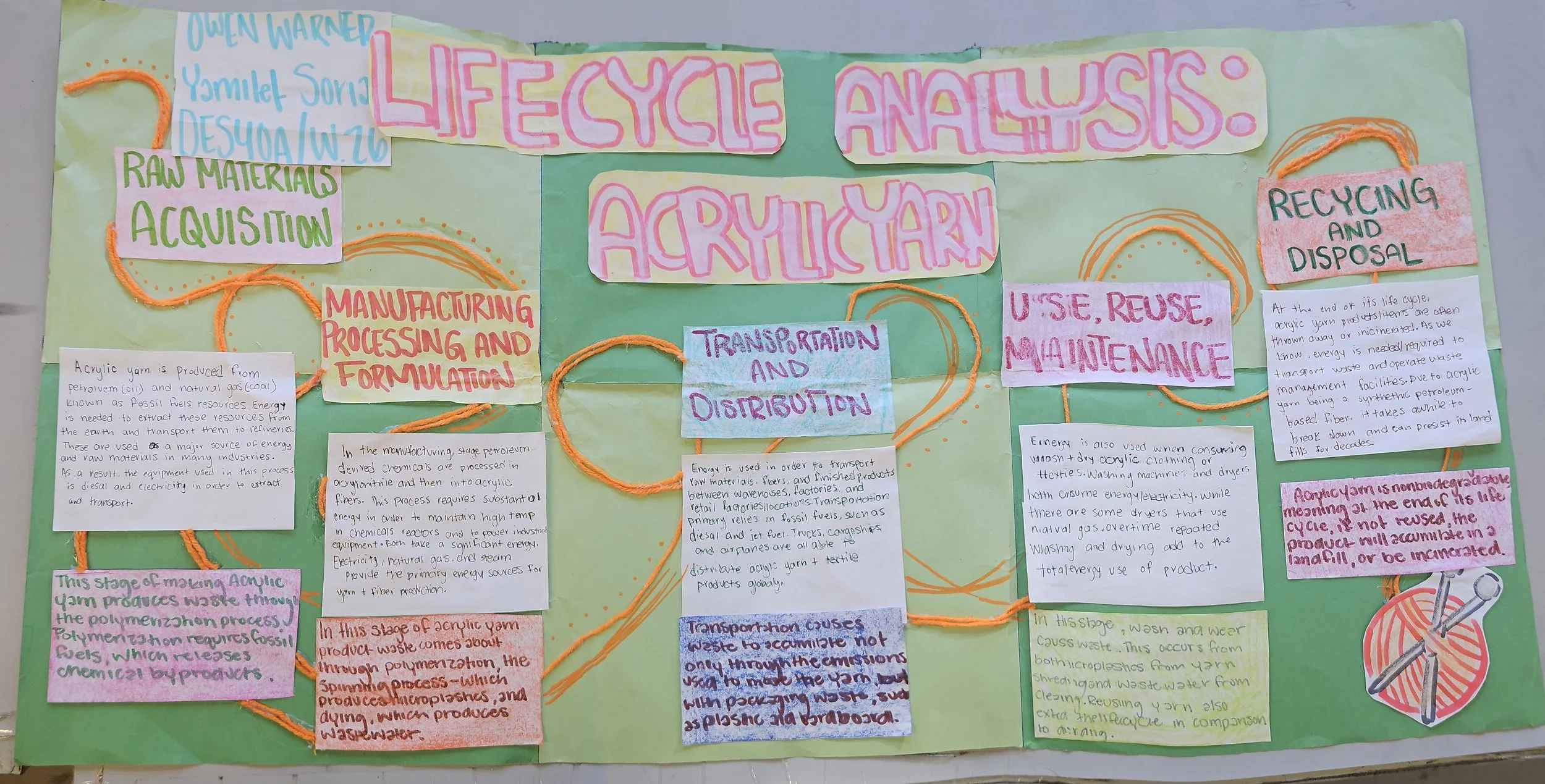
Embodied Energy : Life Cycle Analysis of Acrylic Yarn
Known for its best affordable synthetic textile fiber, acrylic yarn commonly found in blankets, clothing, accessories, and in the crafting industry. In the world of textiles synthetic fibers play a significant role in modern clothing and within many retail products. Unlike the natural fibers, animal hair, cotton, or wool, acrylic yarn is synthetically manufactured through using petroleum-based products, also commonly known as oil and a chemical based product between large scale industrial production. As a result, acrylic yarn takes a huge amount of energy usage which uses a significant amount of energy at the stages of the life cycle. The production and distribution of acrylic yarn requires a major consumption of energy with the fossil fuel extraction process and with processing through a large scale of manufacturing and global supply transportation systems. Energy is required throughout the process of the life cycle of acrylic yarn .
Considering acrylic yarn is made from petroleum based chemicals,its entire life cycle begins with raw material extraction, manufacturing, processing, transportation, consumer use, recycling and waste management. All rely and consume a significant amount of primary and secondary energy which indicates the demand usage of energy in synthetic textile production.
Energy usage in the stages of the life cycle of acrylic yarn begins with the extraction of the raw materials used to manufacture the fibers. With acrylic fibers producing primarily from a strong synthetic plastic fiber, referred to as polyacrylonitrile. Polyacrylonitrile is designed from petroleum based chemicals particularly Acylonitrile. Since these materials come from fossil fuels, the process involves extraction of oil, and natural gas.
A significant amount of energy is used and required to extract petroleum oil and natural gas in order for power drilling equipment to funcunate, and operate to be able to transport those raw materials to refineries and chemical facilities. Substantial machinery is being powered from diesel fuel, commonly used for drilling operations, while a huge portion of electricity is needed to support and operator pumps, monitoring systems, and any other equipment being used at extraction sites. Petroleum which is also known as crude oil is a type of fossil fuel that was formed millions of years ago from ancient plants and animals. Primarily crude oil can be found in underground pools or even in tar (oil) sands. (“Oil and petroleum products explained - U.S. Energy Information Administration”)
According to the US Energy Information Administration, energy is consumed at every stage of its life cycle process through petroleum extractions and with refining processes crude oil into usable fuels and raw materials. (“Oil and petroleum products explained - U.S. Energy Information Administration”). As a result, these are the one the first major energy consumption demands of the start of the life cycle of acrylic yarn materials. After petroleum oil and natural gas are processed and taken from underground, they are sent to refineries where they are processed and turned into products which also include chemicals which are needed to make acrylic fibers. A chemical that is used in this process is identified as acrylonitrile, used to make acrylic fibers. Refineries use thermal and electricity energy to make these chemicals ready to use and access to. This emphasizes that plenty of energy is used even before acrylic fibers were created.
The manufacturing process of acrylic yarn uses a significant amount of energy indicating one of the most energy efficient demand saves in part of the life cycle. In the course of this state, acrylonitrile is chemically converted into polyacrylonitrile, which is processed into fibers and spun into yarn. This creates what we see in retail stores, but we don't get the chance to see what really happens behind the scenes, the process. In order for these industrial processes to operate and work both thermal and electricity energy is used to run equipment that supports manufacturing conditions that create the acrylic yarn .
Manufacturing facilities synthesizing synthetic fibers mainly rely particularly on electrical powered machines used for spinning fiber, polymerization, wash and drying that is needed for these fibers. Not only is electrical energy needed but also thermal energy in order to provide energy for chemical reactions for them to be able to generate burned fossil fuels like coal or natural gas. Studies show that synthetic fiber manufacturing acrylic fibers entails a huge amount of energy, indicating that producing one kilogram of acrylic fiber can require a substantial amount of approximately anywhere between 157-175 major joules of energy (Laursen).
However once the polymer has been established it is pushed through a small service with a tiny hole that converts liquid polymer into thin fibers, typically known as spinnerets. After that these fibers are processed by washing, drying , stretching and then spun into yarn using an electrical powered machine.There is a significant amount of machines that are primarily used for this process that results in a high demand of energy consumption that is tied to synthetic textile production. Therefore, the process of the manufacturing stage emphasizes one of the most energy efficient phases in part of the life cycle of acrylic yarn.
Once acrylic yarn is manufactured and created, it must be conveyed through multifaceted global supply chains before being able to distribute to consumers. In fact, transportation illustrates another crucial step where energy usage is used across the product's life . Typically synthetic fibers and yarn are consumed in major industrial locations and in many retailers across the world. Acrylic yarn is widely distributed to many different retailers as well. (Nguyen)
In order for many places to receive acrylic yarn , transportation systems are needed in order to receive and transport raw material to factories where then acrylic fibers are made. However if we take a deeper look at the transportation systems process, these systems rely on fossil fuel energy sources such as gasoline and diesel in addition to heavy fuel oil. For instance, large amounts of textile materials are transported across oceans whereas trains and trucks ship material between warehouses, retail stores and to factories. Evidence shows that environmental impacts of the fashion industry indicate that both transportation and global distribution systems require large amounts of energy and increase the environmental impacts of clothing production (Niinimäki). Due to modern textile operating global supply chains, both raw materials and finished products typically travel far and long distances which affects the increase of energy being consumed and used. The overall energy plays a key role in its processes before reaching consumers.
Typically people would assume once acrylic yarn products reach consumers there isn't any more energy being continued or made, however that is not the case, energy consumption does not end. The use of the actual product , acrylic yarn, textile products can as well require significant energy especially for washing and drying. Clothing, for instance, is often being washed using washing machines and dryers.
Along with washers and dryers, an everyday household appliance where both appliances rely on electricity, which is produced from primary sources of energy such as coal, natural gas, nuclear power, and renewable energy. Over the life of a clothing item, repeated washing and drying can also increase the total energy consumption. Studies have shown that washing and drying clothing during the consumer use stage adds a significant amount to the overall energy consumption use of textile products (Institution of Mechanical Engineers). While acrylic yarn doesn't quite use energy when people wear it, the maintenance and caring for the clothing acrylic fibers still adds to the total life cycle process.
After the use stage, recycling is another piece of the life cycle where energy can be used. Textile recycling requires collecting and processing used fabrics so the fiber can be reused. This in particular helps process the use of electricity for machines and fuel in order to transport the materials. However, recycling synthetic textiles can be a bit challenging because acrylic fibers are made from complex materials. For this reason, many recycling systems rather use mechanical recycle fibers or reuse textile waste and then transform them into other materials. Research shows that although recycling can consume energy, it can help benefit the environment by reducing the amount of new materials (Sandin and Peters).
At the end of its life cycle, acrylic yarn materials are disposed of and are managed through waste managed systems. Since synthetic fibers recycling is limited, most of the textile materials are in landfills. Waste management sirens still required energy for this process in order to be able to collect transportation and landfills places.
Garbage trucks for instance, require diesel fuel in order to power and operate. They collect textile waste from homes and buildings where they later transport them into waste facilities. At landfills machines are used to move, compress and bury the waste. Each year, large amounts of textile waste are sent to landfills, where synthetic fibers such as acrylic can persist for many years due to them breaking down very slowly, according to the U.S. Environmental Protection Agency (Environmental Protection Agency). This waste system requires energy in order to collect, transport, and manage waste at landfills which also adds an increase of energy.
Every stage of the life cycle of acrylic yarn relies on energy. From extracting fossil fuels and conveying them into chemicals, to operating machines in factories and warehouses, transportation, consumer use, recycling use, recycling and lastly waste management. Understanding the energy demands of synthetic textile fiber helps us see the environmental impact of energy usage with everyday materials that are being used daily. As people become more aware of the energy used in textile production, they can help develop and find more efficient manufacturing processes and materials that can help us use less energy.
Full Bibliography
Institution of Mechanical Engineers. Engineering Out Fashion Waste. 2013.
https://www.imeche.org/docs/default-source/1-oscar/reports-policy-statements-and-documents/imeche-engineering-out-fashion-waste.pdf
Synthetic Fiber - an Overview | Sciencedirect Topics, www.sciencedirect.com/topics/materials-science/synthetic-fiber. Accessed 13 Mar. 2026.
Nguyen, Quynh. “How Sustainable Are Acrylic Fabrics? A Life-Cycle Analysis.” Impactful Ninja, https://impactful.ninja/how-sustainable-are-acrylic-fabrics/. Accessed 13 March 2026.
“Oil and petroleum products explained - U.S. Energy Information Administration.” EIA, https://www.eia.gov/energyexplained/oil-and-petroleum-products/. Accessed 12 March 2026.
Acrylic Fiber - an Overview | Sciencedirect Topics, www.sciencedirect.com/topics/engineering/acrylic-fiber. Accessed 13 Mar. 2026.
“Fabric and Your Carbon Footprint.” Two Sisters Ecotextiles, www.twosistersecotextiles.com/blogs/oeco/fabric-and-your-carbon-footprint. Accessed 13 Mar. 2026.
Niinimäki, Kirsi, et al. “The Environmental Price of Fast Fashion.” Nature Reviews. Earth & Environment [London], vol. 1, no. 4, April 2020, pp. 189–200, https://doi.org/10.1038/s43017-020-0039-9.
Sandin, Gustav, et al. “Exploring the Environmental Impact of Textile Recycling in Europe: A Consequential Life Cycle Assessment.” Sustainability [Basel], vol. 17, no. 5, March 2025, p. 1931, https://doi.org/10.3390/su17051931.
EPA, Environmental Protection Agency, www.epa.gov/facts-and-figures-about-materials-waste-and-recycling/textiles-material-specific-data. Accessed 13 Mar. 2026.
“U.S. Energy Information Administration - EIA - Independent Statistics and Analysis.” Oil and Petroleum Products Explained - U.S. Energy Information Administration (EIA), www.eia.gov/energyexplained/oil-and-petroleum-products/. Accessed 13 Mar. 2026.
Owen Warner
DES 40A
Professor Cogdell / TA Elieza
The "Invisible String” of Waste behind Acrylic Yarn Production
Me and the other members of my team discussed and got to know each other though what our interests were, and this revealed that fiber arts (ex. Crochet, sewing, etc.) were a topic that we all cared about and shared common ground in. This being the background, my portion of the group's project aims to give understanding behind the waste of a commonly used material between us and add context to the story. Before diving into this product it is important to understand, “What is Acrylic Yarn?” Being derived from petrochemicals, acrylonitrile is the main ingredient that goes into developing acrylic yarn. The textile fiber can be found in a multitude of day-to-day objects all around oneself from sweaters, blankets, pillows, rugs, etc. Acrylic yarn specifically is a type of yarn that was created to be utilized as a synthetic alternative to natural fibers, such as wool, when the need exceeded availability. (10) In order to produce the intended outcome of the process, various forms of waste / byproducts are released into the surrounding environment. Manufacturing of this yarn creates waste through environmental emissions, chemical waste, wastewater discharge, and microplastics. For example the spinning and weaving processes produce waste through the energy making greenhouse gas emissions and from the dispersal of microplastics from agitation. (6) (2) This broad overview of the more complete process behind the stages of acrylic yarn production provides context to the life of this textile before and after the consumer use stage. However, diving deeper into specific portions of the “cradle-to-gate” life cycle can reveal just how bottomless it seems these environmental impacts run.
Polymer production- or in simpler terms the process of joining molecules, is one of the most wastefilled stages present in acrylic yarn manufacturing. This is due to the chemical reactions required to produce the synthetic fibers. As discussed in the previous paragraph, acrylonitrile and the polymer synthesis that occurs creates acrylic yarn. I found that after searching though many of the life cycle assessments gathered, this chemical heavy part of the process revealed itself as a major source of waste and byproducts. This industrial production often produces wastewater, as a result of processing and refining the fibers that are contaminated with solvents and processing chemicals that require extensive treatment. (1) This can be eased or worsened depending on if the yarn is left raw or then dyed or pigmented, as this adds additional processing steps that increase chemical waste output. One study found that compared to raw, dyed, and pigmented fibers, dyed showed the highest environmental burden! (4) Beyond just this chemical waste produced as a result of polymer production, the energy required to convert said polymers into fibers able to be used by consumers adds another layer to the full story behind production of this textile.
Power and the generation of it is something that is somewhat overlooked in day-to-day life, yet contributes heavily to impacting surroundings as a result. In the case of acrylic fiber manufacturing, energy and power are heavily extruded to continuously pump out such a used and valued material. Recalling how water was used in the previous paragraph, drying, heating, and then spinning this wet yarn are all stages that require continuous high-energy operations.(1) All of this energy driven by demand directly leads to higher greenhouse gas emissions, as that is the result of electricity generation and fossil fuel use.(6) Emissions are also introduced through transportation, as fuel is required to move the textile across the globe to get it from cradle to gate.(5) However, emerging sustainable technologies (ex. Using recycled materials and reintroducing used garments back into the consumer market) can reduce the environmental footprint.(9) This footprint left as a result of the generation of power and energy used is just one section or standpoint that can be examined when looking at the complete life cycle associated with this synthetic textile. After the fibers are formed, microplastics are released, adding to the waste accumulated.
Even after yarn is produced and all is done, waste still occurs as small, almost microscopic pieces of fibrous microplastics become exposed to the environment as a result of the multiple, differing stages such as when one’s sweater might lose some of itself to the lint trap during the consumer use stage. These textile processing stages where this release of microscopic may occur include spinning, cutting, brushing, and finishing on the manufacturers side and wash and wear on the consumer part. The product essentially releases itself via agitation as the synthetic fiber particles find themselves in both the air and water systems.(2) This microplastic contamination can spread through water systems and find itself in biological organisms. (8) Adding to this, because synthetic polymers do not easily biodegrade, these fibers remain for long periods of time in ecosystems. It’s clear that acrylic yarn’s microplastic dispersal, as well as when combined with all other stages of development inside the factory, can have disastrous impacts, not only on the Earth, but to all of its inhabitants.
Gaining an understanding behind the the complete “cradle-to-gate” life cycle that creates a product, such discussed thoroughly throughout this paper with the example of the synthetic, acrylic-based yarn, can be useful to hold space and fully grasp the complete context and what it takes for something to reach the end goal of the consumer use stage. The full story of this textile involves the production of waste through multiple different stages of development, such as discussed with chemical processing, high energy consumption, and microplastic release. While viewing a product through this lens might fill one with a sense of nihilism or dread because of the negatives, it is important to not stop here, but continue to adopt methods, such as reusing discarded materials or reintroducing worn garments back into the consumer market, to hopefully lessen the burden seen!
VI. Full Bibliography
Yacout, Dalia M. M., et al. “Cradle to Gate Environmental Impact Assessment of Acrylic Fiber Manufacturing.” The International Journal of Life Cycle Assessment, vol. 21, no. 3, 15 Jan. 2016, pp. 326–336,
https://doi.org/10.1007/s11367-015-1023-3.
Hossain, Md Imran, et al. “Fibrous Microplastics Release from Textile Production Phases: A Brief Review of Current Challenges and Applied Research Directions.” Materials, vol. 18, no. 11, 27 May 2025, pp. 2513–2513, https://doi.org/10.3390/ma18112513.
Nolimal, Sarah. Life Cycle Assessment of Four Different Sweaters. 2017, DePaul University Honors Program, https://academics.depaul.edu/honors/curriculum/archives/Documents/2016-2017%20Senior%20Theses/Nolimal,%20Life%20Cycle%20Assessment%20of%20Four%20Different%20Sweaters.pdf
Torres, Catarina Branco. Life Cycle Assessment of Raw White, Dyed and Pigmented Acrylic Fibres and Proposals for the Improvement of Environmental Performance. 2020, Master’s thesis, Universidade Nova de Lisboa,
http://hdl.handle.net/10362/10 9862
“Lifecycle Impact on the Environment of Textiles and Garments.” Green Manufacturing Resources, Sofeast, https://www.sofeast.com/resources/green-manufacturing/lifecycle-impact-on-environment-of-textiles-garments/
van der Velden, N.; Patel, M.; and Vogtländer, J. Environmental Impact of Textiles Made of Cotton, Polyester, Nylon, Acryl, or Elastane: Benchmarking Study. Springer, https://link.springer.com/article/10.1007/s11367-013-0626-9
“New Era of Sustainability in Acrylic Yarn Production.” Polygurteks, https://polygurteks.com.tr/en/news_detail/new-era-of-sustainability-in-acrylic-yarn-production-1.html
European Commission. LCA-Based Assessment of the Management of European Used Textiles. European Commission, 2023. CircularEconomy.europa.eu, https://circulareconomy.europa.eu/platform/sites/default/files/2023-02/LCA-based%20assessment%20of%20the%20management%20of%20European%20used%20textiles_corrected.pdf
ThredUP, Subramanian, Dr. Karpagam, et al. A Comparative Life Cycle Assessment (LCA) of Resale vs Linear Clothing Systems. Version 2.0, ThredUP, 30 Sept. 2022. https://cf-assets-tup.thredup.com/about/pwa/LCAReport-ResaleTextiles-ThredUP-101022.pdf
“Acrylic Fiber.” ScienceDirect Topics, Elsevier, https://www.sciencedirect.com/topics/engineering/acrylic-fiber